The Five Hidden Skills Your Child Masters Before Primary One
What Quality Childcare Is Not
Let us begin with what quality childcare is not.
It is not a pause. It is not a waiting room. It is not a place where children simply pass time until their parents return. This is the lie that the word care sometimes tells, as if what happens between nine and six is merely supervision, mere keeping-safe until the real education begins.
No. The education has already begun. It began the moment your child walked through the door and felt, perhaps for the first time without you beside them, the weight of a new social world. And in that moment, an invisible curriculum started running—one that will teach your child things that no workbook can contain, no flashcard can capture, no primary school classroom can replicate with the same depth and timing.
This is the hidden classroom inside quality childcare. And once you understand what it contains, the way you think about those hours—those precious, ordinary, daily hours—will never be the same.
The Hidden Curriculum: What Your Child Is Actually Learning
Quality childcare is not a pause in your child’s development. It is an active learning environment where your child is mastering five foundational competencies simultaneously. These competencies—social skills, emotional regulation, curiosity, physical mastery, and communication—are the real curriculum running beneath the surface of every play session. Understanding this transforms the question from “Is this place good enough?” to “What is my child becoming here?”
1. Social Negotiation: Learning to Be with Others
Let us start with the room where everything else begins: the room where children learn to be with others.
Social negotiation. Three words that sound almost clinical until you have watched a twenty-two-month-old try to take a toy back from a classmate who will not let go. There is no manual for this. There is no lecture. There is only the raw, immediate, completely genuine experience of wanting something and encountering another person who also wants it, or also has it, or also needs it.
In a quality childcare environment, these moments are not interruptions to learning. They are learning. They are where children discover, for the first time and then the second time and then the tenth, that other people have feelings, desires, and rights that exist alongside their own.
A skilled caregiver does not rush in to solve these problems. They stay close—near enough to ensure safety, far enough to let the negotiation breathe. They might offer a word or two. Jun Wei, you were using the truck. Kai Lin wants a turn too. What can we do? And then they wait. Because the waiting is where the learning lives.
What emerges over weeks and months is something profound: children develop what psychologists call prosocial competence. They learn that conflict is not catastrophe. They learn that their voice matters, but so does someone else’s. They learn the ancient, wordless art of compromise, of turn-taking, of reading a room.
In Singapore’s context, where our children grow up in a society that prizes both academic excellence and social harmony, this takes on particular richness. The children who have had this kind of peer experience learn to navigate difference. They learn that the children around them may speak Mandarin at home or Tamil at home or English or Malay, and that all of these languages and homes and stories belong to the same room, the same circle, the same morning. That is not nothing. That is the beginning of a kind of belonging that schools can reinforce but rarely create.
2. Emotional Regulation: Learning That Feelings Are Survivable
Now let us move from the social world to the inner world—the world of feelings, which in a toddler can be vast and volcanic and completely overwhelming.
Emotional regulation is not the same as emotional suppression. It is not teaching a child to stop feeling. It is teaching a child that feelings are survivable, that they come in waves, and that there are ways to move through them without disappearing.
Here is what this looks like in practice. A child falls down and scrapes her knee. She cries—not because the injury is catastrophic, but because her body does not yet know how to calibrate pain and she feels everything at full volume. In a quality childcare setting, a caregiver kneels down. I see you fell. That looked like it hurt. They do not rush to fix. They do not say, You’re fine, nothing happened. They name what happened, and they name what was felt. Then they stay close—close enough that the child feels held by attention, even when she is not being held in arms.
Slowly, the crying softens. The child looks up. She takes a breath. And in that breath is something extraordinary: she is learning that she can feel something very big and still come back to herself. She is learning that big feelings do not have to mean catastrophe. She is learning that someone who loves her can be near her pain and that the pain does not have to swallow everything.
This is what developmental psychologists call co-regulation. It is the process by which a caregiver’s calm becomes a child’s calm. It is the invisible scaffolding that holds a child steady while she builds her own internal capacity to be steady. And it happens not in a single moment but in thousands of moments, across every day, across every small frustration and small joy and small heartbreak that a child’s morning contains.
In a society that is intensely focused on achievement and outcomes, the children who thrive across their whole lives are not necessarily the ones who were pushed hardest. They are the ones who learned early that they could hold their own feelings. They are the ones who knew, in their bones, that they were not alone with their difficulties. That is what quality childcare gives. It gives your child a training ground for being human.
3. Cognitive Curiosity: The Thinking That Cannot Be Taught
Let us move now to the mind itself. To curiosity. To the way children think.
There is a reason that the best preschools and childcare environments in the world do not look like miniature classrooms. They look like places designed by people who understand how children actually learn—which is to say, through their hands, their bodies, their senses, and their relentless, ceaseless questions.
A child in a quality childcare setting is not being taught to think. She is thinking. All the time. A pile of wooden blocks is not a pile of blocks—it is a question. What happens if I stack them high? What happens if I knock them down? What happens if I sort them by colour? What happens if I ask Mei Ling to help me build a tower so tall we both have to stand on our toes to reach the top?
Every piece of play is a hypothesis. Every experiment is a test. And the thinking dispositions that children build through this kind of play—flexibility, persistence, creativity, the willingness to try and fail and try again—are the exact same thinking dispositions that schools later call intelligence, and employers later call problem-solving, and life later calls resilience.
In a well-designed childcare environment, curiosity is not left to chance. It is invited, extended, celebrated. A caregiver notices a child staring at a butterfly on the window. You see the butterfly. The wings are blue. I wonder what it is doing. And then the morning becomes an exploration. The question multiplies. The thinking deepens. And a child who was merely staring has become, without ever being taught, a scientist in the most fundamental sense—someone who looks at the world and asks what, and why, and how.
Singapore parents often carry a particular anxiety about academic preparation. But here is what the research consistently shows: the children who arrive at Primary One ready are not necessarily the ones who were drilled in literacy and numeracy. They are the ones who arrive curious. They are the ones who cannot wait to find out what comes next. That desire to know, that foundational love of learning, is the most valuable thing any childcare environment can nurture. And it cannot be rushed. It cannot be taught. It can only be allowed to grow.
4. Physical Mastery: Learning What the Body Can Do
Let us speak now about the body. Because children are not only thinking, feeling beings. They are moving, growing, physically mastering beings, and this dimension of development is as important as any other.
Watch a toddler climb. Watch the concentration on her face, the way she tests each handhold, calculates each reach, adjusts her weight. There is not a corporate retreat in Singapore where team-building exercises produce more genuine problem-solving than a child figuring out how to get to the top of a climbing structure.
In quality childcare, gross motor development—the large movements of running, jumping, climbing, balancing—happens through environments designed for purposeful play. But it is not just the big movements that matter. Fine motor development—the precise movements of the hands, the fingers, the wrists—is the foundation for everything from holding a pencil to buttoning a jacket to eventually, years from now, performing surgery or playing a musical instrument. And these small movements develop not through drills but through play: through the squeezing of playdough, the pouring of water, the threading of beads, the tearing and sticking of paper.
What is remarkable to observe is how this physical confidence feeds into everything else. Children who feel capable in their bodies are more willing to try. Children who have learned to manage risk—who have learned that falling is survivable and that trying again is possible—carry that confidence into the social world, into the emotional world, into the cognitive world. The body is not separate from the mind. It is where the mind first learns what it can do.
5. Communicative Confidence: Finding Your Voice
And speaking of what the mind can do, let us turn to language. To communication. To the extraordinary gift of finding your voice.
A child arrives at childcare speaking perhaps thirty words. By the time she leaves for primary school, she will speak thousands. She will tell stories. She will ask questions that have no easy answers. She will argue her point and defend her position and negotiate her way out of situations that would have defeated her younger self. This transformation—this linguistic explosion—happens not in a vacuum but in relationship. And the primary relationship that fuels language development in a childcare setting is the one between the child and the caregivers who respond to her, speak with her, and listen.
Every moment of communication is an opportunity. A child points to a dog across the street. Dog! And the caregiver responds, not with a single word but with a sentence, an expansion, a window. Yes, that is a dog. It is a brown dog. It is running. I wonder where it is going. The child hears not only words but sentence structures, not only nouns but adjectives, not only demands but possibilities. And slowly, her own language grows to match the richness she is absorbing.
But communicative confidence goes beyond vocabulary. It is the confidence to express yourself, to be heard, to know that what you say matters. In a responsive childcare setting, children learn that their attempts at communication are met with attention and respect. They learn that their stories, however small, are worth telling. They learn that they can use words not just to ask for what they want but to share what they think and feel.
In Singapore’s multilingual context, this dimension takes on an additional richness. Many children in quality childcare settings are exposed not only to one language but to several. They hear Mandarin songs and Malay rhymes and Tamil stories alongside English conversations. This produces something valuable: an early comfort with difference, an ease with the idea that the world contains many ways of saying the same thing. This is not merely a linguistic advantage. It is a cultural one.
The Secure Base: Where Everything Begins
And at the centre of all of it, holding everything together, is something deceptively simple: the relationship between your child and the caregiver who knows her.
This is what developmental psychologists call a secure base. It is the knowledge—deep, embodied, pre-verbal knowledge—that there is someone who knows you, who will keep you safe, who will be there when you need them. From this knowledge, children explore. From this knowledge, children take risks. From this knowledge, children grow.
The quality of the relationship your child has with her caregiver is not an added benefit of good childcare. It is the foundation on which everything else is built.
When you choose a childcare environment, you are not just choosing a programme. You are choosing a person—or a small team of people—who will be, for many hours of your child’s young life, the ones who hold her world steady while she learns to hold herself steady.
What Quality Childcare Looks Like at EduNanny Singapore
Understanding the hidden curriculum changes the question. It changes the question from Is this place good enough? to What is my child becoming here?
At EduNanny by BUTLER, we have built our approach around these five dimensions of hidden learning. We are part of the ECDA Childminding Pilot—a programme designed to expand the options available to Singapore families seeking quality care for their infants and young children. We offer both home-based and centre-based pathways, because we know that every family is different, and every child’s needs are different, and the right fit matters.
Care That Holds Just the Right Amount
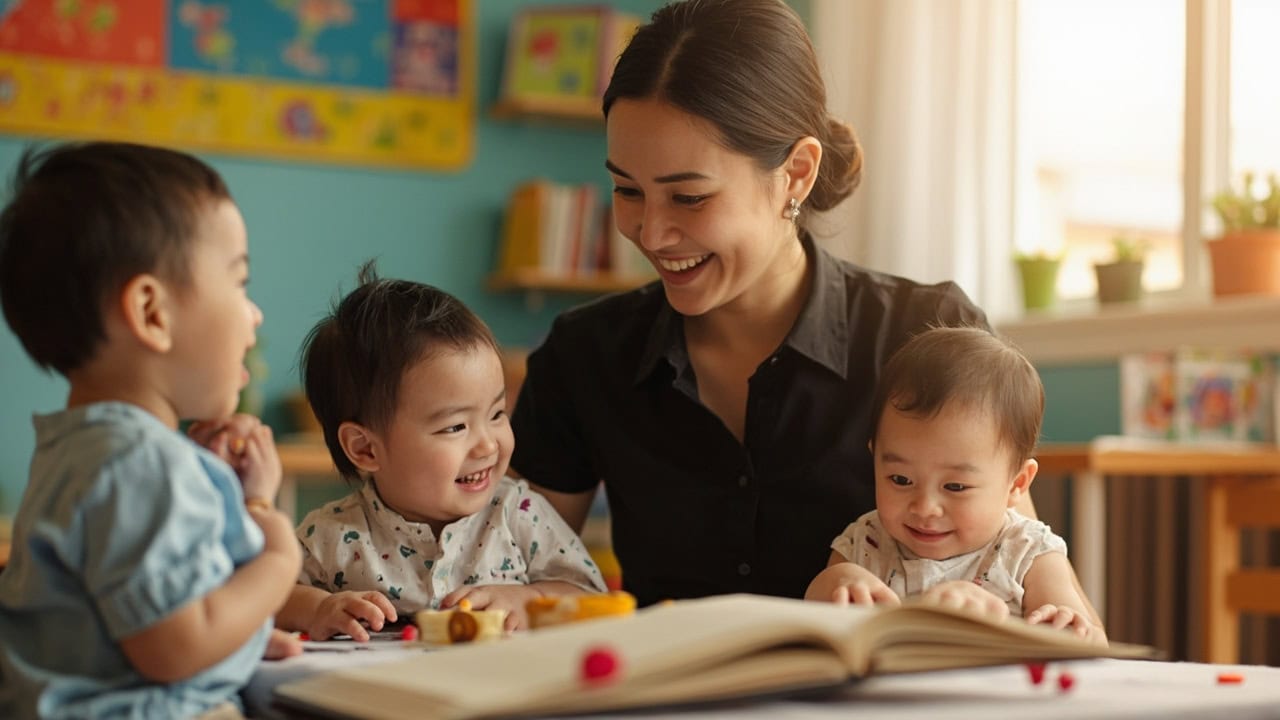
In our infant care programme, we maintain ratios of up to one caregiver to three infants. We adopted this not because regulations require it, but because we believe it is essential. In those early months and years, every interaction matters. Every moment of individual attention shapes the kind of relationship that becomes a secure base. A secure base cannot exist when a caregiver’s attention is so divided that she cannot fully see any one child.
Accessible and Transparent
Our fee structures are designed to be accessible within the pilot framework. We know that Singapore families face real financial pressures, and we believe that quality infant care should not be available only to those who can afford premium prices.
- Government subsidies, the Child Development Account, and Baby Bonus can be used to offset costs
- Our care runs Monday to Friday, in structured blocks designed around working family rhythms
- Consistency and reliability are built into how we operate
Communication as a Responsibility
We believe that transparency is not a feature—it is a responsibility. Where deployed, our centres incorporate CCTV measures, and our caregivers maintain daily communication with parents about what happened, what was learned, what was discovered, what was celebrated. You will not leave your child in the morning wondering. You will have a window into her day, even when you are not there to see it.
For those moments when questions arise between pickups, between days, in the middle of a weekend when you are wondering about something that happened—we have developed Thomas, our AI assistant, to provide responsive, reliable support. Thomas is not a replacement for human conversation. But it is a tool designed to make parenting and childminding easier, to answer the small questions quickly, to help you feel less alone with your wondering.
Questions Singapore Parents Actually Ask
We know that choosing childcare is not a decision you make lightly. Here are the questions we hear most often, and what understanding the hidden curriculum helps you see.
“Will my child feel abandoned?”
When a child has a secure base—a caregiver who truly knows her—she does not experience your absence as abandonment. She experiences it as a temporary, predictable fact of daily life, because she trusts that you will return and that she will be cared for in your absence. The anxiety you might see at drop-off is normal and healthy; it is the expression of a healthy attachment. What matters is what happens after the goodbye—whether she is met with patience, warmth, and the quiet assurance that this place, too, is safe.
“Is my child just being watched, or actually learning?”
This is the wrong binary. In quality childcare, watching is learning—because a skilled caregiver watches not to supervise but to understand. She watches to see what your child is curious about, what frustrates her, what she reaches for, what she avoids. And then she shapes the environment accordingly. Learning in the early years is not separate from care. It is embedded in it.
“How do I know the caregiver is actually good?”
Look for the signs described above. Does your child light up when she sees the caregiver? Does she talk about her day with excitement? Does she seem more herself after a day at childcare, not less? These are not guarantees, but they are indicators.
And ask yourself this: does the caregiver ask you questions about your child? A caregiver who wants to know your child’s preferences, fears, and joys is a caregiver who is building the relationship that matters.
“What if my child is ‘behind’ in something?”
Development is not a race. The competencies that matter most—how to be with others, how to manage feelings, how to stay curious, how to trust that trying is worth the risk—do not show up on milestones charts the way physical growth does. But they are there. They are being built, brick by brick, in every interaction. Trust the process. And if you have genuine concerns, bring them to your caregiver. A good one will welcome that conversation.
Your Child Is Becoming
There is a version of the question that follows you out the door every morning. What is happening in there? Is my child safe? Is she happy? Is this place good enough?
We have spent this time together imagining what that answer might be. And I hope that what you take with you is not just information but something closer to a shift—a change in the question itself, from doubt to curiosity, from anxiety to trust, from the fear that you are missing something to the confidence that you have chosen well.
Your child is not paused while she is at childcare. She is not waiting for real life to begin. She is in real life. She is learning the skills that will matter most—not just in school, but in every room she will ever enter. She is learning to be with others, to manage her feelings, to ask questions, to move through the world with increasing confidence, to use her voice and know that it matters.
A few months ago, I watched a father pick up his daughter from a childcare setting. He knelt down, as parents do. She handed him a piece of paper—painted paper, blue and yellow, still damp at the edges.
For you, Papa.
He held it up. This is beautiful. What is it?
She pointed to a shape in the middle. This is the sun. And this is the ocean. And this is me. She pointed to a small handprint. I am big because I put my whole hand.
He looked at the painting. He looked at her. And I saw something shift in his face—not doubt, not guilt, not the anxiety of the goodbye. Something else. Something like recognition.
She had been there for eight hours. And in that time, she had not only painted a picture. She had learned to put her whole hand into the world. She had learned that what she made mattered. She had learned that she was big enough to leave a mark.
That is what quality childcare gives your child. Not supervision. Not mere care. But the experience of being known, being challenged, being held, and being let go—just far enough to grow, just safely enough to try.
And somewhere, in a room you cannot see, a caregiver is kneeling down. She is handing your child a piece of paper. She is saying, Show me what you see.
Your child is showing her. And she is showing your child that what she sees is worth seeing.
That is what we do at EduNanny Singapore. That is what childminding means—not just watching, but witnessing. Not just caring, but caring about. Not just holding a child, but holding the whole of who she is becoming.
You chose this. And that choice matters. Not because it absolves you of anything, but because it joins you to a community of people who believe, as you do, that every child deserves to be known.
Now go. Your child will be waiting for you at the end of the day with something to show you. Watch for it. And when you see it, know that what you are seeing is not a keepsake. It is proof. It is evidence of the hidden curriculum running exactly as it should.
It is your child, getting bigger. It is your child, becoming.
Ready to Learn More?
If you are researching infant care or childminding options in Singapore and would like to understand how EduNanny can support your child’s early years, we invite you to explore our programmes. Our team is happy to answer questions, walk you through our approach, and help you find the right fit for your family.
You are also welcome to learn more about us or get in touch directly. We would be glad to hear from you.
#QualityChildcareSingapore #InfantCareSG #HiddenCurriculum #ChildmindingSingapore #EduNanny