Raising Children Who Know Where They Come From
What Singapore Parents Are Really Asking When They Search for Childcare
There is a moment every Singapore parent knows. It happens at the gate of a childcare centre, or in the corridor of someone’s home where a trusted caregiver waits. The child is settled, the bags are put away, the morning routine is complete. And in that small pause — between the goodbye and the closing of the door — something moves through a parent’s chest that is more complicated than simple reluctance to leave.
It is not just separation anxiety. It is not only the guilt of a working week. It is something deeper, and quieter, and rarely spoken aloud. It is the question: what am I handing over, along with my child’s daily care?
What stays behind with you — your grandmother’s songs, your partner telling your child where your family comes from, the language that is not quite Mandarin and not quite English but something in between that belongs only to your household — does it travel with them into this new space? Will it shrink? Will it settle somewhere they cannot reach?
This is the question beneath the question when Singapore parents search for childcare. It does not always surface in the tours they take or the forms they fill. But it is there, in the hesitation before they sign, in the quiet worry that raising a child in Singapore today — with all its advantages, all its bilingual promise, all its global horizons — might also mean raising a child who eventually forgets where they come from.
The Cultural Reality of Raising a Child in Singapore
Singapore is not a simple place to raise a child. Here, a child’s heritage is not a single thread. It is woven through multiple languages, multiple family systems, multiple sets of expectations that do not always agree with one another.
A child may be raised in a Mandarin-speaking household by parents who learned English at school, surrounded by grandparents who speak dialect at home, living in a neighbourhood that is Malay-speaking, attending childcare where the primary medium is English. And all of this — all of it — is Singapore. All of it is real. All of it belongs to the child.
Here is what no one tells parents plainly: that complexity is not a problem to be solved. It is a wealth to be managed. The question is not whether your child will navigate multiple cultural worlds. They will. The question is whether the people you trust to care for your child will treat those worlds as assets — as the foundation of who they are becoming — or as inconveniences, distractions from the real work of school readiness and developmental milestones.
There is an assumption — unspoken but pervasive — that professional childcare and heritage-preserving care exist in separate categories. That you can have one or the other. Parents feel this pressure from all directions: from their own parents who worry no one will sing anak sayang songs the way a grandmother does, from parenting forums where conversations about childcare default to enrichment metrics and literacy benchmarks, from the gap between what providers say about cultural awareness and what they actually do in the daily, ordinary moments that shape a child’s sense of where they belong.
And so many parents make a painful calculation. They decide that heritage preservation will be their job alone — on weekends, in the evenings, in whatever hours remain after work and commute and the logistics of modern family life. They quietly accept that childcare will be one thing and cultural grounding will be another, and that the two will not truly meet.
There is a grief beneath this that parents carry in modern Singapore — the grief of time, of knowing that the early years are finite, that the window when a child’s cultural foundations are being laid closes faster than anyone warns you. This grief is real. It is a legitimate mourning for what contemporary life requires of working parents.
What Heritage-Preserving Childcare Actually Looks Like
Before exploring what quality childcare can offer, it is worth being clear about what cultural preservation in the early years actually means — because the conversation often becomes abstract in ways that make it less useful.
Cultural preservation is not a class your child attends on Saturday mornings. It is not a Mandarin tutor or a language cassette played in the car. These things can help, but they are not the foundation.
The foundation is this: does your child feel that the people who care for them know and respect where they come from?
Concretely, this means:
- Your child hears their home language in the spaces where they spend their waking hours, even if imperfectly. The absence of that language tells a child something just as clearly as its presence does.
- The adults around them understand that a Chinese Singaporean child’s relationship with their heritage is not the same as an Indian Singaporean child’s. It is shaped by dialect and grandparent influence and specific family rituals that cannot be reduced to a single cultural label.
- When you say your child is fussy about food, there may be cultural reasons — halal considerations, Hindu vegetarian traditions, traditional confinement practices — that go far beyond pickiness. A culturally intelligent caregiver asks why.
- Your child’s name is pronounced correctly. This sounds simple. It is not always done.
- The festivals that matter to your family are acknowledged — not in a performative way, but in a way that connects your child to the meaning of what your family celebrates.
The Reframing That Parents Deserve
The assumption that developmental childcare and heritage-preserving childcare must be traded off is a false binary. The concern behind it is real. The history behind it is real. But the binary itself does not reflect what quality care can actually accomplish.
Professional care cannot replicate what a grandparent does. No childcare arrangement can. The relationship between a child and a grandparent brings a depth of generational memory, a physical and emotional intimacy, a knowledge of a family’s story that is simply not available elsewhere.
But what professional care can do, when it is designed well, is this: it can protect the space where that grandparent relationship flourishes. It can ensure that a child comes home from childcare not depleted of cultural energy but energised by it — ready to engage with their grandparents, to listen to their grandmother’s stories, to participate in the rituals that connect them to their heritage, because they have been in an environment that reinforced rather than undermined those foundations.
EduNanny’s Approach: Cultural Intelligence in Practice
EduNanny was built within the BUTLER approach, and that approach begins with a simple question that too few childcare providers ask: who is this child, and what do they carry with them?
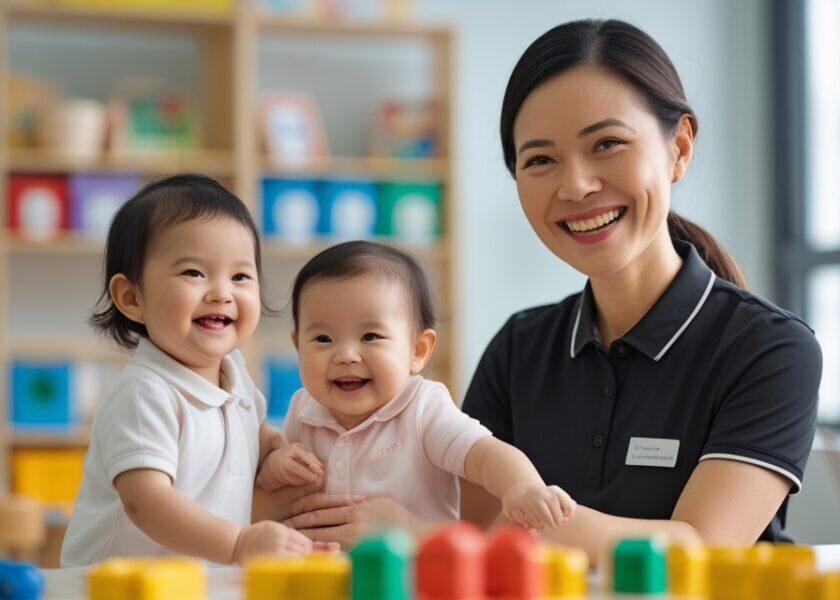
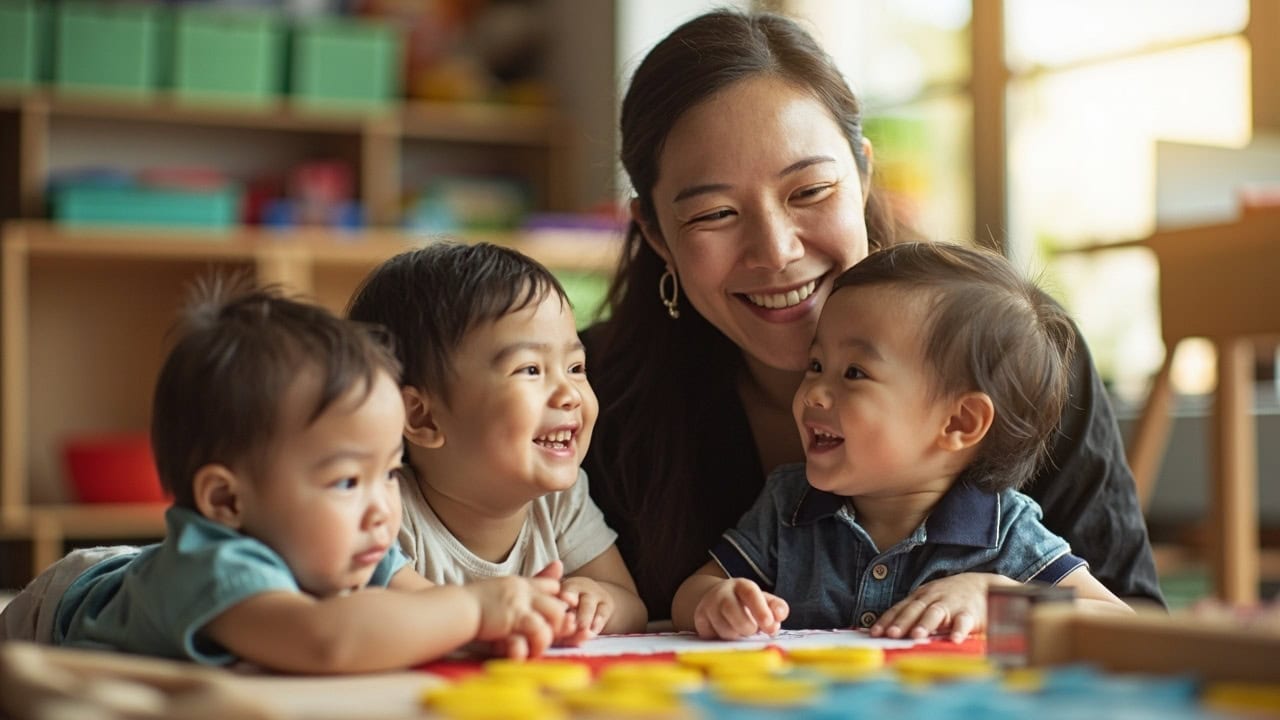
Within the ECDA Childminding Pilot, EduNanny offers a model of care built around smaller ratios — up to one caregiver to three infants in home-based settings, where the caregiver can truly know each child as an individual. This is not incidental to the cultural question. It is central to it.
Cultural intelligence at scale — in a large centre with high turnover and rotating caregivers — is extraordinarily difficult to sustain. The moments that matter most happen in ordinary time, in unhurried interaction, in the kind of relationship that can only form when a caregiver is not juggling ten children at once.
The home-based pathway within the pilot means that for many families, the childcare environment is a home — a real home, with its own rhythms, where cultural familiarity feels natural rather than programmed. There is a warmth in a home environment that children sense, and that parents often describe as different from what they have experienced in larger centre-based settings.
What This Looks Like Day to Day
In a smaller, home-based setting, the caregiver has the bandwidth to notice things that would be invisible in a larger environment. They notice which language your child naturally reaches for when they are tired. They notice that your child is more settled when their meals include the spices that your family uses at home. They notice when your child is carrying something from the morning that needs gentle handling before they can fully engage with the day’s activities.
These are not curriculum items. They are not planned cultural activities. They are the ordinary, unhurried attunement that becomes possible when ratios allow a caregiver to truly see each child.
EduNanny’s caregivers are selected not only for their competence in infant development and early childhood practice, but for their capacity for cultural partnership. The communication and transparency measures that are part of the pilot — including CCTV access where deployed — are not there because trust is absent. They are there because trust, in this context, must be built through openness. Parents deserve to see what their child’s day looks like, and to know that the promises made during the interview are honoured in the ordinary hours when no one is watching.
Making Quality Care Accessible
The practical dimensions of the pilot make this kind of care accessible. The ECDA-supported fee structures, the ability to use the Child Development Account and Baby Bonus, the Monday-to-Friday care blocks that align with real working lives — these are designed to remove the barrier that most often forces families to choose between their values and their budget.
The belief that culturally intelligent, high-quality childcare must be a luxury available only to the wealthy is one that deserves to be challenged. Every Singapore family deserves to ask the cultural question. Not just the ones who can afford a premium boutique service.
What Professional Care Can Build
Beyond preserving what families bring, quality childcare can actively build something important: multicultural confidence.
This is not the same as cultural awareness, though it builds on it. Multicultural confidence is the ability to move through multiple cultural contexts without anxiety, without the need to choose between them, without the internal conflict that comes from feeling that you are betraying one part of yourself to belong to another.
A child who grows up with multicultural confidence knows that their Mandarin is not in competition with their English. They know that their Malay neighbour and their Indian friend and their Eurasian classmate are not threats to their own identity but companions in a shared Singaporean experience. They know that their family traditions are not relics to be preserved in a museum but living practices that give them strength and grounding as they move into a world that will ask them to be many things at once.
This is what quality childcare can build toward: not a child who has been taught about culture in the way a subject is taught, but a child who carries culture the way a tree carries its roots — invisibly, essentially, as the source of everything that grows above.
Questions to Ask Before Choosing Childcare
Not all childcare that claims cultural sensitivity delivers it. These questions go beyond the standard tour conversation:
Language and Communication
- How do caregivers relate to your home language — not just as a subject to be taught, but as a living part of your child’s identity?
- What happens when a child speaks a language at home that the caregiver does not share? How is that gap bridged?
- Will your child hear their home language throughout the day, even if imperfectly?
Cultural Attunement
- How are festivals observed? Is it performative, or does it connect to meaning?
- Has the caregiver cared for children from your cultural background before? What did that look like in practice?
- Does the caregiver ask about your family’s specific story, or is your child being cared for as a generic Singaporean child?
Partnership and Trust
- How is cultural context documented and carried forward? Is it part of the onboarding process?
- What does daily communication look like — not just updates on meals and naps, but on your child’s emotional and cultural experience?
- Is there transparency about how promises made during interviews are honoured in practice?
The Gut Check
Ask yourself this: does this feel like a partnership? Does it feel like you are handing your child to people who will extend your family’s reach, or to people who will create a parallel world that your child must navigate between?
The difference matters enormously, and you will feel it in the early days of any arrangement. Trust that feeling. It is not irrational. It is wisdom.
The Question That Matters Most
There is a line that parents sometimes use when they describe what they want for their children. They say they want their children to know where they come from, so they know where they are going.
This is true. But it requires something more nuanced than parents often feel they are allowed to admit.
It does not require parents to be everything to their children in every hour of the day. It does not require the impossible standard of cultural preservation without support. It requires something like what this article has been describing: a network of care that takes cultural intelligence seriously, that sees your child’s heritage not as an obstacle to development but as the very substance of it, and that works in genuine partnership with your family to build a child who is whole.
Your child’s heritage is not a checklist item. It is not a language class or a cultural event or a festival celebration. It is the story of who they are, told in a thousand small moments across their earliest years. And those moments deserve to be held by people who understand that the child in their care is not just a developing person but a culturally situated one — shaped by language and family and tradition and the particular constellation of expectations that make your family yours.
EduNanny is not claiming to replicate what a grandmother does. No childcare arrangement can, and no honest provider should suggest otherwise. What EduNanny aims to be is part of your village — not the whole village, and not a replacement for it. A trusted part, where Singapore parents can bring their most vulnerable, most precious, most culturally loaded responsibilities and find people who will hold them with the seriousness they deserve.
If you are evaluating childcare options for your infant or young child in Singapore, you deserve to ask the cultural question — not as a secondary concern beneath safety and curriculum, but as a primary indicator of whether this arrangement will truly serve your family.
You deserve to find a childcare partner who will extend your family’s reach. Who will hold your child’s heritage alongside their development. Who will ask who is this child, and what do they carry with them?
That is the childcare we believe Singapore families deserve. That is what EduNanny is building toward. And that is the question we hope every family will ask — because it is the question that matters most.
If you are ready to explore childcare that takes your family’s cultural story seriously, we invite you to connect with EduNanny to learn more about our approach within the ECDA Childminding Pilot. Every family deserves to find care that sees their child completely — not just as a developing person, but as a culturally situated one.