How Singapore Parents Are Developing Sensory Literacy in Childcare Decisions
What Singapore Parents Already Know
You have probably felt it. After a centre visit that looked perfect on paper, something lingers—a quiet unease that does not quite match the checklist. Perhaps your child resists a handover in ways that seem disproportionate, and you wonder whether the centre simply is not the right fit, or whether something deeper is happening beneath their protest.
Singapore parents are remarkably attuned to their children. They trust their instincts. But they have been given no vocabulary for what those instincts are actually detecting. They evaluate through logic while their nervous system is screaming data they cannot yet interpret.
You may have walked into a childcare centre, looked around at the bright colours and busy walls, noted the certifications on the wall, and thought: this looks fine. And yet something in your body said something different. You dismissed it. You re-examined the brochure. You went with the centre that checked the most boxes.
This is the gap worth closing. Not by abandoning logic—you need logic. You need ratios, safety standards, and caregiver qualifications. But by expanding your understanding of what quality childcare actually communicates, and how.
The Neuroscience Your Checklist Cannot Capture
In the first three years of life, your child’s brain builds its foundational architecture at a speed it will never match again. One million neural connections per second during peak periods. This is not a metaphor for learning. This is the literal hardware of thought, emotion, and regulation being installed.
The construction supervisor for that architecture is not a curriculum. It is not a flashcard set or a structured activity schedule. It is the child’s sensory experience of safety. The quality of their interactions with responsive adults. The regulation of their nervous system as it encounters the world.
Here is what happens at the biological level when a child feels genuinely safe: their stress hormones, which flood the system in unfamiliar situations, begin to metabolise. The prefrontal cortex—the part of the brain responsible for attention, impulse control, and the executive functions that eventually determine school readiness—comes online. Learning becomes possible.
When a child does not feel safe, when their nervous system registers threat, inconsistency, or unresponsiveness, cortisol stays elevated. The brain devotes resources to survival rather than development. The architecture that forms under chronic stress is shaped differently from the architecture that forms under secure attachment. Not permanently damaged, but different. The difference between a foundation built on bedrock and one built on shifting ground.
This is why the physical, sensory experience of a childcare environment is not incidental to development. It is developmental. It is literally sculpting the brain your child will carry into adolescence and adulthood.
Why This Matters More in Singapore
Singapore is a city of extraordinary stimulation. Ambient noise, visual density, rapid pace, high expectations—the same qualities that make it vibrant also make sensory regulation challenging for developing nervous systems. For an infant whose stress-response system is still maturing, these constant inputs are not background noise. They are foreground pressure.
Quality infant care in Singapore must account for this. It must provide refuge, not just supervision. A space where a child’s nervous system can settle, where overstimulation is actively managed, where the environment adapts to the child rather than demanding the child adapt to it. This is not a soft ideal. It is a developmental necessity.
What Quality Actually Looks Like When You Are Standing in the Room
So what does this look like when you are visiting a childcare centre, trying to decide?
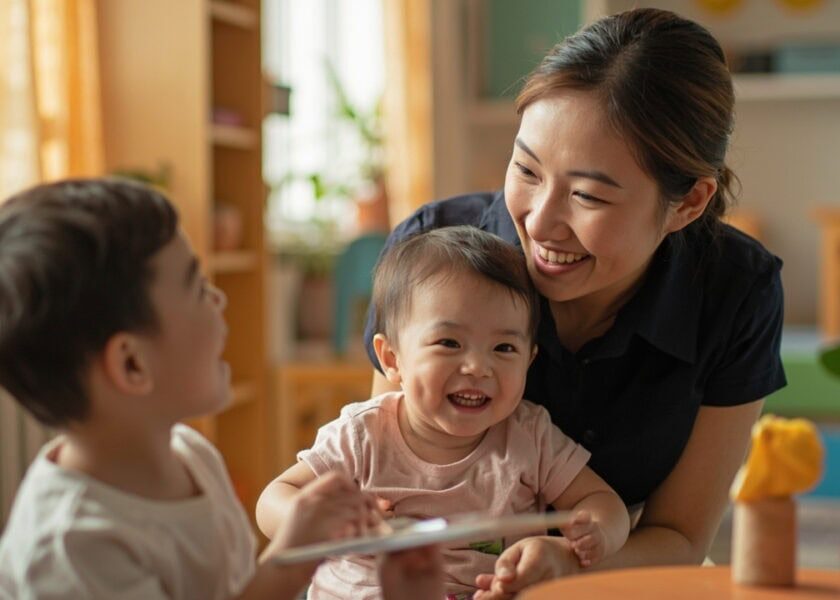
It looks like the way a child holds their body in a room. Not the way they perform for a tour, when caregivers are on their best behaviour and children are curious and alert. But the way they settle, or do not settle, when the novelty fades.
Watch the shoulders. Watch the hands. Watch whether a child’s body is tense and braced, or soft and open. Watch whether they seek proximity to an adult, or whether they have learned to self-soothe in isolation because proximity was never consistently available.
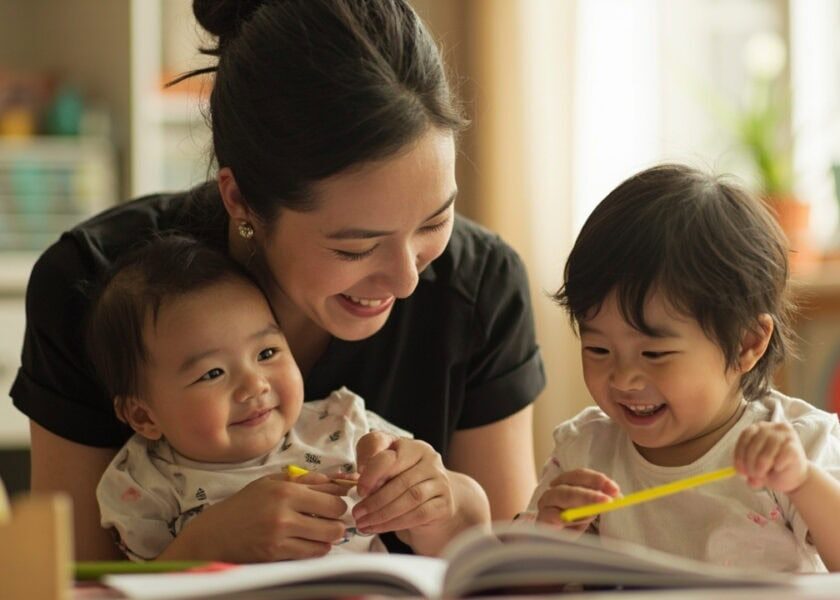
Watch the caregivers. Not for their qualifications on paper—you should verify those independently—but for the quality of their attention. Notice whether their eyes are tracking the room or fixed on a device. Notice whether their voice has the melodic variation that regulates infant distress, or the flat affect that soothes nothing. Notice whether they move with unhurried awareness that comes from knowing exactly how many children are in their charge, or the scattered alertness of a ratio that makes true attunement impossible.
Notice whether the environment itself seems calibrated for regulation or overstimulation. Bright colours and busy walls may look engaging to adult aesthetics, but the developing nervous system experiences visual clutter as noise. A room that supports regulation has something harder to photograph but easy to feel: a quality of calm. A sense that the space was designed for small bodies, not adult expectations of what a childcare centre should look like.
The Signs You Are Looking For
- Children’s bodies are soft, not braced. Shoulders are down, not raised toward the ears.
- Caregivers move slowly and deliberately, with their attention on the children, not on documentation or devices.
- Their voices have natural variation—rising and falling with the rhythm of genuine interaction, not the monotone of routine.
- Children are permitted to seek proximity to a caregiver without being gently redirected toward independence.
- The environment feels calm to you as an adult. Not boring—calm. There is visual space. There is acoustic space.
- When a child becomes distressed, a caregiver responds without urgency or irritation. They co-regulate, not manage.
These are the sensory truths that no checklist captures. They are not mysterious. They are observable. But they require a different kind of looking—one that starts from the body, not the brochure.
What Your Child’s Body Is Already Telling You
Here is what many Singapore parents discover when they begin to understand the neuroscience of sensory regulation: they were already detecting quality, or its absence, all along. Somewhere beneath the checklist and the comparison, beneath the logical evaluation of features and facilities, they were sensing the quality of an environment.
You may not have had the vocabulary for it yet. You may not have been able to articulate what your nervous system detected when you walked through a door and felt the quality of the air, the quality of the attention, the quality of the calm. But that sensing is real data. It is the oldest and most reliable data you have.
When your child cries at the gate and you feel a knot in your chest, that is not overprotectiveness. That is your nervous system recognising something your conscious mind has not yet processed. When your child falls asleep in the car on the way home from a centre visit and you wonder whether they were overstimulated, that is not anxiety. That is awareness.
Learning to trust those signals—and learning to act on them—is what we mean when we talk about sensory literacy for parents. It is not a new skill you need to acquire. It is an existing capacity you need permission to use.
How EduNanny Is Built Around This Understanding
EduNanny operates within the ECDA Childminding Pilot, a framework that recognises what the research has long suggested: infant care is not a lesser form of childcare. It is a distinct developmental stage requiring distinct expertise and distinct ratios.
With up to one caregiver for every three infants in our home-based pathway, we maintain the conditions for genuine attunement to be possible—not as a luxury add-on, but as the baseline from which everything else follows.
This ratio matters because attunement is not a mindset. It is a practice. It requires the cognitive and emotional bandwidth to notice when a child’s breathing changes, when their posture shifts from curiosity to overwhelm, when the sound of a door closing registers as threat rather than routine. That noticing requires presence. Presence at a ratio that allows it.
Our caregivers are trained to read this sensory architecture. Not as clinical observers, but as practitioners who have internalised the connection between a child’s physical state and their developmental environment. They know that a child’s grip on a caregiver’s clothing is not a sign of weakness—it is a biological signal of attachment seeking, of the nervous system requesting co-regulation. They know that a child’s inability to settle may not be behavioural but physiological—their stress response stuck in a loop because no adult has yet provided the external regulation their brain needs to borrow until it can generate its own.
This training is not about technique. It is about changing how caregivers perceive children. When you understand that a child’s body is always communicating, you cannot help but listen more carefully. You slow down. You watch. You let the child’s physiology guide your response rather than your assumptions about what they should be doing.
Environments, Transparency, and Access
The environments we create reflect this understanding. We have thought carefully about sensory safety—not just physical safety, which is the prerequisite no one debates, but the deeper safety of a nervous system that is not overtaxed by stimulation it cannot process. In Singapore’s environment, where ambient noise and visual density are constants, this is not a small consideration. It is essential.
We believe parents deserve visibility into the environments they are entrusting with their children. Where deployed, our CCTV arrangements give families a window into daily life—not as a surveillance measure, but as an extension of the transparency every parent has a right to expect. Our communication practices are designed around genuine partnership with families. You should know what your child’s day looked like. Not as a courtesy, but as a right.
We also believe that quality infant care should not be gated by economic anxiety. The CDA and Baby Bonus structures are pathways we honour because we want this level of care to be reachable for families across Singapore—not only those with significant resources.
The early years of parenting are rich with joy and exhausting with uncertainty. Doubts surface at seven in the morning when a child resists the handover. Questions arise at two in the afternoon when you wonder whether what you observed was within normal range. The Thomas AI Chatbot is not a replacement for human guidance—it is a bridge to it. A resource that gives parents immediate access to information, reassurance, and the sense that they are not navigating this alone.
Pathways for Every Family
EduNanny offers multiple pathways that recognise the diversity of Singapore families.
- Home-based childminding brings care into a domestic environment, calibrated for the sensory needs of infants and built on the one-to-three ratio that makes attunement possible.
- Centre-based care provides structured environments that maintain the same commitments to sensory-aware practice.
- Monday to Friday care blocks give families the predictability that developing nervous systems need—routine that becomes the architecture of trust.
What to Do With the Anxiety of Choosing
It is entirely normal to feel uncertain when evaluating infant care. The decision carries real weight, and that weight deserves to be taken seriously. But anxiety about the decision is not the same as difficulty evaluating options.
If you feel overwhelmed by the number of centres on your list, start with the body’s checklist, not the brochure’s. Visit at different times of day if you can—before a centre tour is orchestrated and after, when ordinary life is happening. Walk in without announcing yourself and notice what you feel in the first sixty seconds.
If a centre feels right, trust that feeling and investigate the logistics. If a centre looks perfect on paper but feels wrong in your body, take that signal seriously. Dig deeper. Ask to observe an unannounced visit. Ask the caregivers how they would respond to a specific scenario—a child who will not settle, a child who falls and cries, a child who clings.
The answers will tell you far more than a facility inspection will.
You Are Already on This Path
When we talk about what makes EduNanny different, we are not making a marketing claim. We are describing a stance. A way of seeing children that begins with the body, with the nervous system, with the sensory truth that your child is communicating to you every day—even before they have words to say it.
Your child’s body already knows what quality feels like. Your child’s nervous system already registers when they are safe, when they are seen, when the environment is calibrated to support their development rather than merely contain it. Your child’s body is speaking. It has been speaking since the moment they were born.
Our work is to listen. To create the conditions where that listening is possible. To give caregivers the training, the ratios, and the philosophy that allow them to respond to what they hear. And to help you, as parents, develop the sensory literacy to trust what your own body already knows.
You chose to read this today. That tells us you are already on this path. We would be honoured to walk part of it with you.
Explore infant care options with EduNanny — pathways built around what your child’s body already knows.
#infantcareSingapore #childmindingSG #sensorydevelopment #ECDAchildcarepilot #EduNannySG #newborncare #earlychildhooddevelopmentSingapore