What Your Child Reveals at the Evening Pickup Doorway
“`html
Reading the Evening Reunion: What Your Child Is Telling You
There is a particular kind of exhaustion that settles over a working parent in Singapore around four-thirty in the afternoon. It is not merely physical. It is the accumulated weight of a full workday pressing against the knowledge that the most important part of the day is still ahead.
The emails can wait. The commute will compress itself somehow. But the reunion with your child—that cannot be rushed, cannot be scheduled around, cannot be outsourced to anyone else.
You know this. And yet, standing outside the childcare centre at pickup, perhaps jostling for position in the queue, perhaps already mentally cataloguing what needs to happen before bedtime, do you ever pause to notice what that moment actually contains?
Most parents do not. Most parents are thinking about the transition their child is making—will they be happy to see the caregiver leave, will they protest the handoff, will the walk home be smooth or fraught. These are reasonable concerns. But they are focused on the child’s movement, not on what that movement reveals.
Here is the truth the childcare industry rarely tells you: the childcare decision was made weeks or months ago. The centre was chosen, the arrangements were settled, the paperwork was filed. The decision feels complete. And yet, standing at that doorway in the late afternoon light, you are standing at the beginning of something else entirely.
You are standing at the place where you will learn, every single day, whether that decision was right.
What You Are Actually Observing at the Doorway
Let us consider what happens in the first moments after you take your child’s hand. You may not be paying attention to these moments consciously. You are gathering their bag, signing them out, perhaps exchanging a few words with the caregiver.
But your child is already communicating. They have been communicating since the instant they saw you. And what they bring to that doorway between childcare and home is not random. It is the residue of every hour they spent without you. It is evidence—not evidence of your parenting, but evidence of the quality of care that filled your absence.
Reading the Physical Signals
Watch the physicality first. A child who has spent the day in an environment of genuine engagement will move differently at pickup. There is a particular looseness in their shoulders, an ease in how they hold their body, that signals something has been metabolized well.
They may not be bursting with energy—in fact, genuinely enriched children are often quietly content rather than manic at reunion, which surprises parents who expect fireworks. But there is a bodily comfort that cannot be faked.
Watch how they walk beside you. Watch where their hands go. A child who has been merely kept safe, rather than meaningfully engaged, often arrives at pickup in a different physical state entirely: tense, clinging, or conversely, oddly blank. The body keeps its own record.
Listening to What Travels Home
Now listen. Not to what your child says—though that matters too—but to the quality of their language, the tone, the narrative impulse. Children who have been read to, sung to, spoken with genuinely throughout the day will often try to tell you about it.
They may lack the words. They may arrive wordless but nonetheless communicative—a hum, a particular inflection, a reference you will only understand if you ask the right questions.
“What was the best part of your day?” is not a trick question. It is an invitation to access what your child absorbed. A child who has spent the day in front of screens or in a rotation of minimal supervision will not have these residues to share. They may have learned something about entertaining themselves, which is not nothing, but they will not have the particular quality of recall that emerges from rich, intentional care.
Understanding the Emotional Register
And then there is the emotional register. This is where Singapore parents often feel most uncertain, because young children do not arrive home and deliver a coherent emotional report. They may be cranky. They may be delightful.
The crankiness is not always what it appears to be. A hungry, overtired child who has also been genuinely well-cared-for will be cranky in a different way than a child who has been under-stimulated and anxious all day. The distinction matters.
One is a manageable, normal state that responds to food, rest, and your presence. The other is a more profound weariness that may not lift even with these interventions, because it is not ordinary tiredness but a deeper depletion.
You cannot always tell the difference in the moment. But over days and weeks, the pattern becomes legible. The evening reunion is not a single data point. It is a cumulative text.
What Quality Care Looks Like at Homecoming
Safety is the floor, not the ceiling. Any arrangement that meets basic physical needs can claim to keep a child safe. But what separates quality care from adequate supervision is precisely what becomes visible at the evening reunion: the residue of engagement, the evidence of stimulation, the child’s evident sense of being known.
Consider what it means for a child to be truly known by their caregiver. Not just fed and changed and prevented from harm, but known—who they are, what they are curious about, what makes them laugh, what they find difficult.
This knowledge does not disappear when the caregiver hands your child to you at the end of the day. It travels home with your child. It shapes how your child encounters you.
A child who has been seen well all day arrives home ready to be seen by you, because they have learned that being seen is what happens when they are with adults who care. A child who has been merely supervised arrives home in a different state—perhaps seeking that attention more desperately, perhaps having given up on it, perhaps simply less fluent in the language of connection because they have not been practicing it.
This is not a criticism of parents. It is an observation about systems. When you choose childcare, you are not just choosing a place for your child to spend their hours. You are choosing the emotional and developmental environment that will shape your child’s capacity for connection, for learning, for trust. And the only place you can observe that environment in action, repeatedly, over time, is the evening reunion.
The Difference Between Care and Supervision
In Singapore’s childcare landscape, parents often feel they must choose between centre-based care and informal arrangements. What gets lost in this binary is a crucial distinction: the difference between care that merely occupies a child’s time and care that genuinely engages their development.
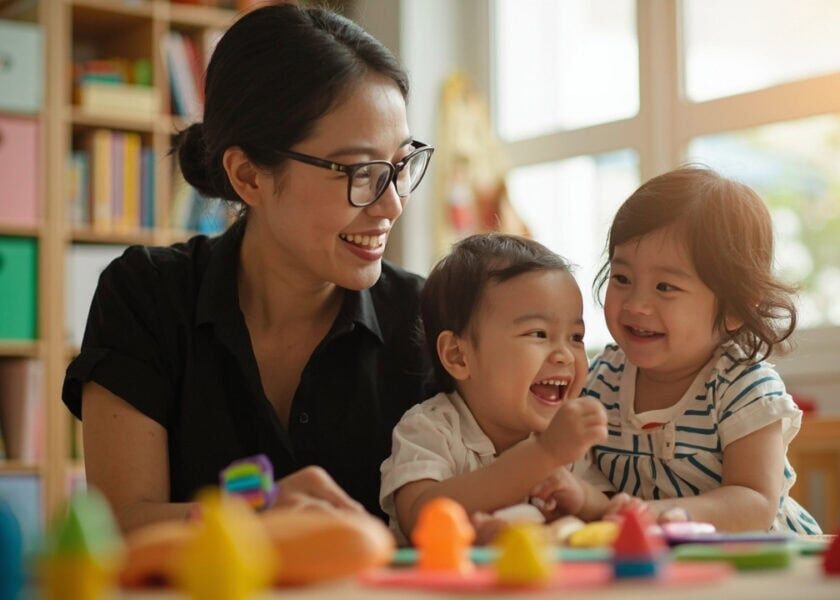
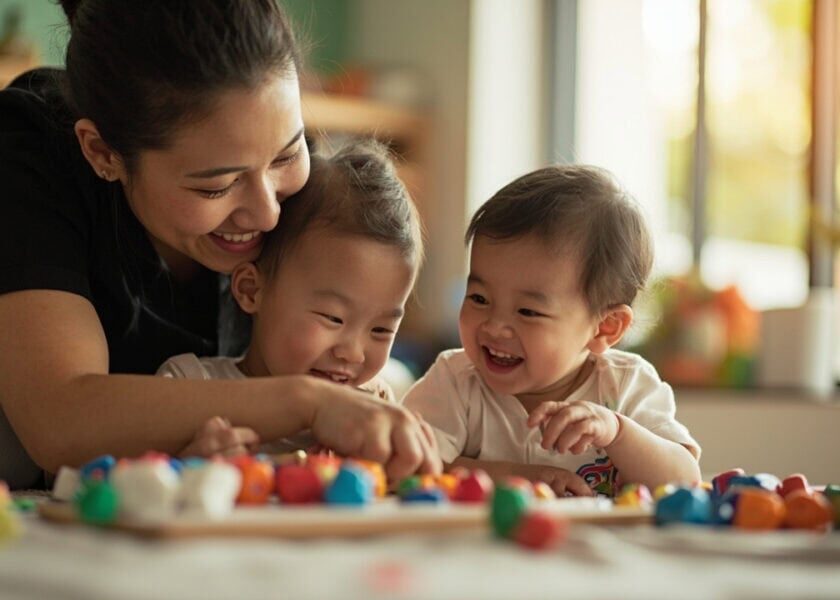
Thoughtful childminding is not a fallback option for families who cannot access centre-based care. It is a distinct pathway with its own strengths: intimacy, individual attention, the possibility of a caregiver who truly knows your child as an individual rather than as one among many.
What makes this possible? Small ratios. An adult who is responsible for three children can know them in ways that are simply not possible when responsible for six, eight, or ten. This is not a failure of will or care on anyone’s part. It is arithmetic. Small ratios create the conditions for the kind of attention that produces the reunion signals we have been discussing.
The Partnership Between Parent and Caregiver
There is another dimension to this that we have not yet named: the dimension of partnership. The evening handoff is not just about your child. It is also about your relationship with the person who has been caring for them.
When you arrive at pickup and your child’s caregiver speaks to you—really speaks to you, not just the transactional exchanges but genuine sharing about your child’s day—you are receiving something valuable. You are receiving evidence that you are both invested in the same small person. You are receiving the caregiver’s observation, which is different from your own, and therefore valuable.
This is the partnership that the evening reunion completes. The childcare cycle is not closed at pickup. It is closed when you go home, reflect on what you observed, bring your child’s experience into dialogue with your own, and perhaps reach out to ask a question that emerged from something you noticed.
Quality childcare providers know this. They expect the evening conversation. They prepare for it. They understand that the handoff is not a termination but a collaboration.
Not every arrangement offers this. Many parents in Singapore know the particular loneliness of arriving at pickup to find their child already standing by the door, bag in hand, with barely a word exchanged before they are handed over. This is not necessarily a sign of poor care—there may be legitimate reasons for this, staff ratios, centre policies, the particular rhythms of a busy day. But it is worth noticing. It is worth asking whether the arrangement you have chosen leaves room for this partnership, or whether it forecloses it.
Because the evening reunion you have with your child is inseparable from the evening reunion you have with your child’s caregiver. They are part of the same system.
Questions Singapore Parents Actually Ask
Over years of working with families, certain questions come up again and again. They deserve honest answers.
“How do I know if my child is actually thriving or just surviving?”
Over days and weeks, the pattern becomes legible. A child who is genuinely thriving will show it in the looseness of their body at pickup, in their attempts to narrate their day, in their ease of transition between caregiver and parent. A child who is merely surviving will show a different pattern: tension, blankness, or desperate clinging. Trust your observations over time.
“What if the caregiver seems nice but I still feel uncertain?”
Your instinct matters. If something feels off, investigate. Ask specific questions about your child’s day. Notice whether the caregiver can tell you something personal about your child—not just that they ate well, but something that reveals they were paying attention to who your child is. A caregiver who can tell you that your child has been fascinated by trucks all week, or that they made a breakthrough in sharing toys, is a caregiver who is truly knowing your child.
“Is home-based care really as good as centre-based?”
This is the wrong question. The right question is: what kind of care arrangement allows my child to be truly known? In a centre with excellent ratios and dedicated staff, your child can thrive. In a home-based setting with small ratios and attentive caregivers, your child can also thrive. The setting matters less than the quality of attention your child receives. Look for the reunion signals. They will tell you the truth.
“What if I can’t afford the most expensive option?”
Quality care should not be a luxury reserved for wealthy families. Singapore has built financial support structures—CDA funds, Baby Bonus—that are designed to make quality care accessible. Ask about these options when you explore arrangements. The evening reunion signals we have discussed are not produced by expensive facilities alone. They are produced by attentive caregivers who have the time and capacity to truly engage with your child.
How EduNanny Singapore Approaches the Evening Transition
EduNanny operates under the ECDA Childminding Pilot, which reflects a national effort to expand quality care options for Singapore families. Our home-based model is built around small ratios—up to one caregiver for every three infants—not as a feature, but as the structural foundation that makes genuine knowledge of each child possible.
This is how it works in practice: when ratios are small, caregivers can pay attention in ways that larger settings cannot. They notice the small things. They remember the fascinations and the breakthroughs. They have time to notice who your child is becoming, and to share that with you at the end of each day.
We have designed our fee structures so that this quality of care is accessible to working families across Singapore, not only to those with significant financial resources. CDA and Baby Bonus funds can be used with EduNanny, which means the financial architecture Singapore has built to support families reaches into our model.
Our caregivers are trained not just in infant development and safety—though these are foundational—but in the art of the evening handoff. They understand that what they communicate at the end of each day matters. It is part of their work, not an addition to it. When we communicate with families, we do so with the expectation that you will ask questions. We document. We share. And where our systems allow, we make that communication continuous and accessible, so that you never have to feel you are guessing alone about what your child’s day contained.
Carrying This Framework Forward
The evening reunion is not a passive transition. It is intentional relational work, and it is some of the most important work you will do as a parent. It is where your child’s day becomes part of your relationship with them. It is where the childcare choice you made is either confirmed or quietly doubted. It is where the partnership with your caregiver is either deepened or left incomplete.
Singapore parents deserve to know that what they are observing at the doorway between childcare and home is not trivial or random. It is meaningful. It is communicative. And it is within your capacity to read it—with practice, with support, and with the right partnership alongside you.
You deserve to feel, at the end of a long workday, when you take your child’s hand at the childcare doorway, that the choice you made is being confirmed. Not loudly, not dramatically, but quietly, consistently, over weeks and months. Through the looseness in your child’s shoulders. Through the stories they tell on the walk home. Through the ease with which they settle into the evening, knowing that the adults in their life are paying attention.
At EduNanny, we believe that every family deserves this kind of confirmation. Your child deserves to bring home evidence that they have been seen, known, and engaged. And we are here, every evening, to help you read what they are carrying.
If you are exploring infant care options in Singapore and want to understand how quality childminding works in practice, we welcome the conversation. The evening reunion you have with your child is waiting to tell you something. We can help you learn how to listen.
“`