Why Your Child’s Heritage Language Deserves the Same Care as English
“`html
The Question We Are Not Asking
The conversation Singapore parents are having about childcare is almost always about readiness. We ask about vocabulary counts and oral interaction. We ask whether the centre follows the NEL framework. We ask if our child will cope when Primary One begins.
These are reasonable questions. But they are incomplete.
We owe it to ourselves and to our children to ask a deeper one: not just whether our childcare will prepare our child for school, but whether it will help our child become whole.
Language Is Not Just a Tool — It Is How Your Child Thinks
Language is not simply a communication vehicle. In the first thousand days, language is how your child organizes experience, processes emotion, and builds the scaffold for every form of reasoning that will follow.
When a toddler learns a word for a feeling she has never been able to name, something genuine shifts in her understanding of herself. When a two-year-old hears a story in her grandmother’s dialect, she is not just listening — she is absorbing the rhythm of a culture, the texture of a people, the particular music of a family line.
Language in these years is not decoration. It is foundation.
And the research is increasingly clear: bilingualism, when nurtured correctly, does not divide a child’s cognitive resources. It multiplies them.
Cognitive Benefits of Growing Up Bilingual
Children who grow up navigating two or more languages develop what linguists call code-switching flexibility — the ability to move between linguistic systems, to understand that meaning lives in context, that words are symbols rather than things.
The bilingual child learns early that language is a choice, that communication is a negotiation, that the same thought can be held in different sounds and still remain true. These are not small insights. They are the beginning of metacognition — the capacity to think about thinking — which will serve your child in every academic subject, every social situation, every challenge that requires flexibility of mind.
The Real Tension: It Is Okay to Want Both
Here is what I suspect many Singapore parents feel most acutely: you want your child to thrive in English. You know it opens doors, that it is the language of opportunity and fluency and integration. You want your child to walk into Primary One with confidence, to absorb lessons without the additional labor of learning the language of instruction.
This is not ambition for its own sake. This is love — the desire to give your child every possible advantage in a world that already has many.
And at the same time, you want your child’s mother tongue — whether it is Mandarin, Malay, Tamil, or one of the many heritage languages spoken across Singapore’s families — not to diminish. You want your parents to be able to speak to your child and be understood. You want your child to know where she comes from, to carry your family’s stories forward, to be at home in the language your ancestors used to make meaning of their lives.
You want the connection between generations to remain unbroken.
These two desires do not have to be in conflict. But they will be in conflict if your childcare treats English as the default and heritage language as a nice-to-have. They will be in conflict if the environment your child spends eight or nine hours in each day is a place where only one linguistic identity is reflected back at her.
Why Heritage Languages Actually Support School Readiness
By the time a child enters Primary One, oral language proficiency is one of the strongest predictors of academic success — not just in language subjects, but across the curriculum. A child who can articulate what she knows, who has a robust vocabulary, who can listen and respond and engage in extended conversation, has an advantage that no amount of early literacy drilling can replicate.
A child who has been supported in maintaining her heritage language does not have a smaller English vocabulary. She has an additional vocabulary. Her cognitive map of language is broader, more flexible, more capable of holding complexity. The two languages grow together when they are both nurtured. They do not compete.
Beyond Exposure: What Quality Childcare Actually Looks Like
Let me be precise about something that many parents do not realize until it is too late: language exposure and language cultivation are not the same thing.
Exposure means your child hears language around her, passively. She listens to the television, overhears conversations, absorbs ambient sound. This has value, but it is not sufficient for deep language development — and it certainly is not sufficient for maintaining a heritage language that is already under pressure from the dominant English environment.
Cultivation means your child is actively engaged with language. It means genuine conversation with turn-taking, not just listening. It means hearing her own name spoken in different tongues, with care and intention. It means songs that rhyme in two languages, rich in rhythm and repetition. It means the caregiver’s quiet narration of the day.
The caregiver is not a teacher. She is a bridge. She holds both shores and helps your child cross back and forth with confidence.
A Morning in a Language-Cultivating Setting
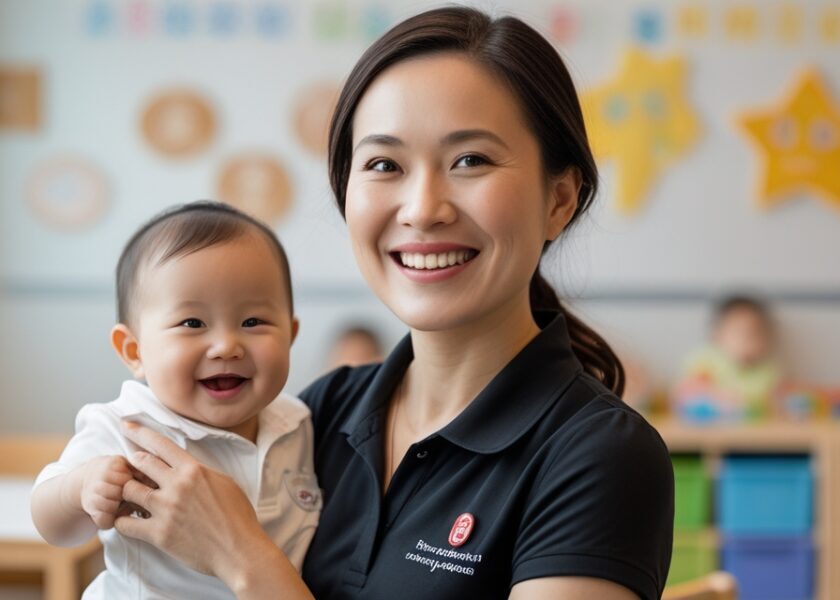
Consider a morning in a well-designed infant care setting. The caregiver greets your child in the language your family speaks at home — the same greeting the grandmother would use, the same endearment, the same small music. This is not a lesson. It is an acknowledgment. It says: I see you. I see all of you. Your language is welcome here.
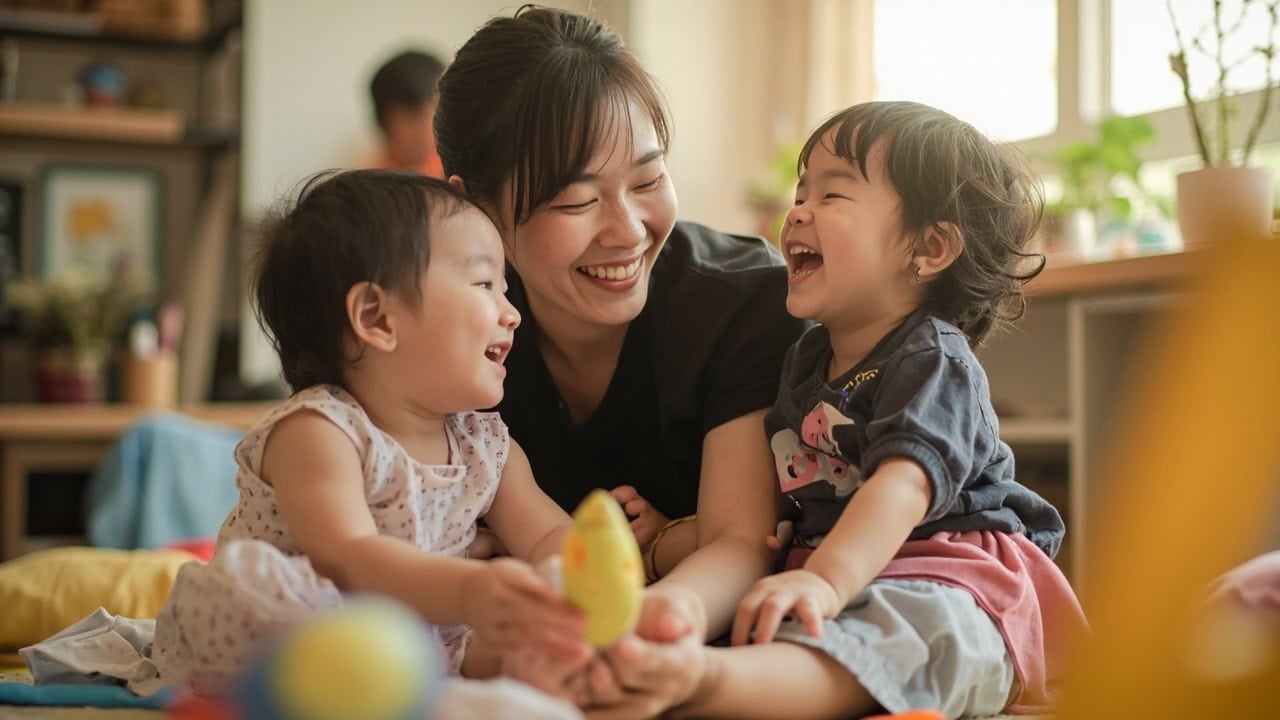
As the morning unfolds, your child encounters English through songs and stories and rich conversation — not through worksheets or drills, but through the natural, joyful texture of interaction. By lunchtime, she has heard both languages. She has been spoken to in both. She has seen that the people around her value both.
The best caregivers do not just supervise children. They mirror them. They reflect back a whole child — a child whose grandmother’s language is beautiful, whose mother’s tongue is rich, whose family’s stories are worth telling.
How to Assess Whether Your Childcare Nurtures Every Language
When you evaluate childcare options in Singapore, here are the questions that matter — beyond the standard ones about curriculum frameworks and operating hours:
- Does the caregiver greet your child in your home language, not just in English?
- Are stories and songs in your heritage language part of the daily routine — not occasional cultural events, but woven into ordinary days?
- Does the physical environment reflect multiple languages — on the walls, in the books, in the music that plays?
- Is your child’s name pronounced correctly and spoken with intention by the people caring for her?
- Can the caregiver tell you what languages your child speaks, and does she speak about them as equally valuable?
- Do the caregivers understand that every language your child speaks is a world she is learning to inhabit?
If the answer to most of these questions is no or not sure, then the childcare setting may be providing language exposure — but it is not providing language cultivation. And in a society like Singapore, where English dominates by default, exposure alone is not enough to sustain what you hope your child will carry forward.
Navigating the Practical Questions
You are navigating a landscape that is genuinely complex. You are weighing cost against quality, convenience against philosophy, trust against evidence.
You may be eligible for subsidies through the ECDA Childminding Pilot and wondering whether the home-based pathway or a centre-based setting is the right choice for your family. You may be checking whether your child’s CDA or Baby Bonus funds can be used, and whether the care arrangement you are considering fits within the schedule your work requires.
These are real and legitimate considerations, and they deserve honest answers. The practical details — subsidies, application processes, daily rhythms of care — should not add unnecessary weight to the joy of raising a bilingual child.
EduNanny Singapore: Built on Language as Foundation
EduNanny Singapore is part of the ECDA Childminding Pilot, which means our approach has been examined and recognized for its commitment to quality care. We offer both home-based and centre-based pathways, because we know that different families have different needs — and because flexibility is not a compromise. It is a recognition that Singapore families come in many configurations.
Our infant ratios are designed to ensure every child receives the attention meaningful caregiving requires — up to one caregiver for every three infants in our care, because in the earliest years, the quality of attention is not divisible beyond a certain point.
Our fees are structured within the pilot framework to be accessible, because quality care should not be available only to those who can afford premium private arrangements. We are transparent about our methods — communication with parents is ongoing and deliberate. Trust is not built on mystery. It is built on clarity.
What Quality Caregiving Looks Like in Practice
The real work of thoughtful childcare is not digital. It is human. It shows up in small, daily acts:
- The caregiver who learns that your child’s favourite story is “The Little Red Hen” and finds a Mandarin version to read alongside the English one
- The setting where the walls carry artwork in multiple languages
- The music played at rest time that includes songs in Malay and Tamil and Cantonese alongside English nursery rhymes
- Your child’s name pronounced correctly — not anglicized, not simplified, but honoured in the way your family honours it
- The quiet, consistent message — never spoken aloud but felt every day — that your child belongs exactly as she is
But all of this — the ratios, the pathways, the fee structures, the communication practices — is infrastructure for what we actually care about. That your child is held in an environment where she is seen completely. Where her language — every language she brings into the world — is treated as a gift rather than a complication.
The caregiver who spends her mornings with your child understands that she is not just a childcare provider. She is a language partner in the most important conversation your child will ever have.
Choosing Is a Statement
When you choose childcare, you are making a statement about what you believe your child deserves. You are choosing the people who will shape the hours your child spends awake — the hours that are not at home with you, not in school with a teacher, but in that in-between space where a young human is learning what the world feels like.
In those hours, your child is either having her full identity reflected back at her, or she is learning that she must leave part of herself at the door.
There is no neutral choice here. Every childcare arrangement makes a statement about which languages matter, which cultures are valued, which kind of person your child is being shaped to become.
Your child will not remember most of what happens in these early years. The memories will not form clearly, the details will blur. But what will remain is the feeling of those years — the sense of being whole or fragmented, of being seen or overlooked, of being told, through a thousand small gestures, that all of who she is is welcome in the world she is growing into.
Language is not just what your child says. Language is how your child thinks, who your child connects to, what your child inherits.
When we talk about nurturing heritage languages while building bilingual foundations, we are not offering you a curriculum feature. We are offering you something more fundamental: the commitment that your child’s voice will be whole.
When she walks into Primary One, she will carry not one language as a tool but two, three, sometimes more as gifts — gifts from her family, her culture, her history — gifts that will serve her not just in school but in life, in relationship, in the ongoing project of understanding who she is and where she belongs.
EduNanny Singapore is here to be that mirror. To hold your child’s full linguistic identity with care and intention. To walk alongside you in these first thousand days, not as a service provider alone, but as a partner in the most important work you will ever do.
Your child’s voice is waiting to be built. Choose a childcare partner who understands that every language your child speaks is a world worth nurturing.
EduNanny Singapore is a trusted, development-oriented childcare and childminding service for families across Singapore. Connect with us to learn how we support every language your child brings into the world, or visit our story to understand the values behind our approach.
“`