The School Readiness Truth Singapore Parents Discover Too Late
The Moment Every Singapore Parent Knows
There is a moment—somewhere between the P1 registration confirmation and the first morning your child walks through school gates—when the weight of it all settles in.
You feel it at the playground, when other parents casually mention their child’s Mandarin vocabulary or how she has already started on problem sums. You feel it in the WhatsApp groups where parents debate the merits of different primary schools with an intensity that would impress any university admissions officer. You feel it at night, when your child is asleep and you are scrolling through forums, trying to understand what you should be doing now to prepare her for what comes next.
This is the moment I want to speak to today.
Not to add to your anxiety. Not to offer another checklist of skills your child should master before Primary One. But because in this moment of genuine parental worry, there is a truth being missed—a truth that, once seen, transforms how you think about the years before school begins.
What “School Readiness” Actually Means
Let me be direct. Singapore is a demanding place to raise a child. The academic expectations are real. The competition is real. And the fear that your child will not cope—that she will fall behind—these concerns are not imaginary. They are the product of a culture that takes education seriously, and asks enormous things of young children and their parents alike.
You are not wrong to worry about Primary One. But the question you are really asking is this: how do I prepare her in a way that builds confidence, not pressure? That nurtures curiosity, not fear?
The answer lies not in pushing academics earlier. It lies in something far more fundamental—and it begins long before your child ever registers for Primary One.
What children actually need to thrive
When we talk about school readiness in Singapore, the conversation usually turns quickly to识字, to basic numeracy, to whether your child can hold a pencil correctly. These are not irrelevant. But they are not the heart of it either.
The children who truly thrive in Primary One are not necessarily the ones who arrived knowing the most. They are the ones who arrive with something deeper:
- Curiosity—who want to know why the sky is blue and where Singapore’s rain goes
- Confidence—who will raise their hand even when they are not sure of the answer, because they trust that learning involves not knowing
- Emotional regulation—who can be frustrated without falling apart, who can wait their turn, who can ask for help
- Social comfort—who know how to make friends, how to share, how to be part of a group
- A love of learning—who find joy in discovery and problem-solving
This is what Primary One readiness actually looks like. And here is the crucial thing: schools cannot build this foundation alone. No matter how excellent your child’s school, no matter how dedicated her teachers, the classroom cannot replace what is built in the years before it—in the daily rhythms of a child’s early life, in the quality of the care she receives.
Surface readiness versus deep readiness
I know what some of you are thinking. If she is not doing worksheets at age three, is she falling behind? If she is spending her days playing and exploring, is she missing out on the head start she will need?
This fear is understandable. It is also based on a misunderstanding of what Singapore schools actually need from children.
Here is what P1 teachers will tell you, if you ask them honestly. The children who need the most support in Primary One are not the ones who arrived with gaps in their academic knowledge. They are the ones who arrived without the capacity to learn:
- Children who cannot manage their emotions in a classroom of thirty
- Children who cannot sustain attention for more than a few minutes
- Children who are so accustomed to being managed that they have never learned to direct themselves
- Children who are anxious about learning, who have already learned to associate education with pressure
A child who has spent her early years in a quality developmental environment walks into Primary One with something no worksheet can provide. She walks in with herself.
| Surface Readiness | Deep Readiness |
|---|---|
| Knowing facts and specific skills | Having the underlying architecture of mind and heart that allows learning to happen |
| Can be built through drills and worksheets | Built slowly through experience, relationship, and patient caregiving |
| Measurable and visible to others | Less visible but more durable—the true predictor of school success |
| Focus: what the child knows | Focus: who the child is becoming |
How Quality Care Builds This Foundation
Quality childcare—thoughtful, intentional, grounded in how children actually develop—does this work.
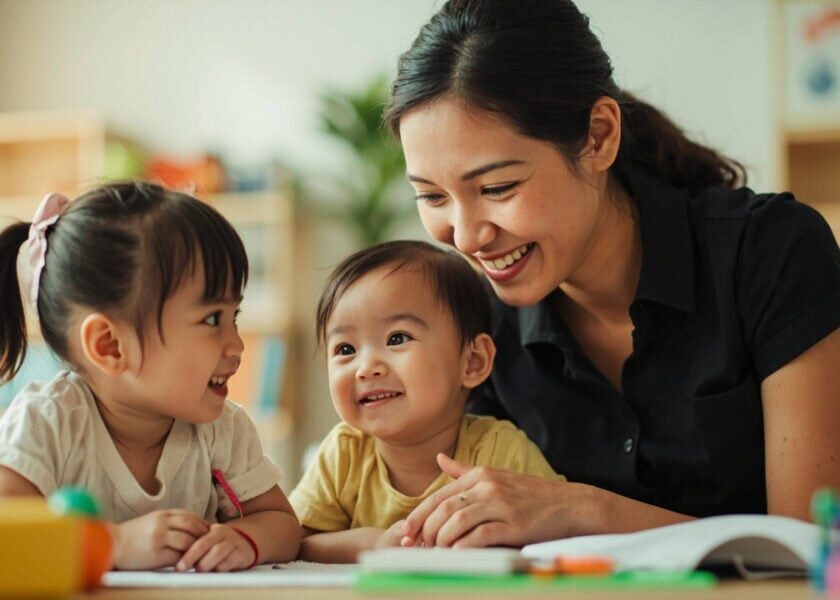
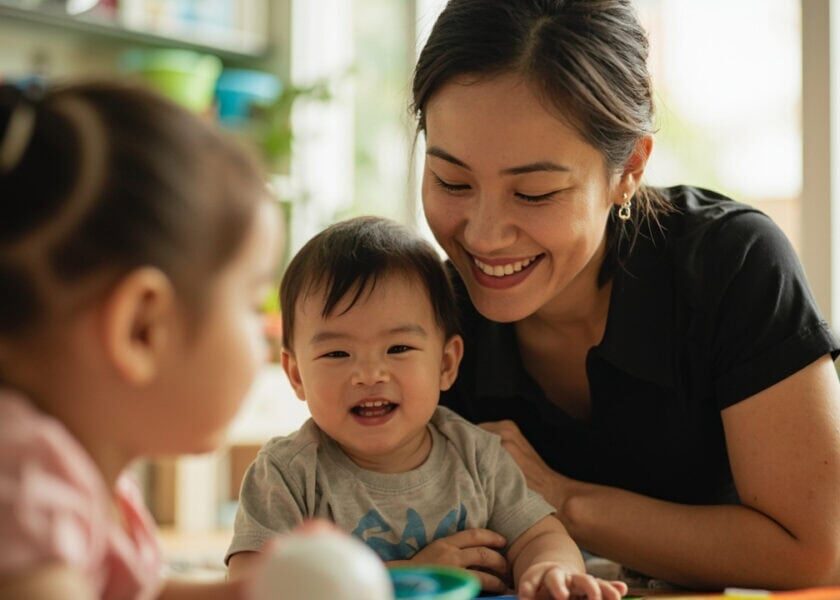
It builds executive function through attentive, responsive adults who give children space to solve problems and support when frustration rises. It builds emotional regulation through caregivers who name feelings, who model calm, who help children learn that big emotions can be managed. It builds social confidence through the daily experience of being part of a small group, of learning to share and negotiate and resolve conflict. It builds physical coordination through active play, through the sensory experiences that develop the body and brain together.
All of this happens not through a curriculum, not through formal instruction, but through the ordinary, extraordinary business of being cared for by people who understand what children need.
Think about it this way. When a caregiver notices your toddler’s frustration as a tower collapses, and sits beside her to say, “That took a long time to build, and it’s okay to feel upset”—that is not just childcare. That is the building of emotional regulation, the foundation for how your child will handle stress for the rest of her life.
When a caregiver pauses at a puddle, lets your child splash in it, and asks, “What do you think makes the water move?”—that is the spark of curiosity being nurtured, the question “why” becoming a habit of mind.
These are not extras. These are the curriculum of early childhood, and they are what prepares a child for everything that comes next.
The EduNanny Approach
We built EduNanny because we believe that Singapore families deserve more than convenience when it comes to the care of their young children. They deserve a partner—someone who understands the pressures you are navigating, who shares your investment in your child’s future, who brings genuine expertise to the work of early development.
EduNanny operates as part of the ECDA Childminding Pilot, reflecting a growing recognition in Singapore that home-based and community-based care is not an inferior alternative to centre-based programmes—it is a vital pathway that meets real family needs. For infants, this means ratios of up to one to three, which is a world of difference from larger group settings. It means caregivers who can be truly attentive, who can respond to each child as an individual.
EduNanny caregivers are trained and supported to provide this kind of care. They are not babysitters waiting to fill time. They are developmental partners who understand why the things they do every day—the way they speak to a child, the way they respond to a tantrum, the way they scaffold a child’s play—matter so profoundly.
Practical support for Singapore families
- Monday to Friday care blocks that fit the rhythms of working parents
- Fee structures within the pilot framework that make quality care accessible rather than a privilege
- Support for CDA and Baby Bonus where applicable, so financial considerations do not force families into arrangements that do not serve their children well
- Presence across Singapore, because this need is not concentrated in any one community
Built on trust
We know that the decision to leave your child in someone else’s care carries weight, and that trust must be earned through transparency and consistency. Where CCTV measures are in place, they are there to support accountability, not surveillance. We communicate openly with parents. We share what we observe. We are partners in your child’s development, not a mysterious arrangement where your child disappears for the day.
Questions Parents Ask Us
Will quality care prepare my child academically?
Yes—but not in the way you might be thinking. Quality care does not directly teach识字 or numeracy. What it does is build the capacity for learning itself. When your child enters Primary One with strong executive function, emotional regulation, social confidence, and genuine curiosity, she has the tools to acquire any academic skill. The worksheets may come later. The foundation comes now.
What if my child seems behind compared to other children?
Children develop at different rates, and what looks like “behind” in the early years often resolves naturally—or was never truly a delay at all. What matters is not whether your three-year-old knows her colours, but whether she is developing the underlying capacities that will serve her for decades.
How do I know if care is truly high quality?
Ask questions. Visit. Observe how caregivers interact with children during ordinary moments, not just during formal observations. Notice whether children seem comfortable, engaged, and secure. Notice whether caregivers respond with warmth and attentiveness, not just efficiency. Notice whether there is time for play, for exploration, for the unhurried moments where development actually happens.
Is home-based care really as good as centre-based care?
The research increasingly suggests that quality matters more than setting. What children need is attentive, responsive, consistent care from adults who understand their development. Smaller ratios allow for deeper relationships and more individualized attention. The question is not whether home-based or centre-based, but whether the specific arrangement you are considering provides what your child needs.
Ready for What Comes Next
There is a question I often ask parents who are considering their options.
What do you want for your child when she walks into Primary One?
If your answer is that you want her to know more than the other children, then perhaps early academics are your priority. But if your answer is that you want her to be ready—that you want her to walk in with confidence and curiosity and the capacity to learn, to make friends, to manage herself, to love the experience of school—then I would invite you to consider what actually builds that readiness.
The answer is not worksheets. The answer is not pressure. The answer is quality care. Thoughtful, intentional, relationship-based care that builds the foundations that schools need but cannot create on their own.
The first bell will ring. Your child will walk through the school gates. She will sit in a classroom of thirty children, and she will be asked to learn, to grow, to belong.
And she will be ready—not because you found a shortcut, but because you understood what readiness really means. Because you built it, day by day, in the ordinary, extraordinary moments of her early life. Because you chose to see her not as a student waiting to happen, but as a whole person, worthy of the time and care it takes to prepare her for everything that lies ahead.
That is what EduNanny is here to do. Not just for your child—but with you.
If you are exploring childcare options and want to understand how quality care can be the beginning of your child’s educational journey, we would welcome the conversation. Because the foundation you are building now will shape everything that comes after.
Learn more about who we are and how the EduNanny approach works.