The Real School Readiness Secret Singapore Parents Are Missing
What School Readiness Actually Looks Like
When you picture your child walking through the school gates on their first day of Primary One, what do you see? A small figure in a crisp uniform. A backpack that might still be slightly too big for their shoulders. Perhaps a little hesitation at the gate before they turn back to wave at you one last time.
Now, let us ask something harder. Behind the proud smile, behind the photograph you have probably already planned, behind the months of preparation — what is the quiet thing you are really hoping for?
Most parents will tell you they want their child to be ready. But if you asked them to define what “ready” really means, something interesting happens. The answers start to narrow. Literacy. Numeracy. Whether they can hold a pencil correctly. Whether they know their alphabets and numbers.
Here is where the trouble begins — because the thing Singapore parents have been taught to fear most, the thing they spend the most money preparing for, is almost never the thing that actually determines whether their child thrives or struggles in those first critical weeks of school.
This article is about what school readiness really looks like. Not the version the enrichment industry has sold you. Not the version that shows up on worksheets and readiness checklists. The real version — the one that lives in your child’s body before it ever shows up in their mind.
The Anxiety Every Singapore Parent Recognises
There is a particular kind of anxiety that lives in Singapore parents in the months before Primary One registration. You have probably felt it.
It is the anxiety that creeps in when another parent mentions their child is already reading. The quiet panic that surfaces when someone casually asks, “Is your child doing extra classes?” The way you find yourself googling “Primary One readiness Singapore” at eleven o’clock at night, disappearing down a rabbit hole of conflicting advice.
This anxiety is real and it is earned. Singapore’s education system is demanding. The transition to Primary One is genuinely significant. Your child will be expected to:
- Sit in a structured classroom for extended periods
- Follow a schedule and transition between activities
- Attend to a teacher and sustain focus on tasks
- Manage social dynamics with dozens of peers
- Regulate their own emotions when things get frustrating
- Engage cognitively with material that will only become more complex
These are not small expectations. They deserve serious attention.
But here is what the anxiety often gets wrong. It tells you to prepare your child by doing more. More worksheets. More tuition. More structured academic drills. More exposure to letters, numbers, and content.
Much of what the market sells as school readiness preparation is addressing the wrong end of the problem entirely.
What Singapore’s Schools Are Beginning to Understand
About two years ago, a teacher in a Singapore primary school shared something that has quietly reshaped how many early childhood professionals think about readiness. She said that by November of Primary One, she could already tell which children would need the most support — not the children who came in knowing the most, but the children who could not yet sit still.
The children who struggled to hold a pencil — not because they did not know their letters, but because their hands fatigued too quickly. The children who could not follow a two-step instruction. The children who became visibly dysregulated when something unexpected happened, unable to calm themselves.
These children were not the ones who came to school knowing the least. They were the ones who arrived without the foundations that would allow them to actually use everything they already knew.
Singapore’s Ministry of Education and primary schools are increasingly aware of this pattern. The shift toward holistic assessment, the growing recognition of social-emotional learning, the conversations happening in staff rooms and MOE training sessions about supporting children with sensory needs — these are real.
Singapore’s schools are beginning to understand what developmental science has known for a long time: the child who walks into Primary One with a regulated body and a regulated nervous system has a significant advantage over the child who has been academically accelerated but developmentally underprepared.
And yet the message most Singapore parents receive from the market is still dominated by academic preparation. Worksheets. Tuition. Literacy and numeracy drills.
Here is the uncomfortable truth: academic content can be taught at any time. The neural pathways for sensory integration, motor regulation, and self-regulation have critical windows. They do not stay open indefinitely.
The Invisible Architecture of School Readiness
Long before your child reads a single word or solves a single sum, their nervous system is building the architecture that will make those things possible. The quality of that architecture — its strength, flexibility, and resilience — depends not on how many worksheets they have completed, but on something far more fundamental.
It depends on whether their sensory systems have been given the right experiences, in the right sequence, during the window of time when the brain is most receptive to building them.
This is where sensory integration comes in — a term that rarely shows up in parenting articles or school readiness guides. It is not flashy. It does not fit neatly on a brochure. But it is, without exaggeration, one of the most important things that happens in your child’s early years.
The Vestibular System: Building the Capacity to Sit Still
When your child climbs a ladder and jumps off a small platform, they are not just playing. Their vestibular system — housed in the inner ear — is receiving information about movement, speed, direction, and their body’s position in space.
This system, which develops rapidly in the early years, is directly connected to your child’s ability to maintain postural control. To sit upright in a chair. To attend to a teacher without fidgeting. To sustain focus on a task.
Children who have rich vestibular experiences in the early years tend to arrive at Primary One with bodies that are calm, regulated, and ready to learn. Children whose vestibular systems have been understimulated — because they have spent their early years in strollers, high chairs, and playpens — often arrive with bodies that are restless, seeking movement, and struggling to do the thing school asks of them: sit still and pay attention.
The Tactile System: Building Body Awareness
When your child digs in sand, builds with blocks, squishes playdough, or explores textured surfaces with their hands, their tactile system is receiving rich information about pressure, texture, temperature, and spatial awareness.
This tactile input is foundational to proprioception — the body’s sense of where it is in space — which is in turn foundational to coordination, handwriting, navigating a crowded classroom, and knowing where your body ends and the world begins.
Bilateral Coordination: Building Neural Pathways for Literacy
When your child balances on a beam, catches a ball, jumps between stepping stones, or navigates an obstacle course, their bilateral coordination is developing — the ability of the left and right sides of the body to work together.
This might seem like a motor skill, and it is. But it is also a cognitive one. Bilateral coordination draws on communication between the two hemispheres of the brain, building the neural infrastructure that will later support reading, writing, and complex problem-solving.
The child who can cross the midline of their body with confidence — reaching across to the left with their right hand, or vice versa — is building the neural pathways that make literacy possible.
Movement as Medicine for the Nervous System
When your child tumbles, rolls, spins, swings, or engages in vigorous physical play, their whole sensory system is being regulated. Movement is not just exercise. Movement calms. It organises. It builds the capacity for self-regulation — the ability to manage one’s own emotional state, to calm down when upset, to modulate energy levels, to shift from one activity to another without falling apart.
Self-regulation is among the most reliable predictors of school success. And it is built primarily through movement, through sensory experience, through the kind of unstructured, messy, physically engaged play that most modern children get far too little of.
What Quality Childcare Looks Like
So what does this mean in practice? What does it actually look like when a child is being prepared for school readiness the right way?
It looks like a childcare environment where children are moving throughout the day — not scheduled movement, but movement that emerges naturally from curiosity and play. Where climbing structures, balance beams, and outdoor spaces are not luxuries but necessities.
It looks like environments where messy play — sand, water, clay, paint, sensory bins — is not avoided because it is inconvenient, but embraced because it is developmentally essential.
It looks like caregivers who understand why sensory experiences are not optional. Who observe not just whether a child is meeting milestones, but how they are meeting them:
- Is their postural control strong enough to sit upright during circle time?
- Is their self-regulation developing in a healthy way?
- Is their attention span growing naturally through engagement, not forced compliance?
- Can they follow multi-step instructions, or does the nervous system still struggle with that level of demand?
This is the readiness that quality childcare builds. Not the visible readiness — the one you can photograph and report on. The invisible readiness. The readiness that lives in the nervous system. The readiness a teacher notices in the first week of school when she sees which children can attend, which children can regulate, which children have the neural infrastructure to actually absorb what she is teaching.
And here is the part worth holding onto: this readiness is not a mystery. It does not require expensive technology or complicated intervention. It is built through the ordinary, profoundly important experiences of childhood. Through movement. Through play. Through sensory exploration. Through care that meets a child where they are and builds from there.
How EduNanny Singapore Approaches School Readiness
EduNanny, a service under the ECDA Childminding Pilot, was built on a recognition that the early years are not a waiting period. They are a building period. And the people who spend the most time with your child during these critical years — your child’s caregivers — have an extraordinary opportunity to build those foundations well.
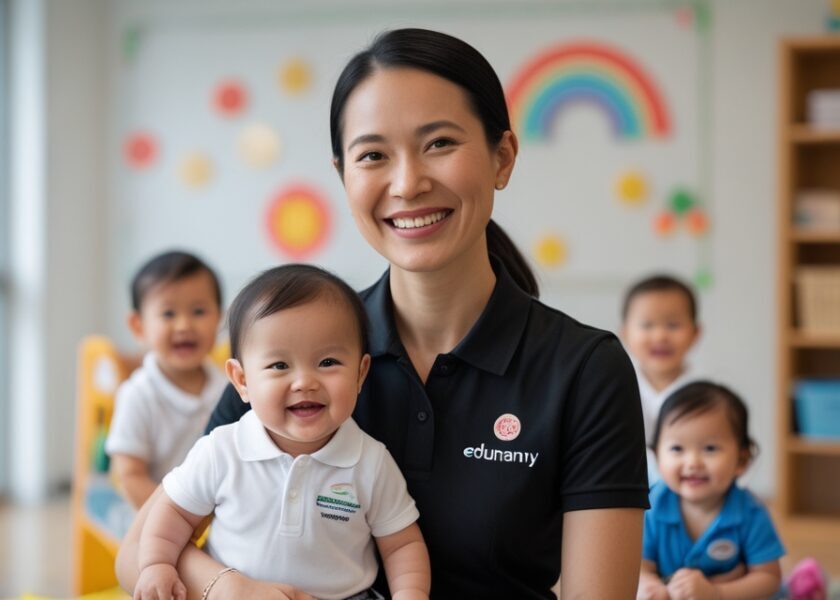
With small ratios of up to one to three infants, EduNanny caregivers can observe, respond, and support each child as an individual. This is not a feature added for marketing — it is the structural foundation that makes genuine developmental care possible.
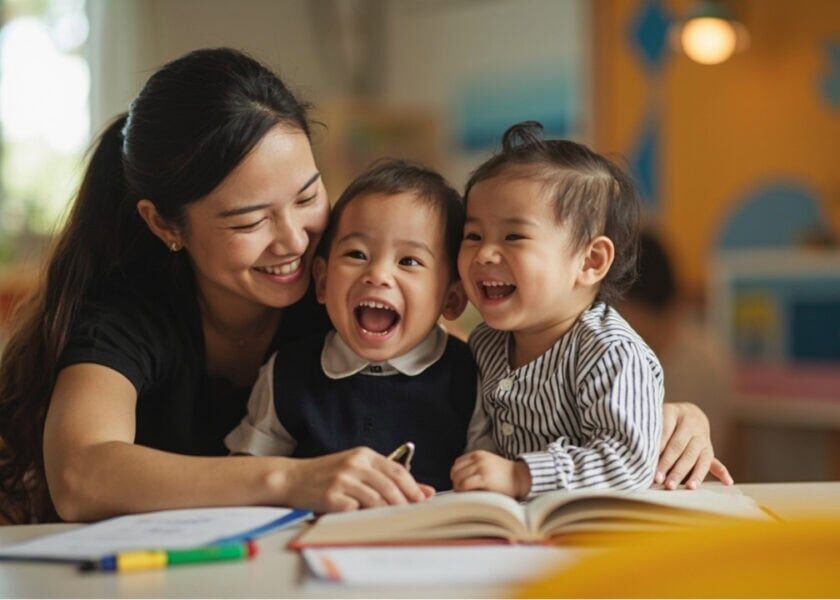
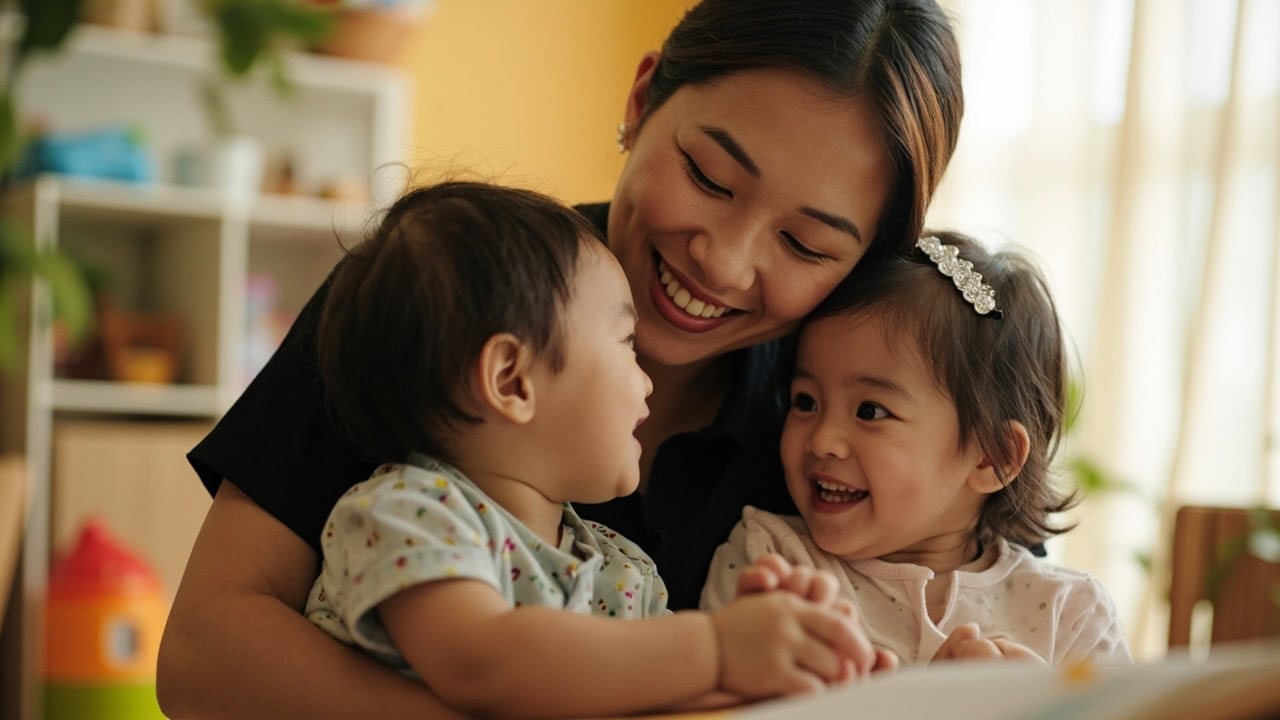
EduNanny caregivers understand why sensory experiences are not optional. They create environments rich with movement opportunities, tactile exploration, and outdoor engagement. They observe not just milestones reached, but how children reach them — building readiness that schools can actually see.
The pilot structure makes this care accessible, with CDA and Baby Bonus funding available to help ease the financial consideration for Singapore families. Care is available across Monday to Friday blocks, providing the consistent, reliable support that families in Singapore’s demanding work environment genuinely need.
Consistency matters for young children — the nervous system calms when routines are predictable and caregivers are familiar. EduNanny caregivers communicate openly with parents about what they are seeing, what they are building, and why. When parents understand what is being built and why, they can reinforce it at home. They can stop worrying about the wrong things. They can become partners in their child’s development rather than anxious observers.
Questions Parents Often Ask
Will my child fall behind if they are not doing worksheets?
The research is consistent: academic content can be introduced at any time. The neural pathways for attention, self-regulation, and sensory processing have sensitive periods. Missing those periods cannot be fully remedied by later academic acceleration. A child who arrives at Primary One with a regulated nervous system and strong foundational capacities will learn faster than a child who was drilled on content but arrived with a restless, unregulated body.
My child seems advanced — is this approach still relevant?
Knowing letters and numbers is not the same as being ready to learn. A child may have been taught to recite the alphabet, but if their visual processing, fine motor control, and emotional regulation are not ready, the actual act of reading will be harder than it needs to be. Developmental readiness and academic knowledge are different things — and only one of them has a critical window.
Is this approach too soft? Will my child be prepared for Singapore’s schools?
Singapore’s primary schools are increasingly aligned with what developmental science tells us about learning readiness. The child who can sit still, attend, follow instructions, manage frustration, and engage with curiosity has a significant advantage — not just in Primary One, but in every year that follows. That advantage is built through sensory-motor experiences, not through workbooks.
Can I do this at home, or does my child need formal childcare?
Parents do remarkable things with their children every day. But building sensory-motor foundations requires time, consistent environments, and the kind of daily physical engagement that many home settings — with their clean floors and careful furnishings — do not easily support. Quality childcare provides structured opportunity for the movement and sensory exploration that developing bodies need. It is a complement to parenting, not a replacement for it.
The Readiness Your Child Deserves
For parents who have been doing everything right — reading the articles, buying the workbooks, enrolling in the classes, asking the questions, worrying in the quiet hours — I want to say something directly.
You are not wrong to care this much. Your attention to your child’s readiness is itself a form of love, and it matters. But I want to invite you to trust the process in a deeper way.
The most important preparation you can give your child is not academic acceleration. It is developmental richness. It is a body that is ready to learn. A nervous system that is organised. An attention that can sustain. An emotional regulation that can handle the inevitable frustrations of school.
These are the things that will carry your child through Primary One and beyond. These are the things that worksheets cannot teach and tuition cannot replicate.
Your child is building readiness right now. In every moment they climb and jump and explore. In every moment they squish and pour and build. In every moment they navigate a conflict, manage a disappointment, find their balance, feel the texture of the world through their skin.
Every one of these moments is constructing the architecture that will allow them to walk into a Primary One classroom and not just cope, but flourish. Not just survive, but thrive. Not just follow, but engage. Not just learn, but love learning.
You brought your child into this world because you believed they deserved the best chance at a life well-lived. The best chance is built not in the workbooks of early enrichment, but in the sensory-rich, developmentally grounded, lovingly supported experiences of these early years.
Trust that. Trust the process. And know that you have a partner in EduNanny Singapore who believes in building school readiness the right way — from the body up, from the foundations outward, from readiness that is real and lasting to the learning that will follow.
EduNanny Singapore is a childminding service under the ECDA Childminding Pilot, offering quality infant and toddler care with small ratios, sensory-rich environments, and a developmental approach to school readiness. We welcome the conversation with families who want to understand how readiness is genuinely built.