The Architecture of the Sibling Bond in Singapore Childcare
The Question That Keeps Parents Up at Night
If you are a parent in Singapore raising more than one child, you already know that having siblings changes everything about what you are looking for in childcare. Not just in the practical sense — the logistics of drop-off and pick-up, the schedule, the fee structure, the subsidies you can access. You know those things. You have done the math.
What keeps you up at night, what sits in the background of every conversation you have with your spouse about who will take leave when a child is sick, what kind of care to arrange for the new baby, what happens to your firstborn when the second arrives — that is something deeper.
It is the question of whether any childcare environment can actually hold the complexity of what your children are to each other. Whether care can protect each child as an individual while simultaneously nurturing the bond between them. Whether anyone outside your home can understand that your children are not just two children being cared for in the same place. They are a relationship.
And that relationship may be the longest one either of them will ever have.
We know that question. We have sat with parents across Singapore who carry it. And what we have come to understand, through years of working alongside families with siblings, is that it is one of the most important — and one of the most overlooked — dimensions of what quality childcare actually does.
What Siblings Actually Are to Each Other
The moment the stakes change is not when you have your second child. It is when you realize that your second child will grow up with your first child, and that however they experience those early years together — in your home, in your care, and in the childcare you choose — will shape a relationship that spans decades.
Siblings carry each other through childhood in ways parents cannot replicate. They are the first peers, the first collaborators, the first rivals, and often the first negotiators of conflict and compromise. The sibling bond, when it is secure, becomes the original template for how a child relates to the world beyond the family. It is where they first learn to share, to apologize, to advocate for themselves, to stand beside someone who is different from them but who knows them completely.
This is not sentiment. This is developmental reality. And it is the reason why childcare for families with siblings is not simply childcare for two children. It is childcare for a relationship.
The Gap in How Childcare Is Designed — and What Quality Care Actually Looks Like
But here is what most parents discover when they begin looking. Almost every childcare option they evaluate is designed around the individual child. The tour highlights how each child receives personal attention. The curriculum promises individualized development plans. The caregiver greets you with the language of one-on-one bonding, and that matters — of course it does.
But when you have two children, or three, you start to wonder about the space between them.
What happens to the younger one when the older one goes to school and the sibling rhythm is suddenly broken? What happens to the firstborn when the new baby arrives and the familiar caregiver is now also caring for a newborn? How does a childcare environment protect the older child from feeling displaced while simultaneously welcoming the younger one with warmth?
These are not edge cases. These are the central anxieties of multi-child family life in Singapore, and they are almost never addressed in the conversation about what makes childcare good.
Quality childcare for siblings is not the same as quality childcare for a single child, and it cannot be approached as if it were. When siblings are in shared care, the environment is doing something that goes beyond individual development. It is holding a social system. It is providing a context in which brothers and sisters learn to be together outside the home — to navigate sharing, to manage the natural competition for adult attention, to experience the comfort of a familiar face that is not their parent’s face, to develop the particular language that siblings develop when they share a world.
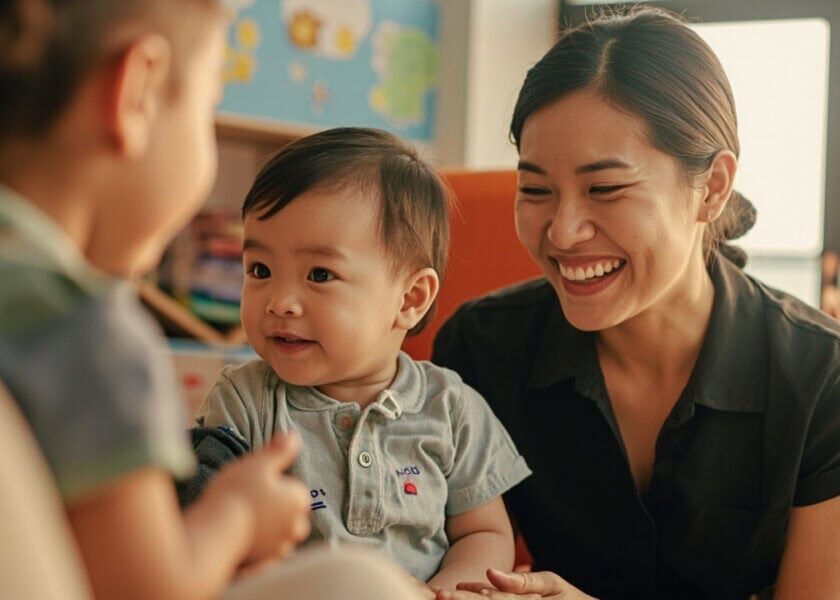
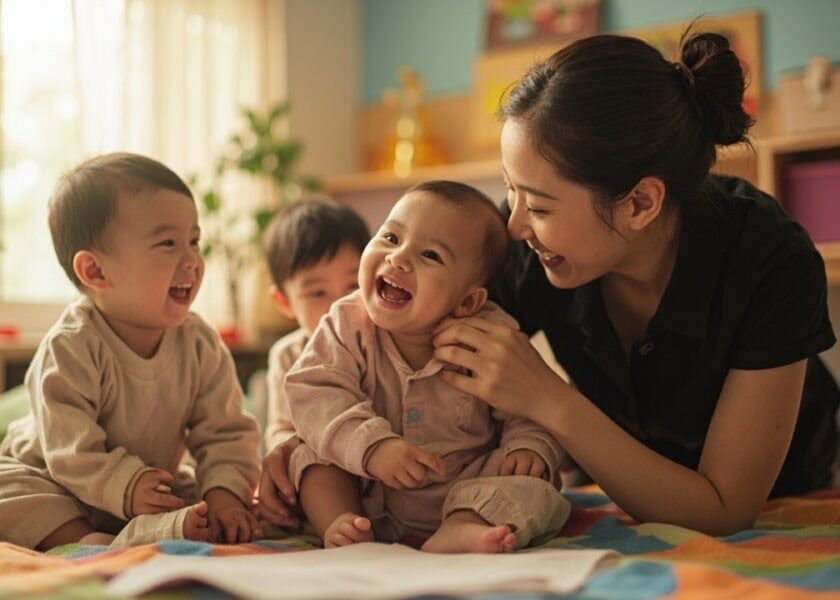
A classroom or a home-based care environment where siblings are genuinely seen as a relational unit — not just as two children who happen to arrive together — is a fundamentally different place. Parents feel it when they walk in and see their children moving toward each other with ease. They feel it when a caregiver naturally facilitates a joint activity between siblings instead of separating them into parallel individual tasks. They feel it in the absence of rivalry language — the “your turn, her turn” that reduces sibling interaction to a queue instead of a relationship.
Caregivers Who See the Whole Picture
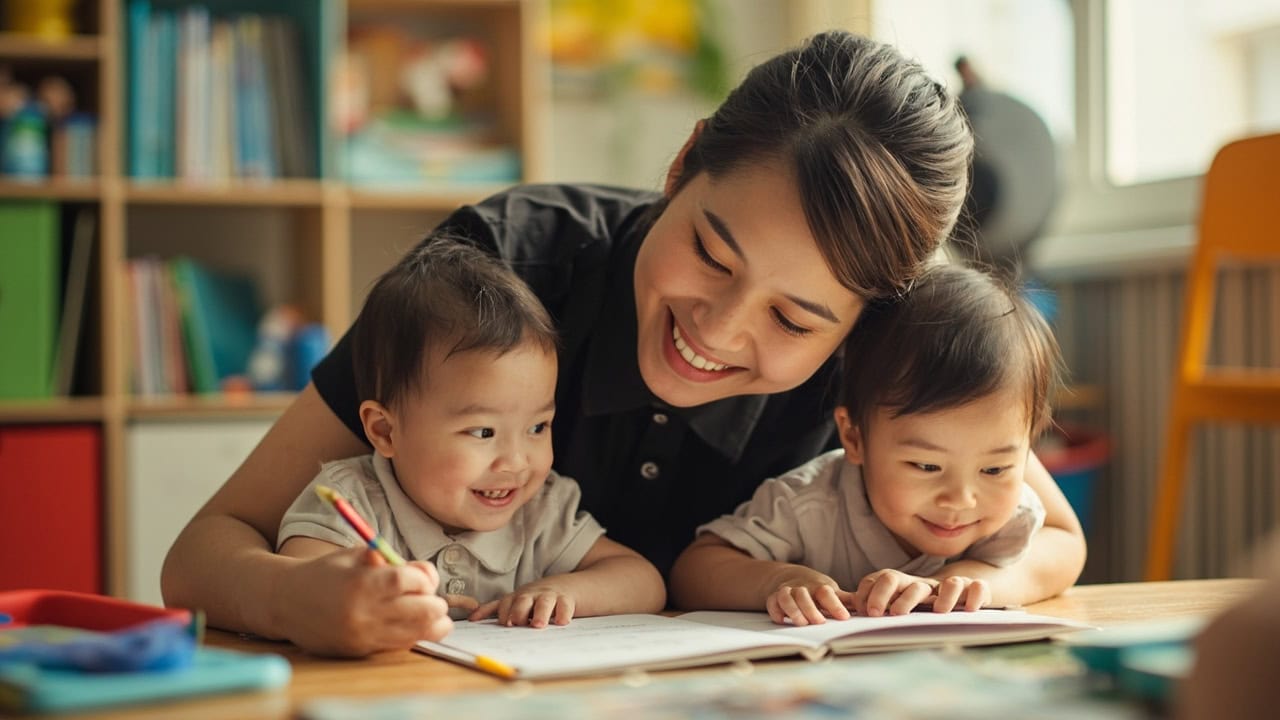
In practice, it looks like caregivers who understand that when two siblings arrive in the same space, they bring with them an entire history — a way of relating that has been built in the home over months or years. It looks like an environment where the older child is not treated as automatically responsible for the younger, but where both are allowed to be children, each with their own developmental needs, while also being given the gift of each other’s company.
The Quiet Milestones Siblings Reach Together
Because siblings in quality care reach quiet developmental milestones that are entirely their own:
- Cooperation skills that are different from the cooperation a single child learns with a caregiver
- Conflict resolution from each other — not from an adult mediating, but from working out differences in the presence of trusted adults who are close enough to help but not so intrusive that they solve everything
- A shared peer culture — a set of shared understandings, private jokes, ways of playing that belong to them alone
Quality childcare protects that. It creates the conditions for it. It does not interrupt it with so much adult direction that the siblings’ relationship with each other is flattened into supervised interaction.
What Families With Siblings Actually Need From Childcare
When evaluating childcare for your family with siblings, here are the questions that matter most — beyond the standard tour checklist:
- Caregiver ratios — Are ratios low enough that caregivers can observe how siblings behave together, not just how each child performs individually?
- Intentional peer grouping — Does the environment thoughtfully group children, or is grouping purely age-based with no attention to sibling dynamics?
- Transition support — How does the programme handle the arrival of a new sibling into a family already in care? Is there a plan, or is it left to chance?
- Communication with parents — Are parents given genuine insight into how their children are relating to each other in care, not just what each child ate or slept?
- Continuity of care — Can the same provider serve your family as it grows? Or will you be piecing together different arrangements at each stage?
These questions matter most during transition moments. Consider the arrival of a second child. In any family, this is a seismic shift. For the firstborn, the world reorganizes itself around a new person, and the firstborn must somehow find their place in that new world.
But in a family that is also navigating childcare — whether the firstborn is already in care, or is about to begin, or the new baby will soon join the same care environment — this transition becomes a question about systems, not just about individuals.
How does a childcare environment welcome a new sibling without making the older child feel replaced? How does it support the firstborn’s continued sense of security while extending warmth to the newcomer?
What we have seen, in environments that understand sibling dynamics, is that the answer lies in something deceptively simple: consistency of relationship. When caregivers know the firstborn well, and that relationship is genuinely secure, the arrival of a sibling into the same care environment does not threaten that bond. It expands it. The firstborn begins to see themselves as part of a family unit that the caregivers also recognize and care for.
And the younger child, arriving into that context, finds not just individual care but the presence of a sibling who already belongs there — who knows the rhythms, the people, the space — and who can, in their own childlike way, be a guide.
How EduNanny Singapore Approaches Sibling Care
We want to be transparent about how EduNanny Singapore structures care for families with siblings, because the structure itself is part of the quality.
EduNanny by BUTLER is part of the ECDA Childminding Pilot, and this matters for multi-child families in ways that go beyond the credential. The pilot offers both home-based care and centre-based pathways, which means families can choose the arrangement that fits their particular constellation — whether that is a caregiver who comes into the home, or a small group environment that still allows siblings to be in shared care with intentional peer grouping.
Ratio as a Relational Prerequisite
The ratios — up to one to three in infant care — mean that caregivers have the genuine capacity to know each child individually and also to observe and support the dynamics between siblings. This is not a luxury. This is a structural prerequisite for the kind of care we have been describing.
When a caregiver is responsible for too many children, individual needs crowd out relational ones. Siblings become managed rather than nurtured. But in an environment where the ratio allows for real observation, the caregiver becomes a witness to the sibling bond — someone who can facilitate, protect, and gently guide it.
Making Care Sustainable for Growing Families
The fee structures within the pilot are designed to be accessible, and for families with multiple children, affordability is not an abstraction. It is a factor in whether the care arrangement can be sustained over the long term.
When parents can access subsidies, use the Child Development Account, and apply Baby Bonus funding toward care, the picture changes. It becomes possible to think about childcare not as a temporary arrangement for one child at a time, but as a sustained partnership with a care provider who knows your family across its different chapters.
That continuity is one of the most underappreciated gifts a childcare arrangement can offer siblings. When children move through care with the same provider as their family grows, they carry continuity of relationship with them — with caregivers, with the environment, and crucially, with each other.
Safety, Communication, and the Reassurance Families Need
Then there is the question that every parent in Singapore eventually asks, especially in the context of news stories that no parent should have to absorb alone: How do I know my children are safe? How do I know what is happening when I am not there?
This is not a question born of distrust. It is a question born of love, and it deserves a real answer.
EduNanny addresses this with communication and transparency measures, including CCTV where deployed, that give parents insight into the daily life of their children’s care.
But here is something worth naming about why this matters especially in the context of siblings. When parents can see — even in glimpses, even in the routine updates that replace the need to watch every moment — that their children are together, that they are calm, that they are engaged, that the environment is warm and consistent, they receive something beyond reassurance about safety. They receive evidence that their children’s sibling bond is being honored in care.
They see, perhaps, their older child helping the younger one with something. They see them resting near each other. They see the rhythm that belongs to them. And that sight, more than any brochure, any curriculum description, any marketing claim, tells a parent that the childcare is working — not just for individual development, but for the family system.
What Siblings Carry Forward
Choosing childcare for a family with siblings is not a matter of finding good care for child one and then extending it to child two. It is a matter of finding a childcare partner who understands that every decision they make — every ratio they maintain, every grouping they create, every transition they support — ripples through the sibling relationship that will outlast everything else.
We believe siblings who feel secure together in shared care carry that foundation forward in ways that matter for their entire lives. They carry it into friendships, into partnerships, into the workplace, into the communities they build. The capacity to be close to someone who is different from you, who shares a history you cannot fully explain to anyone else, who knows your wounds and your joys with the same intimate familiarity — that capacity begins in the home, yes, but it is shaped and strengthened in the environments where children learn to be together.
For Singapore families, where the pace of life is fast, where grandparents and extended family may not always be close at hand, where parents are navigating demanding careers and the particular pressures of raising children in one of the world’s most accomplished cities — for those families, quality childcare is not a convenience. It is part of the architecture of the sibling bond.
EduNanny Singapore meets this with the seriousness it deserves — through the ECDA Childminding Pilot’s structured approach, through ratios that allow for genuine relational care, through pathways that serve both home-based and centre-based needs, through communication that keeps parents connected, and through a philosophy that understands what families with siblings actually need.
Not just childcare. Partnership. Not just individual attention for each child. Attention to the bond between them. Not just a safe place. A secure base — for every child in the family, and for the family itself.
If you are a parent in Singapore raising more than one child, you already know the weight of what you are carrying. The love, the logistics, the worry, the hope that your children will grow up knowing each other — really knowing each other — in a way that sustains them through everything that comes.
We cannot carry that for you. But we can walk alongside you in it.
We can be the environment in which your children’s sibling bond is not left to chance, but is nurtured, protected, and given the conditions it needs to flourish.
If you are a parent in Singapore exploring childcare options for your family with multiple children, EduNanny Singapore welcomes the conversation. We are here to answer your questions honestly and help you find the care arrangement that truly fits.