What Your Child Feels When You’re Not in the Room
What Your Child Actually Needs in Quality Childcare
If you’re short on time, here is what developmental science tells us matters most in those hours apart from you:
- Emotional safety, not just supervision — Your child needs to feel known as a person, not just managed as a charge
- Consistent, attuned caregiving — Responsive caregivers who notice the difference between tired and frustrated, between needing space and needing closeness
- A secure base — An internal sense that the world is trustworthy, so they can explore with confidence
- Co-regulation, not control — Daily moments where their nervous system learns to move from agitation back to calm through warm, present caregiving
- Belonging — The conviction that they matter, that there is a place in the world where they fit
These are not soft concepts. They are the foundation upon which all learning, development, and relationship skills will eventually grow. And they can be built — consistently, intentionally — in quality childcare.
The Architecture of What Your Child Is Quietly Building
That question — what does my child feel when I am not there — is not a small one. It is, in fact, the most important question you could ever ask about your child’s care. Because what happens inside a child in the first years of life does not stay inside a child. It becomes the architecture of everything they will ever feel about themselves, about others, about the world they are just beginning to inhabit.
What That Internal World Looks Like
In the first weeks and months of out-of-home care, a young child is doing something extraordinary and largely invisible. They are learning, for the first time, that a person other than their parent can be a source of safety.
For a child who has known only the voice and scent and touch of home, the arrival of a new caregiver is a profound renegotiation of the world. The child tests. They cry, perhaps more than usual. They watch with an intensity that seems far beyond their months. They are asking, in the only language they have: Is this person safe? Will they come back when I need them? Can I trust that the world — even when it changes — will still hold me?
This is not adjustment. That word belongs to the language of logistics, of settling in. What is actually happening is far more significant. The child is building the first, foundational layer of something developmental psychologists call internal working models — the child’s learned answer to questions like: Are people reliable? Is the world a place where my needs will be met? Am I worth caring for?
These are not questions a child can ask aloud. But they are questions the child is asking, every single day, in every interaction with the person who holds them, responds to them, and meets their eyes with warmth.
The Felt Sense of Safety
When a caregiver consistently answers yes — through presence, through attunement, through the thousand small acts of noticing and responding that happen in a single day — the child begins to internalize something remarkable. Safety stops being a question and becomes a felt sense. It becomes the quiet conviction, settled somewhere deep, that the world is trustworthy. That people can be relied upon. That they themselves are worthy of care.
This is not a belief the child will articulate for years. But it will shape everything:
- Their willingness to explore new environments
- Their ability to manage big feelings
- Their capacity to form friendships
- Their resilience in the face of new challenges
The child does not know they are building this. But they are. And the quality of the care they receive is the reason why.
The Difference Between Being Supervised and Being Known
Supervision asks: Is this child fed, rested, safe from harm? It is necessary, but it is only the beginning.
Genuine emotional knowing asks something different:
- Does this child feel seen?
- Does their caregiver notice the particular quality of their fussiness today — whether it is hunger or overwhelm or a need for closeness?
- Does the caregiver understand that this child’s way of showing distress is different from that child’s way, and honor that difference?
- Does the child leave each day feeling not just that they were managed, but that they were known?
What Emotional Co-Regulation Looks Like in Practice
In a high-quality care environment, the child’s nervous system has been gently co-regulated, again and again. When a caregiver notices a rising distress and intervenes with calm presence — a soothing voice, a warm hold, a moment of eye contact that says I see you and I am here — that caregiver is doing something that shapes the child’s brain at its most fundamental level.
The child is learning, through repetition, what it feels like to move from agitation back to calm. They are building their own internal capacity for regulation, not because they were taught it, but because they felt it, over and over, in the body of someone who cared for them.
This is why emotional co-regulation is not a soft concept. It is a daily, concrete, neurological process. And it is one of the most powerful things that happens in the hours your child is in care.
From Hesitation to Belonging: What Quality Care Makes Possible
When a child is known — truly, attentively, consistently known — something extraordinary begins to happen. The child begins to belong. Not in the way adults belong to groups, through choice and social agreement, but in a deeper, more foundational way. The child begins to feel that they are a person who belongs. That there is a place in the world where they fit. That they are not merely a small visitor passing through someone else’s space, but a full human being whose presence matters.
How Belonging Shows Over Time
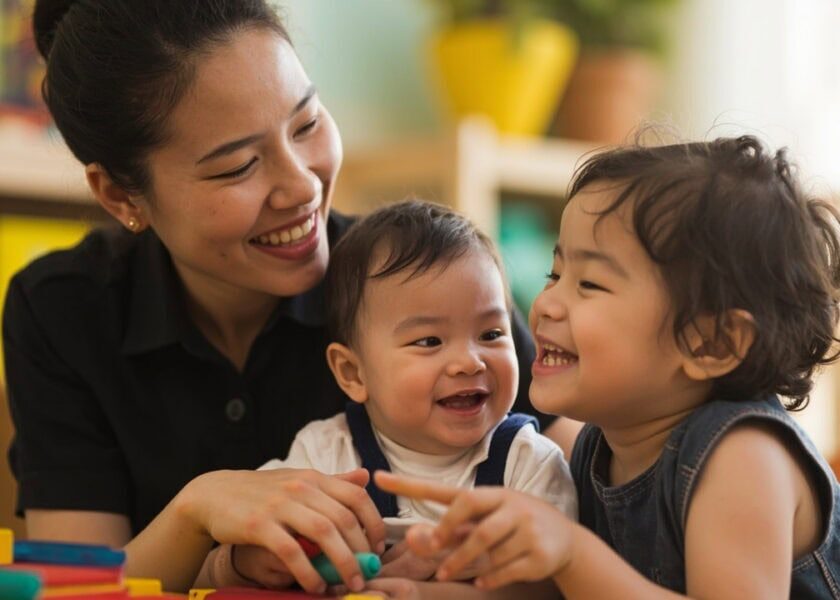
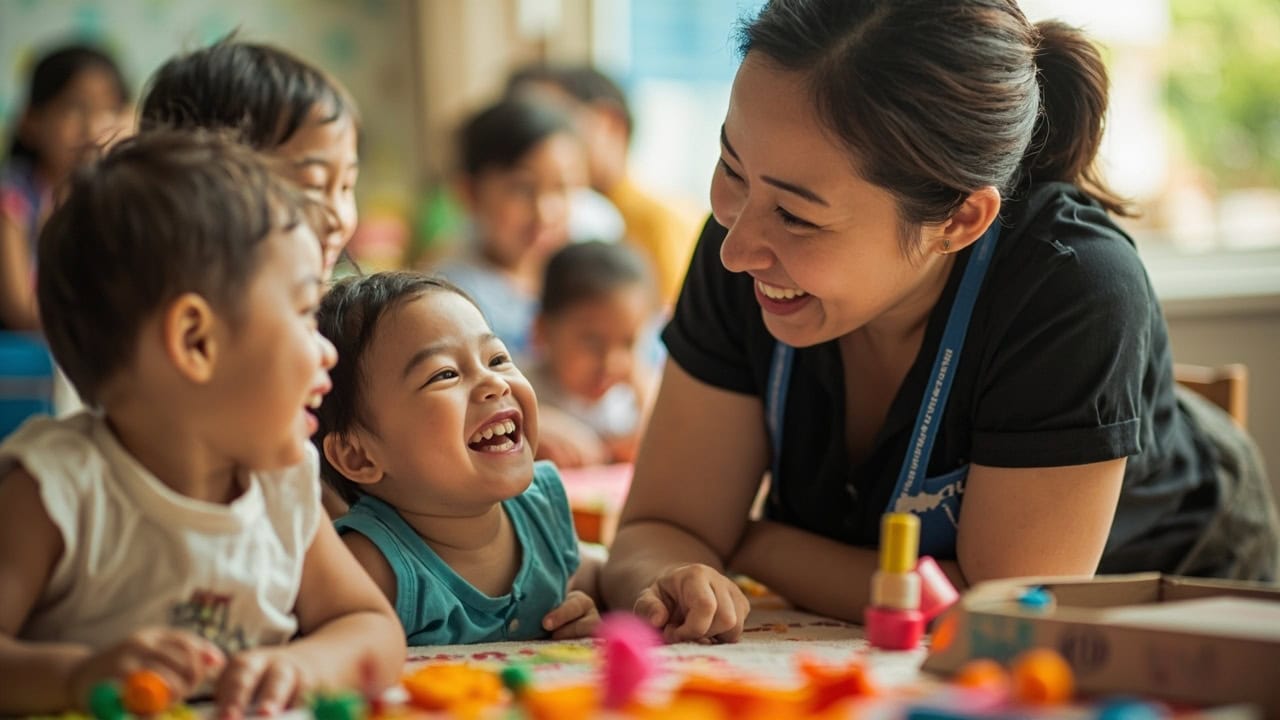
You see it in the beginning: The child who, after weeks of hesitant arrival at the door, begins to walk toward their caregiver with something like recognition. Not yet comfort, not yet eagerness — but recognition. The child is learning the emotional geography of a new place. They are mapping its contours in their mind, filing away its rhythms and faces, and beginning to understand: This is a place where I am expected. This is a person who is glad I came.
You see it later: The child who runs into the room with an energy that surprises you. Who climbs, explores, wanders to the far corners of the space with a kind of buoyant curiosity that you recognize as new. This is the child who has internalized a secure base.
The developmental psychologist Mary Ainsworth described it simply: the secure base is a place from which a child can venture out, knowing they can return. When a child feels truly safe — not just physically, but emotionally — they do not cling. They explore. They reach for new things, test new sounds, push against the edges of their small world with a confidence that is, in fact, the visible expression of deep internal safety.
The Skills That Travel Beyond the Care Room
The belonging skills a child learns in quality care are not skills that stay in that room. They are portable. They go with the child.
A child who has learned to trust a caregiver — who has learned, through consistent, warm, responsive care, that relationships can be safe and rewarding — brings that learning to every new relationship they enter:
- To the sibling they play with in the afternoon
- To the cousin at a family gathering
- To the circle of children on a playground
- To the teacher who will greet them on their first day of school
The internal working model does not reset. It extends. The child who feels they belong in one caring environment carries the quiet confidence of that belonging into every environment that follows.
Why the Emotional Foundation Is Development
Developmental science has shown us something worth saying plainly: the emotional foundation a child builds in their earliest years of out-of-home care is not separate from their development. It is their development. It is the root system from which cognitive growth, social competence, language acquisition, and emotional resilience all eventually grow.
You cannot separate the child’s feeling world from their learning world. They are the same thing, in the early years:
- A child who is anxious cannot learn
- A child who is emotionally defended cannot explore
- A child who does not feel safe cannot take the intellectual risks that true learning requires
The emotional foundation is not preparation for development. In these early years, it is development.
What Quality Childcare Actually Looks Like in Singapore
For parents in Singapore navigating the landscape of infant care and childminding, understanding what quality actually means can feel overwhelming. Here is what to look for — and what it should feel like when you find it.
Signs of Genuine Attunement
In quality care, you will notice:
- Caregivers who notice nuances — The difference between a cry of hunger and a cry of overwhelm. The moment a child’s face changes and the caregiver responds, not reactively, but with understanding
- Consistent presence — The same familiar faces, day after day. Predictability that lets a child relax into trust
- Respect for individual temperament — No two children are handled the same way, because no two children are the same
- Communication that goes beyond logistics — Updates that tell you something about who your child is being that day, not just what they ate
Questions to Ask When Visiting a Childcare Setting
- How do caregivers respond when a child is distressed?
- What does a typical day look like for a child in their first weeks?
- How do you help a child who is struggling to settle?
- What is your approach to building trust with both child and parent?
- How do you communicate my child’s emotional experience to me?
The ECDA Childminding Pilot and What It Means for Families
In Singapore, the ECDA Childminding Pilot sets standards that take a child’s developmental needs seriously. Quality is not accidental — it is designed, overseen, and held to account.
Home-based and community-based pathways under the pilot offer warm, human-scale environments where caregiver-to-child ratios allow for genuine attunement rather than merely functional oversight. The practical realities matter too: Monday to Friday care blocks, the usability of CDA and Baby Bonus, and fee structures designed to make quality care accessible. Because belonging should not be a privilege available only to families with considerable means.
Addressing the Courage of Leaving Your Child
There is a particular kind of courage that it takes to leave your child in someone else’s care. It is not the courage of indifference. It is the courage of love — love that wants to do right by a child even when the right path is complicated, even when the choice is not easy, even when the guilt and the wondering feel too heavy to carry.
If you are feeling this, you are not alone. You are not failing. You are doing something deeply human and deeply difficult because you know, with the same quiet knowing that brought you to this question in the first place, that your child deserves more than okay.
Common Concerns, Honestly Addressed
“Will my child feel abandoned?”
In quality care, your child learns that people can be trusted, that needs will be met, that separation is not permanent. What they feel is not abandonment — it is the beginning of a wider circle of trustworthy, loving attention.
“How will I know what my child actually experiences?”
You cannot be in the room. But quality caregivers help you understand through thoughtful communication — not just reports of meals and naps, but glimpses into who your child is being that day. The wondering should not be left entirely to the imagination. You deserve to know.
“Is my child just being managed, or are they genuinely cared for?”
This is the right question. The answer lies in what you observe: Does your child seem more settled after time in care, not less? Do they show recognition of their caregiver? Does the caregiver speak about your child as a specific, individual person? These are signs of genuine knowing.
How EduNanny Builds This Foundation for Your Child
When we speak about what we do, we are speaking about this. Not primarily about ratios, though ratios matter. Not primarily about curriculum frameworks, though these have their place. We are speaking about the internal world your child is building.
We are speaking about the person your child is becoming in our care — not just the skills they acquire, but the sense they are developing about who they are, what they deserve, and what the world has to offer them.
EduNanny by BUTLER was built on a simple, enduring conviction: that every child deserves to be known. Not managed. Not monitored. Not simply supervised. Known.
- Known in the way that allows a caregiver to tell the difference between a child who is tired and a child who is frustrated
- Known in the way that allows a caregiver to respond to a particular child’s needs in a way that is shaped by that child’s unique temperament, preferences, and rhythms
- Known in the way that means, at the end of the day, your child has spent their hours in an environment where someone was paying attention not just to what they were doing but to who they are
In our home-based and community-based pathways, children experience care in settings designed to feel like extensions of home — warm, human-scale environments. Under the ECDA Childminding Pilot, these pathways are shaped by standards that take the child’s developmental needs seriously. Where monitoring measures are in place, they serve a purpose beyond transparency: they are one part of a broader commitment to trust — the trust that parents place in us, and that we work to deserve.
A Practical Evaluation Framework
Here is a simple guide for evaluating your options, grounded in what developmental science tells us matters most:
| What to Look For | Why It Matters |
|---|---|
| Caregiver consistency | Children build trust with specific people. Frequent turnover disrupts the attachment process. |
| Responsive, attuned caregiving | Children learn emotional regulation by experiencing it. Look for caregivers who notice and respond to individual cues. |
| Environment designed for belonging | Small groups, warm settings, routines that feel predictable and safe — not institutional. |
| Communication that reflects understanding | Updates should tell you who your child is being, not just what they did. |
| Evidence of children’s engagement | Watch for confident exploration, spontaneous play, and children’s ease in the space. |
The most important test is not on paper. It is this: when you watch how your child responds to the caregiver — do you see recognition? Does your child seem settled, not just managed?
You Are Not Leaving Them in a Place of Mere Supervision
When you bring your child to quality care, when you hand them over at the beginning of a care day, you are not leaving them in a place of mere supervision. You are bringing them into an environment that has been designed — with intention, with structure, with warmth, and with deep respect for the human being that your child already is — to do what we believe matters most.
To know your child. To hold them with care. To be a place where their internal world grows strong, and safe, and full of the quiet conviction that they belong.
Because your child is not just learning things while they are in quality care. Your child is learning what it feels like to be loved. They are learning that safety is real, that people can be trusted, that the world is a place where they matter.
And that learning — that profound, wordless, foundational learning — will stay with them long after they have forgotten the songs we sang and the activities we did. It will stay with them in the classroom, at the dinner table, in the friendships they make, in the way they carry themselves in the world.
It will stay with them because it was not taught. It was felt.
And what a child feels in those earliest years becomes the inner compass by which they navigate everything that follows.
You wondered what your child feels when you are not in the room. We want you to know: they feel held. They feel seen. They feel, in the quiet and accumulating way that matters most, that they are exactly where they belong.
Begin the Conversation
If you are exploring infant care or childminding in Singapore, we invite you to take the next step. Speak with us about what your child’s day could look like — not just managed, but known. Not just supervised, but held.
Because this is the gift you are giving your child: not just care, but the quiet, foundational knowledge that they are worthy of it.
And that is a gift that lasts.
Find out how EduNanny can support your family.