Seeing What Matters: How Trained Caregivers Read Your Child’s Development
The Gap Is Not a Personal Failing
Here is what many parents in Singapore do not realize: the gap between what you sense and what you can articulate about your child’s growth is not a personal failing. It is structural.
You were not taught this in school. You may not have grown up observing infant development up close. You love your child enormously — but love is not the same as developmental literacy. And that is not a criticism. It is simply a reality.
Just as a music lover can appreciate a symphony without reading sheet music, a loving parent can feel proud of their child without being able to name the specific milestones unfolding. But here is the difference: when you learn to read the music, you hear the symphony differently. Richer. More clearly. More connected to what is actually happening.
Singapore parents face particular pressure — academic expectations that begin earlier than almost anywhere else, a competitive landscape that makes every choice feel consequential, and long working hours that pull parents away from their children. There is so much noise, so many voices telling you what you should be doing. It is easy to feel not just uncertain but exhausted.
Here is what we want to say to you, as clearly as possible: you do not have to carry this alone. The right childcare partner does not replace you. It equips you. Seeking support is not a sign of failure or insufficiency. It is a sign that you are wise enough to know what you need and brave enough to ask for it.
What Trained Caregivers Actually See
The first thing to understand is that what trained caregivers see is not magical. It is not intuition. It is not some special bond that you, as a parent, somehow lack. It is a discipline — a set of frameworks rooted in child development science that allow a trained eye to watch behavior and understand what is happening underneath: neurologically, sensory-wise, emotionally.
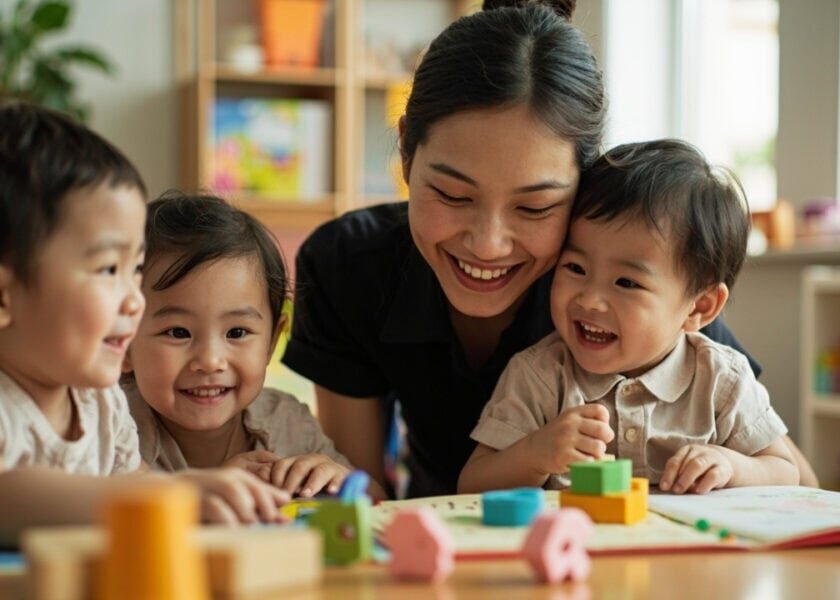
Let us take a simple example. Imagine a fourteen-month-old at a home-based childcare setting. She is playing with a set of wooden blocks. She picks one up, examines it, turns it over, puts it down. Picks up another. Does the same thing. Drops them. Watches them fall.
To an untrained eye, this might look like random play. To a trained caregiver, this is a symphony of development:
- That act of examining, turning, comparing — that is cognitive sequencing developing in real time.
- The way she watches them fall, tracks their movement, predicts where they will land — that is spatial reasoning and early physics intuition forming.
- The deliberate repetition — doing it again, and again, and again — is not boredom. It is her brain building neural pathways through iteration.
A trained caregiver watching this child does not just see a baby playing with blocks. She sees a fourteen-month-old who is, right now, constructing the neurological foundations for later problem-solving, mathematical thinking, and the ability to persist with a challenging task.
She sees the sensory integration happening — the hand-eye coordination, the tactile feedback, the visual tracking. She sees temperament emerging: Is this child methodical or reckless with the blocks? Does she get frustrated when they fall or does she laugh? Does she experiment or does she repeat the same pattern exactly?
These are not trivia. These are the earliest fingerprints of who this child is becoming.
Four Developmental Threads You Can Learn to See
Here is what most parents in Singapore have never been offered: the actual framework for reading your child’s development in real time, through the lens that trained observation provides. These are the threads that trained caregivers track every day — and that you can learn to recognize in your own child.
1. Language and Communication
Not just the words your child says, but the way she communicates before she has words. The gesture at eleven months that precedes the first word by weeks. The pointing that says, Look at that. I want you to see what I see.
Or the way a child at two years old uses language not just to label but to narrate her inner world — Mummy go work. Me sad. But Miss Sarah give me cookie.
That sentence, in that sequence, is a window into cognitive organization, emotional processing, and social trust. A trained caregiver hears it as a milestone. So can you.
2. Sensory Processing
How does your child respond to noise, to texture, to movement? Does she seek out spinning and climbing or does she shy away? Does she melt down at unexpected sounds or does she barely notice?
These are not behaviors to correct. They are information — your child’s sensory nervous system telling you something about how she experiences the world.
Understanding that your child’s relationship to sensation is a core part of her developmental profile changes how you respond to her. It changes how you play with her. It changes how you interpret her fussiness, her preferences, her moments of overwhelm.
3. Social-Emotional Tempo
Every child enters social situations with a certain rhythm. Some children observe for a long time before engaging. Some dive in immediately. Some are intensely relational, focused on connection with adults. Some are peer-oriented from the start.
None of these trajectories is better than another. But knowing which one is your child — understanding that your child’s social style is not a problem to fix but a temperament to work with — is enormously freeing.
It allows you to stop comparing. It allows you to trust the process. And it allows you to support your child in exactly the way she needs, rather than in the way you think she should be.
4. Persistence and Problem-Solving
How does your child respond when something is hard? Does she try once and ask for help? Does she keep going on her own? Does she get frustrated visibly or does she process internally?
These are the earliest signs of resilience, of executive function, of the internal locus of control that will serve her for decades.
Trained caregivers see these moments because they are trained to witness difficulty, not just success. And when they share what they see with you, they are giving you the most valuable information a parent can receive: not just what your child can do, but how she approaches what she cannot yet do.
What Quality Childminding Actually Looks Like
When you choose a childcare arrangement — whether through home-based care with intimate ratios or through community or centre-based pathways — you are not outsourcing your parenting. You are adding a layer of expertise to it. You are creating a team.
The best teams are not the ones where one person does everything. They are the ones where each person brings what they do best, and the result is better than what any individual could achieve alone.
Within the ECDA Childminding Pilot, quality is not optional but embedded. The small ratios — up to one caregiver for three infants in home-based settings — mean that caregivers can actually observe. They can track. They can document. They can notice the shift in language, the new skill emerging, the subtle change in how a child approaches a challenge.
Imagine it is a Tuesday morning. You drop your fifteen-month-old at your home-based care arrangement — one of three infants in a carefully designed home environment, with a caregiver who has been trained in developmental observation.
Your child runs to the corner where a basket of shape-sorters sits. She picks one up. She turns it. She tries to fit it in the wrong hole. She looks at it again. She turns it. She tries another hole. It does not fit. She looks at the correct hole. She turns the shape to match the orientation. It fits.
She pulls it out. She does it again. You watch her repeat this process three more times, each repetition smoother, each attempt more confident.
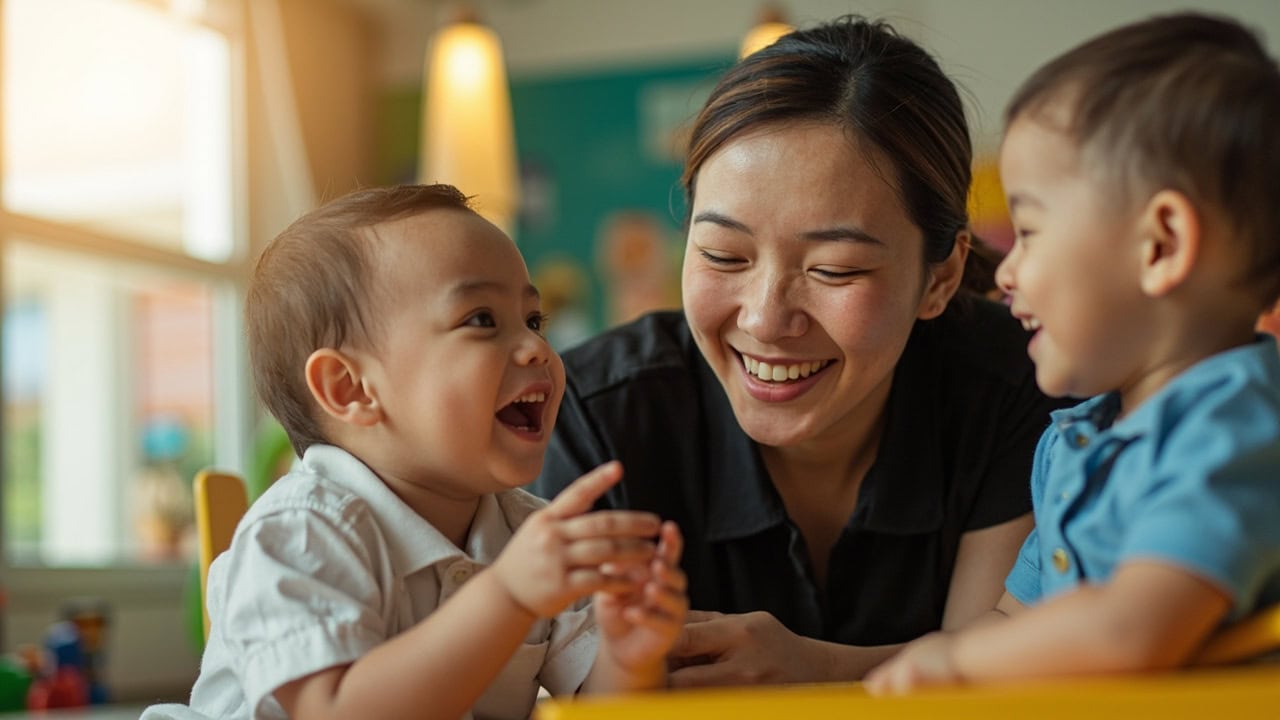
At pickup, your caregiver tells you: She has been working on that shape-sorter all afternoon. I noticed she started by trying to force shapes into the wrong holes — that is normal for this age. But by the third attempt, she had figured out spatial orientation. She is building persistence and visual-spatial reasoning right now. At home, you might try giving her things that require a little twist or rotation to open — that would extend what she is practicing here.
This is not a report. This is not a grade. This is a translation — the caregiver taking what she observed through a trained developmental lens and giving it to you in language you can use.
Now you know what your child was doing. You know why it mattered. You know how to extend it. You leave pickup not just with a happy child but with new understanding.
And that understanding compounds. Over weeks and months, as this kind of sharing continues, you find that you are starting to see it yourself. You are anticipating it. You are noticing the persistence in other contexts, the spatial reasoning in other tasks.
Your child’s development is becoming legible to you — not because you read a book about it once, but because you have been in an ongoing partnership with someone who has taught you how to look.
How EduNanny Builds Your Confidence as a Parent
When you can do this — when you can articulate what is happening in your child’s development, not in vague terms but in specific, observable, real terms — something shifts.
- The quiet uncertainty fades.
- The comparison to other children loses its grip.
- The guilt about working, about needing help, about not being present every single moment — it softens.
Not because you have been reassured with platitudes, but because you have gained something real: the ability to see your child clearly.
EduNanny by BUTLER was built on this understanding. The name itself is a statement of philosophy: not a service that parents receive, but a partnership that parents join.
The ECDA Childminding Pilot framework aligns with this completely — it is designed not just to provide childcare but to build developmental support into the very structure of care. The communication structures — the daily updates, the transparency measures, the open channels between caregiver and parent — mean that observation is not locked away in a professional silo. It flows to you. It becomes yours.
You take the vocabulary that trained caregivers use, and you start to hear it in your own child at home. You start to see the gestures, the social rhythms, the persistence patterns, the sensory preferences that you never noticed before — not because you were a bad parent, but because you had never been given the lens to see them.
For parents navigating the practical realities of childcare in Singapore, the pilot fee structures are designed to be within reach. CDA and Baby Bonus funds are usable, which means the financial architecture of Singapore’s family support system works in your favor. Monday to Friday care blocks provide the consistency that developing brains need.
Common Concerns, Answered Honestly
Will my child form a stronger attachment to the caregiver than to me?
This is one of the most common fears, and it comes from a misunderstanding of how attachment works. Secure attachment to a primary caregiver — you — is built through consistency, warmth, and responsiveness. Quality childcare actually supports this by giving your child a second secure base from which to explore. A child who trusts her caregiver feels safe enough to grow. That security does not compete with your bond; it complements it.
How do I know the caregiver is actually trained and not just experienced?
Experience matters, but training matters more. Ask specifically about their observation practices. How do they document development? What frameworks do they use? How do they communicate what they see to parents? Within the ECDA Childminding Pilot, training is built into the structure — not optional, but required.
What if I disagree with how the caregiver interprets my child’s behavior?
Partnership means dialogue, not deference. The best caregiver-parent relationships are characterized by ongoing conversation — you share what you see at home, they share what they see in care, and together you build a fuller picture. If something does not feel right, ask questions. A trained caregiver welcomes this scrutiny because it makes their observation sharper, not weaker.
Is home-based care actually safer than centre-based care?
Both can be excellent. What matters is the quality of the caregiver, the environment, and the ratios. Home-based care offers one advantage: small numbers. A caregiver with three infants can observe each one with attention that is simply not possible in a larger setting. But the caregiver’s training and the environment’s safety standards matter far more than the setting itself.
Practical Guidance for Choosing Infant Care in Singapore
Here is what to look for when you are researching your options:
- Ask about observation practices: How do caregivers track development? What do daily updates actually include? If the answer is vague — we’ll send you photos — push harder. Photos are nice. Narrative is valuable.
- Visit at an unexpected time: If possible, visit during the day, not just during a scheduled tour. See what the environment actually looks like when children are present and engaged.
- Notice how caregivers speak about children: Do they describe individual temperaments? Do they mention specific developmental moments? Or is the language generic — she’s doing great, she’s so smart?
- Ask about communication structure: How often will you hear from your caregiver? What format does that take? Is there time built in for real conversation, not just logistics?
- Inquire about training: What training have caregivers received? Is it ongoing or one-time? How does training connect to daily practice?
- Trust your gut during the visit: Do the caregivers seem genuinely interested in your child as an individual? Or do you feel like one of many families being managed?
You Were Right to Trust That Feeling
There is a moment that every parent in Singapore knows. It happens in the evening, after pickup, when your child is in your arms or running ahead of you through the mall or settling into the car seat after a long day apart.
Something shifts. You cannot pinpoint it exactly, but you sense it. A new word your child used that was not there last week. The way she looked at another child and waited, watched, then moved toward the toy with a kind of deliberate patience that surprised you. The fact that when you dropped her off this morning, she did not cry — not because she was indifferent, but because she has built something inside herself that says, this is familiar. I am safe here. I will come back to you.
You sense something is happening. But you cannot name it. And that gap — between what you feel in your bones and what you can actually articulate — is one of the quietest, most persistent tensions of modern parenthood.
We want to close by speaking directly to that feeling. You were right to trust it. Something is happening. Every day, in every interaction, in every moment of play and challenge and connection, your child is building a brain, constructing a self, becoming someone.
This process is not invisible. It is happening in front of you. But you need the right tools to see it clearly.
That is what the right childcare partner gives you:
- Not just care for your child today, but a lens for your child tomorrow.
- Not just a service, but a language.
- Not just observation, but translation.
Slowly, session by session, conversation by conversation, you begin to see things you never noticed before — not because you were not looking at your own child, but because you finally have the framework to understand what you were seeing.
This is not a complete solution on its own. It is a real partnership working together for your child. And when you have that — when you have a caregiver who is trained to see, and a communication structure that translates that seeing into language you can use, and a framework that helps you make sense of it all — you become something more than a parent who hopes.
You become a parent who knows. Who reads. Who sees.
And that changes everything. Not just for you. But for your child — who will grow up knowing that she is seen. That her development is not happening in a vacuum, invisible and uncelebrated. That there are people paying attention, tracking her growth, narrating her story, and sharing that story with the people who love her most.
If you are a parent in Singapore exploring infant care options and you want a partner who treats developmental observation as a core responsibility — not an add-on — we would be honored to have that conversation with you.
EduNanny by BUTLER works within the ECDA Childminding Pilot framework, offering home-based infant care with ratios that allow for genuine observation, communication structures that translate that observation into language you can use, and a philosophy built on partnership rather than service.
Your child’s development is not happening in the dark. You just need someone to hold up the light.
We are here to help you see it — clearly, confidently, and together.
If you found this article helpful, you might also enjoy learning more about our approach to childcare or exploring the ECDA Childminding Pilot framework in detail.