The Architecture of Your Child’s Trust Starts Here in Singapore
The Architecture of Trust: What Develops in Quality Care
Let us begin with what is happening beneath the surface — not visible to you at drop-off, but unfolding all day long in the body and brain of your child.
Imagine, for a moment, that you are three years old. Or two. Or eighteen months. You wake in the morning and there is the familiar rhythm of getting ready — the song your caregiver hums, the way she knows exactly how you like your toast cut, the gentle routine that tells your body and brain that the day is beginning. You do not yet have words for what this means, but your body knows. Your nervous system knows.
There is a pattern here, a predictability, and in that predictability, something essential is being built: the architecture of trust.
This is what developmental psychologists call an internal working model — the map a child builds inside themselves of what relationships feel like, what the world offers, whether people can be relied upon. This model begins forming at birth, shaped by every interaction, every response, every moment when a child reaches out and the world reaches back.
In quality care, that reaching and that reaching back happen thousands of times a day. They happen when a caregiver notices a child’s frustration before it becomes a full collapse and offers comfort. They happen when a child completes a puzzle or masters a stair and a caregiver’s face lights up with genuine pride. They happen in the small, unglamorous moments of feeding and diaper-changing and hand-washing, when a caregiver’s voice is steady and warm and full of attention.
This is not supervision. This is attunement. And it is laying down the neural pathways that will determine, in profound ways, how your child relates to others for the rest of their life.
A Morning in Quality Care: Walking Through Your Child’s Day
Let us paint that world for you — step by step.
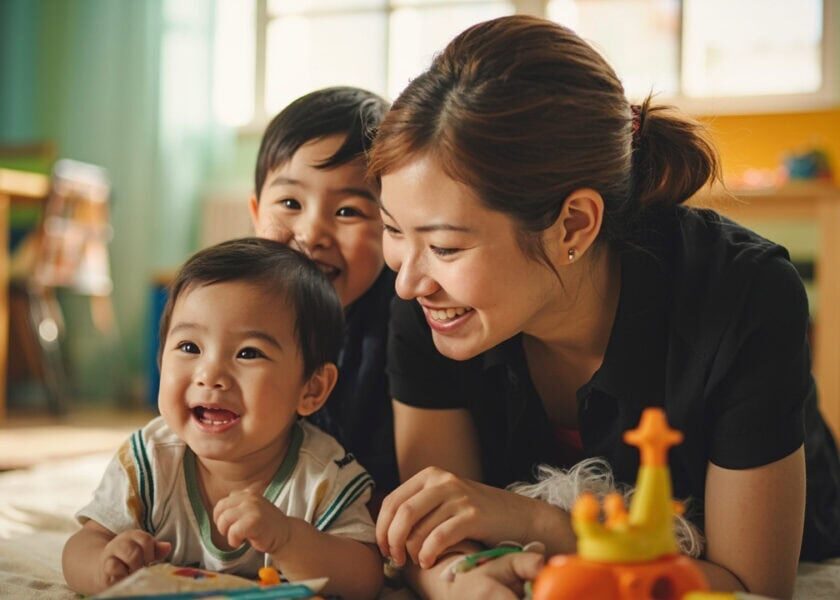
The Arrival: You arrive, and there is your caregiver. She knows your child’s name — not just the name on the enrollment form, but the name she uses when she greets your child in the morning, the name infused with warmth and recognition. She kneels down to your child’s level. She does not rush this. She has learned that these first moments set the tone for everything that follows.
“Hello, my friend. I am so glad to see you today.”
Your child, who may or may not have language yet, understands. They feel the welcome in her body language, in the tone of her voice, in the way she is present with them. They feel known.
Small Ratios, Deeper Attention: The ratio in a place like EduNanny matters more than numbers on a page. When there is one caregiver for every three infants — or fewer, depending on the setting — something changes. There is space to respond. There is space to notice. There is space to remember that this child prefers the red cup, that this child is working through a developmental leap, that this child’s parents are going through a difficult time and might need extra gentleness today.
Knowledge like this is not possible when a caregiver is managing eight children at once. It requires the kind of ratio that allows attention to be rationed carefully — and the ration should always slant toward the children.
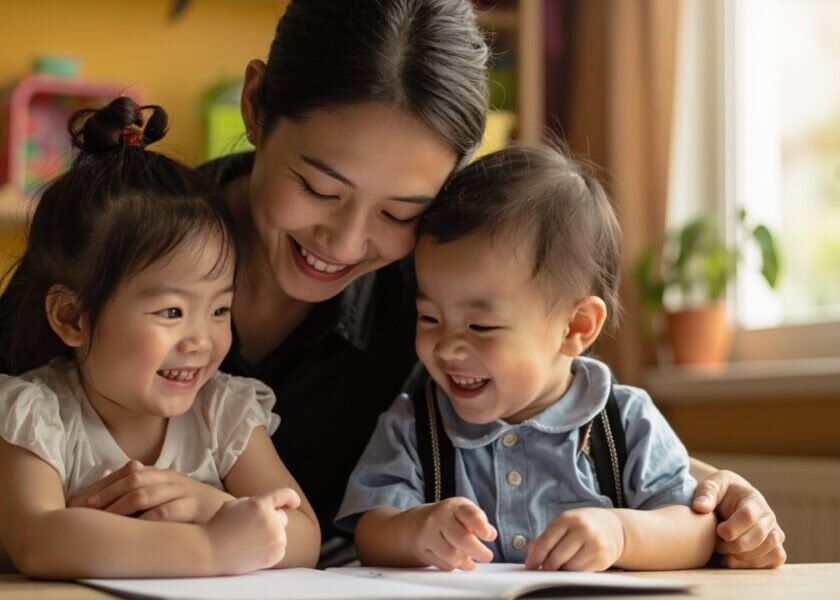
Sensory Play: The Work That Looks Like Play: Your child moves into the morning. Perhaps they are drawn to the sensory table — water, sand, the feel of different textures against their palms. You might think, watching this, that your child is simply playing. And yes, they are playing. But play at this age is not frivolous. It is the work of construction.
Through play, your child is building their understanding of how the physical world operates. They are experimenting with cause and effect. They are developing the fine motor skills that will later enable them to hold a pencil, to zip a jacket, to feed themselves with growing independence.
A skilled caregiver observes this play without interrupting. They are present, nearby, ready to assist if needed, but they understand that intrusion would break the spell. They understand that concentration is sacred work, especially for a young child whose attention is still a muscle being developed. So they watch, and they protect the space, and they let your child be the author of this moment.
Transitions: Learning That Change Can Be Navigated: There will be a transition, because transitions are hard for young children in ways that adults often underestimate. Perhaps it is time to clean up, time to gather for a group activity, time to move to a different part of the environment.
Your child’s caregiver does not announce this transition from across the room. She comes close. She uses words and gestures and, when appropriate, a gentle song — a ritualized way of signaling that change is coming. For a child who struggles with transitions, she might offer a choice: “Would you like to carry the book or the ball to the next room?”
Choice, even small choice, restores a sense of agency. It reminds the child that they have power in their own life.
And here is what your child learns, without being taught: that change can be navigated. That endings contain beginnings. That there are people who will walk alongside them through these shifts. This is resilience — not the hard-edged toughness we sometimes imagine when we hear that word, but something gentler and more durable. The resilience of a child who has learned that the world can be trusted to be kind.
The Dance of Separation and Reunion
For a young child, you are not just a parent. You are a secure base, a harbor, the person from whom the world extends. When you leave, your child experiences a loss — real, felt, though perhaps expressed only in a brief cry or a momentary clinging. And this is where the quality of care becomes everything.
In a less attuned environment, a child might learn to suppress that cry. They might learn that reaching out does not reliably bring a response, so they stop reaching. They adapt. They learn to be quiet. And in the short term, this might look like an “easy” child — a child who does not fuss at drop-off, who seems unbothered by your departure.
But what they have actually learned is something more troubling: that their feelings do not matter, that connection is unreliable, that the world is not a safe place to be vulnerable.
In quality care, the caregiver meets that brief moment of distress with something different. Not dismissal. Not the cold efficiency of “they’ll stop crying eventually.” Instead: presence. A warm voice. An offering of comfort that does not demand the child stop feeling what they feel, but simply lets them know that their feeling is witnessed, that it is okay, that someone is here.
And then — this is the part that is most beautiful — comes the reunion. The moment when you return, when your child sees you and their face transforms, when they run or are carried into your arms.
In that moment, your child is learning something that will stay with them for life: that people you love can leave and come back. That absence is not permanent. That love persists across distance and time. This is a lesson no amount of talking can teach. It must be lived, again and again, until it becomes part of your child’s inner architecture.
Drop-off is not abandonment. It is an opportunity for your child to practice one of the most essential skills of human life: the ability to separate from those we love and trust that the bond remains.
And when you pick your child up at the end of the day and they rush to you with joy, that joy is not the absence of missing you. It is the proof that they have been building something all day long — the capacity to hold love and independence in the same small heart.
The Body as Learning Instrument
A child’s body is a learning instrument of extraordinary sensitivity. They feel the temperature of the room, the texture of the mat beneath their feet, the quality of light. They feel whether the space is rushed or calm, whether the voices around them are sharp or soothing. They are, in a sense, always taking in their environment, always measuring it against some inner barometer they cannot yet name.
In the best childcare environments, this barometer registers safety. The air feels still. The pace is unhurried. There is time — this is perhaps the greatest luxury a child can be offered — time to finish what they are doing, time to move when they are ready to move, time to rest when they need rest.
A child who has had enough sleep, who has been fed when hungry, who has been allowed to follow their own body’s rhythms, is a child whose nervous system can afford to be curious. And curiosity, at this age, is the engine of all learning.
The environment matters deeply. Spaces that are not crowded. Routines that allow for flexibility within structure. Quiet corners for a child who is overstimulated, and open areas for a child who needs to move. Natural materials — wood, cloth, water, sand — because these feel different against a child’s skin than plastic, and that difference matters.
A child who has rich sensory experiences in the first years of life develops a more nuanced relationship with their own body, with their own sensations. They are better able to understand what they feel and to regulate those feelings as they grow.
This is not a luxury. This is the foundation.
What EduNanny Offers: Care Designed Around the Child’s Inner World
Let us speak now about how this philosophy translates into the actual experience of placing your child in care in Singapore.
EduNanny operates as part of the ECDA Childminding Pilot, which means it is embedded within a framework designed to uphold quality standards while remaining accessible to Singapore families. Whether your child attends a home-based setting or a community-based centre, you will find care that is structured around these same principles of attentiveness, small ratios, and developmental respect.
Affordability Without Compromise: The fee structures within the pilot are designed to be sustainable. Your Child Development Account can be used, and Baby Bonus subsidies apply where eligible, so that financial considerations do not force you into a choice that feels wrong for your family. The ability to choose quality care because it is within reach is itself a gift to your child.
Transparent Communication: In a world where parents are increasingly living in a state of ambient anxiety about what happens when they are not looking, EduNanny offers something precious: transparency. Communication channels keep you informed about your child’s day — not in a way that undermines the trust between you and your caregiver, but in a way that reassures you without destabilizing your child’s own trust in their environment.
Where applicable, CCTV measures, regular updates, photographs, and daily notes — these are not surveillance tools. They are bridges. They close the loop of worry that might otherwise follow you through your workday.
Thomas AI Chatbot: Support When You Need It: EduNanny is also stepping into the future with Thomas AI Chatbot — a tool designed not to replace the human warmth that lies at the heart of their service, but to support you as a parent. Thomas can help answer questions about child development, suggest age-appropriate activities, and guide you through the practical and emotional landscape of parenting in Singapore.
When you have a concern at 9 p.m. and the centre is closed, Thomas is there. When you wonder whether your child’s behaviour is typical or worth discussing, Thomas offers informed, thoughtful guidance. This is the marriage of genuine care and thoughtful innovation — technology in service of relationship, never as its replacement.
Your Questions Answered: Choosing Quality Infant Care in Singapore
If you are beginning to search for infant care or childminding in Singapore, here are the questions worth asking — not as a checklist, but as a lens for understanding what kind of place your child will actually experience:
- What is the caregiver-to-child ratio? For infants, a ratio of 1:3 or better allows for genuine attunement rather than supervision.
- How do caregivers handle drop-off? Look for warm greetings at your child’s level, not calls across the room.
- What does the environment feel like? Is it calm? Are there natural materials? Are there spaces for different states — quiet corners, open areas for movement?
- How are transitions handled? Ritualized, close, with choices offered where possible.
- What does communication look like? Regular updates, photographs, daily notes — transparency builds trust.
- How does the centre handle separation and reunion? Presence at drop-off, not dismissal; genuine greeting at pickup.
- Are subsidies and CDA usage supported? Quality care should be accessible, not a privilege.
Will my child feel abandoned? When your child is in quality care with attuned caregivers, the answer is no — not abandoned, but practising an essential life skill. The brief moment of distress at drop-off is not evidence of harm; it is evidence of attachment. What matters is how that distress is met. In quality care, it is met with presence, warmth, and consistency — and over time, your child learns that you always return, that love persists, that the world is trustworthy.
Is my child actually learning, or just being kept occupied? Quality childcare is not occupation. It is active construction. Every sensory experience, every social interaction, every moment of play is building neural pathways, motor skills, emotional regulation, and cognitive frameworks. When you see your child playing with sand or water, they are not idle — they are conducting experiments, processing sensations, and building the physical and mental foundations they will need for reading, writing, and relating to others.
What if my child seems “fine” at drop-off? A child who does not fuss at drop-off may have learned to suppress their distress signals — which is itself a concerning adaptation. True ease comes not from suppression but from security: a child who trusts their environment, who knows their caregiver, who feels safe exploring. Quality care does not produce silent children; it produces children who are curious, engaged, and emotionally available because their needs are consistently met.
The Shift That Changes Everything
There is one more thing worth saying, and it is perhaps the most important.
When you understand — truly understand — what your child experiences in quality care, something shifts. The guilt does not disappear entirely. Perhaps it should not. The love that makes you question your choices is a love worth keeping.
But the quality of that guilt changes. It becomes less a voice that says “I am failing my child” and more a voice that says “I am doing something hard because I love my family, and I am doing my best to make sure my child is cared for in a way that honors who they are.”
And when you pick your child up at the end of the day, and they run to you — not because they are relieved to escape, but because they are delighted to see you — you will know something new. You will know that your child has been in a place where they felt safe. Where they felt seen. Where they were known by name, by face, by the particular constellation of their needs.
You will know that the person who cared for them today was not just a babysitter filling hours, but a guide in your child’s ongoing discovery of the world.
This is what EduNanny offers: not just childcare, but witness. Not just supervision, but recognition. Not just a place your child goes while you work, but a community that holds your child with the same seriousness you do.
You are not leaving your child in someone’s care. You are entrusting your child’s first, most formative years to people who believe those years matter.
That is not a small thing. That is everything.
Your child is building a world inside themselves. A world made of experience and relationship and the slow, miraculous construction of identity. Quality care is not a substitute for your love. It is an extension of it. It is love finding another form, another voice, another pair of hands — and offering your child everything that love can give.
That is what EduNanny is. That is what we are here to offer.
And that is why, when you drive away from the gate or the door or the threshold of the classroom, you can — if you let yourself — feel something other than guilt. You can feel, alongside the ache of parting, something else: the quiet knowledge that your child is okay. Really okay. Not just safe, not just occupied, but known.
And being known, in the end, is what we all long for. Even the smallest among us.
If you are exploring infant care or childminding options in Singapore and would like to understand how EduNanny can support your family, we invite you to reach out. Our team is here to answer your questions, walk you through our approach, and help you understand whether EduNanny is the right fit for your child’s earliest, most important years.
Every child deserves to be known. We would be honored to know yours.