Why Your Child’s First Thousand Days Will Define Their Future
The Quick Summary
If you are reading this between feeds or during a short break, here is the essence of what decades of research and practice tell us:
- The first thousand days of a child’s life—from gestation through approximately the third birthday—are the period of the most rapid and consequential brain development a human being will ever experience.
- Children who experience consistent, responsive, developmentally intentional care tend to carry forward qualities that matter enormously: the ability to separate from a parent without prolonged distress, the capacity to name and manage emotions, the instinct to notice and respond to others, and a tendency to approach the unknown with curiosity rather than fear.
- These are not soft outcomes. They are the foundation upon which academic learning, social confidence, and emotional resilience are built.
- Professional quality care is not a lesser version of parental presence. It is a different kind of relationship—one that, when it is genuinely quality care, adds to the emotional architecture your child is building rather than replacing it.
The Early Years Are Not a Prologue
The early years of a child’s life are not simply a warm and lovable prologue to the real story. They are not a holding period, a waiting room, a gap to be filled until school begins and learning “starts.”
The early years are, neurologically and developmentally, the most consequential years of a human life. This is not marketing language. This is what decades of developmental research—from neuroscience, from attachment theory, from longitudinal studies that have followed children into adolescence and adulthood—has consistently demonstrated.
The first thousand days of life, from gestation through approximately the third birthday, represent a period of unparalleled brain development. Neural connections are forming at a speed that will never be matched again. The architecture of the mind is being built, and what is constructed in those earliest years becomes the foundation upon which everything else rests.
A Singapore toddler between the ages of one and three is absorbing the world at a rate that a primary schooler simply cannot match. Every interaction with a caregiver—whether it is a shared moment of laughter over a picture book, a patient response to a frustrated tantrum, or the consistent rhythm of a morning routine—contributes to the wiring of a brain that is building patterns it will carry for life.
This is why the question you ask—whether this will matter in the long run—is not a superficial anxiety to be gently dismissed. It is, in fact, one of the most important questions you can ask.
What Quality Early Care Produces
Children who experience consistent, responsive, developmentally rich care in their earliest years tend to carry certain qualities forward into later childhood and beyond.
Not because the care is magical, and not because children are passive recipients of whatever environment surrounds them. But because children are extraordinarily adaptive beings, and the quality of their early environments shapes the patterns they form, the expectations they carry, the sense they develop of whether the world is trustworthy, whether they are worthy of attention, whether their needs will be met, whether learning is safe, whether other people are reliable.
These are not abstract qualities. They show up concretely:
- They show up as the child who walks into a new classroom and can separate from a parent without prolonged distress.
- They show up as the child who, when frustrated, has some capacity to name what they feel before they are overwhelmed by it.
- They show up as the child who notices another child who is upset and wants to help.
- They show up as the child who, when they encounter something they do not know, leans in with curiosity rather than pulling back with fear.
These are not skills that can be taught in a single lesson. They are not competencies that appear on a report card. But they are, without question, among the most important qualities a human being can carry through life. And they are, in large measure, what quality early care produces—not by accident, not by luck, but by design. By the deliberate architecture of an environment that treats each child as a person in formation.
Supervision vs. Developmental Care
In Singapore’s childcare landscape, there is a wide spectrum of what parents can choose. It is worth being clear about a distinction that matters enormously, even though it is not always visible on a centre’s brochure.
Supervision watches. It keeps a child safe, fed, rested, and entertained. These are not small things—any parent knows that keeping a young child safe and comfortable for a full day is no minor feat. But supervision, however competent, does not compound. It maintains. It fills time. It does not build the architecture that will support everything that comes later.
Developmental care is different. It is intentional. It asks: What does this particular child need at this particular moment to feel secure, to be stimulated, to be challenged at exactly the edge of their capacity?
It designs environments that invite exploration. It responds to a toddler’s fascination with a stacking toy not just with approval but with a slightly harder challenge tomorrow, a question that stretches just a little further, an acknowledgment that their curiosity matters and will be taken seriously.
It treats every meal as a learning moment, every nap as a signal of trust, every messy play session as an opportunity to build sensory integration that will serve reading, writing, and focus in years to come. It is invisible to the casual observer. But its effects are not invisible—they are simply delayed, visible only in the child who has been formed by it, one day at a time, over months and years.
| Aspect | Supervision-Based Care | Developmental Care |
|---|---|---|
| Primary focus | Safety, comfort, and basic needs | Security, growth, and identity formation |
| Caregiver approach | Managing and occupying | Observing, attuning, and facilitating |
| Short-term outcome | Child is kept happy and healthy | Child is known, challenged, and supported |
| Long-term outcome | Limited compounding effect | Confidence, curiosity, emotional regulation, social ease |
| When effects become visible | Immediately reassuring | Over months and years |
Understanding the Singapore Parent’s Concern
Let us be honest about something that Singapore parents sometimes worry about in private. There is a lingering concern, sometimes unspoken, sometimes carried as quiet guilt: that placing a child in professional care is a compromise. That however good the centre, however loving the caregiver, there is something about a parent’s presence that simply cannot be replicated. And that in choosing childcare, even good childcare, something is being lost.
This concern is understandable. It comes from a good place—from love and protectiveness and a fierce desire to do right by your child. But it is based, in part, on a false distinction.
Professional care is not a lesser version of parental presence. It is a different kind of relationship, and when it is quality care, it is another foundational experience in a child’s life.
The research on attachment tells us something that may be surprising: children can and do form secure attachments to multiple caregivers. What matters is not whether there is one primary figure or several, but whether each relationship is characterised by consistency, responsiveness, and emotional attunement.
A child does not divide their love or dilute their sense of security by having more than one person who truly knows them. They expand. They learn that the world contains reliable people, that relationships can be trusted, that care is not conditional on biology alone.
This is not a consolation prize. This is a developmental gift.
What EduNanny Was Built For
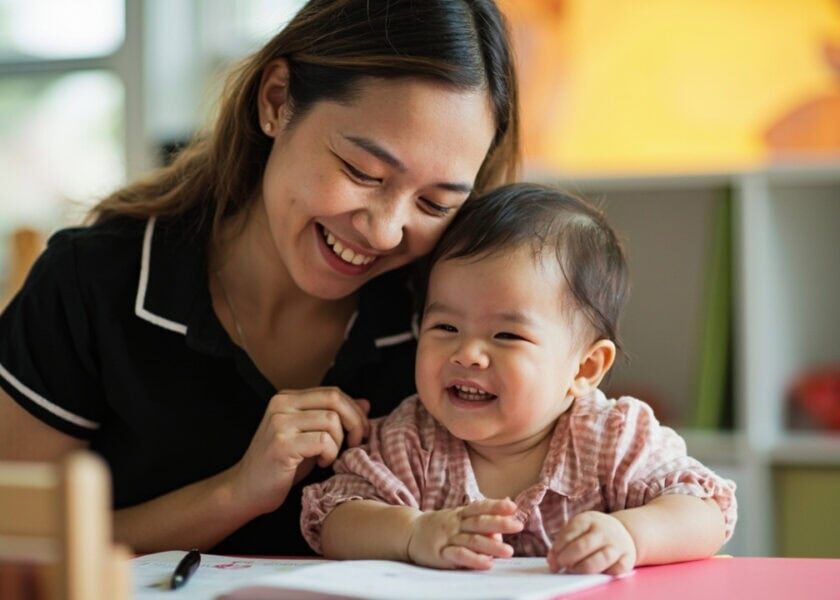
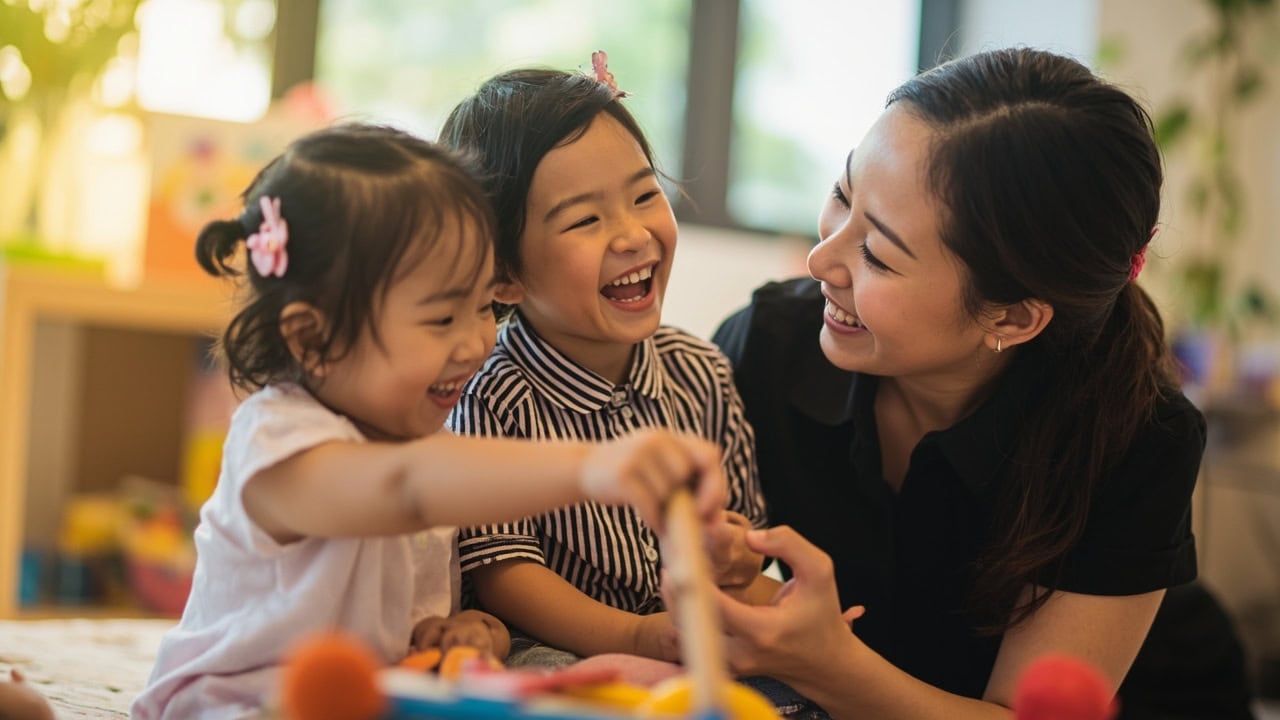
EduNanny by BUTLER was designed as a response to that need. Our approach to infant care and childminding in Singapore is grounded in a simple conviction: that every child deserves to be known. Not managed. Not occupied. Not merely supervised. Known.
This conviction shapes everything about how we work.
Caregiver ratios
In a sector where many centres operate with one caregiver to four, five, or even more infants, we maintain ratios that make genuine knowing possible. With up to three infants per caregiver, there is time to notice. Time to respond. Time to remember what worked yesterday when the child was overtired, what comforted them when they were frustrated, what made them laugh when they were solemn. These are not luxury touches. They are the basic conditions without which quality care cannot exist.
Caregiver selection and training
Our team members understand developmental science and have been trained to observe, to attune, to recognise when a child is communicating something through behaviour before they have the words to say it. They understand that their role is not to entertain but to facilitate. Not to dominate but to accompany. Not to rush development but to create the conditions in which each child’s growth can unfold at its own pace.
Our environment
Our home-based care settings are not scaled-down versions of institutional centres. They are designed to feel like the best parts of home—the warmth, the intimacy, the sense of being in a space that is human rather than bureaucratic—with the added structure and intentionality that professional developmental care requires. We want children to feel, from the first moment, that this is a place where they belong. Where they are welcome. Where they can bring their whole selves—their curiosity and their fear, their joy and their frustration, their need to be independent and their need to be held.
Our partnership with you
We know that choosing childcare is not a transaction. It is a relationship—one that may span your child’s most formative years. And relationships require communication, trust, and transparency.
This is why we have invested in systems that keep you informed not just about what your child ate and whether they napped, but about who they were today. The small moment when they solved a problem that had frustrated them yesterday. The way they interacted with another child during free play. The new word they are trying out, the new skill they are practising.
Accessibility and transparency
We participate in the ECDA Childminding Pilot, reflecting our belief that professional, developmentally rich childcare should not be the exclusive preserve of families with unlimited resources. Our fee structures are designed with affordability in mind, and we actively support the use of available schemes—including the Child Development Account and Baby Bonus.
Where our centres and home settings have deployed CCTV measures, we do so not from distrust but from a commitment to accountability and transparency. We want you to feel that you can trust what you cannot see.
Our Thomas AI Chatbot is available to support you—not as a replacement for human guidance, but as a resource for the moments when you have a question at eleven o’clock at night, when you are wondering whether something your child did today is normal, when you want to understand more about what we are doing and why.
What to Look for When Choosing Infant Care
If you are currently evaluating infant care or childminding options in Singapore, here are the questions that research and experience tell us matter most:
1. Ask about caregiver ratios
Specifically, how many infants or toddlers is each caregiver responsible for? The lower the ratio, the more individualised the attention. Genuine attunement requires time and space that high ratios simply do not allow.
2. Observe how caregivers interact with children
Are they at the children’s level—physically and emotionally? Do they respond to children’s cues or do they follow a fixed schedule regardless of what the child is communicating? Watch for attunement: the moment when a caregiver notices something in a child before it becomes a problem, and responds with something other than control.
3. Ask what the programme actually does
Not what activities are listed on a timetable, but what is the philosophy behind the daily schedule. How does the environment change as a child grows? A programme designed around development will have thoughtful answers to these questions.
4. Consider the relationship with you
Ask how the centre communicates—not just daily logs, but genuine exchange. Can you ask questions? Will someone tell you not just what happened but what it might mean in terms of your child’s development? Quality care is transparent, not mysterious.
5. Think about the long run
You are not choosing a service for next week. You are choosing a developmental environment for the most important years of your child’s life. Ask yourself: if I imagine my child in this setting for eighteen months or two years, what do I expect them to look like on the day they leave?
The Answer to the Question You Carry
Here is what we believe, after years of working with Singapore families, after watching children grow from infants who could not yet walk into children who walk into school with their heads held high: the answer is yes.
Not because we are naive about the complexity of child development, or the many factors that shape who a child becomes. But because we have seen what consistent, quality, developmentally intentional care produces.
We have seen the child who arrives at EduNanny as a wary eleven-month-old, checking every corner before they settle, and who leaves eighteen months later as a confident explorer who knows that the world contains people who will catch them if they fall.
We have seen the toddler who had never learned to trust that their needs would be met, and who, over months of patient, consistent, attuned care, began to trust—not perfectly, not completely, but enough. Enough to try. Enough to reach out. Enough to believe that other people could be reliable.
These changes are not visible on any standardised test. They will not appear in league tables or be celebrated in school reports. But they are real, and they matter, and they will carry forward:
- Into friendships that the child can maintain because they understand the basics of reciprocity and emotional regulation.
- Into classrooms where the child can focus not because they have been drilled but because they have the inner security that makes sustained attention possible.
- Into adolescence, when the pressure mounts and the world becomes complicated, as the quiet self-knowledge that comes from having been truly seen and truly known.
We are not babysitting. We are not supervising. We are participating in the formation of a human being. We take that responsibility seriously. We take it as seriously as you do.
And we believe—with evidence, with experience, with the quiet confidence of people who have seen this work—that what we do together, over months and years, will matter.
Not because we are extraordinary. But because consistency compounds. Because attention compounds. Because feeling known compounds.
Because every time your child walks through our door and is greeted by name, every time their curiosity is taken seriously, every time their emotions are met with understanding rather than dismissal, every time they experience the reliable rhythm of a day designed with their development in mind—something is being built. Something that will outlast the infant years, outlast the toddler years, outlast the day you first walked through our doors with a small hand in yours and a question in your heart.
The child who leaves quality early care is not just a child who has been cared for. They are a child who has been formed. They are a child who knows—in their bones, in their nervous system, in the pattern of their relating to others—something fundamental about who they are.
They are known. And because they are known, they know themselves. And because they know themselves, they can face what comes next not with fear but with something quieter, deeper, more resilient.
That is what we are offering you. Not a promise. Not a guarantee. But an answer to the question you carry. An answer built on evidence, shaped by expertise, delivered with care, and grounded in the deepest respect for what you are entrusting to us.
We do not take that lightly. And we will not forget it—not today, not tomorrow, and not in the years to come when your child has grown beyond our doors and you look back on this time and ask yourself: did it matter?
We believe the answer will be written, quietly and indelibly, in who they became.
Ready to explore what quality developmental care looks like for your child?
EduNanny by BUTLER welcomes families across Singapore to learn more about our infant care and childminding programme. We invite you to speak with our team, visit our home-based settings, and ask us anything—from ratios to philosophy, from daily routines to long-term developmental goals.
Get in touch with EduNanny Singapore today.