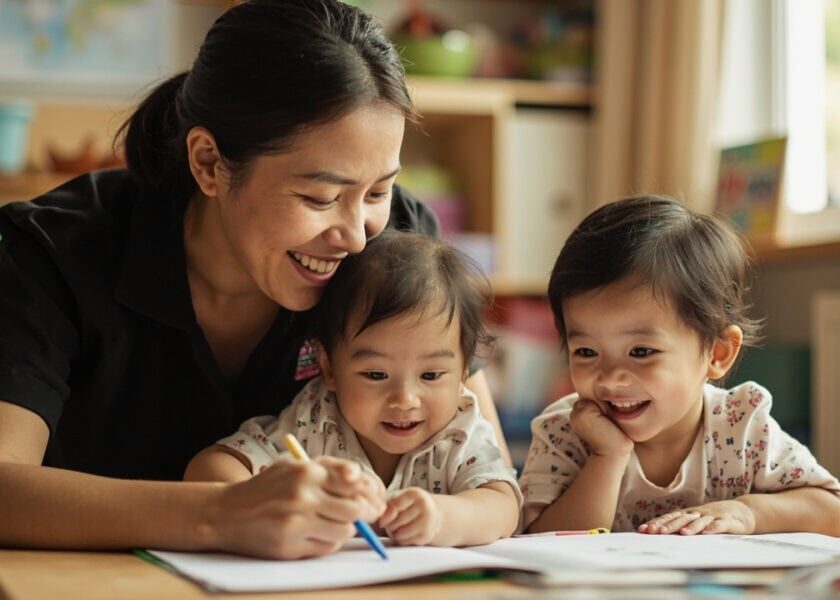
Reading the Quiet Signs: Developmental Partnership for Singapore Families
The Quiet Worry Every Singapore Parent Feels
There is a moment, somewhere between the second week and the second month after enrollment, when the quiet worry sets in.
Not the dramatic kind. Not the kind that sends you calling the pediatrician or refreshing developmental checklists at two in the morning. The quiet kind. The kind that arrives when you drop your child off in the morning and watch them disappear into someone else’s care, and you wonder — not whether they are safe, exactly, because you have chosen carefully and the arrangement feels right, but whether something else is happening.
Whether the person holding your child sees what you see when your child laughs. Whether anyone is paying attention to the way they are changing.
You love your child. You know your child. But somewhere along the way, you have started to wonder if you are reading the signs correctly.
The question is not whether your child is safe. It is whether your child is growing. And more specifically, whether you would even know.
Quick Summary
- The core tension: Parents sense more about their child’s development than they are given credit for. Without professional language to name what they are seeing, that attention can feel like it is floating in space.
- What quality care provides: Trained caregivers who observe development as an interconnected system — not isolated milestones — and translate what they see into a shared language with parents.
- Why it matters: Your child’s development is not a checklist to tick. It is a living architecture of motor, cognitive, language, social-emotional, creative, and adaptive growth that moves forward together.
- The partnership: Professional observation and parental intuition work best together. The trained caregiver becomes your developmental partner, helping you understand not just that your child is growing, but how and why.
- What to look for: Caregivers who notice patterns across time, communicate specific observations, and help you see connections you might have missed.
Why Developmental Milestones Can Mislead You
Let us start with what development actually looks like in the first years of life, because one of the greatest disservices done to parents is the way milestones are communicated — as isolated checkpoints.
A child walks by twelve months. A child says three words by eighteen months. A child stacks two blocks by nine months.
These milestones are not wrong. But presented this way, they give parents a checklist when what they actually need is a map.
A child’s development is not a series of boxes to tick. It is a landscape to understand.
The Moment That Reveals Everything
Consider what is actually happening when a twelve-month-old learns to pull herself up to standing.
On the surface, this looks like a gross motor achievement — legs getting stronger, balance improving. But what you are also seeing is cognitive development. The child has figured out a problem: the toy is on the shelf, and she wants it. She has motivation. She has spatial awareness. She has a model — she has watched someone else stand, and her brain has filed that information away and decided to act on it.
And alongside the motor and cognitive growth, there is something else happening. Social-emotional development. When she finally stands and looks back at you, beaming, what she is communicating is: look what I did. She is sharing a triumph. She is seeking your witness.
Your response — your pride, your applause, your quiet smile of recognition — is teaching her that her accomplishments matter, that she is valued, that the world responds to her efforts.
That single moment — pulling up to standing — is motor, cognitive, social, and emotional development, all woven together, all inseparable. And if you are only watching for the motor milestone, you will miss everything else your child is telling you.
The Six Dimensions of Your Child’s Growth
Professional caregivers trained in developmental observation learn to see early childhood growth across six interconnected dimensions. Understanding these domains helps you move beyond checklists and into genuine comprehension of how your child is changing.
1. Motor Development
This includes both gross motor skills — crawling, walking, climbing, running — and fine motor skills — grasping, manipulating objects, self-feeding, eventually using crayons and utensils. Motor development is often the most visible dimension, which means parents tend to focus on it disproportionately. But it does not grow in isolation.
2. Cognitive Development
This is how your child thinks, learns, and solves problems. It shows up in the way a baby experiments with cause and effect — dropping a spoon to watch it fall, again and again. It shows up in the toddler who figures out how to open a container to get to the treat inside. Cognitive development drives curiosity, and curiosity drives learning.
3. Language Development
Language is more than words. It includes listening comprehension — how much your child understands before they can express themselves — and expressive language, the sounds and eventually words they use to communicate. It includes the gesture language of pointing and waving that precedes verbal language, and the nuanced understanding that develops as children learn to interpret tone, expression, and context.
4. Social-Emotional Development
This is how your child learns to be in relationship with others and with their own inner world. It begins with attachment — the bond between infant and caregiver that forms the foundation of trust. It evolves into social skills: how a child navigates other children, handles disappointment, begins to show empathy. And it includes emotional regulation — the capacity to manage big feelings without being overwhelmed by them.
5. Creative Development
Often overlooked, creative development encompasses how your child expresses themselves through play, art, music, and imagination. It shows up in the songs they hum, the stories their imagination builds, the way they transform a cardboard box into a spaceship. Creative expression is not a luxury — it is a fundamental dimension of how children make sense of the world.
6. Adaptive Development
This is the quiet bedrock of healthy development: the everyday resilience, the self-regulation, the capacity to be soothed and to soothe. Adaptive skills include self-care tasks like feeding and dressing, but also the deeper capacity to adjust to new situations, manage transitions, and develop healthy habits. These are the skills that will serve your child throughout their entire life.
How These Domains Connect
Here is what trained caregivers understand that changes how they observe: these domains do not develop independently. They form a web of interconnected systems, each one feeding the others.
- Language and social confidence: A child who is learning to speak often becomes more willing to enter a group of other children, because the two systems reinforce each other.
- Fine motor skills and cognitive curiosity: The child who learns to pick up small objects begins to explore texture, shape, and cause, which feeds intellectual curiosity, which drives the next motor challenge.
- Emotional regulation and social play: A child who is learning to name their own feelings becomes better equipped to understand the feelings of others.
When you understand these connections, your child’s development stops looking like a collection of separate achievements and starts looking like what it actually is: one integrated person, quietly becoming.
What Professional Observation Looks Like in Practice
You notice the way your child reaches for a block differently than they did last month. You hear the new syllable in their babbling. You see the flash of frustration when a puzzle piece will not fit, and you see them try again.
You are watching. You have always been watching. But watching is not the same as understanding.
Most parents sense more than they are given credit for. What they lack is not attention but a framework — the professional language to name what they are seeing and connect it into patterns that make sense.
The Details That Tell the Story
On any given morning with a trained caregiver, something is happening in every dimension of your child’s development. Consider these scenarios:
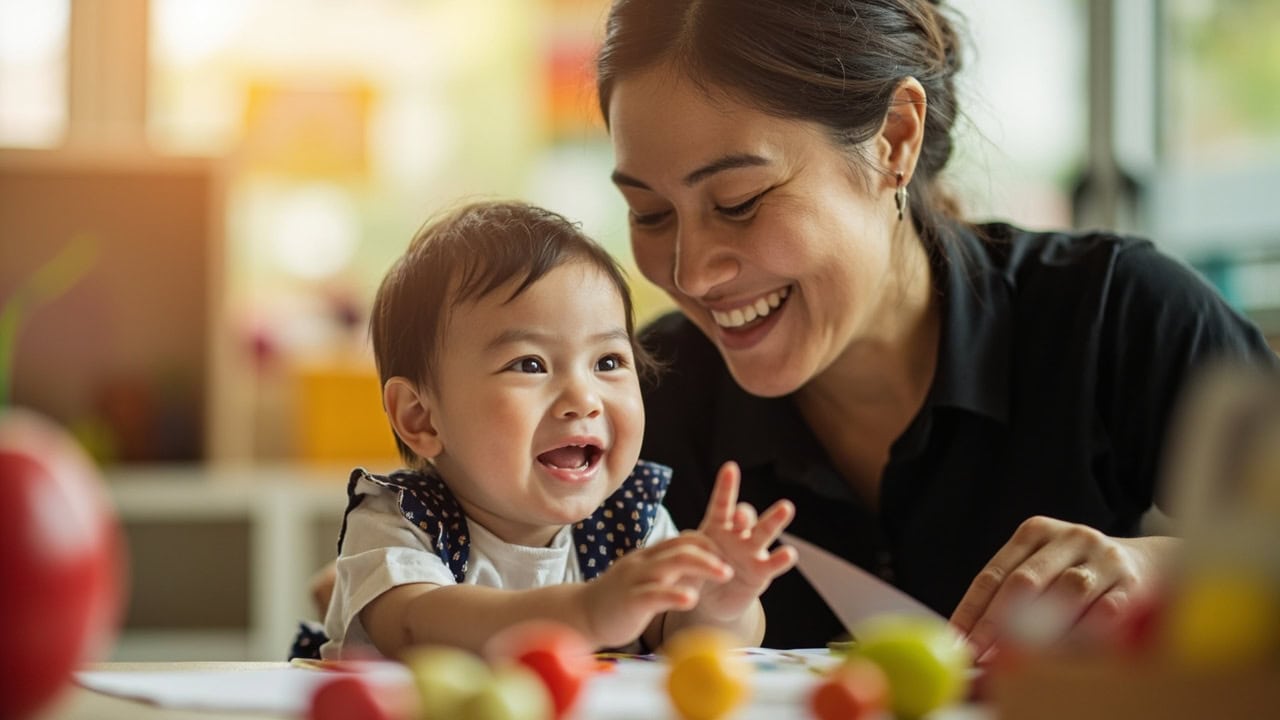
A nine-month-old reaching for a stacking toy: The caregiver notes not just that the child reached, but how — with one hand or two, with open fingers or a fisted grasp, with focus or distraction. These details are not trivia. They are data. They tell a story about motor development, concentration, and level of interest. Across weeks, these notes form a picture: Is fine motor control consistently growing? Is attention span lengthening? Are actions becoming more purposeful?
A toddler pointing at a bird outside the window: The caregiver responds — not just with acknowledgment but with language expansion. “Yes, that’s a bird. It’s small and brown. It’s flying. Look, it’s gone to the tree.” This is not small talk. This is responsive interaction at its finest: language development in real time. The caregiver is tracking whether the child is beginning to repeat sounds, whether comprehension is growing, whether they are starting to put sounds and meanings together.
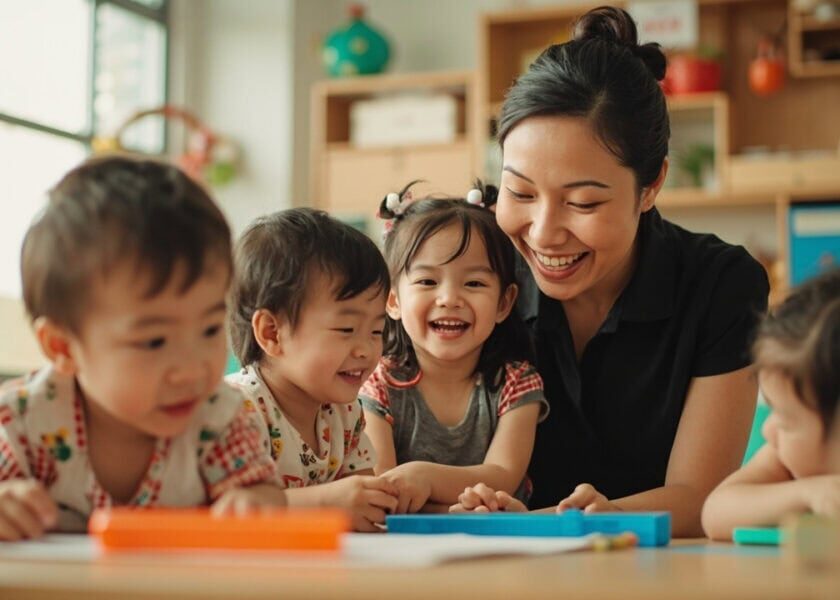
A child navigating the social landscape of a group: The caregiver watches who the child gravitates toward, how they handle disappointment, whether they are developing the capacity for empathy, whether they are beginning to understand sharing as something that happens over time, not instantly.
The Questions That Reveal Professional Intent
When you know what to look for, you can ask better questions. Here are the kinds of questions that reveal whether your child’s caregiver is observing development with trained attention:
- Can you tell me something specific my child did today that showed me they are learning?
- How is my child’s language growing right now? What kinds of sounds or words are you hearing?
- How does my child handle frustration when something does not go their way? What do you do in those moments?
- Who does my child gravitate toward during play? How do they navigate being near other children?
- What is my child curious about right now? What seems to capture their attention?
- How does my child respond when they are upset? What helps them calm down?
The right caregiver will have specific answers to these questions. They will not just say “she had a good day.” They will tell you what kind of good it was. Was it the good of a child who mastered a new skill? The good of a child who resolved a conflict for the first time? The good of a child who simply rested well and was peaceful?
These distinctions matter. They are the difference between care that is adequate and care that is transformative.
The Partnership That Changes Everything
Here is what separates good childcare from truly transformative childcare: your child’s development is not a single line moving forward. It is a living architecture.
Reading it accurately requires trained eyes. Not because your intuition is wrong, but because your child deserves more than your intuition alone. Your child deserves the combined power of your love and a professional’s understanding, working together.
The Virtuous Cycle
When a caregiver shows you, consistently, what they are observing about your child, you begin to see your child differently. You begin to ask better questions. You start to notice, at home, the things the caregiver has trained your eye to find.
You become a more observant parent. A more observant parent is a more attuned parent. A more attuned parent creates better conditions for development at home.
The caregiver and the parent amplify each other.
A parent who was told that their child’s language development was flourishing through responsive interaction might start deliberately narrating their own actions at home — talking their way through bath time, describing what they are cooking, pausing to wait for the child’s response.
A parent who learns that their child’s social development is thriving through parallel play — playing near other children before playing with them — might feel relief instead of anxiety when their child does not seem to be actively sharing toys. They understand the pattern. They know it is age-appropriate. They trust it.
Early Identification: The Quiet Vigilance That Matters
Professional observation also serves another purpose. It helps you know when something deserves closer attention.
A trained caregiver will notice when a child’s growth seems uneven across domains, when they are strong in some areas but seem to be struggling in others.
Early identification is one of the most powerful gifts quality observation can offer. The earlier a developmental question is noticed, the earlier it can be understood, and the earlier support can begin.
This is not about labeling children or creating alarm. It is about the quiet, competent vigilance of professionals who are watching with trained intent, and who have your child’s whole growth — not just their safety — as the goal.
What Quality Childcare Creates for Your Family
Children in quality, observation-driven care environments develop in ways that are measurably different from children in environments where care is adequate but not intentional. This is well understood in early childhood education.
The conditions for development — rich interaction, responsive caregiving, language-rich environments, opportunities for motor exploration, social experiences with peers — accelerate and enrich developmental trajectories in ways that last.
But here is the part that is less often discussed: those conditions do not just change the child. They change the parent.
When you know your child is in the care of someone who is trained, supported, and operating within a recognized structure, something opens up. You stop spending emotional energy on anxiety and start directing it where it belongs — toward understanding your child, toward being present with your child, toward growing alongside your child.
Signs That the Partnership Is Working
When you are partnered with a trained caregiver who observes development systematically, you will notice certain things changing over time:
- You have a growing vocabulary for what your child is doing. You can describe their development in specific terms, not just “they’re doing well.”
- You see connections you did not see before. How motor skills and cognitive curiosity feed each other. How language growth opens social doors. How emotional regulation builds over time.
- You feel less anxious and more curious. Instead of worrying about whether your child is meeting milestones, you find yourself wondering what they will discover next.
- Your home interactions change. You catch yourself narrating, waiting, responding with more intention because you understand why it matters.
- You see your child as a whole person with a developmental story. Not a collection of achievements or delays, but someone who is quietly becoming.
What This Means for Your Family in Singapore
EduNanny by BUTLER operates within the ECDA Childminding Pilot, which means caregivers are part of a structured, recognized framework. They are not simply minding children. They are reading development.
Communication practices are designed for transparency: regular updates, clear channels between caregiver and parent, so that you are never left wondering what happened in your child’s day.
Where CCTV measures are deployed, they provide an additional layer of assurance — not as surveillance but as transparency. These are not bureaucratic details. They are the conditions that allow trust to exist, and trust is the foundation of every developmental partnership.
The practical dimensions matter too. Monday to Friday care blocks designed to fit the rhythms of working families. Fees structured within the pilot framework to remain accessible. The usability of CDA and Baby Bonus for eligible families.
Development does not happen in a vacuum. It happens in the context of a family’s real life — their schedule, their budget, their practical realities.
The Child You Are Raising
You came into this — into parenthood, into the search for childcare, into the daily quiet courage of entrusting your child to someone else — because you want your child to thrive.
Not just survive. Not just be safe. To thrive. To grow into someone who is curious and capable, who can love and be loved, who can navigate the world with confidence and compassion.
That is what development is for. Not milestones. Not scores on a checklist. A whole person, quietly becoming.
You can google developmental milestones in seconds. You can download apps that track growth. You can read forums where other parents share their anxieties and their triumphs.
What you cannot download is the trained eye of a professional caregiver who knows your child specifically, who has watched them over weeks and months, who can tell you not just that your child is on track but who your child is on track to become.
Your presence and your love are not diminished by partnership. A trained caregiver does not replace your role. They enhance it. They give you information you could not have access to on your own. They help you understand your child more deeply. They make you a better parent, not a less important one.
And you are not alone in reading the signs.
Ready to Learn More?
If you are exploring infant care or childminding in Singapore and want to understand how quality, observation-driven care can support your child’s whole development, we would be glad to connect with you.
Our team is available to answer your questions, discuss your family’s needs, and help you understand how our approach might serve your child.
Because your child’s development deserves more than your intuition alone. It deserves your love and a trained partner working together.
If you found this article helpful, you may also want to read our overview of the EduNanny approach or get in touch to speak with our team directly.