What Quality Infant Care Teaches Before the First Word
The Space Speaks Before Words Do
Consider what your child encounters the moment you leave. A room designed not by accident but by intention. The ceiling height, the soft lighting, the arrangement of materials on low shelves, the texture of rugs beneath bare feet — each element considered.
In quality infant care, physical space is not merely containment. It is communication. It tells a child: this is a place where you are safe. This is a place where you can move, explore, rest, and grow.
Watch a child in a well-designed space for the first time and you will notice something remarkable. They do not stay frozen at the threshold. Within minutes, they move toward something — a shelf of wooden blocks, a soft cushion, a mirror at their level. They do this because the space invites them in. It says, through its very design, that this environment was made for them. That they belong here.
This is not a small thing. A child who feels safe in their environment invests their energy in learning rather than in vigilance. The stress hormone cortisol, which floods a child’s system when they feel uncertain or unsafe, begins to lower. And in that lowering, something extraordinary becomes possible: genuine curiosity. The body relaxes. The eyes widen. The hand reaches out. Development begins.
Contrast this with a space that is merely clean, merely organized, but not intentionally designed for the child who inhabits it. There is a difference. You can feel it when you walk into a room that was designed for adults and repurposed for children, versus a room where every detail — the temperature, the acoustics, the sightlines, the color palette — was considered through the eyes of a one-year-old. One feels like an afterthought. The other feels like a welcome.
At EduNanny Singapore, we believe that how a space is designed tells your child something about how they are valued. The physical environment is the first teacher your child encounters each day, and it speaks volumes before a single word is exchanged.
Why Rhythm Creates Freedom
Now let us talk about rhythm, because this is where many parents first begin to feel the gap between what they imagine happens in childcare and what actually supports development.
You might think, reasonably, that a good childcare day is one filled with activities. Lessons, projects, stimulation — the more the better. This is an understandable assumption, shaped by our wider culture’s obsession with productivity and acceleration. But the reality of quality infant care runs in a surprising direction. What the developing brain needs most is not more. It is predictability.
A young child’s brain is constructing the capacity to understand the world. It does this by looking for patterns. What happens next? What comes after this? When a child knows — truly knows, in their body — that snack comes after outdoor time, that naptime follows lunch, that mummy or daddy arrives after the afternoon song, something profound happens. The world becomes comprehensible. It becomes safe. And it is only within safety that a child can truly relax and learn.
This is why quality childcare does not simply follow a schedule. It cultivates rhythm. A rhythm is different from a timetable because it is internalized, felt, embodied. When rhythm is established consistently, children begin to anticipate what comes next before it arrives. Their bodies begin to relax into the day. The low-grade stress of uncertainty that marks much of early childhood experience begins to ease. And in that ease, the child is free.
Free to engage deeply with play. Free to invest in relationships. Free to notice the caterpillar on the leaf rather than scanning the room anxiously for a caregiver. Free to be a child.
Structure creates freedom. The more predictable the environment, the more freedom the child has to explore, experiment, and grow. A child who knows what comes next does not need to spend their cognitive resources on prediction and worry. They can spend those resources on learning.
So when you see your child’s daycare following a consistent rhythm — the same morning greeting, the same transition song, the same order of experiences — know that this is not rigidity. This is not a failure of spontaneity. This is a carefully constructed scaffold that holds your child steady while they build the capacities they will need for the rest of their lives.
The Attuned Caregiver: Responding Before the Cry
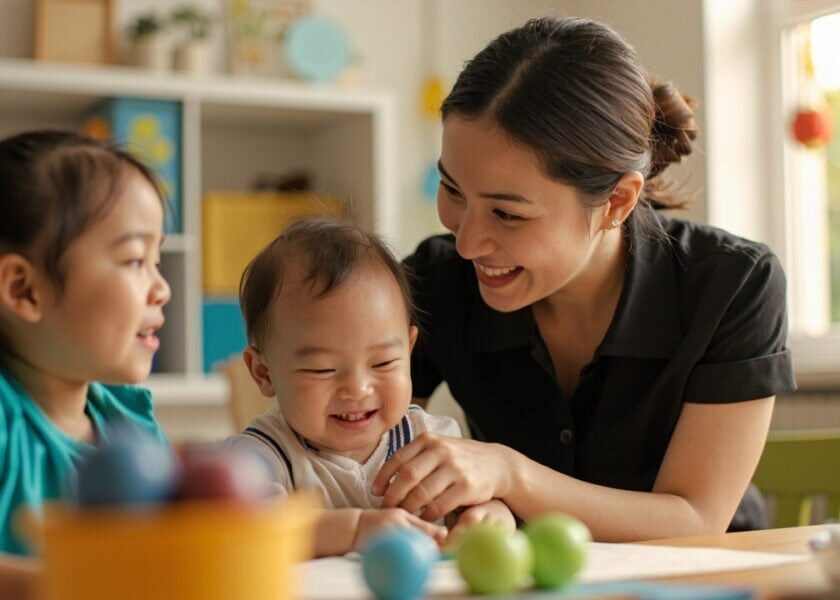
There is a moment that captures quality infant care better than any other. It is the moment when a caregiver meets a child’s gaze across the room, reads something in that child’s expression — a question, a need, a discomfort — and responds before the child has to cry. Before the signal becomes a demand. Before frustration builds. The response is immediate, warm, and precisely calibrated to what the child needs in that moment.
This moment is called attunement. And it is, without exaggeration, one of the most important experiences a young child can have.
Attunement is the caregiver’s ability to read the child’s internal state and respond in a way that makes the child feel understood. It is not just about meeting physical needs — though it includes that. It is about recognizing emotional states, about noticing the subtle cues that indicate a child is becoming overstimulated, bored, anxious, or on the verge of a breakthrough. And it is about responding in a way that says: I see you. I understand. You are not alone.
This capacity to attune does not happen by accident. It is only possible when the caregiver has the time and attention to truly observe the child. When a caregiver is responsible for ten or twelve children, attunement becomes a mathematical impossibility. The human brain simply cannot track that many individual emotional states simultaneously. Something is always missed.
This is why ratio matters so profoundly in infant care. When a caregiver is responsible for three infants, as is possible within the EduNanny by BUTLER approach under the ECDA Childminding Pilot, something shifts. The caregiver can notice that one child is pulling at their ear and infer the beginnings of discomfort before it becomes distress. The caregiver can see that another child is about to have a meltdown and intervene with comfort before the storm arrives. The caregiver can read the subtle cues of engagement and respond by extending the learning moment, asking a question, offering a challenge at precisely the right level.
This is not luxury. This is development. The neural pathways that govern emotional regulation, social connection, and secure attachment are built in these moments. Every instance of attuned caregiving is literally building your child’s brain. And every instance of missed or delayed response — not out of malice, but simply because there are too many children to track — is a missed opportunity for development.
When you choose childcare with a low infant ratio, you are not being overprotective or indulgent. You are ensuring that your child receives the quality of attention that their developing brain requires.
The Sensory and Social World of the Infant
Let us move deeper into the world of the young child, because this is where much of the magic — and much of the invisible learning — actually occurs.
The Sensory World
You may have noticed that young children explore with their whole bodies. They put things in their mouths, run their fingers across surfaces, squeeze and bang and drop objects to see what happens. This is not random behavior. This is the brain’s primary method of learning about the physical world. Every sensory experience — every texture, every sound, every smell, every movement — is building neural connections that will later support reading, mathematics, problem-solving, and abstract thinking.
A quality infant environment is rich in sensory experience. Not chaotic, not overwhelming, but thoughtfully curated to provide the kinds of inputs that develop the senses and the brain together. The crinkle of a fabric book. The cool smoothness of a wooden ring. The resistance of play dough. The echo in a corridor. The smell of wet earth after rain. These experiences are not filler between the “real” activities. They are the real activities. They are the work of early childhood.
The Peer Environment
You may think that young infants do not notice each other, that parallel play is as far as they go for the first two years. But research tells a more nuanced story. Even the youngest infants in a quality care environment are learning from each other. They observe each other’s facial expressions. They notice how another child responds to a toy and incorporate that information into their own behavior. They experience the emotions of those around them and begin to develop the foundations of empathy.
When a child in a quality environment sees another child fall and begin to cry, and observes a caregiver respond with warmth and comfort, something important is being learned. The child is learning that distress is met with care, that crying brings help, that other people have feelings that matter. These are the earliest lessons in social intelligence. They are lessons that cannot be taught through words or instruction. They are learned through observation, through experience, through the environment itself.
This is why the quality of the peer environment matters. Not the quantity of children, but the quality of interaction and modeling that the environment supports. In a well-designed space with attentive caregivers and a reasonable group size, infants begin their lifelong journey of learning how to be with others. They learn that they are part of a social world. They learn that their actions have effects on those around them. They learn, in the most foundational sense, how to be human together.
The Invisible Curriculum: What the Environment Teaches Without Words
All of this — the designed space, the predictable rhythm, the attuned caregiver, the sensory richness, the peer environment — works together as a system. It is an ecosystem for development, and every element supports every other element. This is what we mean when we talk about the invisible curriculum of quality childcare.
The visible curriculum is what you might expect: activities, lessons, skills being taught. But the invisible curriculum is what the environment communicates without words, what the daily rhythm teaches without instruction, what the caregiver models without explaining. It is the message that your needs will be met. That you belong here. That you are worthy of attention and care. That the world is predictable and therefore navigable. That other people can be trusted.
These messages, absorbed day after day, become the internal working models that guide a child’s sense of self and relationships for the rest of their life. They are not visible in any single moment. They are not measurable in any single assessment. But they are there, beneath the surface, shaping everything that comes after.
This is what quality childcare offers your child. Not just supervision. Not just safety. But a carefully constructed experience that communicates, day after day, in a thousand small moments: you are safe, you are seen, you are capable, you belong.
Understanding as the Foundation of Trust
You might be wondering: how do I know if the childcare I am considering is actually doing this? How do I see beneath the surface of a tour or an open house? These are exactly the right questions to ask, and they point toward something important about the relationship between parents and childcare providers.
Transparency is not a buzzword. It is a practice. And it is one of the clearest indicators of a childcare provider’s confidence in their own quality.
We believe that parents should not have to trust blindly. You should be able to understand what happens in the hours between drop-off and pick-up. You should be able to articulate, if asked, why the environment is arranged the way it is, why the day follows the rhythm it does, why the caregiver responds in the way you observed. This understanding is not a luxury. It is the foundation of genuine trust.
That is why communication is built into quality childcare approaches. Regular updates, transparent practices, and windows into the daily experience give parents visibility into what is happening. Not because there is anything to hide, but because there is everything to share. Every day in quality care is full of small miracles: a child mastering a new skill, a breakthrough in social connection, a moment of deep engagement that signals the brain building itself. These moments deserve to be seen and celebrated.
When you understand the environment, you become a partner in your child’s development rather than a distant observer. You can reinforce at home what is being cultivated at childcare. You can ask informed questions, celebrate the right things, and trust the process because you understand the process.
What to Look For in Singapore Infant Care
For parents navigating the Singapore childcare landscape, understanding what to look for can transform an overwhelming search into a focused one. Here are the key indicators of quality infant care:
- Physical space designed for children — low shelves, child-height mirrors, soft lighting, materials within reach, textures to explore
- Predictable daily rhythm — consistent sequences of activity, transition cues that children recognize, no frenetic switching between unrelated activities
- Caregiver attention — responsive without being intrusive, observing more than directing, meeting gaze with warmth
- Low infant-to-caregiver ratios — particularly for infants under 18 months, where attunement is most critical
- Sensory richness — varied textures, natural materials, sounds and smells beyond the artificial environment of most indoor spaces
- Transparent communication — regular updates, willingness to explain practices, openness about daily experiences
Questions to Ask During a Childcare Visit
- Can you walk me through what a typical day looks like for an infant in your care?
- What is the ratio of caregivers to infants, especially for the youngest children?
- How do you support children who are adjusting to the new environment?
- How do you communicate with parents about their child’s day?
- How is the physical space designed to support infant development?
- What training do your caregivers receive in infant observation and responsiveness?
EduNanny Singapore: An Approach Grounded in Understanding
At EduNanny by BUTLER, we have designed our approach around the principles we have explored in this article. Under the ECDA Childminding Pilot, we offer pathways that include both home-based and community or centre-based options, recognizing that families in Singapore have different needs, different schedules, and different circumstances.
For infants, we maintain ratios that make genuine attunement possible. A caregiver responsible for up to three infants can truly know each child as an individual — their rhythms, their preferences, their emerging needs. This is not a luxury feature. It is the developmental requirement that makes quality care possible.
The pilot fee structures are designed to be accessible, recognizing that quality care should not be available only to those with significant financial resources. Payment mechanisms include CDA and Baby Bonus usability, removing administrative friction for families and making the practical arrangements of childcare as smooth as possible.
Care blocks run Monday through Friday, covering the core working week for most Singapore families. And the service is designed to be relevant across Singapore — not limited to one district or one type of neighborhood, but available to families throughout the island.
Behind this service is a commitment to the principles we have explored today. The physical space is designed with intention. The daily rhythm is structured to support development. The caregivers are trained in attunement and responsiveness. The environment is sensory-rich and socially meaningful. And every element is open to your understanding and observation.
We also offer Thomas, our AI chatbot, as a resource for parents navigating the questions and uncertainties of early childhood. Because understanding your child’s development should not stop at the childcare door. It should continue at home, in the evening, on the weekend — wherever you and your child are together.
This is what EduNanny stands for: not just care, but understanding. Not just supervision, but development. Not just a service, but a partnership with parents who want the best for their children and deserve to know exactly what that looks like.
From Silence to Confidence
There is a moment, familiar to any parent who has walked away from their child at a childcare door, when you must simply trust. Trust that the choice you made is good. Trust that the caregivers are kind and capable. Trust that your child is happy and safe and growing.
That trust does not have to be blind. It does not have to be based on hope alone. It can be grounded in understanding — in a clear picture of what quality looks like, why it matters, and how it works.
When you know that your child’s environment is designed for their security and development, trust deepens. When you understand that the daily rhythm is not rigid routine but a scaffold that frees your child to learn, trust deepens. When you see that the caregiver’s responsiveness is not accidental but a product of adequate time and attention, trust deepens. When you recognize that every sensory experience and peer interaction is building your child’s brain and social intelligence, trust deepens.
And when you find a childcare provider who welcomes this understanding, who does not keep parents at arm’s length but invites them in, who is transparent about their practices and proud to explain their philosophy — that is when trust becomes something more than sentiment. It becomes conviction.
You are not leaving your child in the dark. You are entrusting them to a carefully designed ecosystem for development. And now, you understand why that ecosystem works.
That is what we offer at EduNanny Singapore. Not just a place for your child. But a world — intentional, thoughtful, transparent, and designed with your child’s deepest needs in mind.
When you understand the environment, trust becomes natural. And trust, grounded in understanding, is the greatest gift you can give your child: the gift of a parent who knows what good care looks like, and chose it with full confidence.
If you are exploring infant care options in Singapore and want to understand what quality looks like from the inside, we invite you to start a conversation with us. Ask your questions. Visit our spaces. Let us show you not just what we do, but why we do it.
Welcome to partnership. Welcome to a new kind of childcare for Singapore.
#ChildcareSingapore #InfantCare #EduNannySG #ChildmindingSingapore #QualityChildcare