The Physical Foundation Your Child Builds Before Academic Learning
The Question Every Parent Carries
There is a moment, familiar to every parent who has left their child in someone else’s care, when the hallway stretches longer than it should. The door closes. Your child’s face, already turning toward something new, disappears from view.
And in that ordinary, unremarkable instant, a question surfaces that most parents never say aloud:
What is my child doing right now? What are they feeling? Are they safe? Are they engaged? Are they, in some quiet and invisible way, growing?
It is not an unreasonable question. It is, in fact, the most reasonable question in the world.
We talk about safety. We talk about trust. We talk about the comfort of knowing our children are in good hands. All of this matters. But beneath these concerns lies something deeper — something that deserves more than a passing mention.
You sense that something meaningful is happening during the hours your child is in quality care. You feel it in the energy they bring home, in the new sounds you hear, in the way your toddler suddenly reaches for things with new intention. But you lack the language to name it. You lack the framework to see it.
That gap between feeling and understanding? Today, we close it.
The Learning Your Child Does Every Day
Before words. Before formal instruction. Before the kind of education we typically associate with schoolrooms and worksheets — your child is already engaged in the most fundamental and consequential learning of their life.
They are learning through their senses. Through movement. Through the constant, relentless, beautiful process of exploring the physical world with their hands, their feet, their skin, their eyes, their mouths — their entire being.
This is not metaphor. This is neurologically and developmentally how human beings build the architecture of their minds.
A newborn grasping a finger. A six-month-old reaching for a dangling toy. A toddler climbing onto a low bench with determination and joy. These are not random behaviors. These are not incidental moments to be noted and set aside. These are the foundational curriculum of human development.
Consider what it means to reach for something. To a young infant, reaching requires coordination between vision, proprioception — the body’s sense of its own position — and fine motor control. The brain sends signals through an intricate network of neurons, receives feedback, adjusts, and executes. This is not a simple action. It is a symphony of systems working together, systems that are still maturing, still forming, still learning to communicate with one another.
Every time your child reaches, grasps, releases, crawls toward, pulls up on, or navigates a new surface — they are not merely moving. They are building. They are laying down neural pathways that will later support language, literacy, mathematics, and the complex executive functions that allow a child to plan, focus, and adapt.
Why Sensory Experiences Are the Primary Ingredient
Touch. Temperature. Texture. Sound. Light. The proprioceptive feedback of one’s own body moving through space. The vestibular stimulation of rolling, spinning, being lifted and lowered.
These are not background experiences. They are the primary ingredients of early brain development.
When a child crawls across different surfaces — smooth floor, textured mat, outdoor grass — their brain processes hundreds of pieces of information per second. When a child pours water from one container to another, they are learning concepts of volume, cause and effect, and spatial relationships that will later underpin scientific thinking.
When a child climbs, they are building not just muscle and bone, but spatial awareness, risk assessment, and the quiet, powerful confidence that comes from mastering one’s own body.
This is the curriculum your child is engaged in every single day. It is not written in any textbook. It does not come with lesson plans in the conventional sense. But it is a curriculum nonetheless — and one of the most consequential your child will ever encounter.
What Quality Care Looks Like When You Know What to Look For
The question is not whether this learning is happening. The question is whether the environment where your child spends their formative hours is designed to support it.
Observation is the skill that transforms a parent from someone who drops off and picks up into someone who can read the evidence of their child’s development with clarity and confidence.
The Physical Environment
Walk into a well-designed infant and toddler environment — one where sensory and motor development are understood as intentional work — and you will notice:
- Variety, not chaos. Different textures on surfaces. Objects of varying weights and sizes. Open areas for crawling and cruising. Low structures for pulling up. Proximity to natural light and the sensory richness that even a view of greenery provides.
- Children allowed to move. Not directed constantly from one structured activity to another, but given the freedom to explore at their own pace, to repeat actions until they are satisfied, to follow their own curiosity.
- Caregivers who are present but not intrusive. Who observe before intervening. Who understand that a child’s struggle to stack three cups is not a failure requiring rescue, but a problem-solving process requiring patience.
The Repetition That Is Not Boredom
A toddler who drops a wooden block repeatedly is not misbehaving. They are conducting an experiment. They are learning about gravity, about cause and effect, about the properties of objects. They are, in their own small way, doing science.
Repetition is practice. Allowances for mess, for messiness, for the satisfying resistance of real materials — these are not inconveniences. They are the infrastructure of development.
The Children Themselves
Observe how children move through the space. Are their bodies tense or relaxed? Do they approach new challenges with curiosity or hesitation? Are they willing to take small risks — climbing a little higher, reaching a little further — or have they learned to wait, to seek permission, to stay within narrow bounds?
These are observable signs of a quality developmental environment. They are not mysterious. With a little guidance, any parent can learn to see them.
Why This Matters More for Singapore Parents
Singapore is a city of ambition and aspiration. Singapore parents are among the most engaged, most informed, most invested parents in the world. You research preschools. You compare curricula. You think about enrichment, about school readiness, about giving your child every possible advantage.
This is admirable. This is love expressed as action.
But in all of this thinking about readiness, there is a tendency to skip ahead — to focus on the academic and the verbal, on letters and numbers and the skills that will eventually be measured in school.
What gets lost in this focus is something fundamental:
- Before a child can sit still and attend to a story, they need a body that feels safe and capable.
- Before a child can hold a pencil with control, they need hands that have explored, lifted, carried, poured, squished, and built.
- Before a child can focus on a worksheet, they need a nervous system that has been regulated through movement, through sensory input, through the satisfying experience of physical mastery.
The body is not separate from the mind. The body is the first instrument of knowing. Sensorimotor development is not a precursor to real learning. It is real learning. It is the foundation upon which all other learning is built.
When you choose a childcare arrangement, you are not simply choosing who will watch your child. You are choosing what environment your child’s body will learn in for the most critical developmental hours of their early life. You are choosing whether your child will have the space, the materials, and the freedom to engage in the physical curriculum that is their birthright.
EduNanny by BUTLER: Designed for Development
EduNanny is part of the ECDA Childminding Pilot, a government-recognized initiative designed to provide quality care options for Singapore families. What distinguishes EduNanny from conventional childcare is not simply the ratio — with up to three infants per caregiver allowing for genuine attention and observation — but the philosophy that underpins every decision.
The Environment Is Designed for the Body
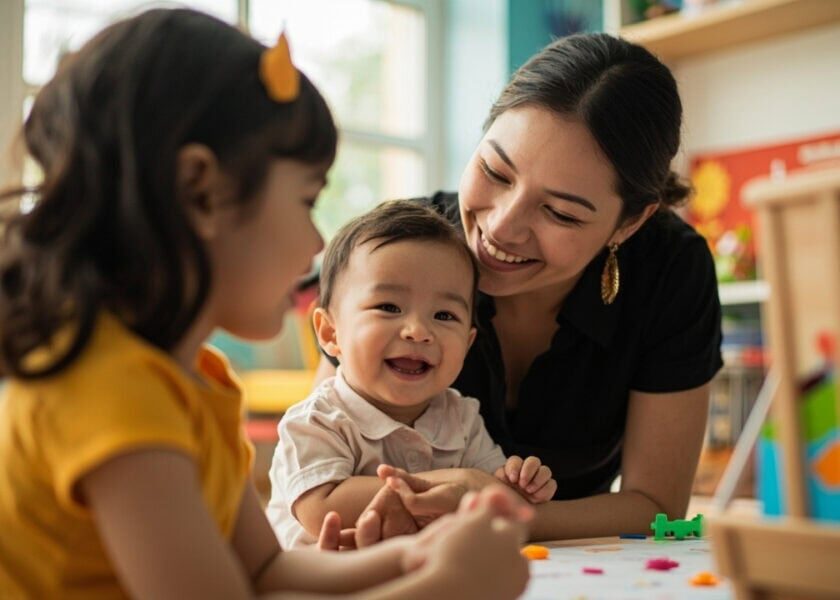
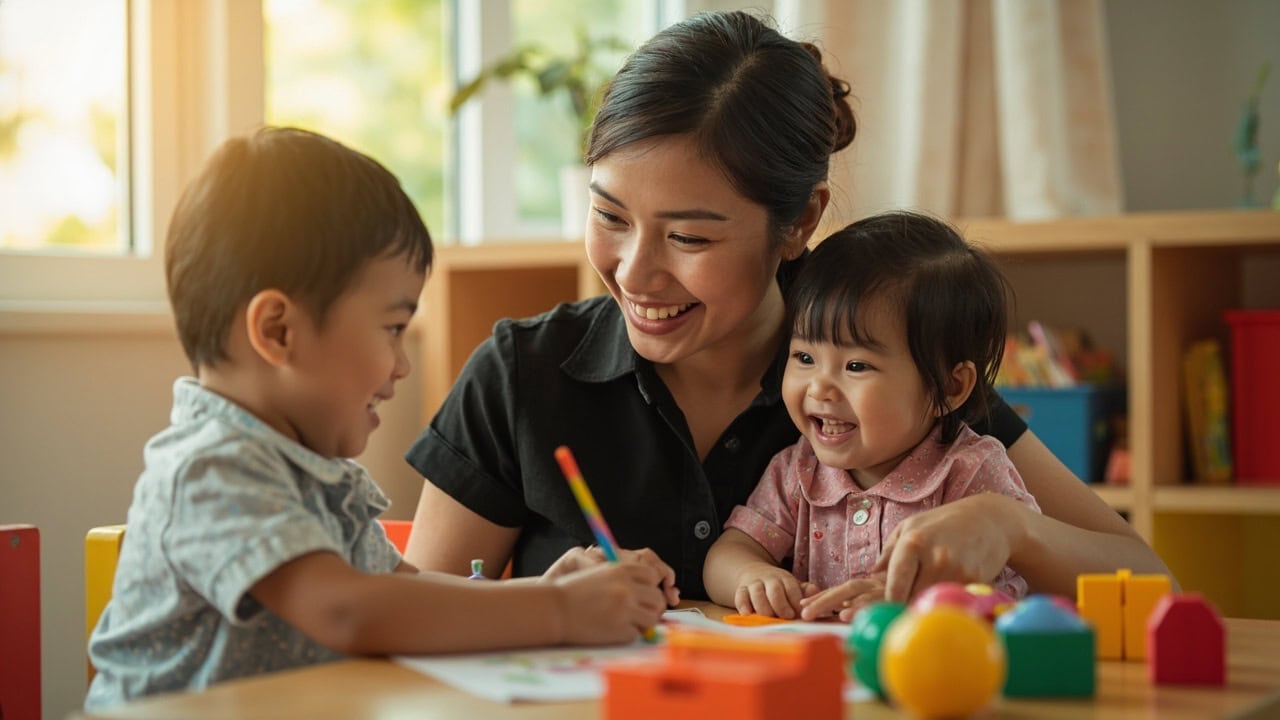
In EduNanny settings, the space is designed for the body. It is a space where infants can move freely, where toddlers can climb and explore, where sensory experiences are varied and intentional. It is a space that acknowledges the developmental importance of outdoor play, of mess and discovery, of the resistance that building with real materials provides.
This is not a space designed for convenience or for adult supervision. It is a space designed for the work that young children do naturally — the work of building themselves from the inside out.
Caregivers Trained to Observe
The caregivers in the EduNanny network are trained not only in safety and basic care — though these are foundational — but in observation. They understand typical development. They know how to read a child’s body language, to recognize when a child is on the edge of a new skill, to create an environment that challenges without overwhelming.
They know the difference between a child who needs rest and a child who needs movement. They know how to support physical autonomy — allowing children to do for themselves what they are capable of doing, even when it is faster and easier to do it for them.
This is not accidental. It is the result of intentional design, ongoing training, and a genuine respect for the developmental science of early childhood.
Communication That Brings You In
EduNanny understands that parents are partners, not problems to be managed. Where CCTV measures are deployed, parents have visibility into the daily environment. Where structured updates are provided, they are focused not on trivialities but on the developmental narrative of the day — what your child explored, how they moved, what engaged them.
This is the language you have been waiting for. This is the vocabulary that helps you see your child’s day not as a black box but as a window into their growth.
Reading Your Child at Pickup: A Practical Guide
You can use this information every single day. When you pick up your child, look for:
- The flush on their cheeks from active play — not from a warm room or screen exposure
- The particular quality of tiredness that comes from meaningful physical effort — different from the listless fatigue of screen time or prolonged confinement
- Confidence in their gait — the way they navigate steps or uneven surfaces
- The way they reach for things and release things and request things with their whole body
Questions to Ask at Pickup
- What did they climb today?
- What did they pour?
- What did they discover?
- What repetitions did they engage in?
- How did they respond to new challenges?
When the answer comes back, hold it as evidence. Not proof in the laboratory sense, but evidence in the parental sense — the evidence that your child spent their morning building something, learning something, becoming someone who knows how to move through the world with increasing skill and confidence.
Addressing Common Concerns
“Will my child actually develop, or just be babysat?”
The difference lies in intentionality. Quality care is designed around developmental science. The environment offers variety, challenge, and sensory richness. Caregivers are trained to observe and support. There is a curriculum — it simply is not written on paper.
“How do I know if the caregiver is doing the right things?”
You can ask questions. You can observe your child’s energy and development over time. You can look for signs of engagement: Does your child seem curious? Confident? Physically capable? These are observable outcomes.
“Is it worth the investment?”
You are not paying for supervision. You are investing in hours of intentional developmental support during the most critical period of your child’s brain architecture formation. The question is not whether you can afford quality care — it is whether you can afford to miss this window.
“What about time with family?”
Quality care complements what happens at home. It does not replace it. The best outcomes occur when developmental support at childcare is reinforced by attuned parenting at home — and vice versa.
A Framework for Choosing Quality Childcare in Singapore
When evaluating any infant care or childminding option, use this framework:
| Look For | Ask About |
|---|---|
| Movement-friendly space | Can infants move freely? Are there areas for crawling, pulling up, exploring? |
| Sensory variety | Are there different textures, weights, sounds, and visual experiences available? |
| Outdoor access | Is there time outdoors, or at minimum, natural light and natural views? |
| Caregiver ratio | How many infants per caregiver? Can each child receive individual attention? |
| Observation over direction | Are children allowed to repeat actions, explore at their own pace, follow curiosity? |
| Developmental communication | Will you receive updates about your child’s engagement, not just their meals and naps? |
| Physical autonomy support | Are caregivers trained to let children do for themselves what they can? |
What EduNanny Is — and Is Not
EduNanny is not a promise about outcomes. It is not a guarantee of school admission or developmental miracles.
What it is: a commitment to the physical, sensory, and motor development that underlies all other development. A space designed for the work of childhood. A caregiver trained to observe, to support, to understand. A communication model that brings you into that understanding.
Development is sequential. The body is the foundation. What happens in the early years matters because it is building the architecture upon which everything else will rest.
When you choose care that understands this, you are giving your child something real. Something visible. Something that you can observe and celebrate and build upon.
The Answer to Your Question
Remember the question you asked at the door this morning? What is my child doing right now?
Now you have the framework to understand the answer.
Your child is building. They are reaching and grasping and crawling and climbing. They are processing textures and temperatures and spatial relationships. They are conducting experiments in cause and effect. They are laying down neural pathways that will support everything that comes after.
The hours your child spends in quality care are not lost time. They are not a necessary compromise while you work. They are productive hours. Purposeful hours. Hours in which your child’s brain is forming, their nervous system is organizing, their body is learning what it means to be capable.
This is not a philosophical position. It is a developmental fact.
And as a parent, you now have the tools to see it — every time you pick up your child, notice the flush on their cheeks, the confidence in their movement, the energy that comes from genuine effort rather than mere passing of time.
You are choosing more than childcare. You are choosing an environment for your child’s growth.
Choose with your eyes open. Choose with confidence. And trust that the answer to your question — What is my child doing right now? — is something worth seeing.
EduNanny is part of the ECDA Childminding Pilot, offering thoughtfully designed infant care and childminding for Singapore families. Learn more about our approach or connect with our team to explore whether EduNanny is right for your family.