Why Your Child’s Attachment to Their Caregiver Is a Good Sign
When Your Child Reaches for Someone Else: A Message to Every Parent in Singapore Who Has Felt This
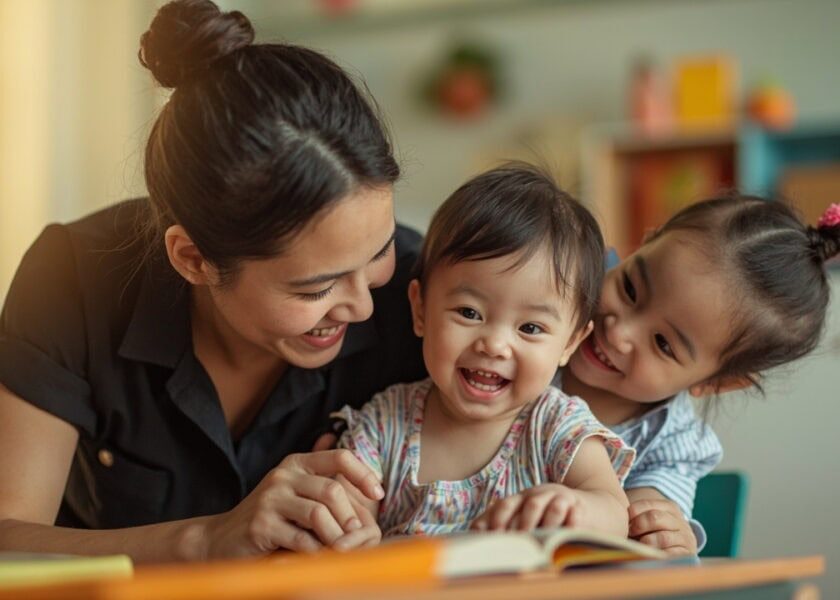
There is a moment — perhaps you have felt it — when you watch your child reach for their caregiver. Not because you have left the room, but simply because that person has arrived. Your child’s face changes. Something lights up. And in that moment, a small, quiet question rises in you. A question so tender that you may not have said it aloud, even to yourself.
Am I being replaced?
It is one of the unspoken realities of modern parenting, particularly in a city like Singapore, where the demands of work and family life often mean that our children spend their earliest years in the care of others. We are told that quality childcare is important. We are told that attachment matters. What we are rarely told is how to make sense of what happens when your child begins to love someone else — and what that love means for the bond you have so carefully, so lovingly built.
Today, we want to speak directly to that question. Not with instructions, but with understanding. Because what you are feeling is not a failure of your parenting. It is, in fact, evidence that your parenting is working.
What Your Child’s Attachment to Their Caregiver Really Means
- Your child’s love for their caregiver is not competition for your bond — it is its complement.
- Securely attached children develop the capacity to form multiple meaningful relationships. This is a sign of healthy development, not a threat to your connection.
- Quality childcare adds to your child’s world rather than substituting for your role as parent.
- Your child loving their caregiver is proof that you loved them well enough to teach them what love feels like.
Understanding Secure Attachment: What Your Child Knows That You Are Still Learning to Trust
A securely attached child is not a child who needs only one person. That is a misunderstanding that has caused countless parents unnecessary guilt. The research is clear: a child who feels safe, seen, and loved by their parents develops the capacity — not the limitation — to form meaningful connections with others.
Think of it this way. When your child learns to walk, they do not stop reaching for your hand. They simply gain the ability to walk toward new experiences, new people, new worlds — and always, always return. The same is true of attachment. Your child is not replacing you. They are expanding. They are growing into the kind of person who can love deeply, connect confidently, and trust fully — because you taught them how.
The child who forms a genuine, warm attachment to a caregiver has not misplaced their parents in their heart. They have learned, through your love, that the world is safe enough to explore. That other people can be trusted. That relationships are sources of joy, not just anxiety.
This is not a diminishment of what you have given them. This is the harvest.
How Attachments Look Across Different Ages
The age and developmental stage of your child matters here. Infants, who are in the depths of forming their first attachments, may show more concentrated attachment behaviours — clinging, distress at separation, intense need for specific caregivers. This is developmentally appropriate and, in fact, necessary for healthy emotional development.
Toddlers, who are beginning to assert their autonomy and test the boundaries of their world, may show these attachments differently — through pride in showing their caregiver new skills, through possessiveness about favourite toys, through the fierce declaration that they do not need you anymore even as they reach for your hand under the table. Both are normal. Both are healthy.
The Difference That Matters: Healthy Expansion vs. Problematic Substitution
Now, let us be honest about something else, because honesty is more helpful than reassurance alone.
Not all attachments formed in childcare settings are healthy. There is a difference — a meaningful, important difference — between a child who is developing a warm, appropriate connection with a caregiver, and a child who has become a surrogate parent because their actual parents are absent or emotionally unavailable.
The first is developmental expansion. The second is compensation for a gap.
Quality infant care understands this distinction with precision. It does not position the caregiver as a replacement mother or father. It positions the caregiver as a bridge — someone who supports the child’s development in the parent’s absence, who honours the parent-child bond as the foundation of everything else, and who builds their own relationship with the child in a way that complements rather than competes.
This is why training matters. This is why intention matters. When a caregiver is trained to observe the child’s cues, to mirror the parent’s rhythms of feeding and sleeping, to communicate transparently about the child’s day, and to speak of the parents with warmth and respect — they are doing so because they understand that they are part of a child’s ecosystem, not the entirety of it. They are guests in the child’s relational world, and they conduct themselves accordingly.
What Healthy Attachment Looks Like in Everyday Moments
You may notice this distinction in small moments. A healthy caregiver attachment shows up as:
- Your child being genuinely glad to see their caregiver — but also genuinely glad to see you at the end of the day.
- Your child talking about their caregiver with affection — but still seeking you for comfort in ways they do not seek others.
- Your child being curious and confident with new people — because you gave them the security to be so.
When your child runs to their caregiver at drop-off and then looks for you the moment something goes wrong — a bumped knee, a frightening sound, a moment of uncertainty — that is your child doing exactly what securely attached children do. They explore. They connect. They expand. And when they need to come home, they know exactly where home is.
Home is not a place. Home is the feeling you gave them.
What Quality Childcare Looks Like in Singapore
For families in Singapore, choosing infant care or childminding is not a decision made lightly. The cost, the logistics, the emotional weight of it — we know. Singapore parents face pressures that are particular to this city: long working hours, extended family often far away, the relentless pace of a society that celebrates achievement and concerns itself with giving children every possible advantage.
Quality childminding in Singapore addresses these realities with intention. Here is what you should look for:
Caregiver-to-Child Ratios That Matter
In those first thousand days of life, when the architecture of the brain is being laid down faster than it ever will again, attentive care is not an add-on. It is foundational. In quality settings, infant ratios reflect this belief — with small numbers of children per caregiver ensuring that every child’s cues are noticed, every need is met with responsiveness, every moment of discovery is captured.
Communication That Builds Trust
Transparency changes everything. Quality caregivers communicate openly about your child’s day — their meals, their moods, their milestones. When you drop off your child in the morning, you should leave feeling informed and trusted, not anxious and in the dark. This is not a marketing feature. This is a practice of respect for your role as parent.
Financial Accessibility
For many families in Singapore, the financial dimension of childcare is real. Quality care should not be a privilege reserved for those with means. Look for arrangements where CDA and Baby Bonus schemes can be utilised, where Monday to Friday care blocks provide the consistency that children thrive on while giving families the flexibility to structure their weeks with intention.
Questions to Ask When Choosing Infant Care in Singapore
- How does the caregiver speak about you? Do they mention your child’s routines, your preferences, your family with warmth and respect? Or do they speak as if they are the primary figure in your child’s life?
- How does your child respond to both of you? Look for a child who is genuinely happy to see their caregiver — and genuinely, uniquely happy to see you at day’s end.
- How does the caregiver handle transitions? Do they support your child’s emotional response to your departure, or do they rush to distract your child away from you?
- How is communication structured? Do you receive regular, thoughtful updates about your child’s day — their meals, their play, their moments of wonder?
- What is the caregiver’s understanding of attachment? A quality caregiver will speak about your child’s attachment to you as the foundation, and their role as complementary.
EduNanny Singapore: Building on What You Have Built
We understand that choosing infant care in Singapore means navigating real logistical, financial, and emotional decisions. EduNanny Singapore is part of the ECDA Childminding Pilot, operating within a framework that gives parents genuine choice in how and where their children are cared for.
Whether your family thrives in a home-based setting, where a caregiver provides individual attention in the warmth of a domestic environment, or in a community or centre-based pathway, where your child benefits from peer interaction and structured learning, we have designed pathways that honour different needs and different lives.
Our caregivers are trained to understand something essential: they are not watching your child. They are reading your child’s relational history, understanding where they are in their developmental arc, and constructing a relationship that adds to the child’s world rather than substituting for the parent.
They know that the parent’s name should be spoken with warmth in their home. They know that the parent’s routines should be respected, not overridden. They know that their job is not to become number one in the child’s life, but to be a trusted, valued presence who makes the child’s world richer.
Permission to Trust What You Have Built
Even with understanding, you may still carry that quiet, unspoken worry — that your child’s love for their caregiver somehow means less love for you. We want to give you permission to release that worry.
Not because your feelings are unfounded. They are not. The love you feel for your child is so profound that the idea of sharing it can feel like a kind of loss. That is real. That is honest. That is the depth of your investment as a parent.
Your child loving their caregiver is not evidence that you have been replaced. It is evidence that you have succeeded beyond measure. It is proof that you loved them so well, so securely, so consistently, that they now have the capacity to love someone else with that same security. You gave them that. That is yours. No caregiver, no matter how wonderful, can take credit for it.
This relational expansion — this ability to love more than one person deeply and well — is not a threat to your child’s school readiness or their social confidence or their sense of self. It is the very thing that makes all of those things possible.
The child who has learned to trust a caregiver beyond their parents enters preschool with social confidence, not social anxiety. They know how to read other adults, how to navigate peer relationships, how to feel secure in a group of new faces. They are children who have learned that multiple people can be safe — because their parents taught them the foundations, and their caregivers built on them.
Every time you responded to your baby’s cry in those first weeks and months — not perfectly, no one does perfectly, but with genuine effort, with love, with the willingness to keep trying — you were building something inside them. You were building the capacity to believe that people are trustworthy. That the world is not entirely unsafe. That connection is worth pursuing. That love, once given, does not disappear when someone else appears on the scene.
Your child’s caregiver is not your competition. They are your collaborator. They are someone who gets to witness the child you made, the child you love, and who has the privilege of walking alongside them for a season.
Your child’s heart is big enough. It was always meant to be this big. And it is big, in no small part, because of you.
Begin Your Search with Confidence
Choosing quality childcare in Singapore is not a failure of parenting. It is an act of parenting — a thoughtful, deliberate choice to surround your child with people who will help them grow into the person they are meant to become.
If you are exploring infant care or childminding options in Singapore and want to learn more about an approach that understands both the science of development and the art of love, we invite you to connect with EduNanny Singapore. Our team is here to answer your questions, walk you through your options, and help you find the right fit for your family — not as a service transaction, but as a partnership in your child’s earliest, most important years.
Because every time your child reaches for someone else with joy and trust, they are telling the world something important. They are saying that they know what love feels like.
They learned it from you.
Ready to explore your options? Learn more about EduNanny Singapore and discover how our approach to infant care and childminding honours both your child’s development and your family’s needs.