What Your Childcare Tour Is Hiding From You
Walking Out Uncertain: Why Every Singapore Parent Needs an Evaluation Eye
There is a particular feeling you know well. You’ve done the research. You’ve read the reviews. You’ve asked your parent WhatsApp groups, weighed the recommendations, and narrowed your list to three centres. You’ve scheduled the tours, shown up on time, walked through the doors with your notebook and your questions, and you’ve listened.
You’ve nodded at the presentations, smiled at the classroom displays, watched the children at play, and left with a glossy brochure in your bag and a strange, uneasy feeling somewhere beneath your ribs.
That feeling is the gap between preparation and certainty. You’ve done everything right, yet somehow, you can’t shake the sense that you’ve learned very little that will actually help you choose. The tour was lovely. The staff were friendly. The children seemed happy. But how do you really know? How do you separate what a centre wants you to see from what a centre actually does every single day, in every ordinary Tuesday afternoon, when no one is there to evaluate?
If this sounds familiar, I want you to know something important: that uncertainty is not a failure of preparation. It is a sign that you are taking this decision seriously. And more importantly, it is a sign that you have not yet learned what to look for.
But that is a learnable skill. You can develop it. And once you do, something shifts. The tours stop feeling like performances you are watching from the outside. They start revealing what they actually contain.
This is not about becoming a childcare expert. It is about developing what I call an evaluation eye—the trained capacity to see what matters, to notice what is real, and to move through the search process with confidence instead of confusion.
What Quality Actually Looks Like in Practice
When you visit a childcare environment, your first impression is usually formed by the physical space. The lighting, the colour on the walls, the size of the play areas, whether there are windows. These sensory details matter, but not in the way you might think. A centre can have beautiful wooden furniture, curated toy shelves, and Montessori-inspired layouts and still miss the things that make early childhood environments genuinely supportive of development.
What you are actually looking for is intentionality. Ask yourself: does this space appear designed for the children who use it, or does it appear designed for parents who will visit it?
Here is what many parents miss: the physical environment is the easiest thing to get right for a tour. You can stage a room. You can bring in beautiful materials for a morning. What is far harder to stage is the way human beings interact with each other when they think no one is paying close attention.
Watch the Caregivers, Not Just the Children
This is where your evaluation eye needs to sharpen most. Watch what caregivers are doing with their bodies, their eyes, their voices.
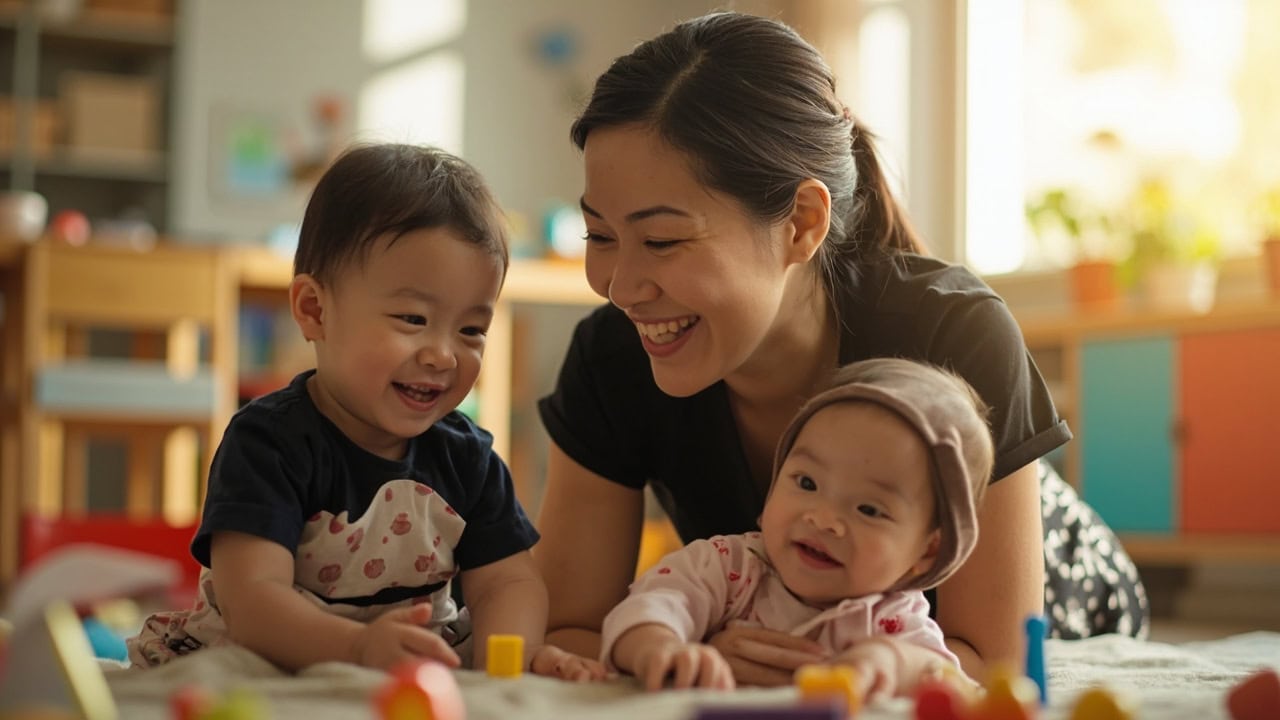
Are they positioned at the children’s level, kneeling or sitting alongside them? Or are they standing above, supervising from a distance? Are they narrating what is happening, saying things like “I see you found the blue block” or “You’re building something tall”? Or are they talking to each other, with their backs partially turned?
The quality of caregiver-child interaction is the single most significant predictor of what your child’s daily experience will actually be like. You want to see responsiveness. You want to see warmth that is consistent and unhurried. You want to see caregivers who are present in the room, not just occupying it.
What Children Show You
The children will show you everything you need to know if you watch them long enough. Observe the overall mood in the room. Is there spontaneous, engaged play? Are children moving freely between activities? Or is there a heavy reliance on screens, on transitions that are adult-directed, on long periods where children are waiting?
A room where children are genuinely engaged will have a particular quality to it—a hum of purposeful activity that you can feel even before you consciously register what you are seeing. A room that is merely managed will feel slightly flat, slightly controlled, slightly waiting for the next instruction.
One of the most valuable things you can do during a visit is to arrive early, or to linger after the formal tour concludes. Walk through the corridors at pickup time. Watch how children and caregivers separate at the end of the day. Watch how parents are greeted. These are unguarded moments, and they reveal what the culture of a place actually feels like when the performance has ended.
The Questions That Reveal True Practice
Your evaluation eye needs specific questions to anchor it—not any question, but the questions that reveal true practice versus rehearsed responses.
When centres prepare for parent visits, they anticipate certain questions. “What do the children eat?” “What is your teacher-to-child ratio?” “What activities do you do?” These are fine questions, but they have been answered so many times that the responses have been polished into scripted safety. You will learn more from questions that are harder to rehearse.
- “Can you tell me about a typical morning here, from when children arrive to when they have their first snack?” Listen to how specific the answer is. A vague, general response about “play-based learning” is not the same as a concrete description of what actually happens in the room. You want to hear about transitions, about how children move between activities, about what the adults are doing while the children are playing.
- “How do you handle a child who is upset or having a difficult moment?” This is a question about philosophy, yes, but it is also a question about practice. Listen for whether the answer reflects an understanding of developmental stages. There is a significant difference between a centre that has thought deeply about emotional regulation and one that knows the right words but not the right practice.
- “What does your staff turnover look like, and how do you support new caregivers joining the team?” Staff stability is one of the most underrated quality indicators in early childhood environments. Young children develop security through consistency. When caregivers change frequently, that security is disrupted, and no amount of beautiful curriculum can compensate.
- “How do you communicate with parents about their child’s day?” Are there daily updates? Photographs? Written reflections? How are concerns raised, and what does that process look like? For infants and toddlers especially, parents need to know not just what happened, but how their child was: their mood, their appetite, their interactions.
- “Is there anything that happens here on a difficult day that a parent would never see on a tour?” It is a brave question, and not every centre will answer it honestly. But the ones that do will tell you something invaluable: that they understand the difference between their presentation and their reality, and that they are willing to be transparent about the gaps.
Environmental Signals and Red Flags Worth Naming
Beyond caregiver interaction, the environment itself tells you about intentionality—whether a programme is genuinely designed around child development or assembled from trending ideas about early education.
Materials matter. Look at whether they are open-ended, allowing for creative use and imagination, or prescriptive, leading to a single intended outcome. A set of coloured blocks can become anything. A plastic toy with buttons and lights can only ever be itself.
Outdoor space, if there is one, should be used daily in all weather-appropriate conditions. Physical movement and outdoor experience are not optional extras in early childhood; they are foundational to healthy development.
The walls tell a story. Do they display children’s work and processes, or adult-made posters about learning outcomes and programme philosophy? If every image on the walls was made by an adult, ask yourself who the space is really designed for.
Clarity about warning signs can save you considerable heartache later. Be attentive to environments that feel overly sterile or overly chaotic. Both extremes can indicate underlying problems.
- A room where children are consistently asked to sit still for long periods, where free movement is restricted, where compliance is emphasised over engagement.
- A room where there is constant shouting, where supervision feels stretched, where the noise level suggests more children than the space can comfortably hold.
- Centres that speak primarily about what they offer parents rather than what they offer children. A centre that leads with “we give parents peace of mind” may have confused their customer with their mission. The children are the centre’s primary responsibility.
- Centres that cannot answer simple logistical questions about their operations. If you ask about feeding schedules for infants and the answer is vague, if you ask about sick child policies and receive an unclear response—these are not minor gaps. They are windows into how the centre thinks about its responsibilities.
Beyond Centre-Based Care: What Singapore Families Should Know
There is a difference between what a centre markets and what a centre actually delivers. This is not about dishonesty. Most centres genuinely believe in what they do. But there is a natural distance between aspiration and daily practice, between the programme a centre has designed and the lived reality of a Tuesday afternoon in November.
Your job is not to find a perfect centre, because one does not exist. Your job is to find a centre whose daily reality is close enough to its stated values that you can trust it with your child’s ordinary, unremarkable, profoundly important days.
For families navigating the early years in Singapore, pathways beyond traditional centre-based care deserve serious consideration. The ECDA Childminding Pilot was designed with Singapore’s families in mind, recognising that the early childhood landscape needs flexibility alongside quality.
Within this framework, services like EduNanny represent one such pathway—one that addresses some of the very concerns we have been exploring. When your child’s caregiver is in your home, or in a carefully structured home-based environment within your community, many of the evaluation challenges we have discussed become qualitatively different. You are not relying on a tour to reveal what happens in closed rooms. You are seeing it, or your child is living it, every single day.
EduNanny has built a model that prioritises the things that matter most: consistent caregiver relationships, low infant ratios that enable genuine responsiveness, and a communication structure that keeps parents informed and involved. The pilot fee structures are designed to be accessible, and families can access relevant subsidies, including CDA and Baby Bonus arrangements, in ways that make quality care genuinely reachable.
This is not a solution that works for every family, and that honesty matters. But for families who are struggling with the childcare search, who have visited centre after centre and left with that same uncertain feeling, who are looking for something that feels more personal, more responsive, more aligned with how they imagine care should actually work for their infant or toddler—it is worth knowing that this option exists.
Making the Choice with Confidence
Choosing childcare is not just a logistical decision. It is one of the most intimate choices you will make as a parent. You are entrusting someone else with the person you love most in the world, during the very years when their brain is developing faster than it ever will again, when their sense of security is being formed, when the quality of their human relationships is quite literally shaping the architecture of who they will become.
That is not a small thing. And the fact that you are taking it seriously, that you are willing to develop your evaluation eye, that you are willing to sit with the discomfort of uncertainty while you learn what to look for—that is itself a form of love. It is the love of paying attention.
So here is what I want you to carry with you when you walk into your next centre tour, when you sit down with a programme coordinator, when you are trying to decide between options that all seem decent on the surface. You are looking for something real. You are looking for the traces that genuine quality leaves:
- In the way a caregiver kneels down to a child’s level
- In the unhurried warmth of a greeting
- In the materials that invite imagination
- In the communication that sees parents as partners
- In the staff who have been there long enough to know the children by name and history
These things are not secrets. They are visible, to anyone who knows how to look. And now, you are developing that knowledge. You are building that eye.
The gap between research and confidence, between preparation and certainty, between walking out of a tour feeling overwhelmed and walking out of a tour feeling clear—that is not an unbridgeable distance. It is the distance that education covers. It is the distance between not knowing what to look for and knowing exactly what you are seeing.
You can cross it. And when you do, something changes. The decision stops feeling like a gamble and starts feeling like what it actually is: an informed, thoughtful choice made by a parent who cares enough to look closely, to ask the right questions, and to trust what they find.
That is the kind of parent you already are. Now you have the framework to go with it.
If you are exploring quality early childhood care options in Singapore and want to understand what a more transparent, relationship-based model can look like, EduNanny welcomes the conversation. Whether you are deep in the search or simply beginning to consider your options, you do not have to navigate this alone.