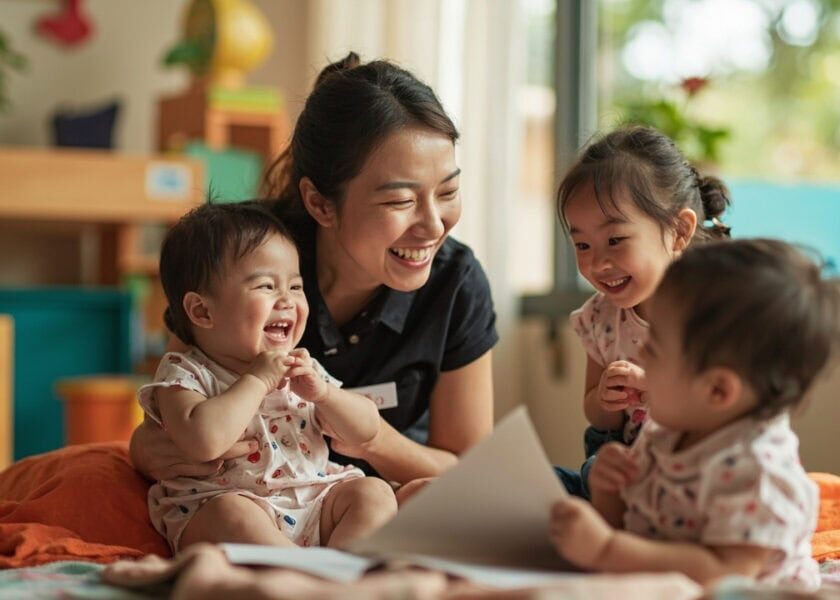
How the Right Childcare Helps Your Child Become More Themselves
You Are Not Imagining This Fear
It is one of the most honest questions a parent can ask when choosing childcare: Will my child leave this place more themselves, or less? Will they return to me with a larger vocabulary for their inner life, or a quieter one?
These are not small questions. They go to the heart of what we believe about children—and what we believe about what they deserve.
In Singapore, where options range from infant care centres with rotating staff to home-based childminding arrangements, parents face a genuine challenge in evaluating what lies beneath the licences, ratios, and fee structures. Safety and compliance are foundations, not destinations. The real question is deeper:
What is this environment doing to my child’s sense of who they are?
The Difference Between Monitoring and Witnessing
Research on early childhood development consistently shows that the environment in which a child explores their emerging self matters enormously. A child who is cared for by someone who merely supervises—who keeps them clean, fed, and uninjured—will develop differently than a child who is cared for by someone who observes. Who notices.
Monitoring asks: Is the child safe? Is the schedule being followed? Are the outcomes being met?
Witnessing asks: Who is this child becoming? What are they trying to tell me through their choices? What does this moment reveal about who they are?
When you understand this distinction, you begin to see why the quality of your childcare decision matters far beyond logistics. You are choosing not just a caregiver, but a witness for your child’s emerging self.
Your Child Is Already Building a Self
From the moment a child is born, they are already constructing an identity. You may have noticed this even before you had the language for it—the three-month-old who turns her head toward a particular voice, the seven-month-old who pushes away the spoon when she has had enough, the one-year-old who stops at a puddle not because she has been told to, but because something in her has decided that splashing is exactly what this moment requires.
These are not random behaviours. These are the first, tentative acts of identity formation. The child is not simply reacting to the world. They are beginning to discover who they are in relation to it.
Milestones That Matter Beyond the Checklists
By eighteen months, most children can recognise themselves in a mirror. This sounds simple, but it represents a cognitive revolution. They are beginning to understand that they exist—that they are a separate being with preferences, opinions, and a perspective that belongs to no one else.
By two, they are making choices not out of defiance, but out of self-discovery:
- I like this.
- I do not like that.
- I want to go there.
- I want you to stay.
This is not stubbornness. This is the beginning of personhood.
Which means that every hour of every day—whether at home with you, in a childcare programme, or anywhere in between—your child is doing the work of identity development. The question is not whether this work is happening. It is whether the environment around them is supporting it or undermining it.
What Quality Childminding Actually Looks Like
So what does it mean, in practice, for a childcare environment to support identity development rather than erode it? It shows up in four concrete ways: consistency, observation, language, and agency.
1. Consistency: The Safety to Explore
When a child is cared for by the same small team of familiar faces, week after week, they do not spend their emotional energy on adaptation. They do not wake each morning wondering who will be there, whether the rules will be the same, whether their particular needs will be understood or forgotten.
Instead, they invest that energy in exploration. In play. In the slow, vital work of becoming.
In our EduNanny programme—part of the ECDA Childminding Pilot—small caregiver ratios create the conditions for genuine relationship-building, not just supervision. The caregiver learns to distinguish between a cry of hunger and a cry of frustration. They remember that your daughter is fascinated by textures and your son is working through a phase of intense interest in how things fit together.
2. Observation: Discovering, Not Just Supervising
At EduNanny Singapore, our caregivers are there to discover children—to track the emergence of preferences, the first signs of emerging interests, the moments when a child’s face lights up because they have understood something new about how the world works.
When an infant reaches for a particular toy, when a toddler begins to organise objects in a way that reveals a nascent sense of order, when a two-year-old uses a word they learned at childcare to describe something they felt at home—these are not incidental moments. These are the building blocks of identity.
3. Language: Giving Shape to Feeling
Children feel everything—fear, joy, frustration, wonder, pride—but they do not always have the words to name these feelings. Without language, feelings remain formless and overwhelming. With language, they become manageable. Communicable. Real.
When your child comes home and tells you they were “so mad” at a friend, or that the caregiver helped them feel “a little bit better,” they are not simply reporting events. They are constructing an inner narrative. They are learning that their inner life is something that can be spoken, understood, and shared.
Our caregivers are trained not just to feed, comfort, and protect, but to narrate. To put into words what the child is experiencing:
- “I see you are building something tall. You look proud.”
- “It looks like you are feeling frustrated because the piece won’t fit.”
- “You miss Mama, don’t you? That feeling is called missing someone.”
These are not scripted phrases. They are the natural language of a caregiver who is paying attention—who is witnessing, not just watching.
4. Agency: The Quiet Confidence of Knowing Your Power
Agency is the feeling that you have some control over your world, that your choices matter, that you are not merely acted upon but can also act.
A child who is merely managed—who is told what to do, when to do it, how to feel—will develop a thin, fragile sense of self. A child who is observed—who is given choices, who is listened to, who sees their preferences reflected back to them—will develop the quiet confidence of someone who knows their own power.
In our programme, this manifests in small, daily moments:
- The child who is allowed to choose between two snacks and experiences the thrill of having a preference honoured.
- The toddler who is given the autonomy to decide the order of their morning routine.
- The two-year-old who is allowed to express a strong opinion about the book that will be read at circle time.
These moments may seem insignificant. They are not. They are the earliest lessons in personhood.
How to Recognise Healthy Identity Development at Pickup
You might be wondering: How do I know if this is actually happening? How do I evaluate whether the environment my child is in is truly supporting their identity development, or merely housing them?
Here is what to pay attention to when you pick up your child at the end of the day.
Listen to How They Tell Stories
Not just what happened—who they played with, what they ate, whether they napped—but how they tell it. Does your child use words to describe their feelings?
- “I was happy when we played in the sand.”
- “I didn’t like it when someone took my block.”
These are signs of a child who is developing the language of selfhood.
Notice New Preferences
Your child comes home talking about something they want to do again, or refusing something they previously enjoyed. They are not being inconsistent. They are showing you the edges of their emerging self—the boundaries, the interests, the developing sense of who they are and who they are not.
Watch for Initiative
Your child comes home and wants to do something they initiated at childcare—telling you a story in a certain way, pretending something specific, wanting to draw or build something they discovered there. This is a child who is bringing their experience back to themselves. Who is integrating what they have learned into their own self-narrative.
Notice How They Speak About Their Caregivers
Not with fear, but with familiarity. A child who says “Miss Sarah said we should try something new today” is a child who feels known by the people in their world. A child who mentions a caregiver’s name casually, as part of the fabric of their day, is a child who has relationships that are supporting their development.
Trust What You Feel
Perhaps most importantly, pay attention to how you feel when you observe these moments. Do you sense that your child is becoming more themselves, or less? Do you feel that their sense of self is expanding, or contracting?
You know your child better than anyone. Trust that knowledge.
The Partnership Between You and Your Childcare Provider
At EduNanny Singapore, we believe that the relationship between you and your childcare provider is not transactional. It is not a service agreement where you deposit your child in the morning and receive them back, improved, in the evening. It is a collaboration.
You are the primary authors of your child’s self-narrative, and we are here to support that work—not to replace it.
Communication That Keeps You Connected
Our approach to communication means that you are not handing your child into a black box and hoping for the best. Where deployed, our measures—including CCTV access in appropriate areas—give you visibility into your child’s day.
More than that, our caregivers maintain open, ongoing dialogue with parents, not as a reporting obligation, but as a partnership in your child’s development.
We send you updates that matter. Not just photographs of your child smiling, though those bring joy. But notes about what your child was engaged in, what they discovered, what they seemed to prefer, what they were working through. These are not inventory reports. They are dispatches from the front lines of your child’s self-discovery.
The Two-Way Flow of Understanding
When you share with us what you observe at home, we learn more about your child. When we share with you what we observe at EduNanny, you learn more about who your child is becoming.
This two-way flow of understanding is what makes quality childcare truly transformative. It is not about outsourcing your child’s development. It is about creating a network of witnesses—people who are paying attention to the same child from different angles, who are contributing to the same story from different chapters.
Choosing Quality Childcare: Building Your Village
Choosing childcare is one of the most consequential decisions you will make as a parent. It is not simply a logistical choice, though logistics matter. It is a statement about what you believe your child deserves—and what you believe they are capable of.
When you choose quality care, you are not admitting defeat. You are not outsourcing the sacred work of raising your child. You are gathering allies. You are building a village.
You are saying: My child deserves to be known, and I will not settle for anything less.
Every Child Is Already Somebody
We believe that every child is already somebody.
Not somebody in potentia. Not somebody waiting to become. But somebody, right now, in the body of a three-month-old who reaches for your face, or a two-year-old who insists on wearing the yellow socks even though they do not match.
The work of identity development is not something that begins at school. It begins at birth. And every hour of every day, your child is doing this work—whether they are at home with you, at a childcare programme, or anywhere in between.
Our role, as your childcare partner, is to create the conditions in which this work can flourish:
- Consistent relationships.
- Attentive observation.
- Language that expands emotional understanding.
- Choices that build agency.
- An environment that treats each child not as a student to be shaped, but as a self to be discovered.
Because your child is not becoming someone else. They are becoming more themselves. And they deserve caregivers who will help them do exactly that.
If you are exploring childcare options in Singapore and would like to learn more about how EduNanny Singapore supports your child’s identity development, we invite you to reach out. We would be glad to share more about our approach, answer your questions, and help you determine whether we might be the right partner for your family’s journey.
We are proud to participate in the ECDA Childminding Pilot, and we welcome families who are looking for something more than supervision—who want their child to be known.