Each Child Deserves to Be Known: Rethinking Sibling Care in Singapore
The Problem With Conventional Sibling Care
The worry that siblings dilute each other’s care is, in most conventional childcare settings, not entirely unfounded. When one caregiver stands before a room of eight children — or more — the cognitive load is enormous. Attention does become divided. Not maliciously, not carelessly, but inevitably.
The child who speaks quietly waits longer. The child whose developmental leaps are less dramatic is noticed less often. And in a room where siblings are just two faces among many, they can easily become grouped. The Lee siblings. The Tan boys. A pair. A duo. A unit.
This grouping is not a personal failing of caregivers. It is a structural reality. When ratios are stretched thin, even dedicated caregivers must generalize. They learn the patterns of groups, not the textures of individuals. They respond to needs that reach them, not to the quieter shifts that only sustained observation can catch.
For parents in Singapore, this matters enormously. The ECDA Childminding Pilot was designed, in part, around the recognition that low ratios create the conditions for something different — something that sees each child before it sees a sibling pair.
Why Precision Multiplies, It Doesn’t Divide
Here is the part worth understanding carefully, because it changes how you should evaluate childcare for your family.
That grouping, that flattening, is not a feature of siblings sharing care. It is a feature of care that is not precise enough. And precision is exactly what distinguishes exceptional childcare from adequate childcare.
When care is delivered at the right ratio — when a caregiver is responsible for no more than one, two, perhaps three infants at a time — something extraordinary becomes possible. Each child can be observed with the kind of attention that reveals who they actually are, not just what they need.
Consider the elder child who gravitates toward comfort and routine, whose face lights up when the familiar song begins. Consider the younger child who processes the world through movement, who learns best when her body is allowed to explore. These are not generalizations. These are the specific, observable truths of specific children.
When a caregiver can hold both of those truths at once, without one cancelling out the other, the siblings are not sharing a diminished resource. They are each receiving something richer than they would receive alone, because the presence of the other child gives each of them a mirror.
Siblings as Developmental Allies
The caregiver who knows your eldest child well enough to understand her hesitations will also understand, more quickly and more clearly, when your younger child is beginning to develop the confidence that will eventually let her push past her own hesitations.
The two children become, over time, not just siblings at home but developmental allies in care. Each one observing the other, learning from the other, and being reminded by the caregiver that they are distinct people with distinct journeys — even as they share the same room.
What Skilled Sibling Observation Looks Like
We talk a great deal about child observation in quality care settings. We talk about developmental milestones, about tracking progress, about the importance of knowing your child. What we do not discuss enough is the specific skill of observing siblings distinctly.
This means noticing that:
- The same caregiving response that calms one child agitates another
- The same environment feels safe to one and slightly overwhelming to the other
- The same social interaction that stretches one child’s confidence makes the other one retreat
These differences are not small. They are the entire story of who your children are becoming.
In a well-structured care environment — one where the caregiver-to-child ratio is kept intentionally small — this kind of observation becomes daily practice rather than occasional insight.
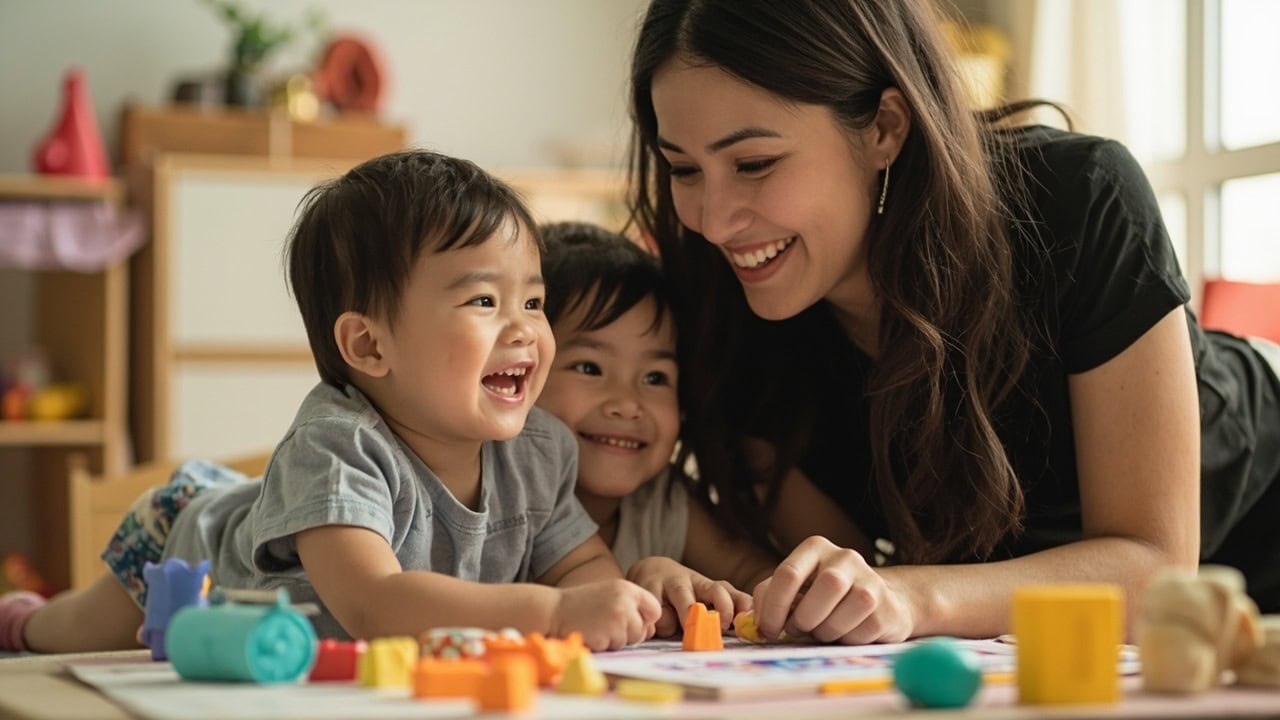
The caregiver is not managing a group. She is reading two or three children at once, the way a good teacher reads a classroom — but with far more depth, because the numbers allow it.
She notices that your younger child is going through a language spurt that nobody at home has picked up on yet, because she has been tracking his syllables week by week. She notices that your older child has been more tentative at meals since the new teeth arrived, and adjusts the texture of food she offers without being asked, because she has been watching his patterns long enough to know what a deviation looks like.
This is the kind of knowledge that does not appear in daily reports as a milestone. It is quieter than that. It is the knowledge that comes from sustained, individualized observation — the kind that is only possible when the caregiver is not spread across ten children but is genuinely present for two or three.
What to Look For in Sibling Care
When you visit a care arrangement — whether home-based through the ECDA Childminding Pilot or a centre-based setting — watch not just for warmth, though warmth matters enormously, but for specificity.
Ask About Each Child Separately
Ask the caregiver about each of your children by name, separately. Not “how are the children” but “how has Aiden been this week, and separately, how has Naomi been this week?”
Notice whether the answers are specific. Notice whether she speaks about them as individuals. Notice whether she can tell you something about each child’s current interests, current challenges, current small victories, that you did not already know.
That gap — the new information, the observation you did not have — is the sign that your child is being seen as an individual in your absence.
Watch How Sibling Tension Is Handled
Two children in close proximity, sharing a caregiver, will occasionally compete for attention, will have disputes over objects or space or proximity to the adult they love. How a caregiver navigates those moments tells you everything.
Does she group the children — “you two need to share”? Or does she address each child’s specific need, validating the older child’s sense of fairness while also acknowledging the younger child’s frustration in a way that is proportionate to who that child is?
Grouped responses teach children that their individual experience does not matter as much as the group’s functioning. Individualized responses teach children that they are each worth a separate conversation, a separate understanding, a separate kind of patience.
Watch Them at Pickup
When you reunite with your children and they run to you with all the drama of children who have been apart from you, watch how they come.
Watch whether they come together or separately. Watch whether one defers to the other, or whether each arrives in their own way, on their own terms.
Children who have been cared for as individuals will often come to a parent as individuals. Not ignoring the sibling, but not leading with the sibling either. They will come as themselves, because that is who they have been allowed to be for the hours they were apart from you.
Signs That Sibling Care Is Working
| What You Notice | What It Means |
|---|---|
| Caregiver refers to each child by name in separate contexts | She sees them as distinct individuals, not a unit |
| Different responses to the same situation | Care is calibrated to who each child is, not applied generically |
| Children show awareness of each other’s preferences | They are learning from each other in a healthy way |
| Each child has a distinct relationship with the caregiver | The bond is individualized, not role-based |
| You receive different observations about each child | Sustained, specific attention is being paid to both |
How EduNanny Approaches Individualized Sibling Care
EduNanny operates within the ECDA Childminding Pilot, which means care arrangements are structured around the principle that small numbers are not a luxury — they are a prerequisite.
When the ratio of caregiver to infant is kept at one to three or fewer, when care is delivered in a home-based environment or a carefully designed centre, the conditions for individualized sibling observation are present. They are not guaranteed — a low ratio is necessary but not sufficient — but they are present in a way they simply cannot be in a large-group setting.
Fee structures within the pilot, supported by mechanisms like CDA and Baby Bonus usability, make this kind of care not just philosophically sound but practically accessible for families across Singapore. High-quality sibling care should not be available only to families with significant financial resources. Every child deserves to be known individually. Every sibling pair deserves to be seen as two people, not one story.
Communication is how trust is built between the hours you are apart from your children. Where EduNanny arrangements include transparency measures such as regular updates, direct caregiver reporting, and structured observation records, these are not administrative processes. They are bridges — the reason you can leave your children in the morning and carry with you not anxiety but a kind of settled trust. The trust that comes from knowing that what is happening in your children’s day is visible to you, reportable to you, and meaningful in the way that your specific children’s lives deserve to be known.
The Long-Term View: What Quality Shared Care Builds
There is a moment parents who have chosen quality care for siblings have felt. You realize that your children are not just tolerating the same environment. They are not just existing in parallel. They are becoming allies in some quiet, developmental way.
Your eldest begins to use words she learned from a caregiver to comfort your younger one. Your younger one begins to imitate something your eldest does that you did not teach either of them — a way of greeting, a way of noticing, a way of being gentle with something small and fragile.
These are not coincidences. These are the fingerprints of shared care done well.
The caregiver is at the center of this. Not as a replacement for you, but as a third significant person in your children’s early story — one who knows your eldest’s need for autonomy and your younger one’s need for safety in exactly the right order, who can hold both truths at once, who can respond to each child in a way that is calibrated to who they are.
Families who find a caregiver who practices that craft for their siblings often speak about that caregiver for the rest of their lives as one of the most important people their children ever knew. That is not an exaggeration. That is what individualized, attentive, sibling-aware care produces — children who grow up knowing, in their bones, that they were seen. That their brother or sister was seen too, differently, in a way that honored the distinction between them.
That the caregiver who held them both did not hold them as a unit but as two separate people who happened to share a room, a schedule, a beloved adult, and eventually, a set of memories that would become part of the family’s mythology.
Your Question, Answered
You look at your children together, and you worry that one of them is less visible. That the care they receive is thinner because it has to cover twice as much ground.
The worry is understandable. The worry comes from love, and love always wants to be thorough.
But in a care environment structured around the right ratios, the right observation, the right communication, and the right understanding of sibling dynamics, your worry becomes less necessary over time. Not because the concern was never valid, but because the care has earned your trust.
Your children are not a divided resource. They are two people who, in the right environment, will come to strengthen each other’s sense of self rather than blur it. Your eldest will become more herself because she has a witness to her individuality. Your younger one will become more herself because she has a companion who reflects her distinctness back to her.
And both of them will carry into their lives — into their future friendships, their future partnerships, their future understanding of what it means to be known — the quiet certainty that they were seen. That they mattered as exactly who they were. That their sibling was seen too, separately, and that the seeing made them both more whole.
That is what we are here to do. Not to care for siblings as a pair, but to care for each child — your children — as the distinct, irreplaceable person they are.
And to trust that the sibling bond, when it is held by skilled and attentive care, does not diminish either of them.
It multiplies them.
If you are researching childcare for two or more children in Singapore, we invite you to learn more about how EduNanny’s approach serves each sibling as an individual. Speak with our team about your family’s specific situation, your children’s distinct needs, and how the ECDA Childminding Pilot might work for you.
Every child deserves to be known. Every sibling pair deserves to be seen as two people.