More Than One Circle of Warmth for Your Child
The Moment Every Singapore Parent Knows
There is a moment, familiar to many Singapore parents, when you watch your mother settle your child into her lap with an ease you will never possess. Your child melts into her in a way that feels ancient, cellular, as if something in them recognizes something in her that bypasses language entirely.
And in that same moment, you feel it: a warmth so profound it nearly breaks you, and alongside it, a question you don’t quite know how to ask. A question that sits somewhere between gratitude and grief.
How do I honor this? How do I also get what my child needs?
This is the tension that lives at the center of so many Singapore families. It is not a problem to be solved. It is a relationship to be understood.
Here is what we have learned from working alongside families across this island: the question is not whether grandparents should be involved. In most Singapore families, they simply are. The question is how to build a structure around that involvement that honors it fully, while also creating space for something professional — something designed with intention and accountability. Something that does not demand your parents give more than they should, but adds a layer of support that benefits everyone.
The Singapore Reality: Why Grandparents Are Not Optional
We live in a country where grandparents are not peripheral figures in a child’s life. They are foundational. They are woven into the architecture of how Singapore raises its children, in ways that are cultural, economic, and deeply emotional.
Singapore ranks among the highest globally for grandparent involvement in childcare. Your parents likely did not wait to be asked. They volunteered. They assumed. They appeared at your doorstep with tupperware containers of soup and unsolicited opinions about how many layers your child should wear, and somehow, against all expectation, they have become essential to your family’s daily rhythm.
But here is what the statistics do not capture: the weight of that reliance. The way it sits on your chest when you hear your mother sigh after a long afternoon with a fussy infant. The guilt that rises when you wonder if you are asking too much. The small, private thoughts you have about how things might be done differently, if only you felt you could say it.
The generational gaps show up not as arguments but as silences. As differences in how comfort is given. How discipline looks. How a child’s cry is interpreted.
You are not ungrateful. You are not dismissive of your parents’ wisdom. You are simply a parent who wants the best for your child, and part of what you want includes knowing that when you are not there, your child is in the kind of care that aligns with how you hope to raise them. You want this without betraying your family. Without suggesting that what your parents offer is not enough.
This is not a contradiction. It is a conversation that many Singapore families are quietly having, without a framework for how to have it well.
The Bond That Is Irreplaceable
Before we go further, let us be clear about something: the grandparent-grandchild bond is irreplaceable. We say this not as a sentiment but as a fact, rooted in everything from attachment science to the particular magic of a grandmother’s voice.
That bond is warmth without agenda. It is continuity across generations. It is your child knowing where they come from, in their bones, before they have words for it.
What grandparents offer includes:
- Unconditional presence — the kind that is not contingent on schedules or curriculum
- Intergenerational continuity — language, stories, songs, and traditions that carry history
- Emotional security — the deep knowing that comes from biological and relational connection
- Cultural grounding — values, customs, and identity passed down in everyday moments
Your child will remember your mother’s lap. They will remember her voice reading familiar stories, her hands preparing food the way their parent remembers from childhood. This is exactly what your child needs.
What Professional Care Adds: Not Lesser, Different
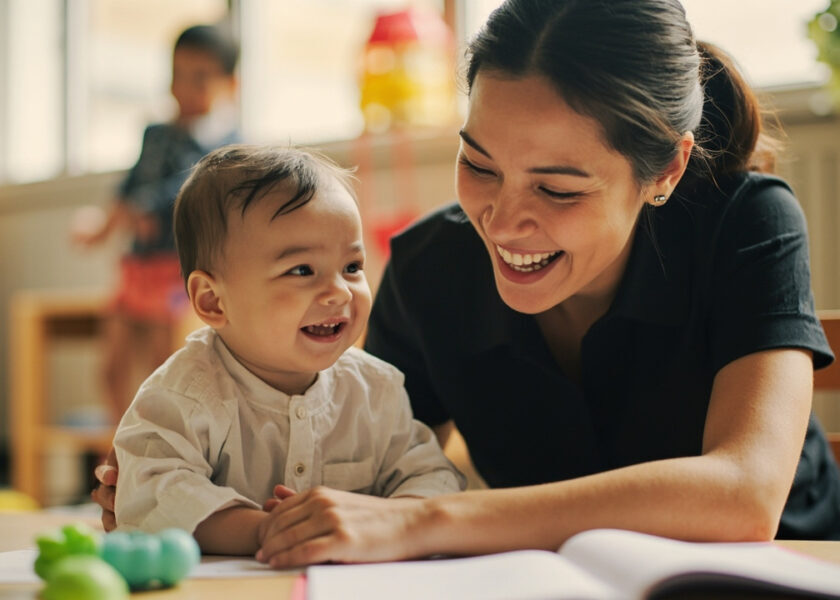
But professional care brings something different, and not lesser. It brings structure shaped by early childhood development research. It brings observation and documentation that helps you understand your child’s emerging patterns over time. It brings ratio care that means your infant is not one of seven but one of three, at most, in the earliest months when the world is still so new and overwhelming.
It brings a caregiver who is rested, trained, and present not because of love alone but because this is their craft. Someone who can step back from the emotional complexity of family dynamics and focus entirely on your child’s needs in that moment. It brings transparency: regular updates, communication rhythms, and in the best arrangements, the kind of openness that builds trust over time.
Research confirms that the quality of attention in the first year matters enormously — not just for development but for the sense of security that becomes a foundation for everything that follows. What your child needs includes:
- Consistent, responsive care — someone who notices their cues and responds with attunement
- Low caregiver-to-infant ratios — especially in the early months when attachment is forming
- Observation and documentation — tracking milestones, patterns, and progress so nothing is missed
- Intentional stimulation — activities and environments designed to support development
- Open communication — parents who know what is happening during the day
These are things that good professional care is designed to provide. They are not in competition with what grandparents offer. They are complementary.
The Weaving Framework: Building a Partnership, Not a Conflict
Here is what that weaving looks like in practice:
1. Conversations Held Early and Often
It starts with a conversation about what each person does best. Your mother knowing that her role is the love, the spoiling, the intergenerational continuity that no curriculum can teach. Your professional caregiver knowing that their role is the structured attention, the developmental observation, the consistent routines that help your infant feel secure. Neither role diminishes the other. Both are necessary.
2. Systems for Communication Everyone Understands
This means clarity about who updates whom. How concerns are raised. How preferences are honored. In a multigenerational Singapore home, where there is often more than one person who loves your child deeply, navigating that is a skill, not an accident.
- Designated check-in times — predictable windows for updates during the day
- Clear escalation paths — how to raise concerns without offense
- Shared documentation — so everyone sees the same information about your child’s day
- Feedback loops — regular check-ins to adjust and improve the arrangement
3. Acknowledging Difference Without Conflict
Different generations will do things differently. Your mother might rock your child to sleep in a way that works differently from what your caregiver would choose. This is not a failure. It is a feature.
Your child will learn flexibility and adaptability. They will understand that love takes many forms and all of them are valid. They will grow up in a family that is thoughtful enough to build something greater than any one person alone.
4. Permission to Want Quality
This is perhaps the most important part of the framework: giving yourself permission. Permission to want care that meets standards you feel good about. Permission to have the conversation with your parents that you have been avoiding, because you believe that having it is a kind of betrayal.
It is not. Having it is an act of respect. It says: I value what you do so much that I want to make sure we are building something sustainable. Something that does not burn you out. Something that works for everyone, including my child, who deserves the best of all the people who love them.
Questions Parents Are Actually Asking
“Will involving professional care mean I’m rejecting my parents?”
No. What we are describing is not a competition between family and professional care. It is a collaboration that, when designed well, gives your child more circles of warmth than most children in the world will ever know. Honoring your parents might also mean not exhausting them. Valuing their role might mean protecting it from becoming a burden.
“My parents expect to be the primary caregivers. How do I have this conversation?”
We know that for some families, this kind of conversation is hard. There are cultural layers here that cannot be simplified. In many Singapore households, involving grandparents is not a choice; it is an expectation. Refusing it can feel like defiance. Questioning it can feel like ingratitude.
The reframe that helps: the best childcare arrangements are the ones that last. The ones that last are the ones that distribute care across a team, not a single pair of aging hands. Choosing to build a support structure is not a rejection of your parents’ help. It is a recognition that sustainable care requires a village, not a single volunteer.
“What if my parents and the caregiver don’t get along?”
Navigating multigenerational dynamics is a skill. Professional caregivers trained in family partnership understand that there is often more than one person who loves your child deeply, and that everyone brings different strengths. Good caregivers know how to work within that ecosystem rather than around it.
“Is home-based care actually better for infants?”
Home-based care means your child is in a familiar, thoughtfully arranged environment close to home. For infants, the familiarity reduces stress and supports attachment. The setting is consistent — not a different room each day — and the caregiver can adapt fully to your child’s rhythms rather than managing a group.
What EduNanny Offers
EduNanny by BUTLER is part of the ECDA Childminding Pilot, which means we operate within a framework designed to expand the range of quality care options available to Singapore families. This is care built on warmth, trust, and the belief that every family deserves support that truly fits.
Home-Based Care, By Design
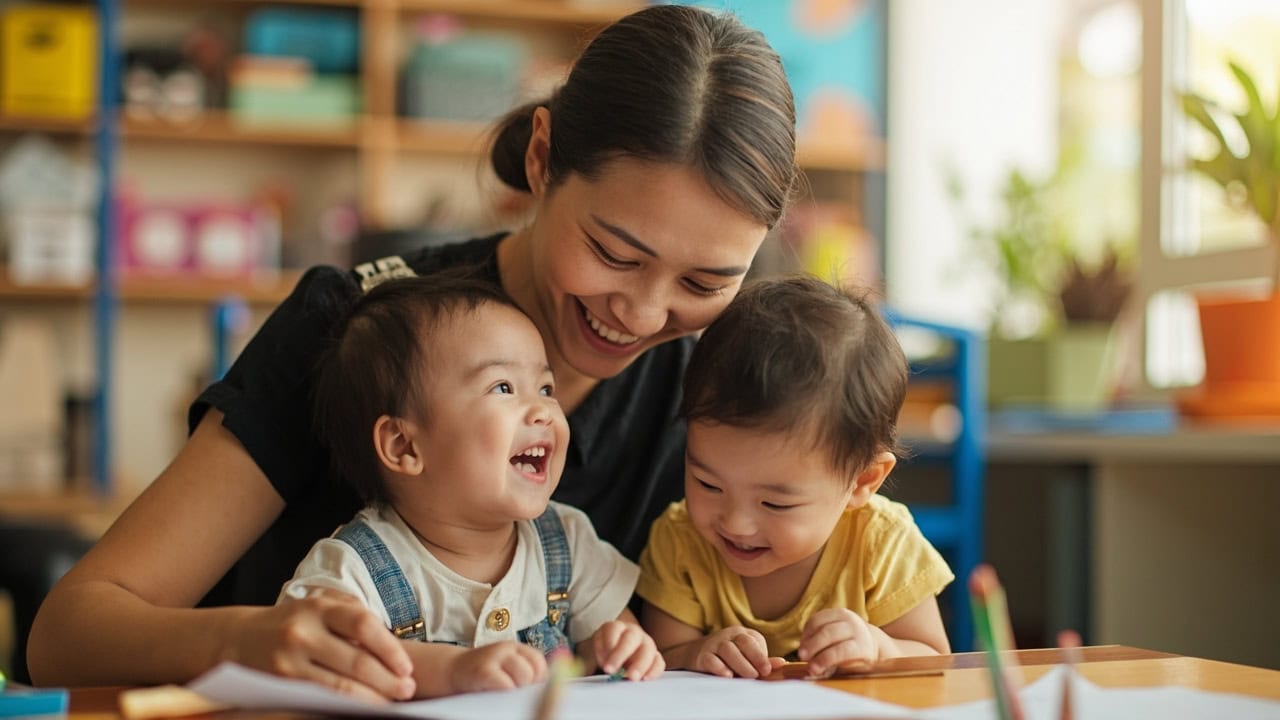
We offer home-based care, which means our caregivers come to you, or your child goes to a familiar, thoughtfully arranged environment close to home. The ratio is intentional: up to one caregiver for every three infants in the early months.
Reliable, Consistent Support
Our care blocks run Monday through Friday, because we know Singapore families need reliable, consistent support. Childcare is not just an emotional decision but a practical and financial one. We have designed our pilot fee structures to be accessible, and we work with CDA and Baby Bonus, so that quality does not require a compromise on affordability.
Caregivers Trained for Multigenerational Dynamics
Our caregivers are trained to understand Singapore family dynamics. They know that in Singapore homes, there is often more than one person who loves your child deeply, and that navigating that is a skill, not an accident.
Communication as Foundation
We place emphasis on communication. On the rhythms of updates and check-ins that let your family know what is happening during the day. On transparency measures that build confidence without surveillance. On a culture of asking rather than assuming, of listening as much as reporting.
Our caregivers are not there to do things differently from how you would prefer. They are there to align with your family’s values, your parenting choices, and the particular needs of your child.
Seeing It Clearly: A Practical Comparison
| What Grandparents Offer | What Professional Care Adds |
|---|---|
| Unconditional, agenda-free presence | Structured observation and documentation |
| Intergenerational continuity and cultural grounding | Low infant-to-caregiver ratios |
| Emotional security from biological bond | Rested, trained, professionally present caregiver |
| Traditions, stories, and family identity | Regular updates and transparent communication |
| Love without agenda | Intentional, research-informed care |
Together, these two circles of care form something neither can create alone: a constellation of people who hold your child with different hands and different strengths, all aligned toward the same goal.
The Child Who Benefits From Both
Your child will remember your mother’s lap. They will also remember the caregiver who noticed their first word, who tracked their progress with care, who sent you that photo at lunchtime that made your whole afternoon brighter.
They will grow up knowing, in their bones, that they were held by more than one pair of hands. Loved by more than one generation. Prepared for the world by a family that was thoughtful enough to build something greater than any one of them alone.
That is what this approach offers. Not just a service, but a perspective. A way of understanding childcare that sees the whole family, honors the past, and builds toward the future. A commitment to being present, communicative, transparent, and excellent. A partnership that begins with listening to what you need and ends with a child who is secure, curious, and deeply loved.
Starting the Conversation
If you are navigating this tension — the gratitude and the grief, the love and the longing for something more — you are not alone. You are not ungrateful. You are simply a thoughtful parent doing the work of building something sustainable.
EduNanny is here to stand beside your family, not to replace it. To add to what your child receives, not to diminish what grandparents provide. To be a partner in the constellation you are already building.
If this sounds like the kind of care you have been looking for — the kind that sees your whole family, not just your child — we would welcome the conversation.
Speak with our team about your family’s needs and discover how EduNanny can fit into the childcare arrangement you are creating. We will listen before we recommend. We will understand before we suggest. And together, we will build something that works for your child, your parents, and you.
Because your child’s first thousand days deserve more than one circle of warmth. They deserve a family that thought carefully about how to love them well, in all the ways that love can take shape.
That is the work. That is the partnership. And that is what EduNanny is here to build with you.