When Siblings Share a Caregiver, Each Child Still Becomes Themselves
The Question Every Parent of Siblings Carries
There is a question that many Singapore parents carry quietly, often without saying it aloud. It surfaces in the moments between dropping your children at a caregiver’s home and driving away. It appears when you return after a long day and wonder whether your younger child was seen for who she is — or whether she disappeared into the larger shape of your family.
The question is this: when siblings share the same caregiver, does each child still become themselves?
This question deserves to be taken seriously. How we answer it shapes not only our choices about childcare, but our understanding of what it means to love and raise more than one child.
Why Siblings in Shared Care Are Not Having the Same Childhood
We live in a country where families are making deliberate, often courageous decisions about how to balance work, presence, and the demands of raising young children. Singapore parents navigate this with a particular kind of practicality and care — researching options, weighing trade-offs, trying to peer through the walls of unfamiliar spaces to understand what their children’s days actually look like.
For parents with multiple children, there is an added layer of complexity that rarely gets addressed directly: the sibling dimension.
Most childcare conversations focus on the individual child. How is my son developing? Is my daughter meeting her milestones? Is she happy, safe, stimulated? These are essential questions. But for families with siblings in shared care, there is another question underneath them — a question about relationship and recognition.
Are my children being seen as separate people, each with their own inner life, their own temperament, their own needs? Or are they, in some quiet and invisible way, becoming interchangeable — grouped under the heading of “the children” rather than understood as two or three distinct individuals who happen to share a home and a caregiver?
Let us begin with an observation that may seem simple but carries profound implications: siblings in shared care are not having the same childhood.
They may sit at the same table. They may play with many of the same toys. They may hear the same songs and move through the same spaces. But childhood is not merely an external experience. It is an internal one — built from the inside out, shaped by temperament, by attachment, by the unique way each child encounters the world and is encountered by it.
When two children share a caregiver, they are building parallel childhoods, not a shared one. Your eldest may move through the world with careful deliberation, processing new experiences before engaging with them. Your youngest may plunge in with energy and impulse, testing everything with her whole body. These are not just different speeds. They are different ways of being human.
What Individualized Attention Actually Looks Like
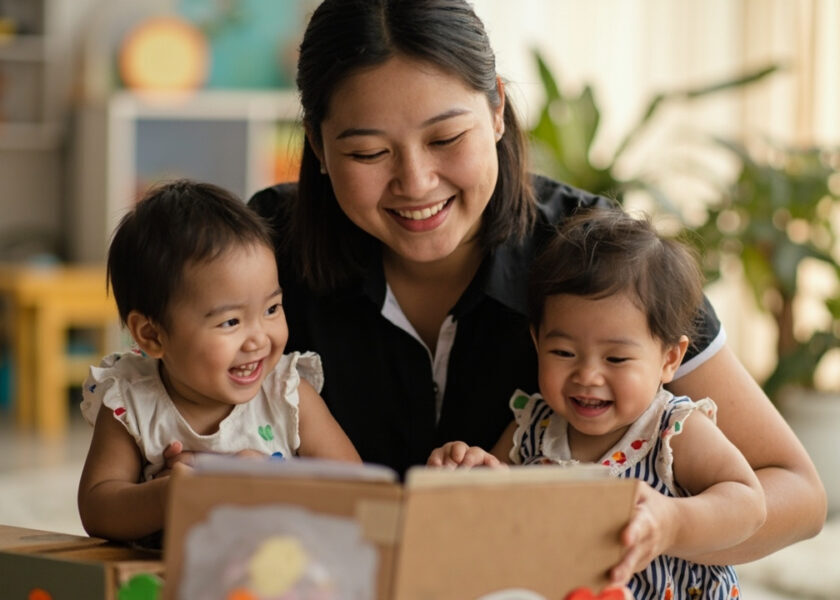
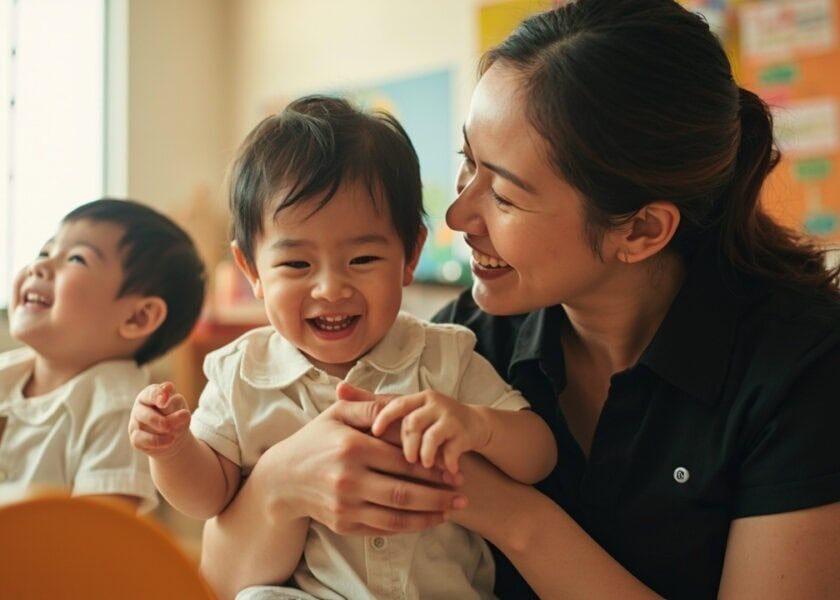
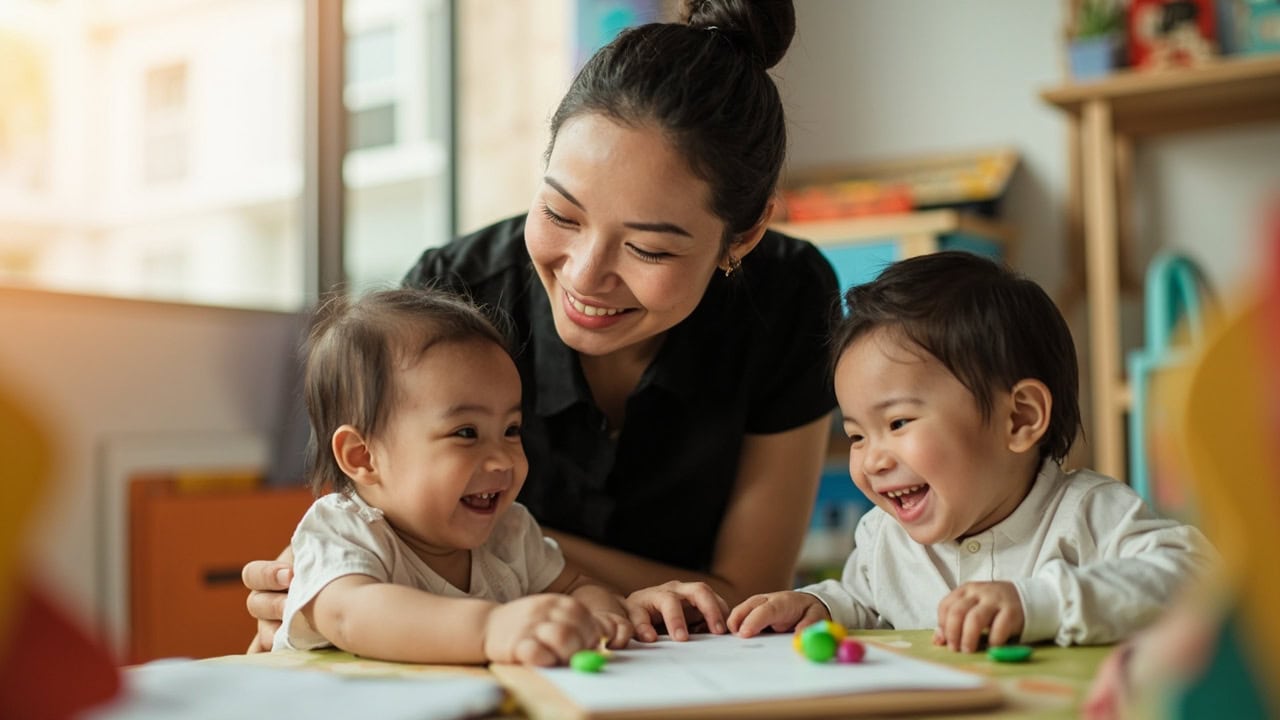
Consider a scene that captures this dynamic in miniature. Two brothers, three years apart, at the same childcare arrangement.
The older boy is quiet and watchful. His caregiver notices that he needs advance warning before transitions — that saying “in five minutes, we will clean up” helps him move through the world with a sense of control that his anxious little body craves.
She also notices that his younger brother — boisterous, fearless, always the first to climb — does not need this preparation. For him, the world is a place to act upon, not a place to brace against.
So she adjusts. She gives the older child his warnings. She gives the younger child her full attention when he returns from his climbs, asking him what he discovered, what he built, who he pretended to be.
But consider what is happening here. The caregiver is not just supervising two children. She is holding two different internal worlds simultaneously. She is calibrating her responses to two separate nervous systems, two separate ways of processing joy and fear and frustration. She is, without perhaps using these words, seeing each child as a separate story.
And the children know it. The older boy, years later, may not remember the warnings. But he will remember feeling safe. The younger boy may not remember being asked about his climbs. But he will remember feeling that his wildness was welcome.
The Signs of Genuinely Individualized Care
There is a practical question that follows from all of this, and it is one that parents are right to ask: how do I know if my caregiver is truly individualizing attention?
- Observe the language. Does your caregiver speak about your children as individuals? Does she say “your daughter has been working so hard on her puzzles this week” or does she say “they’ve been doing puzzles”? The shift from plural to singular is a small thing, but it reveals how attention is being paid.
- Notice what gets reported back. Quality caregivers share specific observations — not just that a day was good, but that a particular moment happened. Your son laughed at something unexpected. Your daughter asked a question that surprised everyone. These specifics are the currency of genuine attention.
- Ask questions that invite individuality. Instead of “how was nap time?” try “how did each child seem today?” This signals that you, too, are seeing them separately — that this is a shared framework for understanding your children.
- Communicate what you know. You are the expert on your children. If your eldest needs more transition time in the mornings, if your youngest is going through a phase of heightened separation anxiety, if one child is sensitive to noise while the other thrives in it — share this. A good caregiver receives this information not as criticism but as data.
What Siblings in Quality Care Quietly Learn
There is a common worry among parents — a fear that sharing a caregiver will somehow diminish each child’s sense of individual worth. That they will compete for attention, feel overlooked, learn to perform rather than to be.
This worry is understandable. It is also, in quality care, often unfounded.
Here is what siblings in thoughtful shared care actually learn: they learn about difference. They learn that the same caregiver can respond to their brother with patience and to them with enthusiasm, and that both responses are forms of love. They learn that people are not interchangeable — that their caregiver knows them specifically, and their brother specifically, and that this knowing does not diminish anyone.
They learn that relationships are not a pie, where someone else’s slice means less for them. They learn that attention is not a finite resource to be hoarded, but a renewable quality that grows when it is given.
These are not small lessons. These are foundational understandings about self and other that will shape how these children move through friendships, partnerships, workplaces — through every relational landscape of their lives.
The Sibling Bond as Training Ground
Sibling attachment, research tells us, is one of the longest-lasting bonds a human being will experience. Brothers and sisters will know each other longer than they know their parents, longer perhaps than they know their own children.
The sibling relationship is a training ground for every other relationship — for conflict and compromise, for loyalty and rivalry, for the discovery that someone can be both exasperating and essential. A skilled caregiver does not intervene in this dynamic. A skilled caregiver creates the conditions for it to unfold naturally, with guidance when needed and spaciousness when not.
The caregiver notices when siblings are learning cooperation, and when they need separation. She understands that sometimes the best thing for a younger child is to watch their older sibling navigate a challenge, and that sometimes the best thing for an older child is to have a space that is entirely their own.
This is what professional care offers: not a replacement for family, but a complement to it. A trained observer who can see patterns you might miss because you are too close, too loving, too invested. A second set of eyes that notices what your children are building together when you are not watching.
Addressing Your Real Concerns
Let us be honest about the worries you may be carrying.
Will my caregiver really know my youngest as an individual, or will she see him mainly as the younger sibling?
In quality care, the answer is: each child is known as themselves. The caregiver builds a separate relationship with each sibling — separate enough that she can tell you what makes your youngest laugh, what frustrates him, what he is currently obsessed with. He is not a footnote to his older sibling. He is a person in his own right.
What if my children have very different temperaments? Can one caregiver really meet both their needs?
Different temperaments require different responses, and yes, one caregiver can provide those different responses — if she is trained to notice them and supported in doing so. This is what individualized attention means. It is not doing more; it is seeing more. A skilled caregiver sees your careful child and your fearless child as two separate people with two separate sets of needs, and she meets them differently.
Will my children learn to compete for attention rather than learning to share it?
When attention is treated as infinite — when each child is shown that their caregiver’s response to them is whole and complete — competition fades. Children learn that there is enough. That being known by one person does not diminish another person’s claim to being known. This is what siblings in quality care learn. Not scarcity, but abundance.
What if my children have conflicts? Will the caregiver intervene fairly?
Skilled caregivers understand sibling conflict as developmental, not pathological. They do not always intervene, because sometimes siblings need to work things out. And when they do intervene, they address the behavior, not the children. They do not compare and they do not assign blanket blame. Each child is held accountable for their own actions, and each child is seen as capable of growth.
How EduNanny Singapore Supports Sibling Development
EduNanny Singapore was built on this understanding. Our caregivers are trained to notice, to differentiate, to hold each child’s individual story alongside the sibling dynamic.
Our observation practices are designed to capture what each child is experiencing — not as a group, but as a person. Our small ratios ensure that individual attention is not just an ideal but a structural reality.
What This Looks Like in Practice
- Individual observation records — each child’s development, preferences, and moments are documented separately
- Tailored response approaches — caregivers learn how each child’s temperament shapes what they need from comfort, play, and guidance
- Flexible grouping — siblings may be together or separately engaged depending on what serves each child’s development in that moment
- Parent communication — we share individual observations about each child, not just group summaries
Our Standards and Structure
EduNanny Singapore operates under the ECDA Childminding Pilot, which means our caregivers meet established standards for professional childminding in Singapore. We offer both home-based care and community or centre-based pathways, depending on what fits your family’s circumstances.
Our ratios ensure that individualized attention is structurally possible. Our fee structures are designed to be accessible within the pilot framework, and families can utilize the Child Development Account and Baby Bonus where applicable.
We believe in transparency. Where CCTV measures are deployed, they are deployed not to surveil but to build trust — to give parents windows into their children’s days, and to give caregivers a tool for reflection and improvement.
The Answer, When Care Is Done Well
Choosing childcare is not just a logistical decision. It is a statement about what you believe children need. It is a statement about what you believe your children deserve.
And if you are a parent of multiple children, it is a statement about whether you trust that the world can hold your children separately — can know your eldest’s careful precision and your youngest’s joyful chaos, can love them both without confusion, can help them become themselves without erasing the space between them.
When siblings share the same caregiver, does each child still become themselves?
The answer, if care is done well, is yes — and not just yes, but more fully yes than they might have otherwise. Because the sibling relationship, when held by a skilled and attentive caregiver, becomes a gift rather than a competition.
Children learn themselves partly through contrast. I am not like my brother, and that is okay. I am not like my sister, and I am still loved. Difference becomes a source of richness rather than a source of anxiety.
The caregiver who knows each sibling individually does something remarkable: she gives each child the experience of being the center of someone’s attention, even within a shared arrangement. She shows them that they do not have to fight for recognition, because recognition is not something that runs out.
And she shows the parents something too. She shows parents that it is possible to have more than one child, to love them with equal ferocity, and to trust that the world outside the family can see them — can truly see them — as separate, whole, irreplaceable individuals.
Every sibling deserves to live their own story. And the best childcare is the kind that makes space for all of them.
Talk to us about your family’s needs. We are here to listen.
If you are exploring childcare options in Singapore and would like to learn more about how EduNanny supports siblings and families, we welcome the conversation. Visit our homepage or read more about our approach to professional childminding.