Understanding Your Child’s Day When You Are Not There
The Question That Keeps Parents Awake
Let us be honest about what actually keeps Singapore parents up at night. It is not whether their child is safe. You have done the research. You have visited the centres, checked the ratios, read the reviews, asked the questions that matter. By the time a child is in someone’s care, that foundational trust has been established—at least enough to get through the door each morning.
What keeps you up at night, what nags at you in the shower and surfaces unbidden at dinner, is a different kind of question entirely. You want to know who your child is when you are not watching. You want to know what makes them laugh, what frustrates them, who they choose to sit beside at snack time.
You want to know if the person taking care of your child truly sees them—not just their safety, not just their schedule, but the particular texture of their joy, their curiosity, their becoming.
This is not a new anxiety. It is as old as the first time a parent left a child with someone else and turned around to walk away. But in Singapore, in this particular moment of intense parenting pressure and dual-income necessity, it has taken on a specific shape.
Parents are not just separated from their children during the day. They feel, sometimes, separated from understanding their children. And that is a different kind of loss.
Here is what I have come to believe after years of watching children and talking with parents: this gap is not inevitable. It does not have to be the price of modern parenting. And it is precisely the kind of gap that the right kind of care can close.
Witnessing, Not Just Supervision
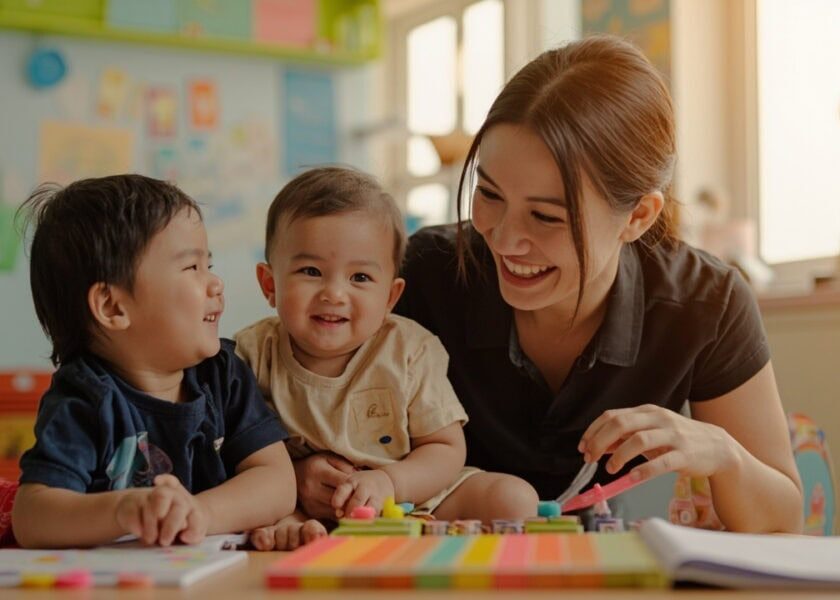
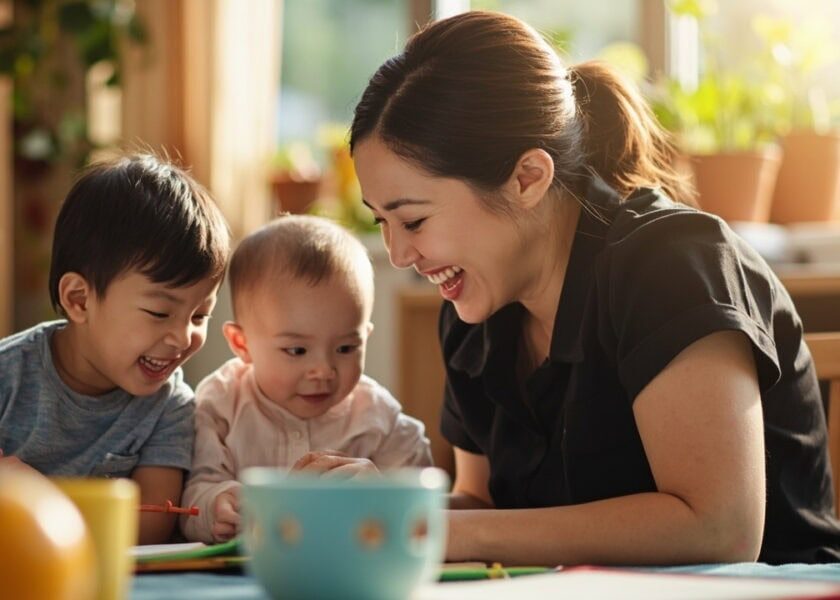
There is a difference between childminding and supervision, and it is enormous. The truest sense of childminding is not watching over a child. It is witnessing them—the disciplined practice of noticing, of tracking across hours and weeks and months the subtle grammar of a child’s development.
What does that mean in practice? It means that when a caregiver is truly watching, she can tell you not just that your eighteen-month-old played today, but that she offered a toy to another child for the first time, unprompted. It means she can describe the particular tone of your two-year-old’s voice when he is pretending to be frustrated versus genuinely frustrated, because she has seen both and knows the difference.
It means she notices that your child’s vocabulary has shifted in the past two weeks—that certain sounds are arriving, that a new kind of sentence is beginning to form.
This is not guesswork. It is the accumulated knowledge of a trained professional who has seen hundreds of children move through these same milestones, who knows the range of normal, and who is paying attention to where your particular child falls within it.
When such a caregiver speaks to you at pickup, she is not giving you a surface report. She is offering you a window.
What Trained Eyes See
Consider language development, one of the most visible and least understood of a young child’s daily occupations.
A parent might ask, “Is she talking yet?” and receive an answer that feels insufficient. But what if the caregiver could say:
“This morning, she independently named three animals in her picture book. She said ‘dog’ and ‘cat’ clearly, and attempted ‘elephant’ with a lovely approximation. She also had a moment where she pointed to a picture and said ‘dere’—which I think was her way of saying ‘there,’ referencing where the duck is standing in the water. She is trying to use location words now. That is new.”
Do you feel the difference? In the second version, you receive something far more valuable than a yes or no. You receive a glimpse into your child’s specific, ongoing project of language acquisition. You understand not just that she is learning to talk, but how—what kinds of connections she is making, what the texture of her emerging speech sounds like.
With that knowledge, you can go home and read that same book and hear her say “there” again. You will know what she means. You will be inside her experience, not outside it.
The same principle applies to the social and emotional world—which is even harder for parents to see. Children under three are not miniature adults navigating social situations. But they are social beings, learning in real time through every interaction how to be with other people.
A parent picking up their child cannot see the moment two hours earlier when another child took a toy and their child did not cry but walked to a different corner and found something else to play with. They cannot see the fifteen minutes their child spent watching two older children build a block tower before tentatively reaching out to add one block of his own. They cannot see the small heartbreak when a friend moved to a different table and the careful, wordless way their child processed that loss before moving on.
These moments are invisible by default. But they do not have to be.
“Today was a big day socially for him. He and Jiahao played together for almost thirty minutes—the longest sustained play I have seen from him. He was the one who suggested they build something together. I think he is really entering a new phase of wanting collaborative play.”
Or:
“She was a bit off this morning. I noticed she kept looking at the door. It might have been the transition from the weekend—Mondays are sometimes harder. I gave her extra time with the sensory bin and she settled eventually.”
Notice what is happening here. The caregiver is not just reporting facts. She is offering interpretation—a framework for understanding what you saw when you picked up your child. And with that framework, you are no longer guessing. You know what you are looking at.
Developing Your Own Observational Eye
The caregiver is not the only one who can learn to see. Observation is a practice that deepens over time, with attention and language and the willingness to slow down.
Many parents feel, in those early years, that they lack the vocabulary to name what they are seeing in their own child. They know something is happening—they can feel it in the quality of their child’s cry or the way their toddler looks at a butterfly—but they cannot articulate it.
And if you cannot articulate it, it is harder to respond thoughtfully. It is harder to trust your own instincts. It is easier to default to generic reassurance or vague worry.
The good news is that this changes. When you are given the language—the developmental frameworks, the observational vocabulary, the practice of noticing—you become a more perceptive parent. Not because you suddenly become an expert, but because you begin to see what was always there.
Think of this as learning a new kind of literacy. Your child is sending signals all the time: through their play, their art, their appetite, their sleep, their behaviour at the end of the day. A parent who learns to read those signals is equipped in a way that no amount of generic parenting advice can provide.
This is why the caregiver-parent relationship, when it works well, is not a one-way street. The caregiver observes the child during the day and shares what she sees. The parent takes that information home, holds it alongside their own evening and weekend observations, and begins to build a richer, more layered picture.
Over time, the parent starts to see what the caregiver sees. The gap between the child’s unseen hours and the parent’s understanding narrows. And when that gap narrows, the relationship changes. The parent feels more competent. More connected. The evening is not spent worrying about whether the child had a good day, but building on what they know about a specific, textured, knowable day.
What Quality Childminding Looks Like
Quality childminding looks like:
- A caregiver who notices the small victories—not just milestones, but the quiet moments of growth
- Updates that go beyond meals and naps to include observations about language, social play, and emotional regulation
- Consistent caregivers who know each child’s rhythms, preferences, and particular way of being
- Ratios that allow for real attention—for infants, one-to-three ratios make observation possible in a way that larger groups do not
- A partnership with parents where both parties contribute to understanding the child
When EduNanny was conceived, this was the vision at its centre. Not just to provide childcare, but to provide a particular kind of care—one in which the observation of children is treated as a professional skill and a relational practice. One in which the caregiver is understood as a developmental partner, not just a supervisor.
EduNanny operates within the ECDA Childminding Pilot, which means caregivers are trained and supported within a framework that takes this work seriously. Depending on the pathway—whether home-based, community-based, or centre-based—families experience ratios that allow for real attention.
This means caregivers who know each child’s rhythms, each child’s preferences, each child’s particular way of being in the world. It means the kind of continuity that allows patterns to emerge. And patterns are where development lives.
Safety remains the foundation. EduNanny’s caregivers are trained within the ECDA framework, with appropriate certifications and ongoing professional development. Ratios are maintained. But trust built solely on safety assurances is incomplete trust. When parents also understand why their child thrived today—and what that means for tomorrow—that trust runs deeper.
Within the pilot framework, fees are structured to be accessible, and the use of CDA and Baby Bonus funds is supported, so that quality care is not only available to those who can pay premium rates. The translation of a child’s day should not be a luxury reserved for families with significant means.
The Early Years: Why This Matters
The early years are not a waiting room. They are not a prelude to the real story that begins at Primary 1. The first thousand days of a child’s life are saturated with development—with the architecture of language being built, with social circuits being formed, with the foundations of emotional regulation and cognitive flexibility being laid down in ways that will matter for decades.
What happens in those hours—the hours when a parent is not in the room—is not a detour from the child’s story. It is part of the story. And parents who are shut out of understanding those hours are shut out of something that belongs to their child and to them.
When a caregiver observes your child—when she notices the moment your daughter first shares a toy without being asked, when she sees the social courage it took for your son to invite another child into his game, when she tracks the emergence of a new sound or a new sentence—she is not just keeping a record. She is contributing to a narrative that you and your child are writing together.
When that observation is shared with you, translated into language you can understand, you become a fuller participant in that narrative. This is what quality childcare offers: a mirror for your child’s inner world. It shows you who they are—not as a projection of your hopes or anxieties, but as they are revealing themselves, day by day, in the ordinary hours of their life.
For the Parent Who Is Still Wondering
I want to close by speaking directly to the parent who has been wondering, in a vague and persistent way, what is really happening during the day. The one who feels a little disconnected at pickup. The one who wants to be better at reading their child but does not quite know how to start.
You are not failing. You are not a bad parent because you cannot be there every moment. You are a parent in Singapore, in this particular time, making the choices that need to be made.
But you are also someone who wants to understand—who longs to see your child clearly, to know them more deeply, to be present in their experience even when you are apart.
That longing is not a weakness. It is one of the most important things about you as a parent.
And it is not out of reach.
Consider what becomes possible when you have a caregiver who truly sees your child, communication that goes beyond surface updates, and a framework that helps you understand what you are looking at when you pick up your child and wonder about their day.
Consider what becomes possible when the unseen hours become seen. When you gain, not a substitute for your own relationship with your child, but a lens—a deeper, richer, more textured understanding of who they are and who they are becoming.
Your child’s day is full of meaning. It always has been. You just need someone to help you find it.
EduNanny is here to offer that: quality care that sees your child, and helps you see them too.
If you would like to learn more about EduNanny’s approach to childminding, you are welcome to read about our team and philosophy, or reach out to begin a conversation. We are glad to answer your questions and help you think through whether EduNanny might be the right fit for your family.