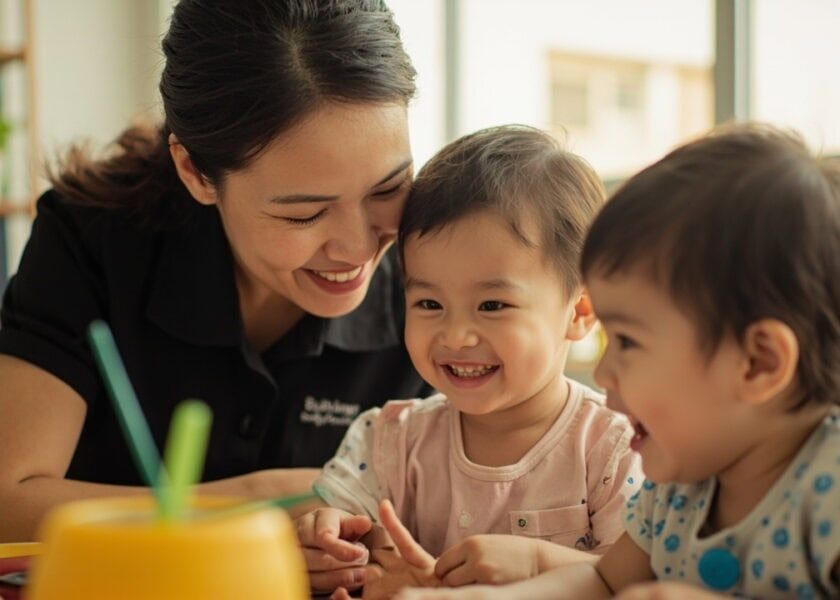
Beyond the Drop-Off Understanding Your Child Through Quality Observation
The Silence After Drop-Off: What Your Childcare Update Is Actually Telling You
There is a particular silence that settles over a Singapore morning after drop-off. The car seat is empty beside you. The nursery door is closed. You have made the decision, trusted the process, handed your child to someone whose name you learned only weeks ago. And now you wait for the update that will tell you something true.
This is the moment most childcare conversations forget to address. We talk extensively about choosing, about the weight of the decision, about the criteria that matter and the questions worth asking. Those conversations are important. But they leave something unsaid about what comes next—the hours between morning and evening when your child exists outside your line of sight, and the only bridge between you is whatever message arrives on your phone.
Quick Summary: What Quality Childcare Communication Should Look Like
- Generic updates confirm survival—a photo of lunch, a note that says “had a good day.” They tell you nothing about who your child was that morning.
- Quality updates reveal development—they describe how your child approached the water table, how they handled frustration with another child, what made them laugh and what gave them pause.
- The difference matters because you are not just leaving your child with a caregiver. You are trusting someone to witness your child’s hours—and that witnessing deserves to be shared with you.
- For Singapore parents, this distinction is especially important. Infant care costs are significant, the ECDA Childminding Pilot sets standards worth understanding, and the gap between routine reporting and genuine developmental insight is wider than most parents expect.
Understanding What Quality Updates Actually Look Like
Here is what most parents discover: the update often says very little.
A photograph of your child eating lunch. A note that says “had a good day.” A timestamp confirming pickup occurred. These are not meaningless gestures—they represent genuine effort. But ask yourself what these updates actually tell you about your child’s emotional state, their growth, their small victories and quiet struggles.
Ask yourself if they answer the question that sits heaviest after drop-off—not is my child safe? but who were they today?
The transition is not always graceful. The first days, sometimes the first weeks, carry a particular texture. There is the moment of handover when your child looks back at you with an expression you cannot quite read. There is the walk to the car where you replay that look, wondering if you made the right choice, if the separation is too much.
This anxiety is not weakness. It is the mark of a parent who cares deeply about what happens to their child. Quality childcare providers understand this. They do not expect confidence to arrive overnight. What they offer instead is something more tangible: a different kind of communication that meets you exactly where this anxiety lives.
The EduNanny Approach: From Report to Reflection
Rather than a daily report, you receive something closer to an observation. Not a list of activities completed, but a window into how your child moved through the morning.
Consider the difference between these two updates:
Generic update: “Sam had lunch and played outside.”
Reflective observation: “Sam spent the morning returning compulsively to the water table, transferring water between containers with intense focus. This kind of concentration signals cognitive engagement and fine motor development—a temperament that approaches learning through sensory exploration.”
One fact. One observation. But the observation invites you into your child’s inner world in a way that the fact alone cannot.
EduNanny’s caregivers operate under an observation protocol that prioritizes specificity over generality. They note not just what happened but how it happened, what preceded it, what followed. They track the texture of your child’s interactions—not as data for data’s sake, but because patterns emerge from texture, and patterns reveal your child’s trajectory.
Here are examples of the kind of communication EduNanny provides:
- Emotional development: “Your daughter spent twenty minutes building a tower and then deliberately knocked it down, laughing. Has she always been drawn to that particular kind of destruction, that satisfaction in beginning again?”
- Social navigation: “Your son showed unusual hesitation at circle time today, hanging back from the group. The caregiver sat nearby without pressure, allowing him to observe before he chose to participate.”
- Conflict resolution: “Your child became visibly upset when another child took their preferred toy. They used words rather than physical action to express frustration, and afterward they sought comfort from the caregiver before returning to play.”
- Small observations with meaning: “Your child refused the afternoon snack but accepted water—a detail that might connect to a tooth coming in. Your child chose a different book than usual at story time, one with more animals than vehicles, a preference you might not have noticed at home.”
These are not extraordinary revelations. They are ordinary moments rendered visible through attentive observation.
Why This Matters for Your Child’s Development
This is one of the most quietly profound outcomes quality childcare can offer: it gives you a better understanding of your own child.
Consider what the conflict resolution example tells you. It reveals your child’s emotional regulation, their conflict resolution instincts, their trust patterns. It tells you that when upset, they reach for human connection before self-soothing. This is information that changes how you understand your child, and it changes how you parent them in the evenings and weekends that follow.
The update becomes a conversation, even when asynchronous. A caregiver might note a behavior and ask if you’ve noticed it at home. A parent might respond with context that helps the caregiver understand the child more deeply. This bidirectional communication creates a feedback loop that benefits everyone—but especially the child at its center.
When the adults in a child’s life share observations, the child receives more coherent care. When caregivers and parents align in their understanding, the child moves between home and care with less friction, because both environments are responding to the same child.
Why does this kind of communication matter so much?
The answer goes beyond the practical value of knowing your child’s schedule, though that matters. It goes beyond the reassurance of safety, though that matters too. It touches something deeper about what it means to love a child you cannot watch every moment.
Parents in Singapore, like parents everywhere, carry a tender paradox: they want their children to be independent, to thrive beyond their direct presence, to grow into capable people who need them less and less. And simultaneously, they want to remain connected, to understand, to be present even when physically absent.
These two desires exist in tension, and quality childcare holds that tension rather than resolving it prematurely. When you receive an observation that reveals your child’s day, you do not feel the distance between you and your child shrink. You feel the connection survive the distance. That distinction matters enormously. It is the difference between enduring separation and experiencing connection across separation.
There is an emotional rhythm to the first weeks with quality childcare that deserves acknowledgment. The initial days carry their own particular energy—hope mixed with hesitation, gratitude mixed with grief for the lost hours of direct connection.
Parents often report feeling uncertain about whether they should be receiving so much information. The answer is yes. Quality childcare communication is still rare. Most parents have grown accustomed to updates that reassure without revealing. When something more arrives—the observation, the insight, the question offered back—it can feel almost too good to expect.
Over time, the rhythm changes. The anxiety of the first days softens into something closer to anticipation. You begin to look for the update not with dread but with genuine interest. You find yourself discussing the observation with your partner over dinner, wondering together what it means, making connections you had not made before.
Parents who receive quality updates rarely second-guess their choice. Not because they have no doubts—doubts are human—but because the evidence of quality is visible daily. A generic report might have come from anywhere. An observation that reveals your child’s emotional landscape, that names a pattern you recognize but had not articulated, that asks a question that deepens your understanding—this could only come from a caregiver who was genuinely paying attention.
The Operational Foundation Behind the Approach
Philosophy without practice is just sentiment. So here is what supports EduNanny’s communication approach on the ground:
| Standard | What It Means for Your Child |
|---|---|
| ECDA Childminding Pilot alignment | Operates within established standards for home-based and community-based care across Singapore |
| Caregiver ratios up to 1:3 | Caregivers can observe rather than merely supervise—they can pause and watch, notice meaning behind behavior |
| Monday–Friday care blocks | Consistency that young children need for security and routine that parents need for planning |
| CDA and Baby Bonus eligibility | Quality childcare accessible within Singapore’s family support framework |
The ratio detail is not incidental. When a caregiver is responsible for fewer children, they can notice more. They can wonder about the meaning behind a behavior rather than simply managing the behavior itself.
We want to be clear about what we offer and what we do not. We offer structured, intentional communication that prioritizes developmental observation over routine reporting. We offer caregivers trained to notice, to reflect, and to share that reflection with parents in ways that are both specific and meaningful. We offer the operational framework of a program committed to quality standards, appropriate ratios, and accessible fees for Singapore families.
We do not offer perfection, because children are complex and caregivers are human. We do not offer guarantees, because development is not linear and every child is unique. What we offer is consistency, attention, and a genuine belief that parents deserve to know their children even during the hours apart.
Questions Worth Asking When Choosing Infant Care in Singapore
If you are currently researching childcare options, here are questions worth asking beyond the standard tour:
- Ask about their update format. Request a sample daily report. Does it tell you what your child did, or does it describe how your child was?
- Ask about caregiver ratios. Singapore’s ECDA Childminding Pilot establishes standards for home-based care. Understand what ratio your potential provider maintains and why it matters.
- Ask how observations are recorded. Is there a structured approach to tracking developmental patterns, or is reporting left to individual caregiver discretion?
- Ask about communication rhythm. When can you expect updates? Are they bidirectional—can you respond with context that helps caregivers understand your child better?
- Pay attention to the emotional tone. During your visits, do caregivers seem engaged with children as individuals, or is the focus primarily on logistics and safety?
You may already sense that something is missing from the options you have encountered. The update that tells you everything and nothing. The photograph that could have been taken on any day. The reassurance that sounds the same whether the day was peaceful or challenging.
That absence is not accidental. It reflects a system that prioritizes efficiency over observation, volume over attention, the minimum required over the maximum meaningful.
Living the Choice You Made
The mornings will still be hard. The first separations will still carry weight. You will still walk to your car after drop-off and feel the particular silence of a child left behind, even if only for hours.
But when that update arrives, something will be different. It will not be a confirmation that your child survived the morning. It will be a revelation that your child lived the morning—fully, specifically, in ways that were noticed and named and shared with you because you are the parent who deserves to know.
When you choose childcare that communicates differently, you enter into something more than a service arrangement. You enter into a partnership that recognizes one fundamental truth: the hours your child spends away from you are not lost hours. They are hours of enormous developmental significance, hours in which your child is learning to navigate relationships, regulate emotions, explore their environment, and discover what kind of person they are becoming.
Those hours deserve to be witnessed with intention. And that witnessing deserves to be shared.
This is what quality childcare communication offers. Not just care, but understanding. Not just a service, but a partnership in the truest sense—a shared commitment to knowing your child as well as they deserve to be known.
You chose this. Now live it.
EduNanny provides development-focused childminding and infant care rooted in attentive observation, meaningful communication, and genuine partnership with families across Singapore. Learn more about the EduNanny approach or connect with our team to explore whether EduNanny is right for your family.