What Your Child Is Quietly Building While You Are Apart
Understanding What Your Child Is Really Building
We call it confidence. We call it self-worth. We call it emotional security. All of those words are true, but none of them are quite enough. What we are really talking about is something deeper and more fragile—something that begins in the earliest years and shapes everything that follows.
The quiet certainty inside a child that says: I am capable. I am safe. I belong here. I can try.
That inner certainty does not appear overnight. It is not taught in a lesson or reinforced by a toy. It is built, slowly and almost invisibly, in the everyday rhythms of a child’s life—in the way they are held, spoken to, responded to, and allowed to explore. It grows in the space between interactions. For many Singapore children today, one of the most significant of those spaces is the time they spend in quality childcare.
Singapore parents are navigating something genuinely difficult. You are raising children in one of the most demanding environments in the world. You are expected to be present at work, present at home, present in your parenting, and present in your own identity—and somewhere in all of that presence, you are making decisions about who will care for your child during the hours you cannot be there.
That is not a small thing. It is one of the most consequential decisions you will make in your child’s early years, and you are making it with incomplete information, imperfect options, and a heart that wants to get it exactly right.
The anxiety around this decision is real and understandable. You hear a great deal about what your child needs in the first five years—their brain architecture, their neural pathways, their language development, their school readiness. And all of that matters.
But here is the truth that matters most: the child who grows up feeling capable, feeling secure, feeling genuinely good about who they are carries something with them into every relationship, every classroom, every challenge, every disappointment, and every triumph for the rest of their lives.
What Genuine Confidence Looks Like in a Young Child
This is where parents often feel the most uncertainty. We know what confidence looks like in an adult. We know what it looks like in an older child—someone who can speak up, who can lead, who can walk into a room and feel at ease. But in an infant or a toddler, confidence is quieter and harder to read. And yet it is there, if you know what to look for.
In a very young child, confidence does not announce itself. It shows up in small things:
- The toddler who attempts the climbing structure again after falling, without needing to be encouraged.
- The infant who reaches for a toy that is slightly out of reach, testing what their body can do.
- The two-year-old who brings a book to an adult not because they cannot hold it but because they want to share the experience of looking at it together.
- The three-year-old who, when another child takes a toy, does not collapse into tears but finds another way to engage—because somewhere inside them, there is a belief that there are options, there are solutions, the world has not ended.
This is not innate personality. This is not temperament. This is something that is being built, brick by brick, in every interaction your child has with a responsive, warm, consistent caregiver who communicates—through action more than words—the message that matters most:
You matter. What you feel is real. You are capable of more than you know. I believe in you.
The Science of What Feels Like Love
That message cannot be delivered in a lecture. It cannot be printed on a poster. It cannot be part of a curriculum. It can only be communicated in relationship—in the moment-to-moment quality of care your child receives when someone is truly present with them.
When a caregiver notices that your child is frustrated and names it. When they let your child struggle a little before helping, because they know that struggle is where capability is born. When they celebrate small victories with genuine delight. When they are consistent, so that your child learns to predict the world’s response and therefore trusts it.
This is not a soft or sentimental idea. This is developmental science in the truest sense of the word. When a child experiences consistent, warm, responsive care in the early years, they are not just feeling good. They are building something structural inside themselves—a sense of security that becomes the internal working model they carry into every relationship for the rest of their lives.
Psychologists call this secure attachment. You might call it the feeling that the world is basically safe and that they are basically okay. And it is one of the most powerful predictors we have of a child’s long-term well-being—not just emotionally, but in terms of their ability to learn, to collaborate, to recover from setbacks, and to form healthy relationships.
Signs to Watch For: Reading Your Child’s Homecoming
Here is the honest question I hear most often, in different words and from different angles: How do I know my child is actually building that kind of foundation when I am not there?
It is one of the most legitimate questions a parent can ask, and it deserves an honest answer. You cannot know for certain, because the most important things happening in your child’s development are invisible. They are not the things that show up in photographs from the classroom, not the activities listed in the weekly update, not the developmental milestones ticked off on a checklist. They are the quiet internal processes happening beneath the surface—in the quality of your child’s felt experience, in the quality of the relationships they are forming with the people who care for them.
But there are signs. There are real, observable signs that your child is building genuine confidence and security. One of the most powerful of those signs is the homecoming.
When your child comes home from a day in quality childcare, you may notice things that tell you something important is happening:
- Energy quality: Your child may be tired, but the tiredness has a different quality to it—the tiredness of a child who has been active, engaged, and growing, not the flat tiredness of a child who has simply been managed.
- Natural sharing: Your child may be eager to show you something—a drawing, a game they invented, a song they learned—not to perform, but to share.
- Warm references: Your child may mention their caregiver by name with warmth, not just in passing but in a way that suggests genuine affection.
- Spontaneous storytelling: Your child may talk about what happened during the day, not because they were asked but because they want to.
- Growing willingness: Over time, your child may show an increased willingness to try new things, to persist at tasks that are difficult, to engage with other children with a growing sense of ease.
And then there is the longer arc. You will see it in how your child handles being away from you—not with dread, not with a daily meltdown that never resolves, but with a kind of underlying trust. The quiet knowledge that you come back, that the day ends, that home is there.
You will see it in how your child plays independently, because they have internalised a sense that they are capable. You will see it in the years ahead, when your child walks into their first classroom, meets their first teacher, makes their first friend—not with anxiety but with a readiness that tells you they believe, in some deep and unshakeable place, that they can handle what comes next.
What Quality Childminding Actually Looks Like
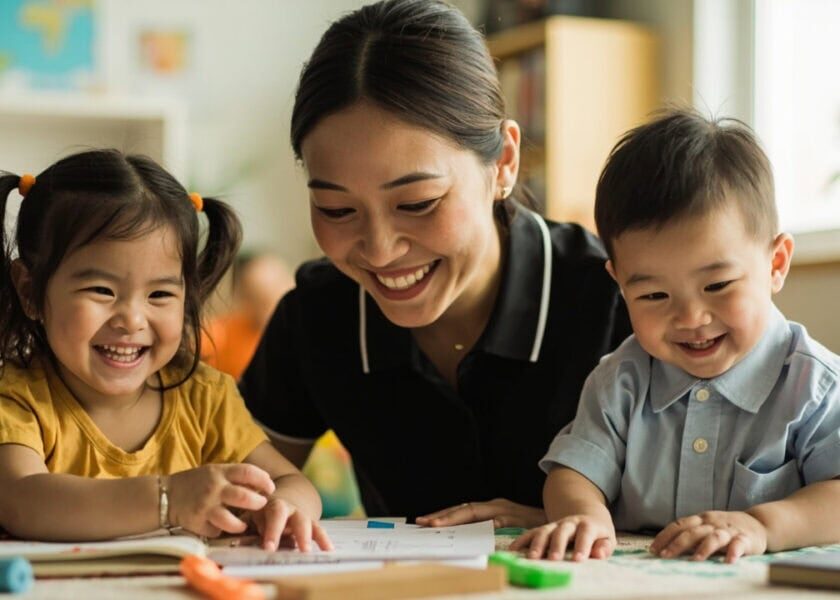
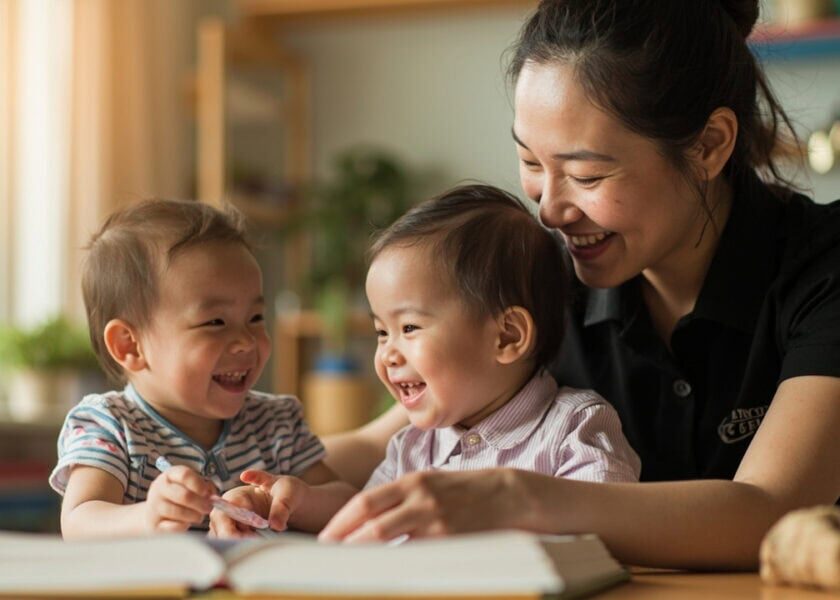
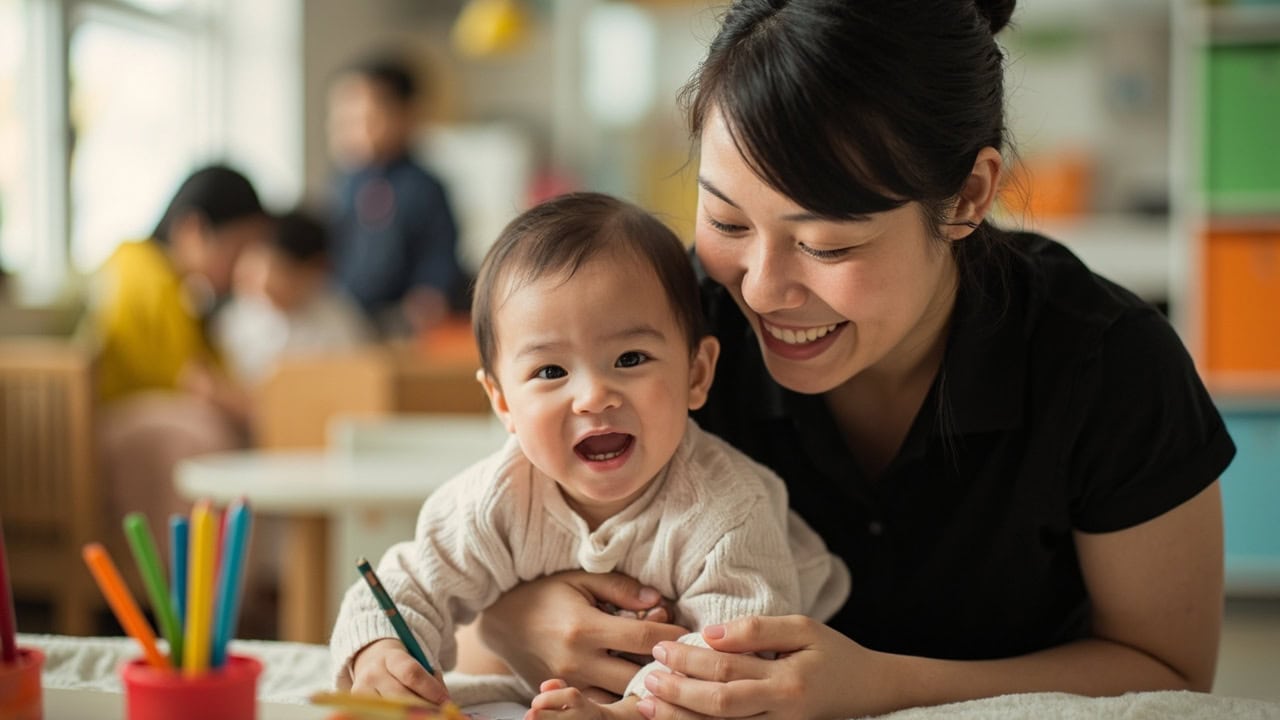
The real work of quality childcare is not visible on a tour. It happens in moments like these:
- A caregiver notices a child beginning to frustrate and gently names what they are feeling before the emotion escalates.
- A child struggles to stack blocks, and the caregiver waits—not rescuing, not withdrawing, but trusting the child to work through it.
- A small victory happens—the blocks finally stack—and the caregiver responds with genuine delight, matching the child’s own excitement.
- A child brings a toy to a caregiver not needing help, but wanting connection—to share the experience of play.
- A child falls, and the caregiver’s calm response teaches them something about the world that words never could.
These are not dramatic moments. They are ordinary ones. And it is in the accumulation of ordinary moments like these—day after day, week after week—that a child’s inner world takes shape.
How EduNanny Creates These Conditions
EduNanny, part of the ECDA Childminding Pilot, is built on a commitment to what quality childcare means in Singapore. We believe the early years are not a waiting room before real life begins—they are real life, and the foundations laid now shape everything that follows.
We operate within both home-based and community pathways, because families are different and one size does not fit all. In our infant care settings, we maintain ratios of up to one to three—which means your child is not one of eight or ten in a room, but one of one, two, or three, in the care of someone who can genuinely know them. Someone who can notice the small things. Someone who can respond in real time. Someone who can build the relationship that makes confidence possible.
Our care operates Monday through Friday, in structured care blocks that give your child’s day a rhythm they can trust. And we have worked to ensure our service is accessible—within pilot fee structures, with the ability to use CDA and Baby Bonus funds, because we believe quality childcare should not be available only to families who can afford premium pricing.
Beyond the structure, beyond the ratios, beyond the logistics, EduNanny is built on a developmental philosophy that sees the child not as someone to be watched but someone to be known. Our caregivers are trained to understand the difference between a child who is quiet because they are calm and a child who is quiet because they are afraid. They are trained to distinguish between a child who is playing because they are engaged and a child who is playing because no one is playing with them. They are trained to read the signals—the small, easily missed signals—that tell them whether a child is building confidence or merely passing time.
Common Questions
“How do I know my child is actually thriving?” Not just adjusting. Not just entertained. Thriving. This is the question beneath the question, and it deserves a direct answer. You know by watching for the homecoming signals described above—not isolated incidents, but patterns over time. The child who comes home energised rather than depleted. The child who mentions their caregiver with warmth. The child who, over weeks and months, shows a growing willingness to explore, to try, to engage.
“Isn’t any good childcare basically the same?” Not quite. The difference lies in intentionality. Anyone can keep a child safe, fed, and clean. But building genuine confidence requires caregivers who are trained to read the invisible—children’s emotional states, the quality of their engagement, the small signals that indicate whether they are growing or merely passing time. It requires ratios that allow for genuine relationship. It requires a philosophy that sees the child as a whole person being shaped from the inside out.
“Is my child too young for this to matter?” The early years are precisely when this matters most. The neural architecture that supports emotional security is being built now, in the first five years, through exactly these kinds of everyday interactions. This is not a race. It is a foundation. And foundations, as any builder will tell you, determine everything that comes after.
Transparency and Ongoing Support
We know that trust, for you as a parent, is not optional. You are leaving your child with someone else during the most important developmental window of their life. You need to know what is happening.
So we have built our service with communication and transparency at its heart—including CCTV where deployed, regular updates, and open lines between our caregivers and the families they serve. Not because we are required to, though we meet regulatory standards, but because we believe you deserve to know what your child is experiencing in the hours you are apart.
There is something else that reflects our understanding of modern parenting: our Thomas AI Chatbot. Parenting in Singapore is demanding. The questions do not stop at the childcare door. Thomas is there—a resource you can turn to at any hour, with questions about development, behaviour, milestones, sleep, feeding, and all the thousand small concerns that arise when you are raising a young child. It is one more way EduNanny surrounds your family with support, not just during the workday but across the whole landscape of early parenthood.
A Framework for Choosing Infant Care in Singapore
When evaluating your options, consider asking not just about curriculum and activities, but about the quality of relationship your child will receive:
- Ratio and attention: How many children per caregiver? Can your child be genuinely known?
- Caregiver training: Are caregivers trained to read emotional signals, not just manage behaviour?
- Communication: Will you know what is happening during the day? How is information shared?
- Consistency: Will your child have the same caregiver over time, building the trust that comes from predictability?
- Philosophy: Does the approach see your child as someone to be watched, or someone to be known?
- Homecoming quality: When you observe pick-up, do the children seem energised, connected, and at ease?
The Choice You Are Actually Making
When you choose a childcare arrangement—whether it is home-based, centre-based, or through a quality provider like EduNanny—you are not just choosing who will watch your child today. You are casting a vote. You are making a statement about what you believe your child deserves and what kind of person you want them to become.
You are saying, through that decision, that the internal world your child is building—the quiet, invisible architecture of confidence, security, and self-worth—matters as much as the external markers of development. That it matters as much as academic readiness, as social skills, as the ability to follow instructions and share toys and use the toilet independently.
In fact, the internal world is the foundation on which all of those other things are built. A child who feels secure, who believes in their own capability, who has learned that the world can be trusted and that they are enough—that child will learn to read, to share, to navigate social complexity, to persist through difficulty. Not because someone taught them to, but because they have the inner resources to do so. They are growing from the inside out, not the outside in.
Let me come back to that moment. Five-thirty in the evening. Your child running toward you. The energy in their body. The light in their face. The something that you can feel but cannot name.
You now know what you are looking at.
You are looking at the most important work that any of us do—the slow, patient, invisible work of building a human being who trusts themselves. Your child is carrying something home in their smile and in their posture and in the way they reach for your hand. Something that grew today while you were not there to witness it. Something that is yours to celebrate and ours to keep building.
We know the question you are asking every day, whether you say it aloud or not: Is my child okay? Is my child growing into someone who believes in themselves? Is my child becoming secure, capable, and ready?
And our answer, in everything we do at EduNanny, is yes. That is exactly what we are here for.
If you are considering your childcare options and would like to learn more about how EduNanny supports families in Singapore, we welcome you to begin a conversation with our team. You can also read more about our approach and what sets EduNanny apart as a trusted developmental childcare and childminding service.
#SingaporeChildcare #InfantCareSingapore #ChildmindingSG #QualityChildcare #EduNanny