How to Choose Infant Care Built on Real Relationships
The Question Beneath the Question
There is a question parents rarely voice — because asking it can feel like admitting doubt. It lives quietly beneath the surface of every childcare visit, every second visit, every moment of second-guessing:
Can anyone outside my family truly know my child the way I do?
Can they read the particular quality of her cry when she is tired versus when she is hungry? Can they notice that he calms when given a moment to observe before joining a new situation? Can they remember that she needs the door left open just a crack?
These are not the questions that appear on childcare evaluation forms. But they are the ones that matter most when you are entrusting your child’s earliest years to someone else.
Here is the honest truth: those questions deserve real answers. Not reassurances. Not platitudes. Not carefully worded copy about qualified staff and accredited facilities. Real answers about whether the kind of knowing your child deserves can actually happen — and what it looks like when it does.
This is what quality infant care was built to answer. And it is where the real conversation begins.
What Research Tells Us About Quality
When we talk about childcare quality, we tend to talk about buildings. We discuss curriculum frameworks and teacher credentials. We evaluate ratios and meal plans and playground equipment. We ask whether the centre is clean, whether it feels warm, whether the staff seem friendly.
All of this matters. But it is not the thing that determines whether your child thrives.
Study after study in developmental psychology points to the same conclusion: the quality of the child-caregiver relationship is the single most predictive factor in early childhood outcomes. Not the toys. Not the program. Not the square footage of the facility.
The relationship.
A caregiver who is warm but does not attune to your child’s particular temperament will not produce the same outcomes as one who is warm and also learns to read your child’s cues, adapt to their rhythms, and respond to their needs as they exist in this specific, unrepeatable child.
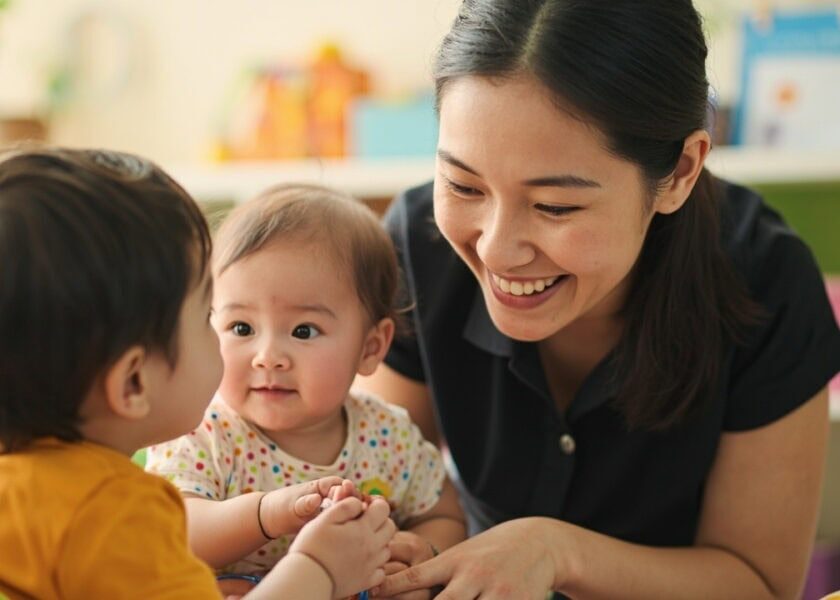
This is the difference between a caregiver who loves children in general and one who knows your child in particular. It is the difference between supervision and the kind of genuine, individualized attention that allows a child to feel: I am seen. I am known. I matter to this person.
When that happens, your child builds something precious — a second relational home, one that carries real developmental weight. A caregiver who has learned your child’s particular language — not the words they use yet, but the signals, the preferences, the inner life still taking shape — becomes a person your child trusts, turns to, and feels secure with.
What Relational Attunement Looks Like
So what does this look like on an ordinary Tuesday afternoon?
It means the caregiver has learned your child’s tempo — whether she plunges into new experiences or hangs back, processing before participating. It means they know how he communicates when he is hungry, when he is overstimulated, when he needs movement versus stillness. It means they have noticed that she is soothed by certain textures, that he reaches for faces before he reaches for objects, that they both have a witching hour when the afternoon tips toward evening and everything needs to slow.
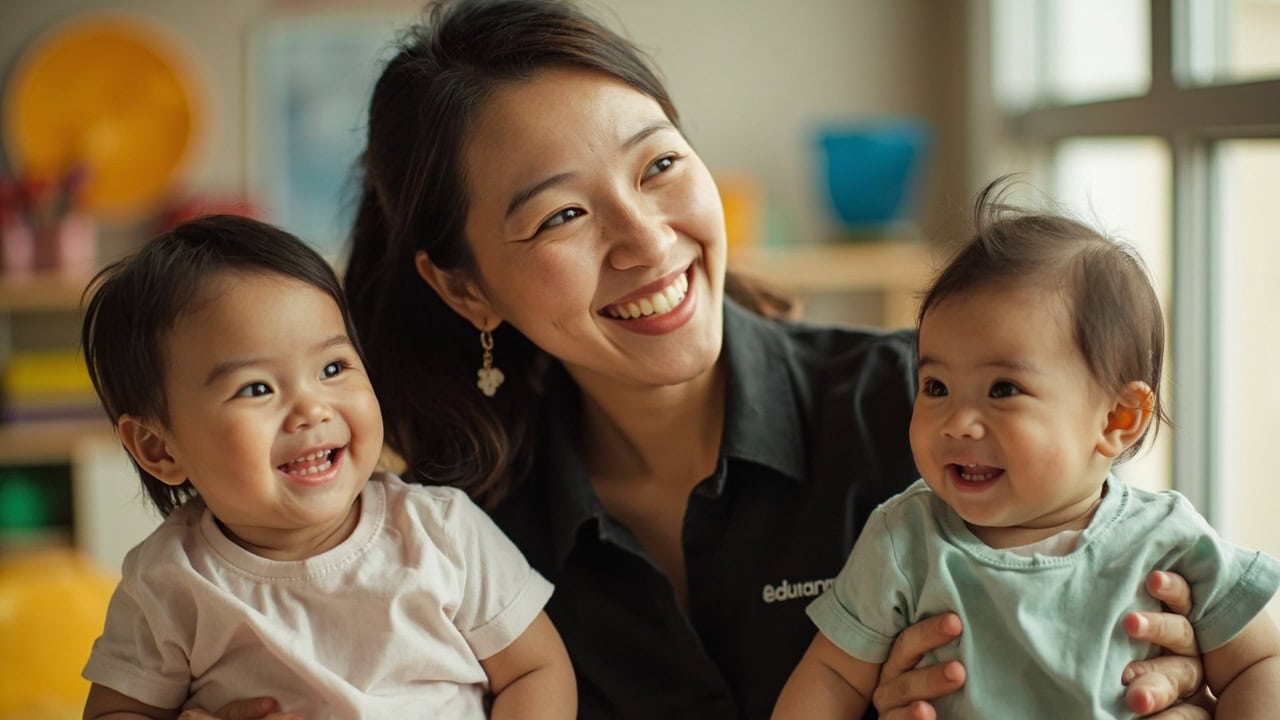
A caregiver who knows your child will tell you, at handover, not just what your child ate and when they slept. They will tell you who your child was today.
“She was particularly focused this morning. She spent twenty minutes building and rebuilding that block tower, and when it finally fell she didn’t get frustrated — she laughed and started again.”
“He was tired today. I could see it in the way he moved. We kept things slower, and he rested well.”
These are not observations a caregiver can manufacture. They emerge only from sustained, attentive presence — the kind of attention that happens when a caregiver has made it their work to understand your child as an individual: not a slot in a group, not a developmental stage on a chart, but a person with a temperament, preferences, and a unique way of moving through the world.
This is relational attunement. It is not something a curriculum can script into existence. It is cultivated through continuity, small ratios, and an environment where a caregiver can actually notice your child instead of managing a group.
Why This Bond Matters for Development
Parents sometimes feel uncertain about whether they are allowed to prioritize this. They worry that they are being too demanding, too particular, too focused on something that seems subjective. They think: surely the credentialed centre with the better resources is the right choice?
Here is what developmental science tells us: the architecture of your child’s brain is being built in these early years in ways that will shape their capacity for emotional regulation, social connection, and learning for the rest of their lives. This is not hyperbole. It is the consensus of decades of research.
The neural pathways that allow a child to trust, to explore, to recover from disappointment, to form healthy attachments — these are built through the quality of their relational experiences. Specifically, through the experience of being responded to by a caregiver who has learned to read them, adapt to them, and meet them where they are.
When a child has even one consistent, attuned caregiver outside the family, they develop what researchers call a secure base. A sense that the world is navigable, that people are trustworthy, that their needs matter and will be met.
This is not a soft or abstract outcome. It is the foundation for everything that follows: how well your child will do in school, how they will navigate friendships, how they will handle the inevitable stresses and transitions of growing up.
The quality of the caregiver-child relationship is not one factor among many. It is the primary mechanism through which early childhood development happens.
How to Recognize and Foster Genuine Connection
How can you know whether this kind of relational attunement is actually happening? You cannot follow your child through the day. You can only observe from the outside, and what you see is limited.
Here is what you can look for.
Observe your child’s ease around their caregiver
A child who has a genuine relational bond with their caregiver will show it in their comfort. Not perfection — young children have difficult transitions, and that is normal. But a baseline of ease. Recognition. The kind of settling that happens when you are with someone who knows you.
Notice the handover conversation
A caregiver who truly knows your child will tell you something about who they were today. They will not just report logistics. They will tell you about their mood, their interactions, the texture of their day. If the answer to “how was she?” is always “fine” or “good,” ask follow-up questions. The depth of knowledge should be apparent in the specificity.
Look for individual recognition
Does the caregiver greet your child by name? Do they anticipate your child’s particular needs? Or does your child seem to move through the day as one of a group, attended to by whoever is available?
Over time, you should feel that your child has a person — not just a position, but a person — who has made it their work to know them.
Understand what makes this possible
For this kind of knowing to develop, certain conditions need to exist. It is not enough to hope that a caregiver will connect deeply with your child — the structure of care needs to make it possible.
Continuity over rotation. A child cannot form a genuine bond with a rotating cast of unfamiliar faces. They need a consistent caregiver who remains present over time, accumulating knowledge of who they are — seeing patterns, learning preferences, remembering what worked last week and what did not.
Small ratios. A caregiver managing a large group cannot attune to each child individually. Their attention is necessarily divided. True relational attunement requires the space to actually notice — to see when a child’s energy is shifting, to respond to a cue that only someone paying close attention would catch.
Intentional matching. Beyond structure, there is the question of fit. Just as children have individual temperaments, caregivers have individual approaches. A caregiver who is naturally calm and observant may be a wonderful match for a child who needs space to warm up. A caregiver who is energetic and warm may be ideal for a child who thrives on responsive play.
Trust your instinct. If something feels off, it probably is. And if something feels right — if you sense that your child is known, attended to, responded to as the specific person they are — that is not wishful thinking. That is the most important indicator you have.
Common Concerns, Honest Answers
“Isn’t this kind of care a luxury?”
Many parents assume that individualized, relationship-centred care is only available at premium fees. This assumption deserves to be challenged. Approaches like EduNanny’s childminding model operate within accessible fee structures, and families can use CDA funds and Baby Bonus contributions where applicable. The commitment is to make this quality of care available across Singapore — not just to those with significant financial resources.
“How is this different from a childcare centre?”
Childcare centres offer important services, and many do excellent work. The distinction is structural. In larger group settings, the primary unit of organization is often the class or the program. In a childminding model built around relational match, the primary unit is the caregiver-child relationship itself. Continuity, small ratios, and intentional matching are not aspirations — they are design principles.
“What about transparency and accountability?”
Parents understandably want to know what is happening when they are not there. Where transparency measures like CCTV are deployed, they function best within a context of relational trust rather than institutional surveillance. The relationship comes first. The structures exist to support it, not to replace it.
“Am I being too particular in looking for this?”
No. Developmental science confirms what your instincts already tell you: the caregiver-child relationship matters more than any other factor in how well your child thrives in care. Prioritizing relational quality is not being difficult or demanding. It is being clear about what actually matters.
Practical Guidance for Choosing Infant Care
If you are evaluating your options, here is a framework for thinking through what matters most:
| What to Consider | Questions to Ask |
|---|---|
| Continuity | Will my child have a primary caregiver, or will care be shared across multiple staff? |
| Ratios | What is the caregiver-to-child ratio? How does this affect the attention my child will receive? |
| Matching | How does the service approach the fit between caregiver and child? |
| Handover quality | Can I expect to hear about my child’s mood and experience, not just logistics? |
| Affordability | Can CDA funds or Baby Bonus contributions be used? |
Ask these questions not just of the service, but of yourself. Notice how your own child responds during visits. Notice what feels aligned and what feels off. You are the expert on your child. Trust that expertise as you make this decision.
Your Child’s Most Important Relationship Outside Your Family
Singapore parents face real pressures. Long work hours, demanding careers, extended family often scattered across distances. The stakes feel high. The decision about who will care for your child in these crucial early years carries a weight that is difficult to articulate — which is why it often goes unarticulated.
You want someone who will love your child. You want someone who will keep them safe. You want someone who will notice when they are frustrated and help them through it. You want someone who will see who they are becoming and nurture it.
This is not too much to ask. But it does require choosing differently than the default — prioritizing the quality of the relational match over the shininess of the facility, the depth of the caregiver bond over the breadth of the curriculum.
The question beneath the question is never really about credentials or ratios or even curriculum. It is about whether your child will be known. Whether the person caring for them will come to understand who they are — their particular temperament, their individual ways of taking in the world, the specific constellation of needs and strengths that makes them unrepeatable.
If you find that — if you find the caregiver who has made it their work to learn your child, to respond to them, to build a relationship of genuine attunement — you will know it. You will feel it in the handover conversation. You will see it in your child’s ease. You will sense that something important is happening, something that goes beyond the logistics of childcare into the territory of real developmental partnership.
Your child’s most important relationship outside your family is waiting to be built. And the right match can make all the difference in how they move through the world — not just today, but for years to come.
If you are beginning to explore what this kind of care looks like in practice, EduNanny Singapore offers an approach designed around the relational match as the primary principle — built for families who believe, as the research confirms, that relationships are where early childhood development actually happens.
To learn more about how EduNanny approaches relational infant care in Singapore, visit edunanny.com. For questions about fit, timing, or getting started, the team is available here.