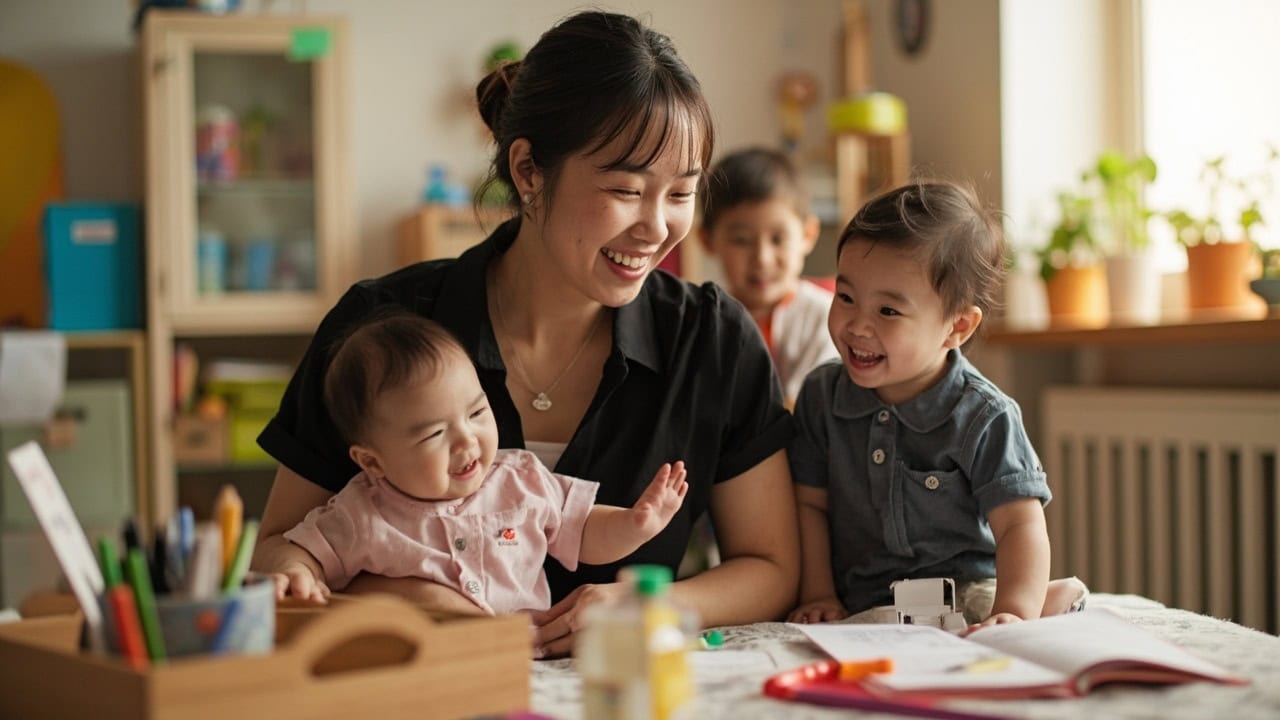
Singapore Parents Discover Childcare That Empowers the Whole Family
Quick Summary
- The real search: When you look for childcare, you are not just finding someone to watch your child. You are finding the conditions that allow you to remain whole.
- The tension: Singapore parents carry immense weight—professional excellence, family duties, future planning—all while cultural messaging suggests that good parents give everything of themselves.
- The reframe: Quality childcare is not a compromise. It is a choice made for your whole family, including you. The parent who flourishes creates better conditions for everyone.
- The option: EduNanny by BUTLER operates within Singapore’s ECDA Childminding Pilot, offering home-based infant care with a one-to-three ratio, consistent caregivers, and transparent communication—designed to serve the entire family.
- The decision: Choosing childcare is not just logistical. It is a statement about who you are becoming as a parent and what you value for your family.
Understanding What You’re Really Looking For
When a parent begins searching for childcare, they frame it as a practical matter. They talk about returning to work, about logistics, about who will watch the baby while they are gone. The language is careful, competent, focused outward.
What is rarely said—what feels almost too vulnerable to name—is that the search for childcare is also a search for something the parent needs for themselves. Space. Permission. The conditions under which they can remain whole.
We know that Singapore parents carry a particular weight. The expectations are high: excel at work, raise capable children, maintain a home, preserve family ties, plan for the future. The support systems that once existed—extended families nearby, villages that raised children collectively—have shifted.
In their place, we have built a culture of individual responsibility where asking for help can feel like an admission of failure, and where the parent who chooses quality childcare is sometimes subtly encouraged to feel they are choosing something other than their child.
EduNanny Singapore was built with this understanding at its center. Not as a marketing insight, but as a genuine recognition of what families in this city actually need.
What Quality Childminding Actually Looks Like
When we speak about EduNanny by BUTLER, we are speaking about a childminding arrangement that operates within Singapore’s ECDA Childminding Pilot—an initiative designed to expand the range of quality care options available to families across this island.
It is a pilot grounded in the understanding that home-based care—when done well, when supported by proper training and oversight—offers something that institutional settings often cannot:
- Continuity: A consistent caregiver in a familiar environment
- Genuine attention: Small ratios that allow for real connection
- Reliability: The kind of presence a child can count on, built for depth rather than scale
For the infant, this means care that is attentive and responsive, rooted in the understanding that those first months and years are not simply a waiting period before real life begins. They are real life—when identity is formed, when trust is established, when the architecture of connection is being built.
The one-to-three infant ratio that EduNanny maintains is not an abstract number. It is the practical expression of a belief that every infant deserves to be known, not just watched.
Why the Best Arrangement Serves the Parent Too
Here is what we have learned, and what we want parents to hear: the arrangement that serves the child best is also the arrangement that serves the parent best.
This is not a compromise. This is not settling for less. This is the truth that our culture often obscures behind the language of sacrifice.
When a parent has quality childcare—when they know their infant is not merely safe but genuinely well-cared for in a setting that reflects their own values—that parent has something easy to underestimate and almost impossible to overestimate. They have the ability to think. To breathe. To return to the version of themselves that existed before, and to begin the work of integrating that person with the person they have become.
This is not selfishness. This is not avoidance. This is the foundation from which sustainable parenting actually becomes possible.
Consider what it means for a parent in Singapore to return to work not from a place of guilt, but from a place of confidence. When the childcare arrangement is one you genuinely trust—when you receive regular communication and updates about your child’s day, when there is transparency about what is happening and how—the mental load that once consumed your working hours begins to lift.
You can focus. You can create. You can be present in your professional life without the low-grade anxiety that has become so normalized many parents no longer recognize it as anxiety at all.
This matters not because professional achievement is the measure of a good parent, but because parents are people—and people have aspirations that existed before parenthood and do not simply evaporate because a child has arrived.
A parent allowed to grow professionally is a parent who can model what it looks like to pursue meaningful work. A parent allowed to maintain their interests, friendships, and sense of self is a parent who returns to their child not depleted but replenished.
The presence that matters most is not constant proximity—it is genuine attention, and genuine attention requires that the person giving it has something left to give.
The EduNanny Approach: What Sets Us Apart
EduNanny understands this. Our approach is built on the recognition that childminding is not a lesser form of childcare, not a stopgap between infancy and more serious educational settings. It is its own discipline, its own calling, with its own dignity.
Our childminders are trained, supported, and treated as the professionals they are. They are not interchangeable figures who happen to be present. They are partners in the child’s development, and in the family’s wellbeing.
The communication protocols we maintain—regular updates, transparent practices, and where deployed, measures like CCTV that give parents visibility into their child’s day—are not bureaucratic additions. They are expressions of respect for the parent, for the trust they are placing in us, and for the weight of the decision they have made.
We also know that families have practical questions. Here are the ones we hear most often:
“Am I failing my child by choosing childcare?”
The cultural narrative in Singapore tells parents—particularly mothers—that good parents sacrifice completely. That wanting anything for yourself, any space outside of caregiving, means loving your child less.
This narrative is not true, and it is not helpful. A parent who maintains their own identity—who continues to grow, to learn, to pursue interests beyond parenthood—is a parent who returns to their child as a whole person. The child benefits not from a parent who has given everything, but from a parent who has kept something for themselves.
“What should I actually look for in infant care?”
When evaluating childcare options, consider what matters most for your family’s situation:
- Ratio and attention: For infants, look for small ratios—at most one caregiver to three infants. This allows for genuine responsiveness rather than management of many children at once.
- Consistency: Consistent caregivers build trust with your child over time. Babies develop security through predictability and familiar faces.
- Environment: Home-based care offers a different quality of environment than larger centers—smaller, more personal, often more adaptable to the child’s rhythms.
- Communication: How will you know what happens during the day? Look for arrangements that prioritize transparency and regular updates.
- Training and oversight: In Singapore, the ECDA Childminding Pilot ensures proper training and oversight for home-based caregivers.
“Is this financially accessible?”
The ability to use the Child Development Account and Baby Bonus funds for childminding services removes a layer of financial friction that can make the difference between a family choosing care they feel uncertain about and a family choosing care that genuinely meets their needs.
Childcare as Family Leadership
We know that choosing childminding is not a small decision. It is a statement about how a family understands its own needs.
It is a declaration that the parent matters—that their wellbeing is not incidental to the project of raising a child but central to it. It is an act of family leadership, of the kind that says: we are going to do this thoughtfully. We are going to invest in arrangements that serve everyone. We are going to reject the idea that love must look like self-erasure.
When you choose childcare, you are not choosing between your child and yourself. You are choosing conditions that allow everyone in the family to flourish.
The child does not need a parent who has given everything. The child needs a parent who has kept something for themselves—ambition, curiosity, joy, the capacity to grow—and who can therefore offer presence that is full rather than depleted.
There is a transformation that happens in families when this truth is embraced. It is not dramatic. It does not announce itself with grand declarations.
It is quiet. It is the mother who realizes one morning that she has been thinking about her own future again. It is the father who notices that the time he spends with his child on evenings and weekends feels richer than it did before—not because he loves his child more, but because he has more of himself to give.
It is the subtle shift from parenting as obligation to parenting as something that flows from a place of fullness rather than emptiness.
Begin the Conversation
EduNanny by BUTLER is honored to walk this path with the families who choose us. We know the weight of what you carry. We know that Singapore asks much of its parents, and that much of what it asks goes unspoken.
We are here because we believe that the way a family cares for its children is an expression of its deepest values, and because we believe those values should include the care of the caregiver as well.
So if you are a parent reading this—if you have been searching for childcare and finding yourself unable to articulate what you actually need—we want you to know:
- It is alright to need something for yourself
- It is alright to choose an arrangement that serves your whole family, including you
- It is alright to refuse the story that says good parents disappear
The choice you make in childcare is not just about who watches your child. It is about who you are becoming. It is about what kind of parent you want to be—not in the abstract, not in the ideal, but in the real, in the daily, in the sustainable reality of raising a family in Singapore today.
Explore your options. Ask questions. Discover what it feels like to have a partner in this journey—one who understands that the best care is the kind that serves everyone it touches.
Because this is what childminding can be. And this is only the beginning.
Learn more about EduNanny’s approach to childminding, or connect with our team to discuss what your family needs.