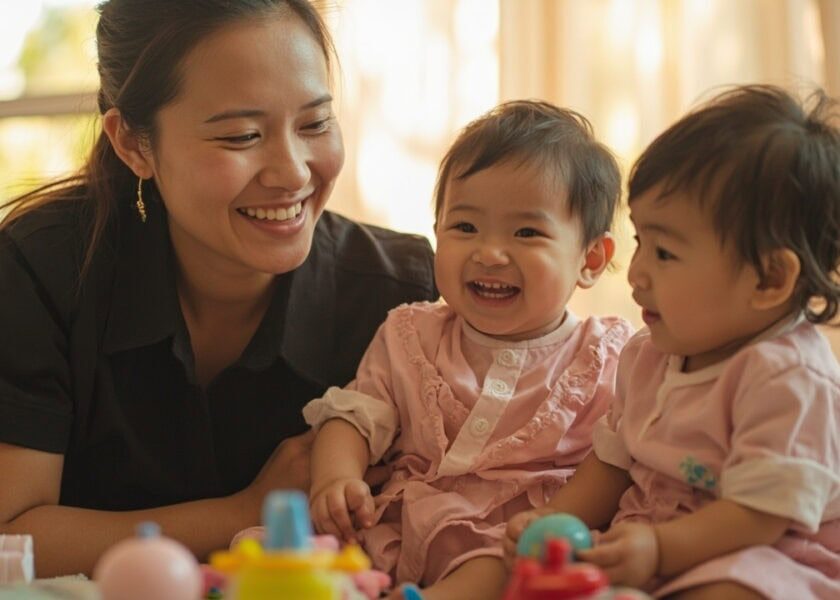
How Singapore Parents Are Building a Better Village for Their Children
You’re Not Choosing Between Family Love and Quality Care. You Can Have Both.
There is a question many Singapore parents carry quietly—sometimes for months, sometimes for years. It surfaces late at night, after the children are asleep. It sits in the back of the mind during family gatherings, during conversations with parents and in-laws, during moments when someone asks, “Who looks after your child during the day?”
The question is not really about childcare. It is about loyalty. It is about love. It is about whether wanting something different for your child means you are turning away from everything your family has given you.
This is one of the most under-discussed tensions in Singapore parenting today. And if you are a parent who has ever felt caught between the way your family cares for your child and the care you wish your child could have—you are not alone.
The discomfort you feel is not a character flaw. It is a sign that you care deeply about both things: your family’s role in your child’s life, and your child’s future.
Where Singapore Families Actually Live
In Singapore, raising a child is rarely a private affair. It is woven into the rhythms of families—grandparents who step in without being asked, helpers who become trusted figures in a child’s early years, relatives who have opinions and offer opinions and sometimes intrude and sometimes save you.
The village that raises a child is not an abstraction here. It is real. It is present. And it is complicated and precious and exhausting and wonderful all at once.
And it is changing.
More parents today are thinking carefully about what quality looks like in the early years. They read about developmental milestones, about the importance of language exposure, about how a child’s brain builds fastest in those first years in ways that will never come again. They want their children to have routines, spaces designed for play and exploration, and caregivers trained in how children learn and grow.
But wanting those things creates a particular kind of guilt in a Singapore context. Because the moment a parent considers professional childcare—not just for emergencies but as a regular part of the week—something complicated begins.
The parent starts to wonder: Am I replacing my mother? Am I telling my mother-in-law that what she did for her children was not enough? Am I being ungrateful?
These are not easy questions. And they deserve more than easy answers.
The Real Source of the Guilt—and the Reframe That Changes Everything
After years of walking alongside Singapore families through these decisions, we have come to understand something important: the guilt so many parents feel is not actually about the childcare itself. It is about identity. It is about belonging. It is about the fear that choosing something new means abandoning something old—and that in doing so, we are somehow less of a son or daughter, less of a family.
This is especially true in Singapore, where multigenerational care is not just a tradition but a financial and practical reality for many households. The grandparent who provides free childcare so both parents can work is not just a caregiver; they are a pillar of the family’s structure. The helper who has been with the family for years is not just an employee; she is part of the household’s emotional fabric.
To bring in professional care can feel, at first, like a judgment—like saying: what you do is not good enough.
But here is what we have also learned: that feeling, as real as it is, does not reflect the truth of what professional childcare does. And the sooner we name that clearly, the sooner parents can breathe.
The Difference Between Family Love and Developmental Care
There is an important distinction between the love that family gives and the developmental care that children need. They are not competing products on a shelf. They are not two versions of the same thing.
Family love is where a child first learns what safety feels like. It is where identity begins. It is the grandmother who speaks in her mother tongue, the grandfather who tells stories from a childhood your child will never know otherwise. It is the particular way your family holds a baby, sings a song, celebrates a birthday. These things cannot be replicated, and they should not be. They are the inheritance your child receives simply by being part of your family.
But children also need more than love. They need enrichment. They need language exposure—lots of it, consistently, across different voices and contexts. They need routines that help them understand the world is predictable and safe. They need spaces designed for their developmental stage, with materials that invite curiosity and challenge.
They need caregivers who understand how children think, how they process, how they play their way into understanding. They need to be in groups sometimes, learning to navigate peers, to share, to resolve small conflicts, to experience the particular joy of being known by more than just family.
These are not luxuries. They are not things you add on when your child is old enough for school. They are the very substance of early development—and the people who provide them professionally are not replacing your family. They are doing something different, something your family was never meant to do alone.
Professional Care Is a Complement, Not a Substitute
Professional childcare is not a substitute for family care. It is a complement to it. It fills a different role in your child’s life—not instead of grandmother, not instead of you, but alongside.
The question is not whether professional care should replace your family’s love. The question is: what do you want each part of your village to do well?
When families make this reframe, something shifts. The guilt does not disappear entirely—emotional lives are not that simple—but it loosens. It makes space for something else: clarity. Purpose. The quiet confidence that comes from knowing you are not betraying your family. You are building something new that includes them.
Honoring Everyone in Your Village—Grandparents, Helpers, and Beyond
Let us talk about the people who are already in your child’s life, because this is where the tension is most acute for many families.
Grandparents: Not Replaced, Re-Imagined
If you are a parent whose own parents have been heavily involved in caring for your child, you know that this involvement is not simple. There is gratitude, yes. There is also exhaustion—for them and for you. There is the unspoken knowledge that their ways of doing things may not align with what you have read, what you believe, what you want for your child. There is the difficulty of correcting someone who raised you, of setting boundaries with someone who has authority in your life that goes deeper than childcare.
And when you think about introducing professional care, there is the fear: they will feel replaced. They will feel rejected. The relationship will suffer.
But this fear, while understandable, underestimates your parents. It also underestimates the nature of what grandparents actually give your child.
Grandparents offer something that no amount of professional care can replicate. They offer continuity—generational links to culture, to story, to identity. They offer a different quality of attention: unhurried, patient, suffused with the particular joy of loving a grandchild without the daily weight of discipline and decisions. They offer a relationship that will outlast your child’s school years, that will be there when professional caregivers have moved on.
What professional care offers is different: structured learning, developmental support, small group environments with ratios that allow for real attention, training that equips caregivers to nurture cognitive and physical growth in age-appropriate ways.
These two things are not in competition. They are not even on the same axis.
In fact, many families find the opposite of what they feared. When professional care steps in during the day, grandparents often find themselves more present during visits. They are not exhausted from full-time caregiving. They can simply enjoy their grandchildren again. The quality of their time together improves. The relationship deepens. They become, once more, the beloved grandmother and grandfather—not the substitute parents who were struggling to do everything.
The Helper in Your Child’s Life
There is another figure in many Singapore households that deserves mention: the domestic helper who has become a primary caregiver.
For many families, the helper is not just someone who assists with household tasks. She is the person who has spent the most waking hours with your child. She may have been there at the first steps, the first words, the first separations. She may have a bond with your child that is real and meaningful.
When families consider professional childcare, there can be guilt here too. A fear that professional care somehow invalidates the helper’s contribution. A worry about how to integrate professional support when a helper is already deeply involved.
Here is our perspective: professional childcare does not erase what your helper has done. It does not diminish her role in your family’s story. What it can do is provide the training, the structure, the oversight, and the developmental framework that a busy household may struggle to provide on its own.
It can give her support—resources, guidance, clearer boundaries—so that she can do her job with more confidence and less isolation.
The helper who works alongside a quality childcare program is not replaced. She is elevated. She becomes part of a team, with clearer expectations, better resources, and the knowledge that your child is getting professional attention that complements her own care.
What Quality Childminding Actually Looks Like
Parents often tell us they know they want something better for their child—but they are not sure what “quality” actually means when it comes to infant and early years care. This is understandable. The language of early childhood development can feel abstract when you are standing in a childcare centre or meeting a childminder for the first time.
Here is a clearer way to think about it. Quality childcare, for infants and young toddlers, is care that:
- Understands how children learn at this age. Not through worksheets or formal instruction, but through play, through sensory exploration, through responsive interactions. Every song, every stack of blocks, every mess made in a sensory bin is a lesson in how the world works.
- Provides consistent, warm responsiveness. Infants and toddlers learn that the world is safe when the adults around them respond reliably. This is not about being perfect—it is about being present, consistent, and attuned.
- Supports language development actively. Quality care means caregivers talk to children constantly—not at them, but with them. They narrate, they name, they respond to babbling as if it matters, because it does. Language exposure in these early years is one of the strongest predictors of later school readiness.
- Offers age-appropriate routines and environments. Infants need different things than toddlers. Toddlers need different things than preschoolers. Quality care adapts to the developmental stage of each child, not the convenience of the schedule.
- Maintains safe, manageable group sizes. For infants and young toddlers, smaller ratios matter enormously. One-on-one attention or very small group settings allow caregivers to observe, respond, and support each child’s individual development.
- Works as a partnership with families. Quality care is transparent. It communicates with parents, listens to their concerns, shares what the child is doing during the day, and integrates the family’s culture and values into the care setting.
These are not extras. These are the foundations of early development—and they are what professional, trained caregivers are equipped to provide.
How to Build Your Village: Practical Steps
It begins with a conversation. Often the hardest part is not finding the right childcare. It is talking about it—with your spouse, with your parents, with the people who will be affected.
Talk to Your Partner First
Before anything else, make sure you and your co-parent are aligned. These decisions carry emotional weight, and it helps enormously to know you are on the same page before entering conversations with extended family. Ask each other: What do we want for our child? What do we want each part of our support system to do well? What are we worried about?
Frame It as Addition, Not Replacement
When speaking to grandparents or extended family, frame professional childcare not as a replacement but as an addition. Say: We want our child to have what grandparents give and also what trained caregivers give. We want them to have the best of both. We are not choosing against you. We are choosing more.
Invite Them In
Let grandparents visit the childcare setting. Let them meet the caregivers. Let them see that this is not about distrust—it is about wanting more for their grandchild than any one person or arrangement can provide alone. When extended family can see quality care firsthand, the fear of replacement often dissolves into genuine curiosity—and sometimes, pride.
Be Clear About What Professional Care Will and Won’t Do
It will provide structured learning, developmental activities, small group experiences, trained caregivers, and consistency. It will not erase your family’s role. It will not replace the way your child is shaped by your family’s love and culture. It will not make your child forget where they come from. Being explicit about this helps everyone adjust.
EduNanny: Built for Singapore Families
We want to speak plainly about who we are and what we offer, because trust matters more than marketing.
EduNanny is part of the ECDA Childminding Pilot—a program built on the understanding that Singapore families need more options, not just more of the same. We offer home-based and community-based pathways for families who want professional, quality care that fits within the rhythms of their lives.
What does that mean, in practice?
- Small group settings with ratios of up to one to three infants, because in the early years, smaller really is better.
- Caregivers trained in early childhood development—not just in keeping children safe, but in understanding how they learn, how they grow, how they need to be supported in these foundational years.
- Structured, play-based activities designed to support language, cognition, motor skills, and social-emotional development in age-appropriate ways.
- Transparent communication with families—regular updates, clear channels, and in some settings, measures that allow parents to see what is happening during the day. We want you to feel not just comfortable with our care, but genuinely confident in it.
- Accessibility. The pilot fee structures are designed to make quality childcare accessible to more families. We are happy to share how CDA and Baby Bonus funds can be used to support your enrollment. This is not a service designed only for those who can afford premium pricing. It is a program built to serve Singapore families broadly, across different neighborhoods and circumstances.
- Monday to Friday care blocks, structured around what working families actually need—not just childcare that fits a schedule, but care that is intentional, developmental, and aligned with what research tells us about how young children thrive.
And most importantly: we do not come into your family and take over. We listen first. We learn about your household, your dynamics, your hopes. We see ourselves as an extension of what you are already building—not a replacement for your family’s love, but an addition to your village.
Common Questions, Honest Answers
“Will my child be confused by having multiple caregivers?”
Children are remarkably adaptable. What they need is not fewer relationships but secure ones. When each caregiver is warm, consistent, and responsive, children learn to trust and attach across contexts. Multiple loving relationships do not dilute attachment—they expand it.
“What if my parents feel hurt?”
This is one of the most common concerns we hear. The key is in how you frame it. Emphasize that you want more for your child—not something different, not something better than what your parents gave, but an additional layer of care that complements what they offer. Invite them into the process. Let them see the setting. Let them meet the caregivers. Let them feel like part of the decision, not excluded from it.
“Can we afford quality childcare?”
EduNanny’s pilot fee structures are designed with accessibility in mind, and many families are surprised to learn how CDA and Baby Bonus funds can be applied. We encourage you to ask us directly—we would rather have an honest conversation about affordability than have families rule themselves out unnecessarily.
“What if the care doesn’t align with how we parent?”
Quality childcare should feel like an extension of your family, not a parallel universe. Before enrollment, ask about how the programme communicates with parents, how it handles routines, how it approaches feeding and sleep and discipline. The right programme will not just tolerate your input—it will actively seek it.
The Children Who Thrive—and the Village That Holds Them
Here is something we have come to believe deeply through working with families across Singapore: the children who thrive most are not those who have only one kind of care. They are those who have many sources of warmth, many people who love them well, many contexts in which they feel safe and curious and known.
When a child has a secure base at home with grandparents who adore them, and also has quality care during the day that supports their development, they are not confused or conflicted. They are enriched. They learn that the world is full of people who care for them, that love can come from many places, that they can attach to more than one trusted adult without it diminishing any of those bonds.
This is not a theory. It is what we see every day in the children who come to us. They bring home the songs they learned, the stories they heard, the skills they practiced—and they bring them to the grandparents who delight in hearing them. They show off what they learned at childcare, and grandparents beam. The two worlds do not compete. They weave together.
And the parents? They arrive home less exhausted, because they have had the support they needed during the day. They are more present, more patient, more able to enjoy the evenings and weekends with their children and their families. The guilt they carried has softened into something else: the recognition that they made a choice that served everyone better, not just their child.
In every generation, in every culture, children have been held by more than just their parents. They have been shaped by grandparents and aunts and uncles and neighbors and community figures and, yes, by caregivers outside the family who brought skill and care and intention to the work of nurturing.
We are part of that tradition. Not the beginning of it, and not the end. Just an addition—another piece of the village, designed to serve families who are navigating the beautiful complexity of raising children in a world that is changing faster than any of us expected.
A Note for Parents Still Thinking
If you have been thinking about this for months—if you feel the weight of what it would mean to make this choice—here is what we want you to hear:
You are not being disloyal. You are not being ungrateful. You are not failing your family.
You are trying to do something difficult and important: build the best possible future for your child, within the context of a family you love and a culture you belong to.
That takes courage. It takes thoughtfulness. It takes the willingness to have hard conversations and hold different perspectives at once.
And it takes the right partner—someone who understands that your family is not a problem to be solved but a culture to be honored. Someone who will not try to replace what your family gives, but will seek to complement it, extend it, and strengthen it.
If you are ready to explore what that looks like for your family, we would welcome the conversation. Not a sales pitch. Not pressure. Just a listening ear and an honest discussion about what you need, what you hope for, and how we might walk alongside you.
Your child deserves your family’s love. And they deserve more. Both are true. Both can be yours.
EduNanny is here to help you build a village that holds them both.
Because every child deserves a village. And yours is worth building well.
Ready to explore what EduNanny can offer your family? We’d love to hear from you.
Learn more about EduNanny and our ECDA Childminding Pilot programme, or read about who we are.