Beyond Hope: How Singapore Parents Can See Quality Childcare Clearly
What Trust Looks Like When It Is Anchored in Understanding
You enrolled your child with trust. You read the reviews, observed the environment, watched how caregivers greeted the children at the door. You trusted your instincts—instincts honed by months of reading your baby’s cues, learning the particular rhythm of their cries and smiles—and they told you this was a place where your child would be safe.
And that trust—that initial, brave act of trust—is not misplaced. But here is what we have come to believe at EduNanny Singapore: trust without understanding is fragile. It holds. But it bends. And on the hard mornings, when your baby clings a little tighter at drop-off, when a new caregiver is ill at ease, when the day feels long—trust bends in ways that feel like breaking.
Understanding, unlike trust, does not waver. Understanding transforms you from a parent who hopes for the best into a parent who knows what to look for—who can walk into a childcare environment and read it with informed eyes.
This is not about second-guessing. It is about participation. It is about becoming so deeply attuned to what quality care looks like that you no longer need to take it on faith. You recognize it because you understand its architecture.
Inside a Quality Childcare Day: What Quality Looks Like in Practice
Arrival: The Most Important Transition of the Day
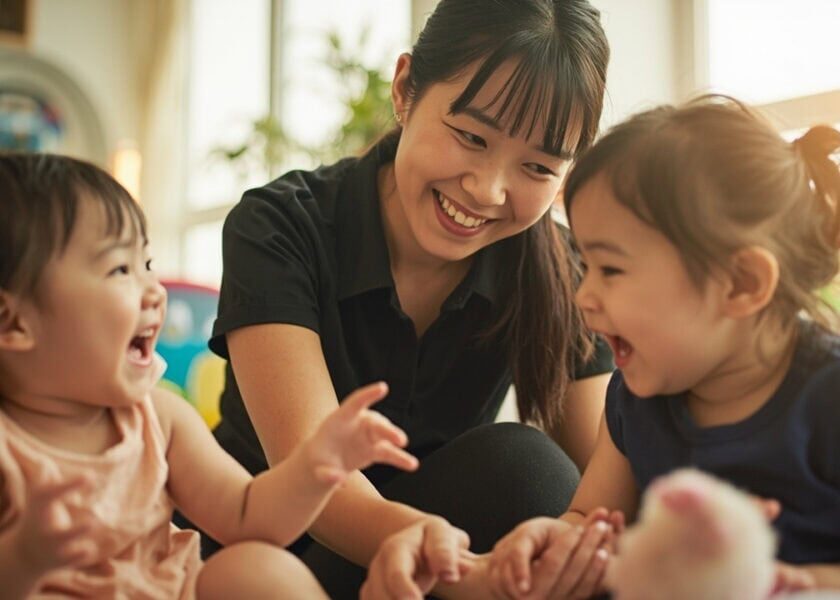
Morning arrives, and with it, the most emotionally loaded transition of the childcare day: arrival. In a quality care setting, this is not a logistical handover. This is a bridge.
The caregiver who greets you at the door does not simply take your child. She receives your child. She takes a moment to kneel at eye level, to speak your child’s name, to acknowledge what is happening.
“Good morning, Aiden. Daddy is going to work now, and I am here.”
This is not small talk. This is neurological scaffolding. Your child’s brain, still wiring itself at a pace that will never again be this rapid, needs continuity. It needs someone to narrate the transition, to name what is happening, to say without words: you are not abandoned, you are handed over, and that is different.
Watch how a quality caregiver reads a child’s face in these first moments. The slight tension in the jaw. The way a fifteen-month-old reaches for a parent’s leg and then pulls back, testing. The caregiver sees all of this. She reads it not as defiance or difficulty but as communication. Your child is telling her something. And in a quality setting, she responds.
This is what we mean when we speak about the difference between supervision and genuine attentiveness. Supervision is watching. Attentiveness is witnessing. It is the difference between ensuring a child does not fall and understanding why a child is reaching for your hand as you walk.
Rhythm: The Architecture of Security
As the morning unfolds, the day begins to reveal its structure. Rhythm is not decoration. Rhythm is the architecture of security.
Your child, in these first years of life, does not experience time the way you do. When a day has rhythm—when meals happen at roughly the same time, when rest follows play with predictable sequence, when transitions are named and acknowledged—your child’s brain learns something profound.
It learns that the world is reliable. It learns that hunger will be answered, that tiredness will be met with a quiet space, that crying will bring comfort.
This is the foundation of what researchers call secure attachment, and secure attachment is the single greatest predictor of resilience, of emotional regulation, of the capacity to learn that a child will carry forward into school and into life.
Play: Where Development Happens in Plain Sight
You will see rhythm made visible in a quality childcare day. You will see a morning of active play—sensory play, where infants explore textures and temperatures; gross motor play, where toddlers learn the joy of running and climbing and falling and getting up; guided play, where a caregiver sits at eye level and narrates what a child is discovering.
“You found the blue block. It is smooth. You put it in the bucket.”
This is not idle chatter. This is language building. This is the caregiver doing exactly what your child’s brain needs most: reflecting language back, expanding language, showing your child that words connect to experience.
Rest: A Designed Experience
Then, predictably, the rhythm shifts. The play quiets. The children are gathered. Rest in quality infant care is not nap time as afterthought. It is a designed experience.
- The room dims. The noise softens.
- A caregiver walks the room, gently patting backs, humming low.
- For infants, this might mean being held, rocked, allowed the warmth of human contact that no white noise machine can replicate.
- For toddlers, it might mean a favorite blanket, a soft toy, a story.
The caregiver does not simply leave the room. She stays. She remains present.
Research consistently shows why this matters: a caregiver’s proximity during sleep is not about surveillance. It is about the subtle way that a child’s nervous system calibrates to safety when another human being is near. The child falls asleep more deeply, more peacefully, because somewhere beneath conscious thought, they know they are not alone.
This is the level of intentionality that separates quality from adequacy. It is felt by the child, and it expresses itself in ways that parents eventually notice but often cannot name: a child who falls asleep easily at night, a child who wakes without distress, a child who runs to the caregiver at drop-off not because they have forgotten you but because they have learned that this place, too, is safe.
Feeding: Where Intimacy Meets Development
Feeding is one of the most intimate acts of caregiving, and in a quality setting, it is never reduced to logistics.
A caregiver does not prop a bottle and walk away. She holds the infant in her arms, cradling the head, speaking softly, allowing the feeding to be a time of connection.
For children on solids, mealtimes are social events. They sit together. They are offered food that reflects cultural familiarity—because in Singapore, this matters enormously. The food on a quality childcare table should feel like home. It should honor the cuisines your family eats.
And during the meal, the caregiver sits with the children, models eating, names foods, celebrates attempts.
“Look, you used the spoon. That is wonderful.”
This is development happening in real time. This is your child’s fine motor skills emerging. This is language expanding. This is social learning. And it is happening in the ordinary context of a Tuesday lunch, which is precisely why it is so extraordinary.
Peer Interaction: The First Lessons in Being Human
There is a moment in every childcare day that is so often overlooked: peer interaction. Young children in group care are not simply present alongside one another. They are learning, for the first time, how to be human in relation to other humans.
A toddler takes a toy from another toddler. A caregiver observes—not to punish, not to lecture, but to intervene with precision. She moves close. She speaks calmly. She names what she sees:
“Wei Long, you wanted the truck. Jin Lei was using it. Let’s find another truck for you.”
This is conflict resolution at its earliest form. This is social negotiation. And the way a caregiver handles these moments—without shame, without coercion, with patience and clarity—teaches your child something that will shape their relationships for the rest of their lives.
The Environment Speaks
The physical space of childcare communicates in a language that operates beneath conscious thought.
Walk into a quality infant room. You see clean lines, but not sterile emptiness. You see soft corners, natural light where possible, materials that invite touch and exploration. You see low shelves where children can reach what they need. You see distinct zones: a calm area for reading, an active area for movement, a quiet area for rest.
You see photographs of families on the walls—not just for decoration, but because a child’s face lights up when they see their mother’s photo, and that recognition is a form of continuity, a thread connecting the childcare world to the home world.
The environment speaks. It says: we designed this for children. We thought about how they move, how they see, what they need.
In quality care, the environment is always speaking the same language: the child comes first.
Quick Summary: Signs of a Quality Childcare Day
- Arrival is a bridge, not a handover. Caregivers narrate transitions and kneel at eye level.
- Rhythm is the architecture of security. Predictable routines help infants learn the world is reliable.
- Rest is designed, not assumed. Proximity matters. Presence matters.
- Feeding is relational. Infants are held. Toddlers eat together. Food reflects home.
- Peer interaction is facilitated. Conflict becomes a lesson in social negotiation.
- Communication is daily and specific. You receive evidence, not vague reassurances.
What Transparent Communication Actually Looks Like
Quality childcare providers do not wait for you to ask. They do not leave you wondering. They tell you—not in vague generalities, but in specifics.
A good caregiver will say, at pickup: “Aiden had a wonderful morning. He was very interested in the water table. He said ‘wa-wa’ for water. He napped for an hour and a half and woke in good spirits.”
This is not small talk. This is data. This is you receiving evidence that your child’s day was textured, that your child was seen, that the hours were filled with developmental experience.
At EduNanny Singapore, this communication is not an add-on. It is built into our model. We believe that parents who receive consistent, specific, honest updates about their child’s day do not become anxious parents. They become confident partners in their child’s development.
The transparency is not a feature. It is a value. And where we operate with open communication channels, we do so not because we have something to prove but because we believe you have the right to know.
How Singapore Parents Can Evaluate with Informed Eyes
If you are still making a decision, still touring childcare centres, still weighing options—you are not helpless. You are not powerless. You have, in fact, a great advantage that most parents do not realize they possess.
You have spent every single day of your child’s life learning to read them. You know your child’s cry for hunger from their cry for discomfort. You know the difference between tired and overtired. You know the exact pitch of distress that means something is wrong.
This is not nothing. This is expertise.
When you understand what quality looks like, when you know the architecture of a quality day, those instincts become not guesses but assessments. You will walk into a room and see the caregiver kneeling at a child’s level, not towering above them. You will notice whether the children seem at ease in the space. You will hear whether the caregiver’s voice is warm and modulated, whether it escalates when a child escalates or whether it stays calm, anchoring.
Questions to Ask on Your Tour
- How do caregivers handle the arrival transition?
- What does the daily rhythm look like—meals, rest, play?
- How do you communicate with parents about the child’s day?
- How is conflict between children managed?
- What training do caregivers receive in infant development?
- How is the environment designed for children, not just visitors?
The best decision you can make for your child is not the one made in hope. It is the one made in knowledge.
The ECDA Childminding Pilot: What It Means for Singapore Families
At EduNanny Singapore, we operate within the ECDA Childminding Pilot, and this represents something important for families in Singapore.
The pilot was designed to expand the pathways available to Singapore parents—to recognize that not every family needs the same solution, that home-based care, community-based care, and centre-based care each offer distinct advantages, and that flexibility is not a compromise. It is a recognition of reality.
Parents in Singapore work long hours. Parents in Singapore live far from extended family. Parents in Singapore need options that are safe, structured, affordable, and aligned with their values.
Within the EduNanny model, we offer pathways that reflect this reality:
- Infant ratios that honor the attention every young child deserves—ratios that are not numbers on a form but commitments to presence.
- Care across Monday to Friday, structured in blocks that respect both parental work realities and child developmental needs.
- Fee structures designed to be accessible within the pilot framework, because quality care should not be a privilege for those who can afford the most expensive option.
We also help families navigate the practical architecture of support: CDA funds, Baby Bonus provisions, the mechanisms that Singapore has put in place to support parents in these earliest years. We do not leave you to figure this out alone. We walk beside you.
Parenting is not a 9-to-5 activity. Neither is our support. Our AI Chatbot represents our commitment to being present for you not only during childcare hours but in the spaces between—when you have a question at 9 p.m., when you are wondering about a developmental milestone, when you need guidance that is immediate, informed, and reliable.
When Understanding Transforms the Decision
Here is what we offer at EduNanny Singapore: not a promise that every day will be perfect. No honest provider would make that promise, and you should distrust any who do. Children get tired. Caregivers have off days. The realities of group care mean that some mornings will be harder than others.
What we offer is something more durable than perfection. We offer transparency. We offer an invitation to see exactly what we do and why we do it. We offer the confidence that comes not from blind faith but from informed observation.
We offer a partner in your child’s earliest years—not a replacement for your role as parent, but an extension of it, a continuity of care that feels coherent and connected and safe.
When you understand what a quality childcare day looks like, something shifts. The separation does not disappear, but it transforms. You stop being a parent who wonders and becomes a parent who knows.
You can visualize the morning greeting, the sensory play, the transition to rest, the shared meal, the moment of conflict and resolution, the caregiver kneeling at eye level. You can see your child’s face in that room. And you can trust—not blindly, but knowledgeably—that the hours are well spent.
This is what we believe parenting in Singapore deserves: not just care, but understanding. Not just supervision, but attentiveness. Not just a place to leave your child, but a place you can see clearly, a place that has nothing to hide and everything to show.
If you are researching infant care or childminding in Singapore, we invite you to take the next step. Schedule a tour, ask your questions, and see for yourself what a quality childcare day looks like when it is designed with intention, delivered with warmth, and shared with transparency.
We believe the best decisions are made in knowledge, not hope. Let us help you see clearly.
The curtain is open. Come look.