The Professional Every Singapore Parent Needs to Recognise
The Morning That Changes Everything
There is a moment every parent in Singapore remembers. You may not have marked it. You may not have named it. But you remember it.
It is the morning of the first handover. The bag is packed. The bottle is warm. You have dressed your child in something comfortable, something familiar — because that feels important, though you could not explain why.
You walk through the door — to the home-based caregiver’s flat, to the childminder’s living room, to the first day of something you have planned for months — and you hold your child a little longer than you need to. You breathe in the top of her head. You memorize the weight of her in your arms.
And then you put her down. In someone else’s arms.
You look at the person holding your child. She is smiling. She is warm. She says all the right things. And yet she is, in that moment, a kind stranger. A recommended stranger. A stranger who has been background-checked and carefully selected. But a stranger nonetheless — because you do not yet know how she holds a fussy child at 3 p.m. You do not know what she does when your child refuses to eat. You do not know whether she sings in the car, or talks to the plants, or lets children climb higher than feels comfortable before she intervenes.
You know nothing about this person. And yet you are leaving your child with her. And you are walking out the door.
The Relationship Nobody Warns You About
Most parenting content in Singapore is about what happens after. It is about the settling, the routine, the trust that gradually builds. It is about what parents feel — the guilt, the relief, the complicated mathematics of returning to work.
All of that is real. All of that matters.
But there is a relationship that most parenting resources have simply skipped over — the relationship between you and the person who holds your child in that first morning, and every morning after.
Here is what most parents discover only gradually, and what needs to be named clearly from the start: the caregiver is the most under-recognised professional in your child’s life.
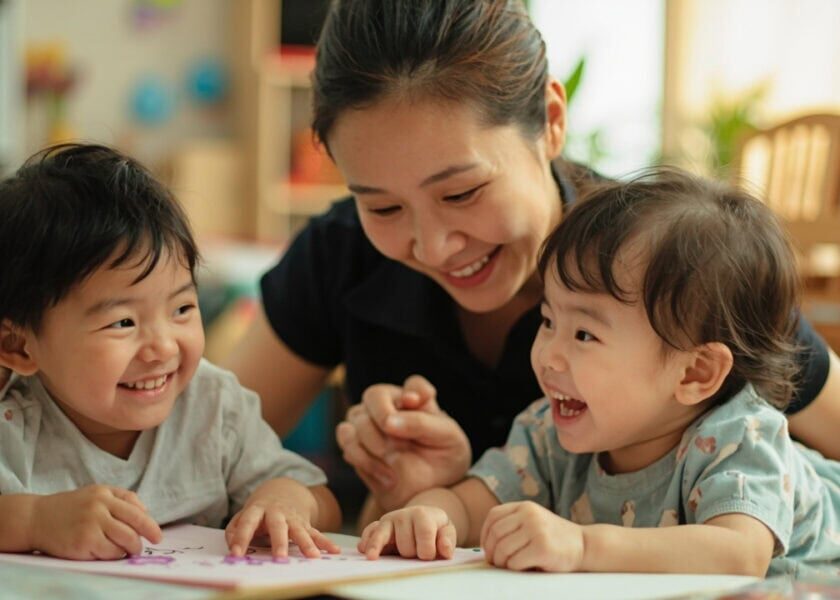
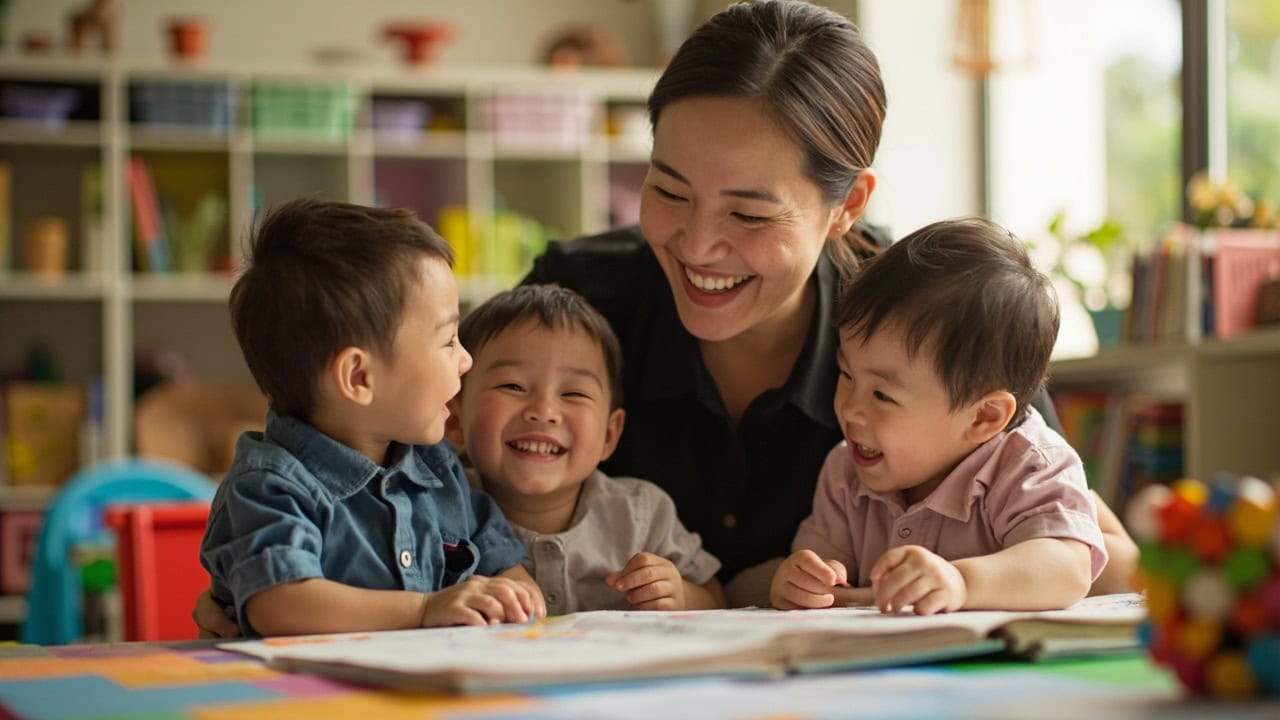
She — or he — is the person who spends the most waking hours with your infant during the first and most formative years. She is the one who notices the first word, the first step, the first time your child learns to stack blocks with intention rather than by accident. She reads the cues you have not yet learned. She has seen your child in a thousand different states — hungry, frustrated, delighted, exhausted, radiant — and has quietly, patiently, built a map of who your child is becoming.
She knows your child. And she did not have to. She was hired to care for your child. But somewhere in the weeks and months of that care, something else happened. Something professional. Something invested. Something real.
When You Stop Seeing a Caregiver and Start Seeing a Professional
This is the transformation that most parents do not expect and that no one warns them about. You hired someone to look after your child. What you received — if the relationship is built well — is a partner in your child’s development.
The shift begins with recognition. Not gratitude alone, though that matters. Not politeness, though that too. But recognition — the act of truly seeing another person as they are, not as your convenience has defined them.
When you see your caregiver as a person, you start to notice things:
- How she greets your child each morning — not with routine, but with genuine attention
- The rituals she has quietly introduced: the song before nap time, the way she narrates what she is doing when she changes a diaper
- That she remembers things you mentioned in passing — that your child is afraid of the sound of the vacuum, that she prefers吃肉胜过吃菜 — and acts on them without being reminded
These are not small things. These are the signs of professional investment. Once you begin to notice them, you cannot go back to seeing her as a pair of hands you hired.
The Moment the Relationship Transforms
There is a moment — it arrives differently for every parent — when you realise your caregiver has seen something in your child that you missed.
Perhaps she tells you, gently, that your child has been working on a new skill. Perhaps she shares that yesterday, during play, your daughter sat with another child and shared her toy — and she watched it happen with the quiet pride of someone who has been paying close attention. Perhaps she says, with care, that she has noticed your son seems more tired than usual, and has some thoughts about what might help.
And in that moment, you feel something unexpected. Not resentment, not displacement, not the strange jealousy that sometimes surfaces when someone else knows your child well.
What you feel, if you are open to it, is gratitude so precise it takes your breath away. You feel 感激 — the kind that goes beyond politeness, beyond courtesy, into the territory of genuine, earned respect.
That is the beginning. That is the moment the relationship transforms from transaction to trust.
What Quality Childminding Actually Looks Like
Here is what needs to be understood clearly, because it is the heart of what separates ordinary childcare from excellent childcare — and it is the thing most parents do not know to look for:
A caregiver’s professional identity is not defined by her title or her years of experience alone. It is defined by the quality of her observation and the depth of her thinking about the child in front of her.
Consider the difference between:
- Someone who sees a list of tasks — feeding, changing, putting to sleep
- Someone who sees a whole person, in process, whose inner life is worth understanding
Ask yourself: Can she tell you what makes your child light up versus what makes your child shut down? Has she formed a picture of your child as an individual with preferences, rhythms, and a developing sense of self?
When parents understand this distinction, they start listening differently. They stop receiving updates as reports and start engaging with them as conversations. They ask questions. They share context. They treat the caregiver’s perspective as genuinely informative, not merely supplementary.
Signs of Professional Quality
- Curious, sustained attention — She describes your child in ways that reveal she has been watching carefully, not just managing
- Developmental awareness — She notices patterns, emerging skills, shifting behaviours — and can articulate what she observes
- Individual recognition — She knows your child’s preferences, rhythms, and what makes them unique — not just their routine
- Proactive communication — She shares observations without being asked, offers context, asks questions
- Reflective practice — She thinks about her approach to the child, not just executes tasks
This is what distinguishes a skilled childminder from someone who is merely capable. It is the difference between a person who does the job and a person who understands it.
The EduNanny Approach: Professional Partnership, Not Staffing
Here is what is quietly remarkable: when parents relate to caregivers with professional respect, the caregiver responds. Not with gratitude — though that follows — but with deeper engagement. With a greater sense of responsibility and ownership over the work. With the kind of attentiveness that cannot be mandated or monitored, but that flows naturally from being seen and valued.
This is the dynamic that EduNanny by BUTLER has built its approach around. Not as an accident. Not as a byproduct. But as a deliberate, structured philosophy of care.
EduNanny understands that the parent-caregiver relationship is not a side element of childcare — it is the foundation. And so they have designed their model to support that foundation from the very beginning.
The ECDA Childminding Pilot
Through the ECDA Childminding Pilot, EduNanny offers families in Singapore access to home-based childminding pathways — where the caregiver comes to your home or a carefully structured home environment — and community-based options, each structured to maintain the ratios that allow for genuine, individual attention.
In infant care, the 1-to-3 caregiver-to-infant ratio is not a regulatory technicality. It is the condition that makes professional attention possible. It is what allows a caregiver to know your child the way your child deserves to be known.
What Professional Partnership Means in Practice
- Caregiver selection is about alignment — of values, of communication style, of the kind of warmth and structure the family is hoping for
- The relationship is treated as something worth investing in — developing and sustaining over time, not just filling a temporary need
- The caregiver is supported, trained, and thoughtfully matched — so she arrives ready to work alongside you with clarity and commitment
Practical Support for Singapore Families
- Monday to Friday care blocks aligned with the rhythms of working families — from Bedok to Bishan, Jurong to Tampines
- Accessible fee structures within the pilot framework
- Use of CDA and Baby Bonus funds supported — because the economics of childcare should not force families to choose between affordability and excellence
- Structured communication — regular updates, documented observations, shared records that keep parents informed not just of what their child ate or when they slept, but of how they were, what they discovered, what made them laugh, what challenged them
- Transparency measures — in home-based arrangements where deployed, CCTV offers additional reassurance — not because trust is absent, but because transparency and trust are companions, not opposites
Addressing the Concerns Every Singapore Parent Has
It is reasonable to have questions. These are some of the concerns parents bring to EduNanny — and honest answers to each.
“How do I know I can really trust this person with my child?”
Trust is built, not declared. The caregiver selection process matters — background checks, interviews, and reference conversations are the starting point. But the deeper answer is this: watch how the relationship develops over time. Does your caregiver show up with genuine attention? Does she remember details? Does she communicate with honesty? These are the behaviours that build trust, and they become visible in the daily small moments of care.
“What if something goes wrong — will I know?”
EduNanny builds in structured transparency — regular updates, documented observations, and clear communication channels. You should know how your child was, not just that they were fed and changed. In home-based arrangements where deployed, CCTV provides an additional layer of reassurance. The goal is not surveillance — it is partnership through transparency.
“I feel guilty about leaving my child. Is that normal?”
That weight in your chest before the first handover — it is not irrational. It is not weakness. It is not something to be managed away. It is the most human response to the most important responsibility a person can hold. What matters is what you do with that feeling. When you channel it into choosing care thoughtfully, building the relationship intentionally, and showing up as a partner to your caregiver — that guilt transforms into something generative.
“What if the caregiver and I don’t get along?”
Different communication styles and expectations are natural in any professional relationship. What matters is how differences are navigated. EduNanny’s matching process aims for alignment from the start — of values, communication style, and the kind of warmth you are hoping for. When the relationship is structured as a partnership, there is room for honest conversation, adjustment, and growth.
Practical Guidance for Choosing Infant Care in Singapore
Whether or not you work with EduNanny, here is guidance for building the parent-caregiver relationship intentionally — regardless of which care option you choose.
What to Look For
When evaluating a caregiver or childminding arrangement, look beyond certifications and ask yourself:
- How does she talk about children? Does she describe them as individuals with inner lives, preferences, and developing selves — or as tasks to be managed?
- What does she notice? Can she tell you something specific and observant about your child during the introduction? Or does she speak in generalities?
- How does she respond to your questions? Does she engage thoughtfully, or does she seem to be performing for you?
- Does she ask about your child? A professional caregiver is curious about the family context, not just the job description.
Questions to Ask
During any caregiver interview or centre visit, consider asking:
- Can you tell me about a recent moment when you noticed something new about a child in your care?
- How do you handle it when a child is struggling with a transition?
- What does your communication with parents look like on a typical day?
- How do you think about your role in a child’s development?
Listen not just for the content of the answers, but for the quality of attention in the responses. A caregiver who thinks carefully about children will communicate differently than one who is simply capable of the tasks.
How to Build the Relationship Intentionally
Once you have chosen a caregiver, invest in the relationship actively:
- Share context generously — your child’s moods, recent changes at home, things you are working on together. The more she knows, the better she can care.
- Ask for her observations — not as reports, but as conversations. “What did you notice today?” opens a different dialogue than “How was her nap?”
- Treat disagreements as partnerships — if something is not working, approach it as a problem to solve together, not a failure to correct.
- Recognise her professional investment — acknowledge the care she brings, not just the tasks she completes. A simple “I noticed you remembered that about her — that means a lot” goes further than you might expect.
- Show up consistently — the relationship deepens with regular, present engagement from both sides.
What Your Child Is Learning
There is a reason this matters beyond your own peace of mind. The deepest reason this approach transforms outcomes for children is what your child sees.
Your child, long before she can articulate it, is watching. She is watching how you and your caregiver relate to each other. She is absorbing the atmosphere between the two adults who care for her most. And what she is learning — not from a lesson, not from a word, but from the quality of what she feels in the room — is something profound about human relationship.
She is learning:
- What it looks like when two people treat each other with respect
- What it sounds like when adults communicate with honesty and care
- Whether the people around her trust each other
- Whether the caregiver is someone her parents regard as worthy of trust
Children read adults with an accuracy that often humbles us. They internalise patterns. They learn relationship from the relationship they are held inside.
And when that relationship is one of genuine respect, collaborative warmth, and professional care — when your child watches you greet your caregiver with real regard, listens to her observations with genuine interest, and navigates the small disagreements and adjustments of daily care as partners rather than as employer and employee — your child is learning something that will shape how she relates to others for the rest of her life.
She is learning the architecture of trust. She is learning that adults can collaborate. She is learning that the people who care for her are people she can rely on, and that her parents see that too.
The child thrives — not because of a specific curriculum or a particular toy or a single magical technique, but because she is held inside a relational environment that is coherent, warm, and real. She explores more confidently because she feels secure. She communicates more freely because she has been heard. She negotiates, collaborates, and connects — because she has watched it modelled by the two adults she loves most, working together with genuine regard.
This is why the relationship between you and your caregiver is not a footnote in your child’s story. It is the climate in which your child’s story unfolds.
Ready to Begin?
So let me come back to that morning. That first morning, and every morning after.
When you hand your child over, and you feel that weight in your chest — not doubt, not fear, but the profound gravity of caring deeply — know that what you are feeling is entirely human. And entirely appropriate.
What I want you to know — what EduNanny Singapore has always understood — is that the person on the other side of that handover is not just receiving your child. She is receiving your trust. She is choosing, every day, to meet both with the seriousness and the warmth they deserve.
When you recognise that — when you see her as a professional, a partner, a person whose investment in your child’s life runs parallel to your own — you do something extraordinary for your child. You give her a model of trust. You give her a template for collaboration. You give her the experience of being loved by two people who respect each other — and who have chosen each other — in her service.
That is what changes everything.
That is the relationship that matters most.
And that is why what EduNanny does is not just childcare.
It is the quiet, daily, profound work of building a world your child can trust.
If you are exploring infant care or childminding options in Singapore and want to understand how EduNanny approaches the parent-caregiver relationship from the very first day, we invite you to start a conversation with us.
Because the most important professional relationship in your child’s early years deserves to be built on intention, recognition, and care — from the very beginning.
#ChildmindingSingapore #InfantCareSG #EduNannySG #ProfessionalChildcare #ParentCaregiverRelationship