What Your Child Is Building at Childcare and Why It Matters
Quick Summary: What Your Child Is Learning at Childcare
- Emotional regulation: Learning to manage frustration without being consumed by it
- Language skills: Developing richer vocabulary through peer interaction and responsive caregivers
- Motor development: Building body competence through intentional movement experiences
- Executive function: Forming the mental skills for planning, focus, and impulse control
- Social intelligence: Learning to navigate relationships with peers as equals
- Identity: Constructing a sense of self—capable, worthy, and belonging
Here is what developmental science and observation of children in quality care reveals: your child is not simply being watched. Your child is working—actively, intensely, and with a purpose that will shape the rest of their life.
The Architecture of a Young Mind
The first five years of human life represent the most concentrated period of brain development we will ever experience. In these brief years, the architecture of the mind is being constructed with extraordinary speed and precision.
Neural connections are forming at a rate that will never be matched again. The emotional patterns that will govern how your child responds to stress, to joy, to frustration, and to connection are being laid down. The foundations of language, of reasoning, of who your child understands themselves to be—these are being built not in a single dramatic moment but in thousands of small interactions, decisions, and discoveries that happen each day.
And here is what is most important to understand: much of this construction happens when you are not in the room. This is not a cause for fear. It is a cause for wonder.
Inside a Quality Childcare Day: The Invisible Curriculum
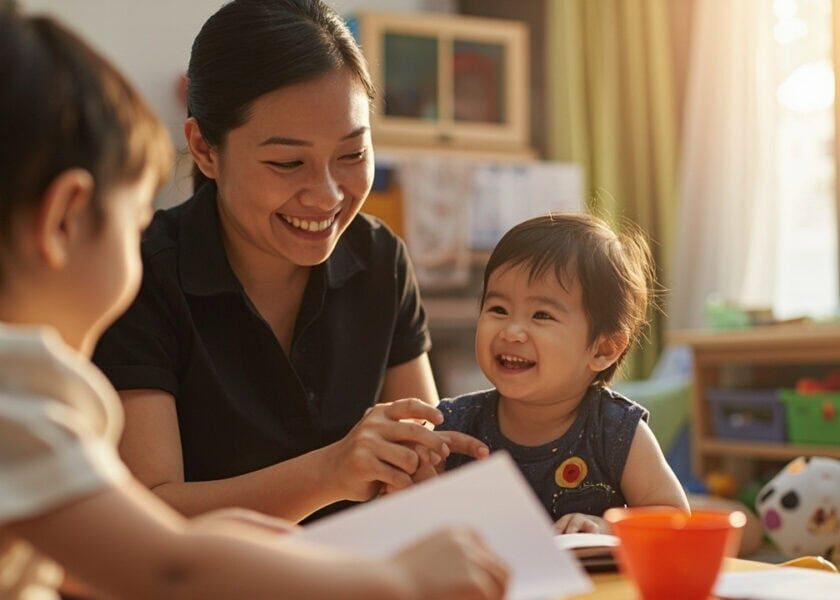
Consider what your child encounters on any given morning in quality care. The environment itself becomes a teacher. The space is arranged not merely for safety—though safety is foundational—but for invitation.
Low shelves hold materials that call to be explored. Open floor areas allow for movement that strengthens growing bodies. Corners are shaped for quiet moments when a child needs to withdraw from the stimulation of peers. Every element has been considered because in early childhood, environment is curriculum.
Within this environment, your child is engaged in what developmental psychologists call the work of childhood. They are building—not with blocks or playdough alone, though those materials matter too, but building the internal structures that will allow them to function in the world.
A Window Into Invisible Construction
Emotional regulation: A child who has been in quality care for several months arrives one morning and encounters frustration. A toy has been taken by another child. In an infant at fifteen months, this might produce immediate, overwhelming distress. But by twenty-two months, something has shifted. This child has begun, sometimes with a caregiver’s quiet guidance and sometimes through their own hard-won learning, to feel that frustration and not be destroyed by it.
They have begun to develop emotional regulation—the capacity to hold an uncomfortable feeling without it consuming them entirely. They might cry, but they do not collapse. They might seek help, but they do not give up. This capacity, so unremarkable when we see it in an older child, represents months of invisible internal work.
Language development: A child alone at home hears the speech of adults—typically one or two voices, often simplified and directed toward the child. In quality group care, the child encounters something richer and more complex. They hear peers attempting words, struggling with sounds, celebrating small victories of expression. They hear caregivers narrating actions, naming emotions, expanding on what a child points to and says.
Research consistently shows that children in quality peer environments develop more robust language skills—not because they are being drilled, but because language becomes a social necessity. If you want to play with that truck, you need to say so. If you want the crackers, you must ask. This is not accident. It is design.
Motor development: A well-prepared childcare environment offers what is sometimes called a “movement curriculum”—not formal instruction, but intentional provision of challenges that help a child’s body grow in capability. Ramping surfaces that teach balance. Containers to fill and empty, building both fine motor control and early cause-and-effect reasoning. Space to run, to climb, to fall, to get up again.
Each of these experiences sends messages to the developing brain: this body can do things. This body is competent. This body belongs in this world.
Executive function: Perhaps most fascinating is what happens to executive function in these early years. This refers to the collection of mental skills that allow us to plan, focus attention, remember instructions, and juggle multiple tasks successfully. It is the foundation of academic achievement, of healthy relationships, of effective parenting, of civic participation.
Watch a two-year-old in quality care learning to wait. Not because they have been told to wait—two-year-olds are not yet sophisticated enough for that kind of abstract instruction—but because they have experienced, again and again, that the world does not always respond immediately. The caregiver is helping another child. The snack is not yet ready. The sand is not available until everyone has shoes off.
These small, repeated experiences of delayed gratification, handled sensitively by responsive caregivers, are building the neural pathways that will later allow your child to resist impulses, to persist at difficult tasks, to think before acting.
You will see this capacity emerge over months. One day you will realize that your child, who once screamed at every frustration, now pauses. Takes a breath. Asks for help. And you will wonder when that happened. It happened in the invisible hours. It happened while you were working.
The Social World of Peers
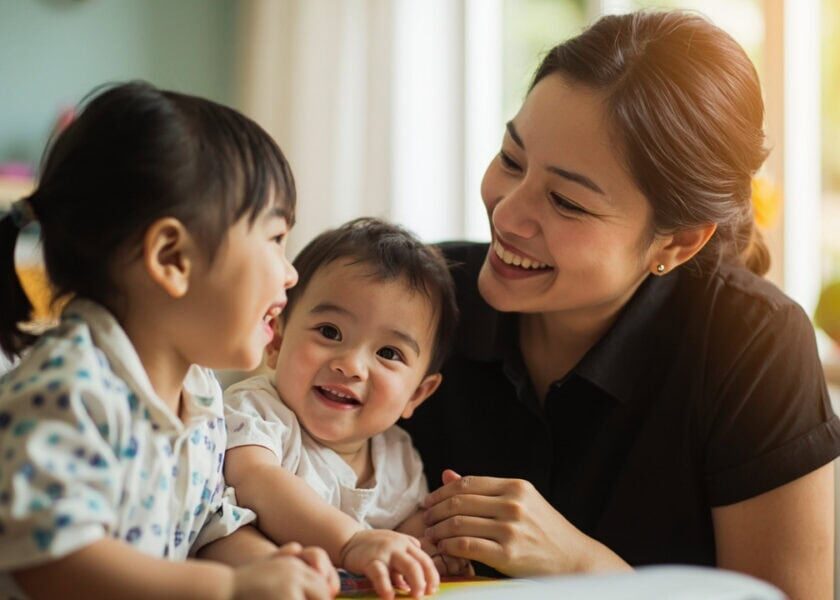
There is something else happening in quality care that research continues to illuminate: the development of social intelligence. Human beings are fundamentally social creatures. We learn through connection, through observation, through imitation, through the push and pull of peer relationships.
In group care, your child encounters other children who are their equals—not smaller adults, not servants, not people whose needs are less important than their own. Peers. Other children who want the same toys, seek the same attention, experience the same big feelings.
Learning to navigate this social world—learning to notice others’ emotions, to share, to take turns, to resolve conflicts with words rather than actions—these are among the most important skills your child will ever develop. And they develop them best in environments where there are other children to practice with, and where trained adults provide just enough scaffolding to guide without taking over.
This is why ratios matter. When a caregiver is responsible for three infants, something different is possible than when one person must manage six or eight. The quiet moments of attunement can happen. The responsive feeding, the sensitive handling of distress, the recognition of each child’s individual rhythms and needs—these require time and attention.
In a world where ratios are stretched thin, these moments disappear. In an environment designed for attentiveness, they become the curriculum.
What Is Built From All This Invisible Work
Identity. The sense of self that your child is constructing is not abstract. It is being built from concrete experiences:
- I am capable.
- I am worthy of attention.
- I can solve problems.
- I can be angry and still be loved.
- Other people have feelings too.
- I belong here.
These beliefs, formed in the first years of life, become the lens through which your child will view themselves and the world for decades to come. This is the work of quality infant care. Not supervision. Not entertainment. Development.
Attachment, Partnership, and Your Role
There is a fear that quality care means replacing you. That your role as parent becomes less important, or that the bond between you and your child will somehow be diminished by the hours spent in other care. The science offers clarity here.
Attachment research tells us that children can form multiple, healthy attachments. What matters is not the number of attachment figures but the quality of those attachments. A child who feels securely attached to their parents—who has experienced consistent, responsive, loving care at home—can also develop positive, nurturing relationships with other caregivers. These attachments do not compete. They complement.
There is a crucial insight here: the developmental gains your child makes in quality care can be amplified at home. When you understand what your child is working on, you become a developmental partner.
- When your child learns to manage frustration in a peer setting, you can acknowledge that growth: “I saw you waiting for your turn. That was hard, and you did it.”
- When your child brings home a new word learned from peers, you can expand it, celebrate it, invite them to teach it back to you.
- When your child shows signs of growing independence—a newfound determination to do things themselves, a willingness to venture further from you in new environments—you can recognize that this, too, is the fruit of experiences you provided by choosing quality care.
You are not a distant observer of your child’s development. You are its author. Quality care provides the conditions. Your love provides the foundation. Together, your child grows.
What Quality Childcare Actually Looks Like
For parents researching options in Singapore, understanding what separates quality care from adequate care matters. Here are the indicators worth looking for:
- Caregiver-to-child ratios: In infant care, lower numbers mean more attunement. One caregiver to three infants allows for the responsive interactions that support development.
- Environment as teacher: Spaces designed for exploration, with materials accessible to children, opportunities for movement, and areas for quiet withdrawal.
- Trained, consistent caregivers: Staff who understand child development, not just safety protocols. Consistency matters—your child benefits from familiar relationships.
- Communication beyond meals and naps: Updates that help you understand what your child is learning, not just what they ate.
- Respect for the child’s inner life: An approach that treats children as active participants in their own development, not passive recipients of care.
If you are researching childcare options, here are questions worth asking during your search:
- How are caregivers trained in child development, not just safety?
- How will you communicate my child’s day—what does that look like in practice?
- How is the environment designed to support development?
- What happens when my child is upset? How do caregivers respond?
- What does a typical day look like in terms of play, rest, and interaction?
- How do you handle feeding, sleep, and individual routines?
The right fit is not just about credentials and ratios—it’s about whether the approach aligns with how you want your child to spend these important hours. Trust your instincts during visits. Notice how the caregivers interact with the children. Ask to see beyond the tour.
EduNanny’s Approach
EduNanny is part of the BUTLER family, operating within the ECDA Childminder Pilot programme—a national effort to provide affordable, accessible, high-quality infant and childminding care for Singapore families. This means our programme meets the standards set by the Early Childhood Development Agency, committed to the developmental care described here.
We offer pathways to suit different family needs:
- Home-based childminding: Our trained caregivers come to you, providing the most familiar environment for your infant and the most personalized attention.
- Community and centre-based options: Peer environments with the social and developmental benefits those provide.
- Infant care: With ratios of up to one to three, ensuring every child receives the attunement and responsiveness that quality development requires.
We understand that affordability matters enormously to Singapore families. The pilot fee structures are designed to make quality care accessible. Many families find that CDA funds and Baby Bonus can be used toward their care arrangements, and our team is happy to help you understand the options available to you.
We also understand that transparency matters to parents. When you cannot see what is happening during the day, trust becomes essential. We maintain open communication about your child’s day—not just the meals and naps, though those matter too, but the moments of growth, the small victories, the challenges overcome. Our approach to communication is built on the belief that you deserve to know what your child is becoming, not just what they ate for lunch.
A Note on Dignity
We believe that every child deserves to be treated with dignity—not as a recipient of care but as a participant in their own development. A person whose inner life matters, whose emotions deserve acknowledgment, whose emerging capabilities deserve celebration.
We believe that parents deserve dignity too—not as anxious figures to be managed but as the most important people in their child’s world, the partners we are honored to work alongside.
When you entrust your child to EduNanny, we do not see a transaction. We see the continuation of a story that began at your child’s birth and will continue for the rest of their life. We see ourselves as temporary custodians of a process that belongs ultimately to your family. Our job is to create the conditions for growth. Your job is to love your child and to make sense of who they are becoming. Together, we serve your child’s future.
That quiet afternoon wondering—what is my child doing right now? Here is what you can carry with you:
Your child is building. They are constructing the architecture of their mind, one experience at a time. They are learning that they can survive frustration, that words have power, that their body is capable, that other people matter, that they belong in this world. They are becoming someone—someone with a personality, a resilience, a capacity for connection, a sense of who they are.
And when you reunite at the end of the day, when you pick them up and hold them and hear about their morning, you are not arriving at a place where nothing happened. You are returning to witness a transformation. The child you pick up is not quite the same child you dropped off. They have grown. They have learned. They have become a little more themselves.
Your role in this is not diminished by the hours apart. It is made possible by them. The love you provide at home creates the secure base from which your child can explore, can take risks, can grow. The quality care you have chosen creates the conditions for that growth to flourish. Together, they add up to more than either could achieve alone.
Your child is becoming. Understanding how is the first step to partnering in that becoming.
We would be honored to answer your questions and help you explore whether EduNanny is the right partner for your family. Reach out to learn more about our infant care and childminding programmes in Singapore.