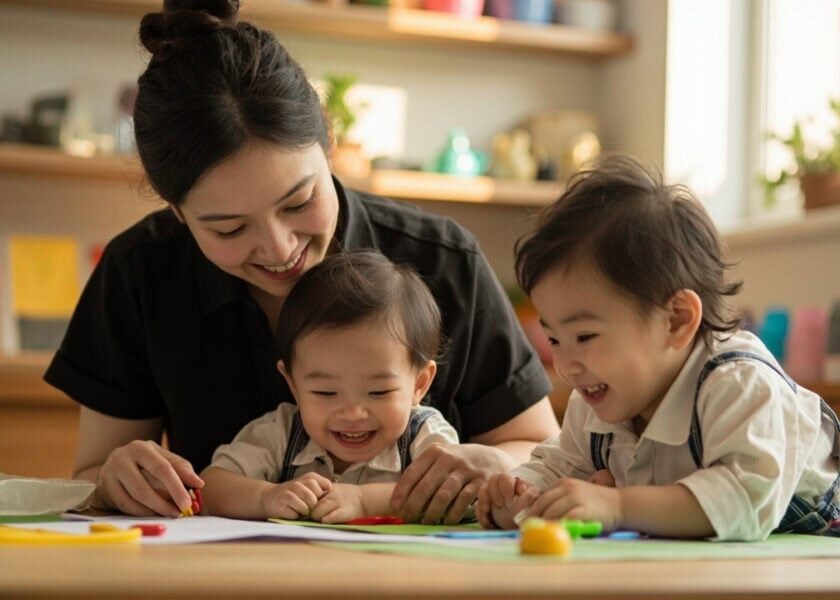
How the Right Childcare Transforms Your Whole Family Beyond the Child
The Evening That Shows You Everything Has Changed
Onesix30. Not yet six, not quite dark. The flat in Punggol or Toa Payoh or Ang Mo Kio looks like any other Tuesday evening, but something has shifted.
Your toddler is sitting on the living room floor with Duplo, building something improbable. Your infant’s murmurs have softened into the deep, even breathing of sleep — the kind that comes when someone has learned her rhythms well enough to settle her fully. And your partner is setting down two mugs of teh halia on the sofa table without asking whether you want one, because tonight, that is simply what happens.
You have just walked through your own front door. You are home. And for the first time in months, you are not already calculating the next logistics problem before you’ve even taken off your shoes.
This is the evening that shows you everything has changed.
Not just the child. Not just the child.
That is the sentence we forget to finish in Singapore, where every conversation about childcare begins and ends with the child. We ask: Is she reaching her milestones? Is he safe? Does she cry at drop-off? Does he eat enough?
These are not wrong questions. They are necessary questions. But they are incomplete — and parents know this, even when they cannot say it yet.
What we do not often ask — what almost no one in the childcare conversation asks — is this: What else changes when childcare is truly right? Not just for the child. For the couple. For the siblings. For the parent who has not felt like themselves in two years. For the grandparents who have been holding the family together out of love and obligation. For the whole living, breathing, fragile, extraordinary system that is your family under one roof.
Beyond the Child: What Quality Childcare Changes for Your Whole Family
For the couple who have become co-managers
There is a conversation that stops happening in many Singapore households around the time the first child arrives. Not a dramatic, identifiable moment — no fight, no coldness, no obvious ending. It is quieter than that.
It is the slow disappearance of the conversation that has nothing to do with the children, nothing to do with the schedule, nothing to do with who is picking up from school or whether the formula is running low. It is the conversation that used to happen on weekend mornings, over hawker centre breakfast, when you talked about what you were thinking, what you were worried about, what you hoped for your life together.
That conversation does not disappear because the love is gone. It disappears because there is no air left in the room. Because you are both running on four hours of sleep and the mental load of managing a household, and somewhere along the way, you have become co-managers of a family instead of partners in one.
When childcare is right, something comes back between the two of you. Not because you went on a couples retreat. Not because you read the right book. Because the evening is no longer a gauntlet of tasks to complete before you collapse. Because you have your hands back — not metaphorically, but literally. You can sit together. You can eat together. You can finish each other’s sentences about something that is not the children.
I am not saying childcare fixes a marriage. That would be too simple, and too much to promise. What I am saying is something more specific, and more honest: when childcare is right, it removes one of the most corrosive forces in family life — the quiet, grinding exhaustion that leaves no room for the relationship that predates the children. In that removed exhaustion, something can return.
For the siblings who should not have to compete
When your first child was born, you had most of your attention to give. Not all of it — new parents are always overwhelmed, by definition — but most of it. Your first child, for better or worse, became the child who absorbed that attention, who shaped your identity as a parent, who had you completely.
Then came the second child. And something changed — not because of anything your second child did, but because the container of your attention, your patience, your energy, had become finite in a way it was not before. You found yourself responding differently to your first child. Not with less love. With less presence.
And your first child felt that. Not consciously, not articulately — they felt it in the quality of your distraction, in the sharpness that crept into your voice at the end of a long day, in the way you were always half-thinking about the baby even when you were playing blocks together.
Here is what changes when childcare is truly right for your family: the container expands. Not magically, not without effort — but structurally. The care that your second child receives is not coming out of the limited reserves that were being divided between two children. It is coming from a system that is designed for this.
Your older child, who has been holding so much of your attention by default, is suddenly released from the strange position of being the older sibling who must also be the one to share. When your older child can be curious about the younger one instead of jealous. When they can be siblings in the way you always hoped — not because you managed it perfectly, but because the system around you made it possible.
For the parent who has disappeared into the role
And then there is you. Not you as a parent. You as a person.
I want to speak directly to the parent who has been doing this — the dropping off, the picking up, the endless negotiation of nap schedules and feeding routines and the specific way your child needs to be held to fall asleep. The parent who has been so immersed in the immediate demands of small children that there has been no surface left to see yourself from the outside.
The parent who catches their reflection in a window or a mirror and thinks: who is that?
This is not a failure. This is what immersion feels like. When you are in water, you cannot see the water. When you are in the relentless present tense of early childhood, you cannot see the shape of your own life.
Here is what parents describe, again and again, when they finally have the right care arrangement in place: the sensation of surfacing. Of having enough distance from the immediate demands to remember that they exist beyond them. Of being, for a few hours each day, a professional with skills and ambitions and ideas. A person with friends, with interests, with a future that extends past this year’s school registration cycle. A spouse. A sibling. A child of their own parents.
Quality childcare does not diminish your role as a parent. It restores your capacity to be one fully.
Because the parent who is running on empty — who is so depleted by the sheer logistics of managing young children — that parent is not the parent they want to be. They are doing their best, and their best is remarkable, but it is not the same as the parent who has had a full night’s sleep, who has been able to work without interruption, who has had thirty quiet minutes to read or walk or simply exist without someone needing them.
This is not about pampering parents. This is about the biology of depletion. We know — from neuroscience, from psychology, from the lived experience of every exhausted parent in every country — that human beings cannot give what they do not have. When parents have more, they have more to give. And what they give, when they are not running on empty, changes everything for their children too.
The Evening: Where Everything Converges
I want to say something now about the evenings, because this is where you can see all of this converge.
In Singapore, the evening is where family life is made or unmade. It is compressed between the end of the workday and the beginning of bedtime, and in that compression, every tension that has been building during the day comes to the surface. The children are tired. The parents are tired. The grandparents, if they have been helping, are often exhausted in ways that go unspoken because they do not feel entitled to their exhaustion.
When childcare is right, the evening stops being a battlefield and starts being what it was supposed to be: the time when your family comes back together. Not because everything is perfect. Because you have enough left to give each other.
Your older child, who has been in consistent, attentive care all day, comes home in a different state than the child who has been in a setting where the ratios were too high, where the day was too stimulating, where no one could give them what they needed. Your younger child, who has been held by someone who knows their cues, who can read their tiredness and their hunger and their need for movement, arrives home settled rather than overstimulated.
And you — you arrive home without the knot of anxiety that comes from knowing you will have to pick up the pieces of a difficult day before you have even begun to address your own.
This is what families mean when they say something has changed. They are not always able to name it precisely. But they feel it in their bodies. In the ease of the evening. In the quality of the play. In the breath they can finally take on the way home from work because the destination is not dread but arrival.
The Grandparents: The Invisible Support System
There is one more layer here, and it is often the one that is most invisible in the childcare conversation: grandparents.
In Singapore, grandparents are a central part of the childcare ecosystem — not by choice alone, but by economic necessity and cultural expectation and the sheer reality that quality childcare is not always accessible in the right place, at the right time, at the right price. And many grandparents have been carrying this, often gladly, but sometimes at a cost that no one acknowledges.
I have spoken to grandparents in Singapore who love their grandchildren fiercely but are quietly overwhelmed by the demands of full-time childcare at their stage of life. I have spoken to grandparents who have sacrificed their own health, their own social lives, their own plans, because someone had to watch the children and they were the ones available.
When quality childcare is in place, something shifts for grandparents too. They are not replaced — no one is suggesting that. But their role changes from exhausted obligation to genuine gift. They visit to play. They visit to read stories. They visit to be grandparents, which is a different thing entirely from being a full-time caregiver, and which is infinitely more sustainable, emotionally and physically.
This matters for the entire family system. Because when grandparents are rested, when their relationship with their grandchildren is free from the strain of daily responsibility, they become the intergenerational bond that holds the family together across time. They become what grandparents are meant to be: witnesses to your family, carriers of its history, people who pour love into your children without the depletion that comes from being the only option.
Why This Matters in Singapore
Singapore is one of the most demanding environments in which to raise children. Consider the reality:
- The cost of living shapes every decision
- The educational culture creates pressures that begin before most children are out of nappies
- The housing market means that extended family is not always nearby
- Both parents typically work, not by preference alone but by economic necessity
- The rhythm of life here — the long hours, the competitive workplaces, the geography that means commutes swallow evenings — creates a context in which family life is perpetually at risk of becoming something you manage rather than something you live
In this context, childcare is not a peripheral concern. It is a central one. And the quality of your childcare arrangement is not a detail — it is a variable that determines the shape of your entire family life.
Parents often feel this without being able to name it. They sense that something is not quite right with their current arrangement, but they cannot articulate why. They know they are exhausted, but they think that is just parenthood. They know their marriage has become strained, but they think that is just what happens after children. They know their older child has become difficult, and they think that is just the phase.
What I am telling you is that these are not inevitabilities. They are symptoms — of a childcare system that is not quite right for this family, at this moment, in this season of their lives.
And they can change.
What Quality Childminding Looks Like
So what should you actually be looking for? Beyond the glossy brochures and reassuring conversations, here is what quality looks like in practice:
For your infant
- Consistent, attentive ratios — your child is not one of twelve. In quality settings, caregiver-to-child ratios for infants are kept deliberately low so that each child’s cues can be known and responded to.
- Rhythm over stimulation — the environment supports your child’s natural sleep-wake cycles rather than forcing them into an adult schedule.
- Responsive feeding — whether you are breastfeeding or bottle-feeding, your child’s feeding cues are read and honored.
- Attachment-supportive care — the caregiver works with, not replaces, your relationship with your child.
For your family
- Predictable structure — you know what you are getting. Monday to Friday blocks that work with your work schedule, not against it.
- Communication you can count on — regular updates that tell you what happened, not just that “everything was fine.”
- Transparency measures — visibility into the setting so trust is built on evidence, not hope.
- Financial clarity — simplified payment options, subsidy access, use of CDAC and Baby Bonus funds where applicable.
How EduNanny approaches this
EduNanny by BUTLER was built on a different premise: that childcare works best when it is designed for the whole family, not just the child.
EduNanny operates under the ECDA Childminding Pilot, which means it is not operating in a regulatory vacuum. It is part of a structured initiative that sets standards for quality, for caregiver training, for the conditions that make excellence possible. If you are going to trust someone with your children — and with your family’s wellbeing — you deserve to know that the framework around them has rigor.
EduNanny offers home-based childminding under this pilot, which means your child is cared for in a home environment during these crucial early years. The familiarity and continuity of a home setting can make a profound difference in how securely your child attaches, how confidently they explore, how peacefully they sleep. The first thousand days are not just a phrase — they are the period in which your child’s neurological architecture is being formed, and the environment they are in during those days matters in ways that researchers are only beginning to fully understand.
EduNanny also offers community and centre-based pathways, so families have options that fit their specific circumstances. Not every family needs the same arrangement, and the right arrangement for your family may not be the right one for the family next door.
Here is what the pilot structure means in practical terms:
- Caregiver-to-child ratios of up to 1:3 for infants — your child is not one of twelve. Your child is not one of eight. Your child is in a setting where the caregiver can know them — can know their rhythms, their preferences, their cues for hunger and tiredness and the need for comfort.
- Monday to Friday blocks — structured for working parents who need predictability, not last-minute scrambling.
- Subsidized fees within the pilot structure — because EduNanny believes that quality care should not be available only to families who can afford premium pricing.
- CDAC and Baby Bonus fund access — simplified financial logistics at a moment when simplification is a gift.
- Communication and transparency — regular updates, clear channels for questions, and CCTV measures deployed in relevant settings so that parents can see, not guess. Trust is not built on hope alone. It is built on visibility.
Common Concerns, Honest Answers
“Will my child adjust?”
Every transition involves adjustment. But quality matters in how that adjustment unfolds. A setting with low ratios and trained caregivers who understand infant cues creates an environment where your child can form secure attachments and settle into new rhythms with support, not stress. The question is not whether adjustment will happen, but whether the environment will support it well.
“Is home-based care really as good as centre-based?”
Research on attachment and early development consistently shows that the consistency and quality of the caregiver relationship matters more than the setting type. Home-based care can offer familiarity, smaller ratios, and a domestic rhythm that eases infants into care more gently than larger centre environments. The key is the training and ratios of the caregiver, not the building itself.
“Can we afford quality care?”
This is a legitimate concern, and EduNanny’s subsidized pilot fees exist precisely to address it. Using your Child Development Account and Baby Bonus funds further reduces the logistical burden. The question to ask is not just whether you can afford quality care — it is whether you can afford not to have it, given what strained, inadequate care is costing your marriage, your older child, your own sense of self.
“What if it doesn’t feel right?”
You know your family best. Quality providers build in communication channels precisely because they understand that fit matters. If something feels off, you should have the ability to raise it and see it addressed. The best care relationships are partnerships, not transactions.
Choosing the Family You Are Becoming
Choosing childcare is not just choosing who watches your child.
It is choosing the kind of family you are becoming. It is choosing whether the next three years will be years of survival or years of flourishing. It is choosing whether your evenings will be gauntlets or gifts.
When you choose a childcare arrangement that is designed for your whole family — that understands the couple needs room to breathe, that the siblings need to not compete for attention, that the parent needs to surface and remember who they are, that the grandparents need to be grandparents again — you are not just solving a logistics problem. You are reshaping the architecture of your home.
You are giving back to yourself the people you had begun to forget you were married to, siblings to, parents to, children to. You are restoring to yourself the family you were trying to build before exhaustion made that feel like an impossible thing to say out loud.
I want to close by coming back to that evening, because that is where everything makes sense.
Onesix30. You are home. The flat is not perfectly clean, and your toddler has coloured outside the lines on the Duplo instructions, and one of the mugs has a lipstick mark on it because tonight, you had time to drink your tea while it was still warm.
And you look at this — at the children, at the person beside you, at the life you have built — and you think: we are becoming ourselves again.
This is what quality childcare gives back to a family. Not just the child. Not just the logistics. Not just the hours in the day.
- It gives back the marriage that had become logistics.
- It gives back the siblings who can be curious about each other.
- It gives back the parent who had disappeared into the role of parent.
- It gives back the grandparents who can be grandparents.
- It gives back the home that had become a staging ground for managing life, and is becoming again, quietly, steadily, a place where your family actually lives.
The invitation is simple: choose intentionally.
For your child, yes — but not only for your child.
Choose for your marriage. Choose for your other children. Choose for yourself. Choose for the grandparents who have been holding on. Choose for the family you are trying to become.
Because quality childcare, in the right hands, does not just change who is watching your child. It changes who you all become under your own roof.
And that is not a small thing. That is everything.
EduNanny Singapore understands this. That is why their approach is designed not only for the child, but for the family that child lives inside. Explore how EduNanny’s ECDA Childminding Pilot can support your whole family — not just through the logistics of childcare, but through the transformation of your daily life together.
Learn more about EduNanny · About the team · Get in touch