What Singapore Parents Discover When Childcare Observation Goes Deeper
The Knowledge Gap: What Nobody Tells You About Enrollment
When you enrolled your child in childcare, you made a decision based on a tour, a feeling, a conversation with someone who seemed to understand what you were looking for. You looked at the environment. You watched how the caregivers moved, how they spoke, whether their eyes followed the children with the kind of attention that cannot be faked for an hour.
You made the best choice you could with the information available.
And then your child walked through those doors, and your role shifted. You became the person on the outside, hoping.
This is the reality of childcare enrollment that nobody talks about enough: the moment after you choose is when the real questions begin. You chose well. But now you need to know—every single day—that the quality you sensed during those thirty minutes of observation is still there, humming along quietly in the hours you cannot see.
You need to know that your child is not just being supervised but being known. That the person holding your infant’s hand during the afternoon walk has noticed how she reaches for things with her left hand first. That the caregiver who calms your colicky baby in the early morning has learned, over weeks, exactly which hold unlocks his tension. That the afternoon rest your toddler takes is not just monitored but understood—observed for patterns, for growth, for the small developmental shifts that happen so quietly they would be invisible if no one was paying attention.
Beyond “Fine”: What Quality Communication Actually Looks Like
The difference between being told your child is fine and understanding your child’s actual day is the difference between living with a stranger and living with a partner.
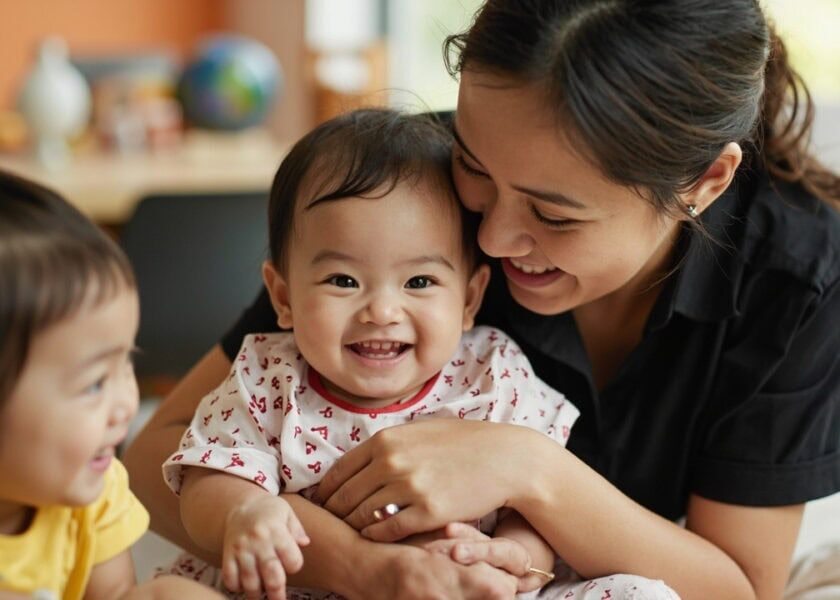
When your childcare communicates with depth, with intention, with specificity, something shifts. You stop being the anxious parent who imagines worst-case scenarios during the commute home. You start being the parent who arrives with context, with a story, with the beginning of a conversation that will continue tomorrow and the day after.
You start knowing your child better—not because you are with them more, but because the person who is with them has made it their business to help you know them too.
Consider the difference in these two scenarios:
The first: “Your child had a good day.”
The second: “She didn’t want to join the group activity at first, but I noticed she was watching from the edge, so I sat there with her. After about five minutes she crawled closer. By the end she was reaching for the shakers.”
Both are technically updates. But they are not the same thing.
The first is evidence of survival. The second is a window.
In quality childminding, daily communication goes beyond meals and naps. It reflects genuine observation of who your child is becoming. It sounds like a childminder telling you on a Tuesday that your daughter has been working on her pincer grip—reaching for puffs with her thumb and forefinger instead of her whole hand, and that this is wonderful to see because her fine motor development is really coming along.
It sounds like a note that says your son laughed differently today when the bubbles floated past—not the polite chuckle he offers adults, but something deeper, realer, a full-body giggle that made the caregiver stop and watch.
It sounds like a morning message that describes your toddler’s frustration during circle time in a way that helps you understand she may be experiencing a language leap—that her ability to understand is outpacing her ability to express herself, and that this is a normal, significant developmental stage.
This is what quality childcare hands back to you. Not just updates. Knowledge.
The Conditions That Make Genuine Observation Possible
Here is what most parents do not realize: this kind of communication is not an accident. It does not happen because some caregivers are naturally more talkative than others.
It happens because quality childcare is built around the principle that observation is caregiving. When a childminder is trained to observe, trained to document, trained to translate what she sees into language that helps a parent understand, the result is a level of insight that transforms the entire childcare relationship.
You stop wondering whether your child is okay. You start seeing that your child is not just okay but extraordinary—growing, changing, becoming someone new every single week.
But observation requires something practical: the conditions that make it possible. Attention is finite. When caregivers are responsible for too many children, the subtle observations that reveal who a child is becoming get lost.
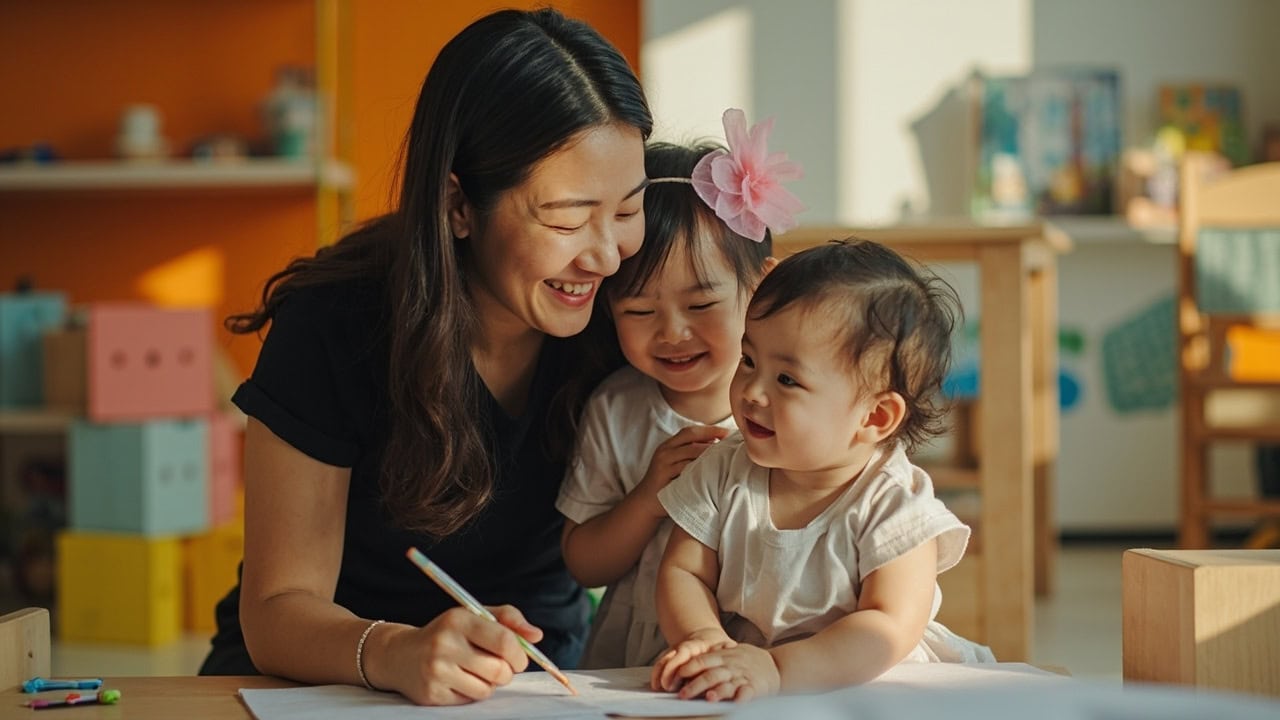
A child who is learning to stack blocks. A baby who has just discovered her feet. A toddler whose frustration during circle time signals a developmental leap in language that is outpacing her ability to express it.
These are the moments that require a caregiver to be paying attention not just for safety, but for meaning. And that kind of attention requires ratios small enough to make it possible.
What Singapore Parents Should Realistically Expect
For parents in Singapore, the context matters. Singapore parenting happens in a reality of intense pressure—academic pressure, professional pressure, the pressure to optimize, to plan, to prepare your child for a world that will demand more than any previous generation was asked to give.
In that context, it is easy to lose sight of the small, essential truth that your child is not a project. Your child is a person who is becoming, day by day, through experiences you can and cannot see.
The childcare you choose is not just a place that watches your child while you work. It is a place that participates in that becoming.
When that participation is thoughtful, when it is communicative, when it is grounded in genuine observation and genuine care, you get something remarkable: a childcare arrangement that strengthens your relationship with your child rather than creating distance. You arrive home each day with more context, more insight, more connection.
The hours apart do not feel like loss. They feel like a collaboration.
Questions to Ask When Choosing Infant Care
If you are considering enrollment, ask not just about the curriculum, the safety measures, or the food menu. Ask about the daily knowledge loop—because that is where the quality of care reveals itself.
- How will your child’s day be communicated to you? Ask specifically about daily updates—will you receive generic summaries or observations written about your individual child?
- Are caregivers expected to observe and document developmental milestones? Or do they simply report on meals and naps?
- What happens when your child has a difficult day? Will you hear about it, and how?
- Does the communication feel generic? The same message for every child? Or does it feel specific, like something written to you and your child alone?
- What is the caregiver-to-child ratio? Can they genuinely observe each child, or are they too overwhelmed to see any of them clearly?
These questions reveal something fundamental about what the childcare believes about its role. A program that sees itself as a service provider will give you the minimum required updates. A program that sees itself as a developmental partner will give you something far richer.
EduNanny’s Approach: Built Around the Daily Knowledge Loop
At EduNanny Singapore, we built our approach around a simple conviction: the gap between what parents wonder and what parents know does not have to stay open.
We are part of the ECDA Childminding Pilot, which means our home-based and community-based pathways operate under a framework designed to deliver something different—not just a different location, but a different quality of attention.
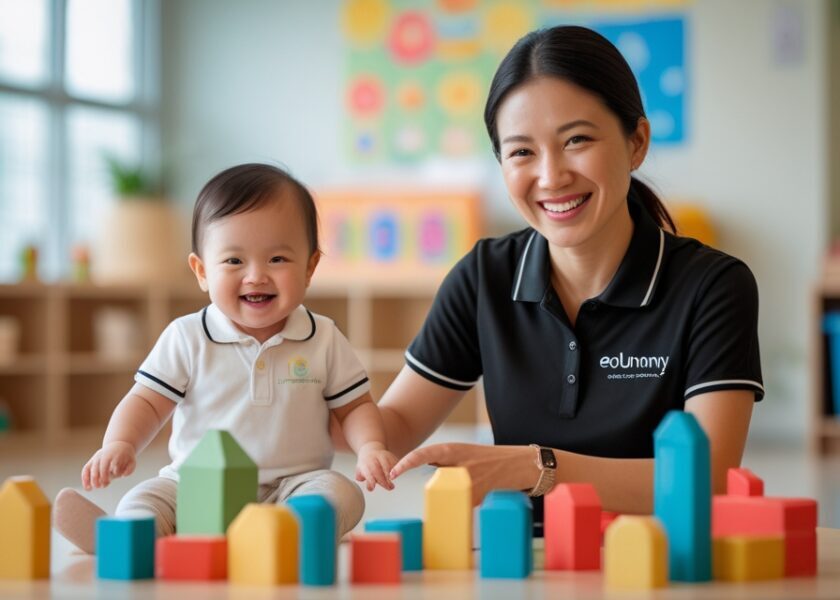
With ratios of up to one to three infants in our care, our childminders have the space to observe, to notice, to remember. They are not rushing between twelve children, too overwhelmed to see any of them clearly. They are present in a way that creates the conditions for genuine knowledge exchange.
Our caregivers are trained not just in safety but in observation, in documentation, in the art of the daily knowledge loop. Monday to Friday care blocks give working parents the consistency they need. And where deployed, we offer transparency measures like CCTV access—not as surveillance, but as partnership. When you can see what is happening, the questions that live in your imagination lose their power.
We know that Singapore parents carry a great deal. You carry the expectations of extended families, the pressures of a competitive environment, the guilt of a culture that sometimes tells you that being present and being professional cannot coexist.
We are not here to add to that burden. We are here to take something off it—to carry part of the weight by being the kind of partner who tells you what you need to know. Who notices what your child is doing. Who treats your child’s days with the attention they deserve.
Trust is not given. It is built, slowly, through repeated evidence that the promise of quality is not just words but practice. Every evening, through what we communicate, through how we observe, through the specificity of what we hand back to you, we will show you that your child is not just fine but flourishing.
This understanding is not an extra. It is the point. Communication depth is the quietest and most honest signal of whether the care your child receives is truly worthy of your trust. And it is a standard every parent in Singapore should be able to expect.
EduNanny Singapore operates under the ECDA Childminding Pilot, offering home-based and community-based childminding pathways with small ratios designed to make genuine observation and daily knowledge exchange possible. For families who qualify, CDA and Baby Bonus subsidies are available.
If you are ready to learn more about what thoughtful, communicative infant care looks like in Singapore, we invite you to start a conversation with us.