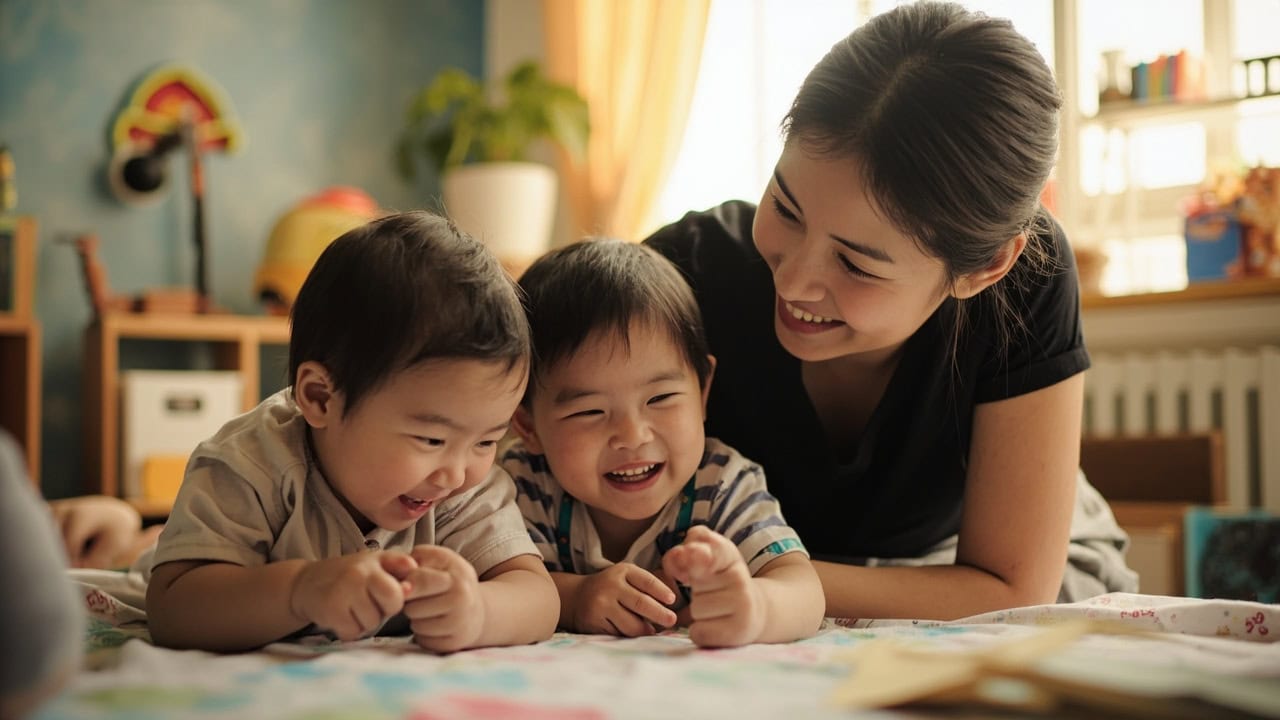
The Quiet Season After Enrollment: A Guide for Singapore Parents
The Quiet After Enrollment
There is a particular kind of quiet that settles over a family in the weeks after they have enrolled their child in care. It is not the quiet of certainty. It is the quiet of a door that has just closed behind you, and you are still learning to trust that it is the right door.
The enrollment paperwork is signed. The orientation visits are complete. Your child has met the caregiver, and you have nodded along to explanations about routines and developmental milestones. You made your choice. Now begins the harder work of living inside that choice.
Here is what most parenting content will not tell you: everyone wants to help you choose. Nobody seems interested in what happens after. And yet, for parents in Singapore navigating the transition into childcare, the months after enrollment are where the real journey begins — emotionally, practically, and in ways that reshape your entire family’s rhythm.
This article is for that season. For the quiet days of morning goodbyes becoming easier. For the evening homecoming conversations that start awkward and gradually open like a window. For the slow, beautiful work of building trust and finding your family’s new normal.
What This Season Looks Like
- The morning goodbye is not a test. Tears are not a sign you chose wrong. They are a sign your child knows the difference between home and not-home.
- The transition takes weeks, not days. Around week three or four, you may notice your child beginning to settle. The timeline varies for every child.
- Evening homecoming matters more than you think. The homecoming conversation evolves over months and becomes a window into your child’s daily life.
- Communication is the architecture of trust. Photos, updates, and shared moments are not extras — they are how trust is built daily.
- Belonging is for the whole family. When care is right, it becomes part of your family’s story, not just a service you use.
The Morning Goodbye and the Hours That Follow
There is perhaps no more emotionally loaded three minutes in the entire day than the moment you hand your child to someone else and walk away. You stand at the doorway, bag in hand, heart suspended somewhere between your chest and the room you are leaving behind.
Your child may cry. They may cling. They may wave goodbye with a solemnity that makes you want to cancel the whole arrangement. Or they may not react at all — and somehow that absence of distress can feel worse, a distance opening between you that you cannot yet name.
The morning goodbye is not a test of whether you made the right choice. It is a developmental milestone in its own right — for your child and for you.
In those early weeks, the goodbye is still new. The caregiver is still relatively unfamiliar. The room, the routine, the other children — it is all a foreign country, and you are asking your child to trust that this unfamiliar place is safe. Of course there are tears. That is not a failure of care. That is a child who has formed a secure attachment, who is not yet convinced that the not-home can hold them the way home does.
When the Goodbye Begins to Change
Somewhere around week three or four — though every child is different, and the timeline is not the point — you may notice a shift. Your child looks toward the caregiver not with wariness but with recognition. There is still the ritual of separation, still the necessary grief of it, but it is overlaid now with something else: the faintest suggestion that leaving might be okay.
And then comes the morning — and you will know it when it arrives — when your child sees the caregiver and their face opens. When they do not cling. When they turn toward the activities already underway and glance back at you with a kind of casual reassurance, as if to say, You can go now. I am fine here.
It is not indifference. It is trust. And it is one of the most profound gifts quality care can give a family.
What Happens in the Hours You Cannot See
Follow your child through the day, not in detail, but in spirit. Because the hours between morning goodbye and evening homecoming are where the real work of care happens, and understanding what that work looks like can transform how you feel about the invisible time you are not there.
When your child arrives, they enter a prepared environment — a space that has been thoughtfully arranged. Light and noise levels, the sequence of activities, where a child can be physically close to a caregiver and where they can explore with appropriate independence. It is a space where materials are organized in a way that a child can begin to understand, over time, that this block goes here and that book goes there and that activity is available if I am ready for it.
In home-based settings, this prepared environment often has a quality that larger centre-based care cannot fully replicate: intimacy. The scale is human. The sounds are domestic rather than institutional. The caregiver does not need to manage many children at once. She can be fully present to the small number in her care. She can follow the child’s lead in a way that large-group settings, however excellent, make more difficult.
She can notice, because she is not distracted, that your child is working on fitting shapes into containers today — a concentration that will eventually, in ways you cannot yet imagine, become the capacity to sit with a difficult problem or persist in learning something new.
What happens in these hours is not babysitting. It is the slow, essential work of development — cognitive, social, emotional, physical — that will shape your child in ways that will not become visible for months or years.
Communication: The Architecture of Trust
Because you cannot see these hours, because you are at work or wherever life takes you, there is a natural anxiety that accompanies not knowing. You drop your child in the morning and they are, in a very real sense, beyond your direct knowledge until you return.
This is one of the most difficult emotional realities of modern parenting: the necessary trust that you extend to another human being with your most precious person.
Here is where transparency becomes not a feature but a lifeline.
The families who feel most at peace with the hours of separation are not those whose children never cry — all children cry; it is how they learn — but those who have insight into what is happening in those hours. Photos. Updates. Brief notes about the morning’s activities or a particular moment that struck the caregiver as noteworthy.
This is not micromanagement. This is the basic human need to know that someone we love is okay.
The Difference Between Being Watched and Being Known
There is a concept in early childhood development that is useful to hold alongside this experience: young children need not just supervision but genuine knowledge of them. Being watched is not the same as being known. And the difference, over time, shapes not only the child but the parent.
When you are in the search phase — visiting centres, meeting caregivers, trying to assess whether this is the right place — you are looking for evidence that your child will be known. You want to see that the environment is attentive, that the caregiver notices things, that your child is not just one face in a crowd.
This instinct is correct. Children who are truly known — whose individual temperaments, interests, rhythms, and needs are understood and honored — develop differently than children who are adequately supervised.
But here is what no tour can show you: what it feels like to be the parent of a child who is known by someone else. When your child has a caregiver who knows them — who knows their particular way of waking from a nap, their favorite book, the small triumph they achieved this morning with the puzzle — something shifts in your own identity as a parent. You begin to see yourself not as the sole vessel of your child’s world but as the center of a web of relationships that includes, importantly, someone you have chosen to be part of your child’s life.
From Resistance to Partnership
This is not always easy. There can be complicated feelings here. Some parents describe an initial resistance, a sense of protectiveness, an unwillingness to share what feels like their exclusive domain.
This is understandable, and it deserves to be honored rather than dismissed. But what often happens, in families who move through the post-enrollment months with grace, is that this initial resistance softens into something else.
It softens into partnership.
When you know — really know, in your bones — that your child’s caregiver loves your child, when you see evidence of that love in the way she holds your child, in the way she speaks about your child’s day, in the small attentions she pays that no checklist could require of her, then the relationship transforms. It is no longer you and the caregiver. It is you and the caregiver, together, on the same side. Both of you wanting the same thing: for this small person to thrive.
The Evening Homecoming: Where the Choice Becomes Real
The evening homecoming is one of the most underexamined moments in the entire experience of childcare. We focus so much on the morning goodbye — the dramatic separation, the tears, the anxiety — that we often fail to notice what is happening when the family comes back together.
But the homecoming is where the childcare choice becomes lived experience. It is where you begin to understand, gradually, what your child’s day has been, who they have become in your absence, and what your family has been changed into by this new arrangement.
The Early Days: Disorientation Is Normal
In those early days and weeks, the homecoming can be disorienting. Your child may be tired — more tired than you expected, in ways that suggest the day was full in ways you cannot quite see. They may be irritable or clingy or oddly distant.
You may feel a strange guilt, as if you have no right to the fatigue of your evening when your child has been working so hard to integrate into a new social world. Or you may feel a distance — a sense that you have missed something, that there is a part of your child’s day that is opaque to you.
This is normal. It is, in fact, one of the earliest signals that you are in a genuine transition — that you and your child and your family are all adjusting to a new configuration.
The Evolution: When Homecoming Becomes a Window
What begins to happen, though, around the second month or the third month, is that the homecoming starts to change. You start to notice things.
Your child uses a word you have not taught them — a word the caregiver introduced, perhaps, or a concept that emerged from an activity you know nothing about. Your child mentions another child’s name, or the caregiver’s name, in a way that suggests these are not strangers but people who have meaning.
This is development becoming visible. This is the hours of care you could not see beginning to bear fruit in the moments you can.
And alongside this, the homecoming conversation begins to evolve. In the beginning, if you ask your child about their day, you may get little or nothing in return. Toddlers and infants do not narrate their days. But slowly, over weeks and months, a conversation begins to emerge — not in complete sentences, but in fragments and moments that, pieced together with the updates from your caregiver, begin to form a picture.
A Story from Singapore
A mother in Singapore described this recently. Around the three-month mark, she started to notice that her daughter would come home and immediately do something — a song, a hand gesture, a way of stacking blocks — that clearly came from somewhere else.
She asked, Where did you learn that? And her daughter said the caregiver’s name with a warmth and familiarity that struck her every time.
I realized that my daughter had a whole other person in her life, the mother said. A person I trusted to teach her things, to play with her, to be patient with her. And somehow, instead of feeling like I had been replaced or made less important, I felt grateful. Because I could see that this other person loved my child too. And that my child knew it.
This is what quality care makes possible: not a replacement for parental love, but an expansion of it. A child who has multiple adults who know them, care for them, believe in them. A family that is not isolated but embedded in a wider network of care.
Belonging: When Care Becomes Part of Your Story
There is a moment that arrives, in families who have been in quality care for some time, when something becomes undeniable: the care you chose has become part of your family’s story.
This is different from satisfaction. You might be satisfied with a service — a product that works as advertised. Satisfaction is an evaluation. What I am describing is something else: a sense that the care arrangement has become woven into who you are as a family.
The caregiver is not just someone who watches your child. She is part of the village that is raising your child. The rhythms of drop-off and pick-up are not just logistics; they are the texture of your week. The updates and photos and conversations are not just information; they are windows into a world that you have invited into your life.
How Quality Care Changes Your Evenings
As the months pass, you may notice something else beginning to shift: your evening family time is changing.
This is subtle and easy to miss if you are not watching for it. But families who have been in quality care for some time will often describe a different quality to their evenings together. The frantic scramble of early parenthood — the exhaustion, the isolation, the sense that you are managing a series of crises with no relief — begins to ease.
Not because parenting becomes easy. It never does. But because you have a rhythm now. Because your child is being held by someone who knows them during the day, and that holding creates a kind of stability that ripples outward into the hours you are together.
When your child has had a good day — a day of engagement and stimulation and meaningful activity — they come home in a different state than they would after a day of inadequate attention. Children who are cognitively stimulated during the day sleep better. They are more available for connection. They have the surplus energy that comes from having been genuinely occupied rather than merely occupied.
And you, as the parent, have had your own day. Your work. Your own mind and heart full of things that are not about childcare. When you pick up your child at the end of the day, you are able, if the handoff has gone well, to be truly present. You are not running on empty. You have had the hours to do your own work, to be your own person, to maintain the adult identity that parenting so easily erodes.
Recognizing When Care Is Working
I want to pause here and name something that many parents feel but few are given permission to say.
After you enroll your child in care, you may feel anxious. Not just at the beginning, but for weeks or months afterward. You may worry that your child is unhappy. You may worry that the caregiver is not doing what she says she is doing. You may worry that you made the wrong choice, that there is a better option you missed.
These worries are not failures of parenting. They are the price of love.
So let me offer you a framework for recognizing when care is working — not when it is perfect, but when it is genuinely good and right for your child and your family:
- Your child shows signs of security over time. Not the absence of all anxiety — some separation anxiety is normal and healthy — but a baseline of security. Your child is curious. They are learning. They are developing skills and interests that you can observe in their play and their language and their social interactions.
- You feel, gradually, less anxious yourself. If you find yourself checking your phone less compulsively, if you feel more able to focus on your work during the hours of care, if the evening homecoming feels less fraught and more like a genuine reunion — these are signs that the trust is deepening.
- The caregiver is a resource for you, not just a service provider. When she offers insights about your child’s day, when she asks questions about what you are observing at home and connects it to what she sees in care, when she treats you as a partner in your child’s development — this is a sign of a relationship, not just an arrangement.
- Your family, over time, begins to feel more sustainable. When evenings are richer. When weekends are more playful. When you have energy for your children and for each other and for yourselves. When the arrangement you chose begins to feel less like something you are managing and more like something that is simply part of your life.
This is not a checklist. It is a direction. Quality care, over time, tends toward these outcomes. Not perfectly, not without difficulty, but consistently.
And if you are not seeing these signs in your own family, it may not be because you are doing anything wrong. It may be because the care arrangement is not the right fit. That is worth examining, gently and honestly.
The Question of Cost: A Different Way to Think About It
Let me be direct. Raising children in Singapore is expensive. The pressure on young families is enormous, and the decision about childcare is not made in a vacuum.
Parents are weighing real financial constraints against their desire to give their children the best possible start. They are calculating CDA balances and Baby Bonus eligibility and the gap between what they earn and what quality care costs. They are making trade-offs that no parent should have to make.
This is not an abstract observation. It is the lived reality of families across this island.
Reframing the Question
The question is not just Can we afford this? It is also: What is the cost of inadequate care? What is the cost of a child who is not developing to their potential because they are in a setting that cannot meet their needs? What is the cost to the family’s wellbeing when parents are running on empty, when evenings are survival rather than connection, when the marriage is fraying under the weight of exhaustion and unmet needs?
The research on this is consistent: quality early childhood care is one of the best investments a family can make. Not because it guarantees certain outcomes — no intervention can do that — but because it creates conditions in which children are more likely to thrive and families are more likely to sustain the energy and connection that make a home a home.
The cost of care is real. But so is the cost of its absence.
Programmes like the ECDA Childminding Pilot offer pathways that are structured to be accessible to families across Singapore — not just those with significant financial resources, but the broad middle of families who need quality care that does not require choosing between childcare and groceries.
The EduNanny Approach
EduNanny was built around a simple but profound recognition: childminding is not a transactional service but a developmental partnership.
In the home-based care model under the ECDA Childminding Pilot, the ratio of children to caregiver is small enough that each child can be known — can be held, can have their individual rhythms and needs honored. Your child is not one of many. They are one of one, or two, or three.
The caregiver can learn the particular music of your child’s cries — the difference between tired and hungry and overstimulated. She can notice the moment a child’s face clouds before a meltdown arrives and gently intervene. She can remember, because there is space to remember, that your daughter hates having her socks changed last and your son needs a few extra minutes of transition warning before naptime.
These are not luxuries. These are the building blocks of the security your child is constructing, brick by brick, in those morning hours you are not there to witness.
Built for This Season
EduNanny was designed with the post-enrollment season in mind. The model invests in communication practices — in the regular sharing of moments from the day, in the openness about what is happening. It addresses not a luxury demand but a profound emotional need that every parent carries.
The ECDA Childminding Pilot framework is built on the recognition that when a caregiver is supported, trained, and given the space to develop genuine relationships with the families in her care, the quality of that care rises exponentially.
The child is not a case to be managed. They are a person to be known.
The Door Closes Behind You Each Morning
That quiet I described at the beginning of this article is still there, for families who have found the right fit. But it has changed.
It is no longer the quiet of uncertainty, of waiting for something to go wrong, of wondering if you made the right choice. It is the quiet of confidence. The quiet of a family that has found its rhythm. The quiet of a parent who knows, in the deepest part of themselves, that their child is in a good place.
This quiet does not arrive all at once. It builds slowly, in the accumulation of days and weeks and months of consistent, quality care. It builds in the morning goodbye that gradually, imperceptibly, becomes easier. It builds in the evening homecoming that slowly, over time, becomes richer. It builds in the caregiver who becomes, over months and years, not just a service provider but a trusted partner in your child’s life.
It builds in the development you see emerging — language, social skills, confidence, curiosity — that tells you, quietly but unmistakably, that something good is happening here.
An Invitation
The early years are brief. They feel long when you are in the thick of them, but they are brief. The child who depends on quality care today will not be a child for long. The caregiver who holds your infant’s hands during morning circle time will not always be part of your family’s story.
The rhythms you are building now — the morning goodbye and the evening homecoming, the weekday structure and the weekend play — these are the architecture of your family’s life in this moment. They will not last forever. But they matter enormously, precisely because they will not last forever.
This is the invitation that quality childcare offers: to be part of that architecture. To build, together with you, a space where your child can grow. To walk alongside your family in this brief, precious season of early childhood. To offer not just supervision but knowledge, not just attention but love.
You made a choice. Now you are living inside that choice. And what you are building, in those ordinary days of morning goodbyes and evening homecomings, of caregiver updates and weekend rhythms, is something that no one can take from you:
A family that is finding its way. A child who is growing. A confidence that is, day by day, replacing the anxiety.
The door closes behind you each morning. But it opens again in the afternoon, and your child is there, and the caregiver is smiling, and the day has held.
And you know — not perfectly, not without doubt, but deeply and truly — that you have found something good.
That is enough. That is more than enough. That is everything.
Begin a Conversation
If you are in the season of searching — or if you have already made a choice and want to feel more confident about the months ahead — we would welcome the conversation.
EduNanny offers complimentary consultations for families exploring home-based childminding under the ECDA Childminding Pilot. No pressure, no obligation. Just a thoughtful conversation about what you are looking for and whether the model might be a fit for your family.
Learn more about how the ECDA Childminding Pilot works, or get in touch to schedule a consultation.
You can also read more about EduNanny and the standards we hold ourselves to as a team.