Finding Quality Childcare by Trusting What You Notice
The Weight of This Decision
Two working parents, or a single parent carrying the weight of dual responsibilities — this is the reality for so many families across Singapore. They are navigating a childcare landscape that is rich with options and yet somehow still inadequate to the enormity of what is being asked of it.
Not just: who will watch your child? But: who will shape them? Who will notice the moment they reach for something just beyond their grasp? Who will sit with them in the confusion of a new word, a new face, a new room?
The stakes are not abstract. They are felt in the body every morning at drop-off, in the half-second pause before the classroom door closes.
And yet, the prevailing narrative around this search treats parents as consumers making a purchasing decision. As if the difference between one centre and another can be resolved with a better spreadsheet.
Here is what we believe instead: the parent walking into a childcare environment for the first time is not arriving empty-handed. They arrive with instincts — the deep mammalian pull to protect, to evaluate, to sense safety or its absence. And they arrive with something that is being quietly, and often painfully, built through the very act of searching.
From Choosing to Recognizing
Call it discernment. Call it an eye for quality. Call it the developing judgment that comes from caring enough to look carefully. Whatever name we give it, it is real. And it is growing. And it is exactly what Singapore parents need most as they navigate one of the most significant decisions of early parenthood.
Here is what we have observed, working alongside families across this island: the parents who ultimately find the right fit are not necessarily the ones who arrived with the most research. They are the ones who stayed present long enough to start noticing things.
- Who learned to feel the difference between a room full of activities and a room that is genuinely engaged
- Who could read a caregiver’s face and sense whether the warmth there was trained or genuine
- Who, somewhere in the middle of the search, stopped looking for a list of credentials and started trusting a feeling they could not yet articulate
That shift — from evaluating to discerning — is not a small thing. It is the difference between choosing something and recognizing it. And it is a skill. Genuinely, quietly, a skill that parents develop through the process itself — through the visits and the questions and the moments of doubt and the moments of unexpected clarity.
The discomfort you feel during the search is not a symptom of your uncertainty. It is evidence of your engagement. It is the feeling of judgment being built, of an eye for quality sharpening itself against real choices and real observations.
What Quality Actually Looks Like
We have sat with parents during tours and watched their faces change from polite attentiveness to something sharper, more focused, more alive. We have seen them pause at a doorway and ask a question that no checklist would have prompted — a question that came from somewhere deeper than preparation.
We have seen them leave a centre that looked immaculate on paper and sit in their car feeling something close to relief, because they had learned, through the search itself, to recognize what they were looking at.
- A room that was clean but not alive
- A schedule that was full but not responsive
- A caregiver who was professional but not present
Learning to see these differences is not a natural talent. It is a literacy. And like all literacies, it can be taught, practiced, and deepened.
The Signs You Are Already Noticing
As you move through the search, pay attention to what is capturing your attention — even if you cannot immediately explain why. These moments often signal your developing discernment at work:
- The way a caregiver shifts their attention when a child makes a sound, versus waiting for a scheduled activity to begin
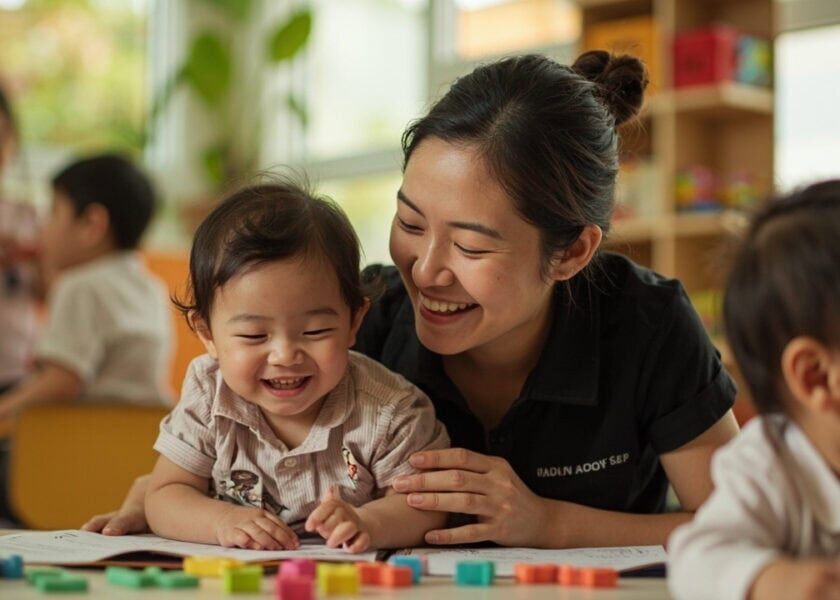
- The quality of eye contact between caregiver and infant — not performed, but natural
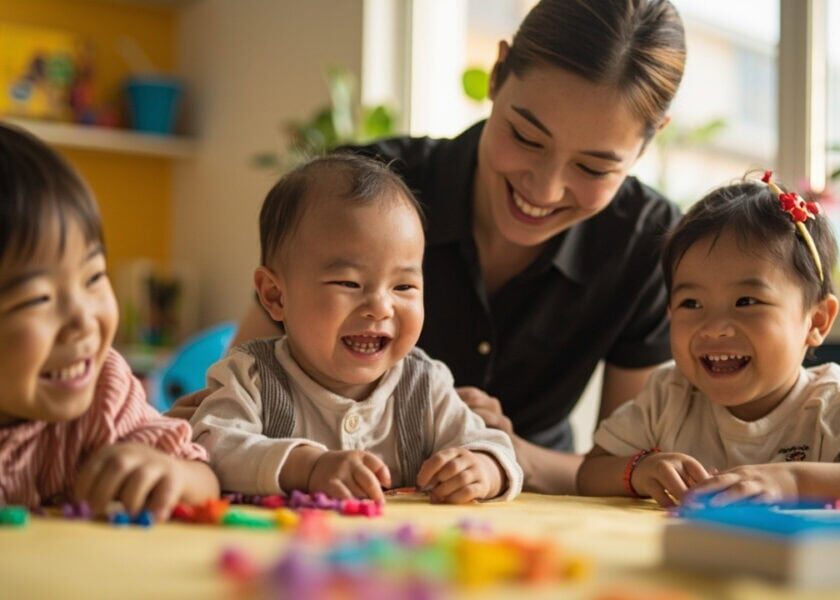
- Whether the space feels like it was designed for adults to admire or for children to explore
- The pace of the room — rushed transitions signal something different than unhurried settling
- Whether you can picture your own child in that space, at their current stage, with their particular temperament
Singapore’s Childcare Landscape
Singapore has built a childcare infrastructure that acknowledges a fundamental truth: there is not one single pathway that works for every family.
Some families need centre-based care, with its community rhythms and peer interaction. Others need something closer to home — home-based care that feels like an extension of family life rather than a departure from it.
A three-month-old and a three-year-old have different needs. A parent working in the CBD and a parent working shift hours have different constraints. Quality childcare must be flexible enough to honour that reality.
This is why EduNanny by BUTLER participates in the ECDA Childminding Pilot — a framework designed to expand what is possible for Singapore families, not to compress diverse needs into a single model.
What We Hold Non-Negotiable
Within whatever model fits your family, certain standards are not negotiable — not as marketing language, but as statements about what infants deserve.
The caregiver-to-infant ratio: Up to one caregiver to three infants. In many settings, this ratio is a theoretical maximum. In ours, it is a commitment.
Why does this matter? Because an infant’s world is small and slow and built on trust. And trust cannot be rushed or distributed across too many relationships at once. Unhurried attention. Responsive care. The feeling of being known rather than managed.
Transparency that builds genuine partnership: For parents to trust what they are seeing, they need to see it clearly. Communication channels that keep families informed not just of schedules and meals, but of moments — the small, daily moments that make up a child’s interior life in care. CCTV measures where deployed, not as surveillance, but as an extension of the transparency that builds genuine partnership between educator and family.
Making Quality Care Accessible
We know that for any of this to work — for good care to reach the families who need it — access cannot be an afterthought. The pilot fee structures are designed to make this level of care achievable for families who need it. CDA and Baby Bonus funds are usable, because Singapore has built instruments to support families in these early years, and those instruments should reach the families they were designed for.
This is not charity. It is infrastructure. It is part of what it means to take the childcare question seriously — not just for those who can afford the premium end of the market, but for every family wrestling with the weight of this decision.
Questions Parents Ask
If you are in the middle of this search, certain questions are almost certainly on your mind. Let us speak to them directly.
“How do I know if a centre is genuinely good, or just good at presenting itself?”
This is exactly the right question — and the fact that you are asking it means you are already developing the right tools. The presentation of a centre and its actual quality are not always aligned. What you are learning to look for is alignment: between what is said and what is done, between the mission statement on the wall and the actual pace of the room, between a warm greeting and a warm presence throughout the visit.
“I keep second-guessing myself. Is that normal?”
Second-guessing is not a sign that you are lost. It is a sign that you are paying attention — and that you care enough about getting this right to hold your own first impressions up to scrutiny. That scrutiny is not weakness. It is the process of discernment refining itself. The parent who second-guesses thoughtfully is building something different from the parent who accepts the first polished presentation they see.
“What if I make the wrong choice?”
This fear is real, and it deserves to be honored rather than dismissed. But here is what the search teaches, if we let it: the ability to recognize quality is portable. It does not disappear after enrollment. The parent who has learned to read a room, to sense warmth versus performance, to notice responsiveness — this parent will continue noticing. They will catch misalignments early. They will ask the right questions. They will know, in a way that cannot be taught from a brochure, when something is not quite right — and they will have the vocabulary to address it.
Practical Guidance for Your Search
As you move through the process of finding infant care in Singapore, consider these approaches:
- Stay present during visits. Put down the notepad occasionally. Let yourself feel the room before you start analyzing it.
- Watch the caregiver-child interactions, not just the curriculum. How children are responded to in unguarded moments tells you more than any activity schedule.
- Ask the questions that arise naturally. If something catches your attention — a child’s expression, a particular corner of the room, a sound from another area — follow that instinct. The questions that come from genuine curiosity often reveal more than prepared queries.
- Notice how you feel when you leave. Relief, discomfort, warmth, unease — your emotional response is data. It is not the only data, but it is real data.
- Trust the process, even when it is uncomfortable. The discomfort of searching carefully is not a flaw in the process. It is the process working.
The Dignity of This Work
Singapore parents are developing something precious in this process. They are developing the capacity to see quality when it stands in front of them.
And the caregivers who do this work — who have been chosen, trained, and trusted to hold the foundation of a child’s early days — deserve recognition not just for their warmth, but for their skill.
The ability to observe an infant’s face and know that something is shifting — that a frown is not simply displeasure but perhaps the beginning of a word, a thought, a new internal landscape being mapped. The patience to wait when an infant is frustrated and the wisdom to know when to intervene and when to stay close. The quiet professionalism that does not perform care but practices it, daily, with intention.
These are not interchangeable individuals. They are professionals who understand the significance of what they hold.
For all of this to matter, you have to be able to find them. Not through a checklist. Not through a comparison table. Through something more personal and more reliable: the confidence that comes from having learned, through careful searching, what quality looks and feels like.
The visits, the questions, the evenings spent second-guessing and then second-guessing your second-guessing — all of it is contributing to something real.
- A growing capacity to recognize quality when it is in front of you
- A deepening trust in your own observations
- The kind of wisdom that does not announce itself but quietly, confidently, guides you to the right decision
Finding the Right Fit
EduNanny by BUTLER is here to walk that path with you. Not to tell you what to look for, but to help you see more clearly what you are already beginning to notice — and to offer a different kind of conversation when the search feels overwhelming.
We meet parents at the moment of greatest uncertainty and show them that this uncertainty is not a flaw in their judgment. It is the feeling of discernment taking shape. It is the parent you are becoming — the one who searched carefully, observed deeply, and chose from a place of genuine knowing rather than anxious checking.
That parent is already here. That parent has been here since the first centre visit, since the first question asked, since the first moment of doubt that turned out to be the first moment of clarity.
The right fit is not found. It is recognized. And you are closer to that recognition than you know.
If you are ready to explore what thoughtful, development-oriented childminding can look like for your family, we invite you to connect with us. No checklist required. Just a conversation about what you are noticing, what you are looking for, and how we might walk this path together.
#ChildcareSingapore #InfantCareSingapore #ChildminderSingapore #EduNannySG #QualityChildcare