How Singapore Parents Build Childcare Partnerships That Grow With Their Child
Finding a Caregiver vs. Building a Relationship
When you first bring your infant to a caregiver, you know almost nothing about how this arrangement will feel a year from now, or two years, or five. You know your own instincts. You know what you observed during visits—the warmth in a voice, the way a caregiver lowered herself to a child’s eye level, the questions asked about your family’s rhythms and values. But the person across from you in those early conversations is, in a real sense, a stranger. Someone you have assessed, perhaps carefully, but whose presence in your daily life remains entirely theoretical.
This is the central tension of early parenthood: you must invest enormous trust before you can fully know if that trust is warranted. It is a vulnerability unlike almost any other. And it is the reason that the conversation about childcare so often stops at the moment of selection, as if choosing well were the whole story.
But choosing well is not the whole story. It is merely the opening chapter.
The Two Questions Every Parent Faces
There is a difference, one that becomes visible only with time, between finding a caregiver and building a caregiving relationship.
Finding a caregiver is an event. It has a timeline. It involves interviews, trial visits, reference checks. It can be measured. It can be optimized. And it matters enormously—because the foundation you lay determines what becomes possible above it.
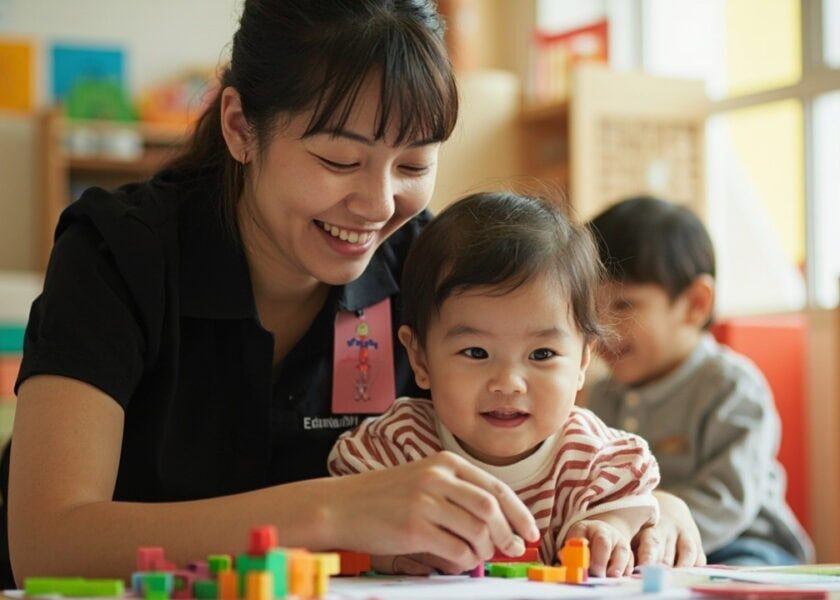
Building a caregiving relationship is a process. It unfolds across meals shared and milestone moments witnessed, across quiet afternoons when a caregiver texts you a photograph of your child discovering something new, across mornings when your child runs toward the door before you have finished unstrapping the pram, because they already know where they are going and who is waiting.
The first question you answer once: Is this person capable?
The second question you answer again and again, every day, in every small interaction, in every choice to show up with patience and honesty when something goes differently than expected: Can we grow alongside each other in service of this child?
The Early Months: Learning Each Other
In the early months, what happens between you and your caregiver is largely a matter of observation. You are watching each other. You are watching how each of you responds to your child. You are establishing the rhythms that will eventually feel like the heartbeat of the arrangement.
This mutual observation is often invisible in conversations about childcare quality. We talk about caregivers assessing children—which matters enormously, because an infant’s non-verbal communication reveals everything from hunger to discomfort to curiosity. But we less often talk about the caregiver observing the parent.
And yet this observation is reciprocal. The caregiver is learning your family’s language, your unspoken preferences, the small things that matter to you even when you have not said them aloud. She notices whether you prefer detailed updates or a simple reassurance. She sees how you hold your child when you arrive, the tone of your voice, the questions you ask first.
The Shift to Shorthand
Something shifts, slowly, in the months that follow. The formal give-and-take of those first weeks begins to soften. The caregiver no longer waits for your explicit permission to make small decisions. You no longer feel the need to explain the reasoning behind every preference. A shorthand develops—not because you have stopped communicating, but because you have communicated so much, so consistently, that the shorthand now carries the weight of what has already been established.
You will notice this deepening in the rituals that emerge—small, unremarkable, and utterly important: the caregiver who always has your child’s favourite song ready when the afternoon energy dips, the way your child points to a specific corner of the room when asked where they go to read books, the greeting that has become something your child anticipates with visible joy.
This is what long-term quality feels like from the inside. It is not a feeling you can capture in a first visit. It is the texture of a relationship that has been built, deliberately and patiently, over time.
What Presence Actually Means
When I speak about presence, I mean something specific. I mean the willingness to pay attention to what is actually happening, rather than what is expected to happen. To notice when a child’s mood has shifted before anyone has said a word. To remember that Tuesday afternoons have historically been harder than Monday, and to prepare accordingly. To understand that the way a child enters a room matters as much as what they do once they are in it.
Presence is not a policy. It cannot be mandated. It is cultivated, over time, by caregivers who are treated as partners rather than vendors, who are respected for their expertise and trusted in their judgment, who feel that the work they do is seen and valued.
A caregiver who feels respected will offer respect in return. A caregiver who feels trusted will take genuine ownership of the child’s wellbeing. A caregiver who is invited into the conversation—rather than simply given instructions—will begin to think alongside you, not just follow your directions.
Staying Engaged Without Micromanaging
One of the tensions parents often feel, once a childcare arrangement is established, is how to stay involved without micromanaging. How to maintain your role as the primary authority in your child’s life without undermining the caregiver’s ability to do her work.
The answer lies in understanding that engagement is not the same as control.
What Engaged Parenting Looks Like
Engagement means staying curious. It means asking questions not because you doubt the answers, but because you are genuinely interested in what happens in the hours your child spends away from you. It means sharing information about your child’s development at home—new words, new fears, new fascinations—so that the caregiver can build on what is happening elsewhere.
Engagement means offering feedback that is specific and kind. It means acknowledging what is going well, not just flagging what is not. It means trusting your caregiver enough to let her know when something matters to you, and then trusting her to incorporate it.
Engagement means recognizing that your caregiver sees your child in a context you do not. She sees how your child interacts with other children, how they respond to structure, how they navigate conflict and comfort. She has access to observations that you, as the parent, cannot have. And so the most engaged parents are those who invite this perspective, who ask to learn what they cannot see, who treat the caregiver as a window into a world that is not visible to them.
This is not relinquishing authority. This is expanding it. Because the parent who knows most about their child’s life at home, and who also knows what their caregiver observes in their absence, is the parent who has the fullest picture of who their child is becoming.
When Things Do Not Go Smoothly
There will be moments, in any long-term childcare relationship, when things do not go smoothly. A misunderstanding. A communication that should have been clearer. A child’s behaviour that signals something is not quite right. These moments are not failures of the partnership. They are, if approached with honesty, opportunities to deepen it.
What distinguishes a relationship that is genuinely strong from one that merely persists is what happens when difficulty arises. In a surface-level arrangement, difficulty creates distance. It becomes evidence of incompatibility. It leads to the sense that perhaps this was never the right fit.
But in a relationship that has been built over time—in which both parties have shown up consistently, have learned each other’s patterns, have developed a reservoir of trust—difficulty becomes something else. It becomes the moment when you discover what you actually have. When a concern raised honestly leads to an adjustment that works. When a conversation that might have been awkward becomes instead an opportunity to recalibrate and move forward together.
The partnerships that last are not the ones where nothing goes wrong. They are the ones where both people believe the relationship is worth the effort of working through what goes wrong.
Why Continuity Changes Everything
Continuity matters profoundly. The caregiver who has been with your child since infancy has seen everything—the first steps, the first words, the first days of separation anxiety and the slow, triumphant return of confidence. She has a context for your child’s behaviour that no amount of briefing can replace. She knows, from experience, what is normal for this child and what is unusual, what warrants attention and what will pass on its own.
When we talk about quality in infant care, we often focus on ratios and qualifications—and these matter, they matter enormously. Every caregiver should be trained and licensed, and infant ratios should be maintained at levels that ensure attention does not become diluted. These are the foundations. But the walls of the house—the warmth, the intuition, the genuine understanding of who this particular child is—these take time to build.
Time is not a luxury in childcare. It is a necessity.
The Architecture of Who They Become
Let me be direct about why this matters so much. The early years of a child’s life are not simply a phase to be managed. They are the period in which the architecture of who that child will become is being laid. The security they feel, the curiosity they develop, the trust they learn to extend to the world—all of this is being formed in the environments we create for them.
A child who knows, with bone-deep certainty, that they are held—by people who love them, by people who see them, by people who show up consistently—is a child who enters the world differently. They take risks because they know they have a base to return to. They extend trust because they have received it. They explore because they are not afraid.
And this child is not created by one person alone. They are created by the village. By the parent who chose with care and commitment. By the caregiver who brought patience and presence and expertise. By the institution that created the conditions for this relationship to flourish.
Signs of Quality You Can Look For
When evaluating any childcare arrangement, here are indicators that point toward genuine quality:
- Trained and licensed caregivers – Credentials matter, but so does the culture of ongoing learning
- Appropriate infant ratios – Small group sizes mean more individual attention and better observation
- Consistent communication – Updates that feel natural, not mandated; sharing as a default, not a response
- Transparency measures – Where measures like home CCTV are in place, it should be framed as clarity, not surveillance
- Rhythm and routine – Predictability that serves the child’s security without becoming rigid
- Questions about your family – A caregiver who asks about your values and preferences is building partnership, not just following protocol
- Responsiveness to concerns – How a caregiver handles a question or worry tells you more than any brochure
Questions to Ask Before You Decide
If you are evaluating childcare options in Singapore, here are questions worth sitting with:
- Does this arrangement feel like something that could work for years, not just months?
- Do the caregivers ask about my family—our values, our routines, what matters to us?
- Is there a structure in place that supports continuity—reasonable fees, accessible funding options, a model designed for long-term relationships?
- How is communication handled? Is it consistent, proactive, and two-way?
- Do I feel respected as a partner, or like a client receiving a service?
- What happens when something goes wrong? Is there a culture of honest conversation?
The EduNanny Approach: Built for Depth
EduNanny was built with this kind of deepening in mind. As part of the ECDA Childminding Pilot, it offers families in Singapore an approach to infant care that balances professional standards with the relational depth I have been describing. Whether through home-based arrangements or community pathways, the structure is designed to create continuity—the conditions in which a partnership can grow.
The caregivers in the EduNanny network are trained and licensed, with infant ratios maintained to ensure attention does not become diluted. Fee structures within the pilot make quality care accessible, and the ability to use CDA and Baby Bonus funds reduces the friction that pulls families away from arrangements that are working.
But beyond the structures, there is a philosophy embedded in how EduNanny approaches its work. It begins with a belief that every child deserves to be known deeply, not just watched carefully. That parents deserve to feel not just satisfied, but genuinely confident. That the early years matter, and that the relationships formed in those years are worth investing in, slowly and intentionally, over time.
This is not a promise made in marketing language. It is a commitment embedded in the structure of what they do—in the training, the ratios, the transparency, the ongoing communication, the respect for both parent and caregiver as partners in the same essential work.
The Story That Unfolds
When you think about childcare, I invite you to think not in terms of days but in terms of years. Not in terms of finding the right service, but in terms of building the right relationship. Not in terms of choosing once, but in terms of choosing to continue—to keep showing up, to keep communicating, to keep investing in a partnership that will, over time, become one of the most meaningful in your family’s life.
The moment after enrollment ends is not an ending. It is a beginning.
What follows is the real story—the one written in morning hellos and afternoon discoveries, in the slow accumulation of trust, in the routines that become sacred, in the caregiver who has seen your child grow from infancy and who knows, in her bones, who this small person is becoming.
This is confidence through continuity. It is not the confidence of having made a good decision on a single day. It is the confidence of having built something that continues to prove itself, day after day, year after year.
The caregiver who holds your infant today is not simply providing a service. She is participating in the making of a person. And so are you. And so is everyone who has worked to make this kind of care possible—not as a transaction, but as a calling.
If you are looking for an infant care or childminding arrangement in Singapore that is designed for depth—not just coverage—I invite you to learn more about EduNanny and the ECDA Childminding Pilot. Understand the funding options available through CDA and Baby Bonus. Have a conversation about what continuity could look like for your child, in the years ahead.
The decision you make now is the beginning. What you build from there is up to you—and the partner you choose to build it with.
EduNanny is part of the ECDA Childminding Pilot, offering trained, licensed caregivers and structured infant care for families in Singapore. Enquire today to explore how we can support your family’s journey.