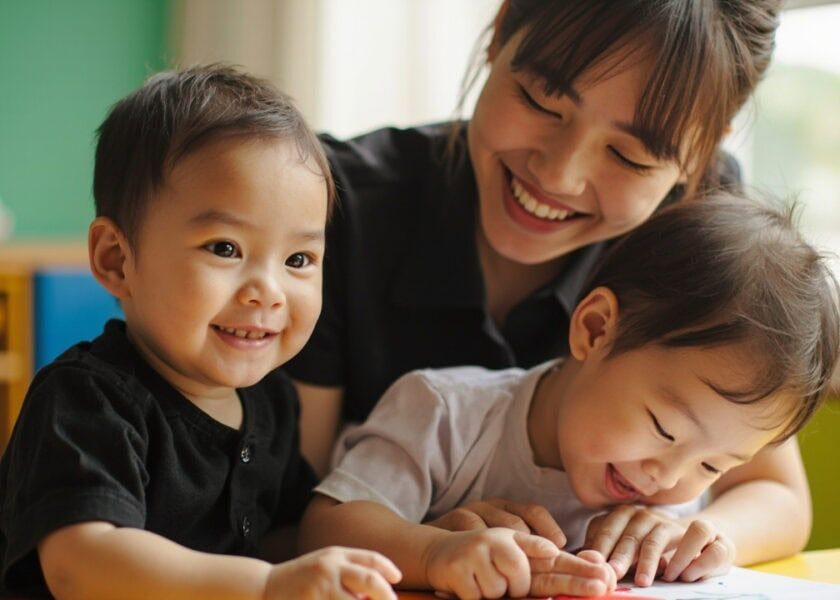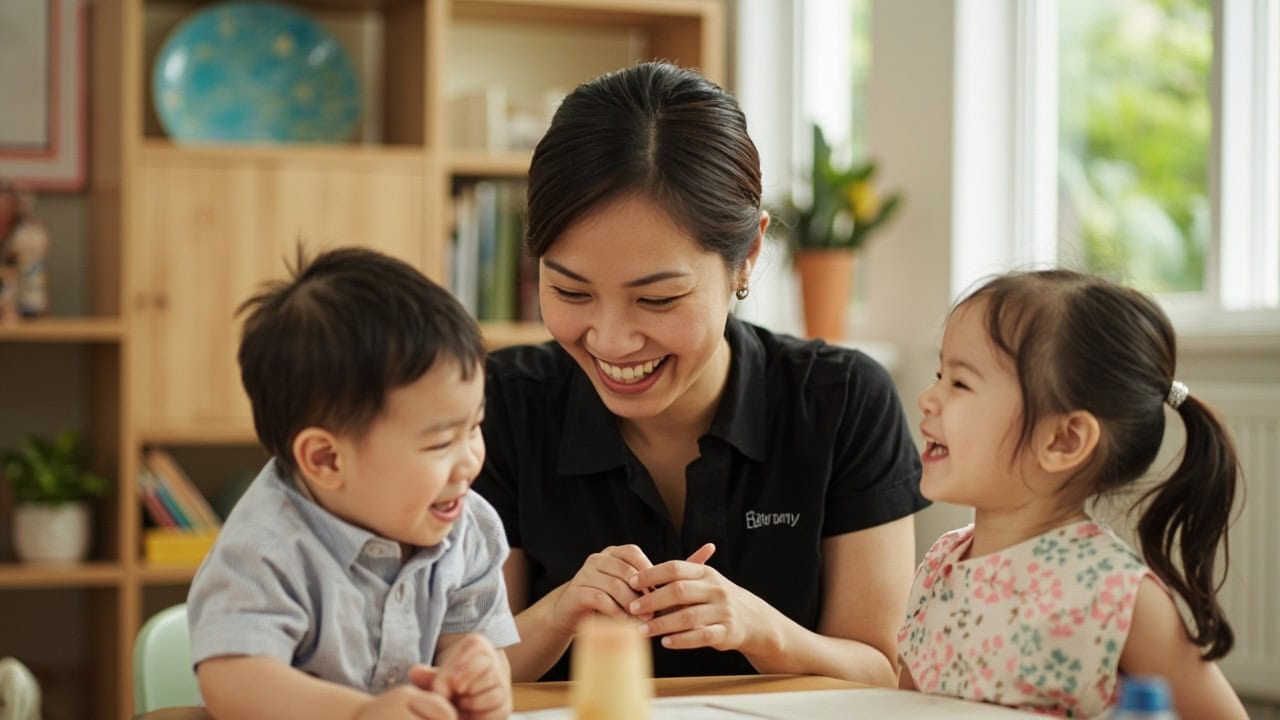
Why Singapore’s Most School-Ready Children Often Arrive Without a Single Worksheet
Is My Child Going to Be Ready? The Question Every Singapore Parent Carries
There is a question that arrives the moment your child is born. Sometimes it surfaces quietly at 2am during a feeding. Sometimes it sharpens at a playground conversation with other parents. Sometimes it rises when you walk into a childcare centre and feel the weight of a decision that will shape the years ahead.
The question sounds like this: Is my child going to be ready?
Not ready in the sentimental sense. Not in the way we marvel at how quickly babies grow, how suddenly they are walking and reaching for our hands. I mean ready in the way Singapore schools demand readiness. Ready to sit, to focus, to perform, to keep pace. Ready to not fall behind.
It is one of the most universal tensions I know how to witness among Singapore parents. You want your child to be happy. You want your child to be safe. You want your child to be loved. And underneath all of that — sometimes louder than all of that — you want your child to be genuinely prepared for what comes next.
So you start looking at childcare options. You walk into centres. You speak with caregivers. And somewhere in that search, a quieter fear begins to take shape:
What if choosing a childcare setting that feels warm and nurturing means my child will not learn enough? What if the love comes at the cost of readiness? What if, by choosing a place that treats my child like a whole human being rather than a student, I am somehow letting them down?
I want to address that fear directly, because it is one of the most consequential anxieties we have allowed to take root in how we think about early childhood.
The Fear That Warmth and Learning Are in Opposition Is Misguided
The children who arrive at Primary One most ready are not, by and large, the children who spent their preschool years doing worksheets. They are not the children who could recite alphabets at two, or write their names at three, or complete addition problems before they could tie their shoes.
Those children may perform well on certain narrow measures, in certain controlled conditions, for a certain period of time. But what experienced teachers, principals, and seasoned educators consistently observe is this: the children who thrive, who adapt, who recover from difficulty, who lean forward into learning rather than pulling away from it — they arrived at school with something far more foundational than academic knowledge.
They arrived with curiosity. With resilience. With the ability to regulate their own emotions when frustration arose. With the social intelligence to ask for help, to collaborate, to read a room, to understand that learning is not a solo act but a shared one.
The Crucial Difference: Academic Readiness vs. True School Readiness
This distinction matters enormously.
Academic readiness is the ability to perform specific tasks associated with literacy and numeracy — recognising letters, counting objects, following instructions in a controlled setting.
True school readiness is a much richer, more durable, more human set of capacities that allow a child to walk into a classroom at six years old and say:
- I am capable of being here.
- I can manage how I feel.
- I know how to learn.
- I am interested in what happens next.
Academic readiness can be taught quickly. True school readiness is built slowly — through thousands of small moments of interaction, exploration, security, and meaning-making. Most of these moments look nothing like a lesson. They look like play. And that is precisely why they are so powerful.
Where Learning Actually Happens: Inside Quality Childcare
Everything I am describing — the readiness, the curiosity, the emotional resilience — none of it happens in a vacuum. It happens in the presence of a caregiver who is trained, supported, and given the time and space to actually be present with the children in their care.
It happens in environments where the daily architecture of a child’s day — the transitions, the meals, the outdoor time, the quiet moments, the storytimes, the block play, the unstructured exploration — is understood not as babysitting but as curriculum. Not the curriculum of worksheets and benchmarks, but the curriculum of a human being learning how to be a person in the world.
A Concrete Example: The Tower That Fell
Imagine your eighteen-month-old at the play table, building a tower out of soft blocks. She stacks three blocks. The fourth falls. She looks up at her caregiver.
That moment — that exact moment — is a learning event. It is not on any lesson plan. No worksheet was completed. No alphabet was practiced. But what happened?
- She experienced the natural consequence of a tower falling.
- She felt frustration — a real, legitimate emotion — and she had to decide what to do with it.
- She looked to a trusted adult, not in desperation, but in connection, because she has learned that other people are sources of support, not just supervision.
What does the caregiver do in that moment? Does she say, “It’s okay, let me do it for you”? Does she say, “Try again, you can do it”? Or does she sit down beside your child, meet her eyes, and say something like: “You worked so hard on that tower. It’s frustrating when it falls. Do you want to try again, or would you like to build something different?”
That second option — where the adult names the feeling, validates it, and gives the child genuine agency over what happens next — that is learning. That is the most important learning that happens in the first five years of a child’s life.
That same moment happens at your dinner table. It happens when your toddler throws a cup of water across the kitchen in frustration. It happens when your three-year-old screams because you said no to a third bedtime story. What you do in those moments — how you name the feeling, how you stay regulated yourself, how you give your child the dignity of being capable of choosing their next response — that is the same learning. You are not a passive observer of your child’s care. You are an extension of it.
What EduNanny Makes Possible
EduNanny by BUTLER operates within the ECDA Childminding Pilot, which means it is part of a deliberate, government-recognised effort to expand the quality and accessibility of childcare in Singapore.
These are the material conditions that make everything I have described actually possible:
- Pathways available: Home-based care, centre-based care, and community-based options within the pilot structure
- Affordable quality: Within the pilot fee structures, the cost of quality care becomes something more families can realistically manage
- Government support: The Child Development Account and Baby Bonus can be used, reducing financial burden for eligible families
- Structured for working families: Care runs Monday through Friday, in structured blocks designed around real work rhythms
- Infant care ratios: In infant settings, ratios of up to one caregiver to three infants mean your child’s cries are heard, their needs met with responsiveness rather than delay
That last point matters more than it might seem. The kind of attunement that research tells us is the single most important predictor of healthy development is only actually possible when caregivers have the time and support to provide it.
EduNanny understands that the hours your child spends in quality care are not lost hours. They are hours in which your child’s brain is building the architecture it will use for the rest of their life. They are hours of social learning, of emotional scaffolding, of a love of discovery being gently nurtured by people who have been trained, who care, and who have the time and ratios to actually see your child.
Questions to Ask and Actions to Take Tonight
When you are evaluating a childcare arrangement — whether it is a centre, a home-based setting, or a community-based pathway — I want you to ask a different question than the ones most parents default to.
Of course you ask about safety, about hygiene, credentials, and licensing. Ask all of those things. But then go deeper:
- Do the caregivers seem genuinely interested in my child as a person? — This reveals whether your child will be seen as an individual or managed as a task.
- How does this setting respond when a child is upset? — How caregivers handle dysregulation tells you everything about the care quality.
- What does a typical day look like, and does it include time for my child to choose what to do? — Whether child-initiated play is valued or only structured activities fill the schedule.
- How will you communicate with me beyond the logistics? — Whether you will know what your child was curious about, struggled with, found funny.
- How do you support children who are behind or struggling? — Whether the approach is developmentally responsive or one-size-fits-all.
EduNanny, operating within the ECDA framework with its pilot structure, clear standards, and accountability mechanisms, is built to answer those questions with both professionalism and heart.
If Your Child Is Already Enrolled
You can become a more conscious participant in that learning at home. When your child comes home and tells you about their day — or more likely, when they do not tell you much at all because at two, three, and four, language is still catching up to experience — you can ask differently.
Not just: “Did you have fun?”
Instead, try:
- “What did you play with today that you really liked?”
- “Did anyone need help with something?”
- “What made you laugh?”
- “What was hard today?”
- “What do you want to do again tomorrow?”
These questions open doors. They tell your child that their day mattered, that their experiences at childcare were important enough to discuss, that learning is something that belongs to them and not just to the institution.
And when your child is frustrated after dinner because you said no to something reasonable, you can name that feeling with the same calm confidence: “I can see you’re really upset. That makes sense. I’m here while you figure out what to do next.”
You are not just managing behaviour. You are teaching your child that emotions are information, that they are survivable, and that they do not have to be afraid of their own feelings.
That is school readiness. That is the deepest preparation you will ever give your child, and it costs nothing except your attention and your willingness to stay present.
You Are Not Choosing Between Warmth and Readiness
Every child in Singapore who enters Primary One is going to face a system that will test them in very specific ways. It will measure their ability to read, to count, to follow instructions, to perform. And yes, they will need those skills.
But the children who will navigate that system with confidence and joy — who will recover from a bad test score, who will ask the teacher to explain something again, who will form a study group with classmates because they understand that learning is collaborative, who will stay curious long after the worksheet is complete — those children did not begin their education in Primary One.
They began it:
- In a highchair, being talked to while food was being prepared.
- On a caregiver’s lap, hearing a story for the third time and loving it more each time because repetition is the engine of mastery.
- In a childcare setting where the environment was designed not just to keep them safe but to make them feel capable.
- Where they were given the gift of just enough challenge and unconditional support to believe that effort leads to growth.
This is what EduNanny Singapore is building. Not a childcare service that competes with school, but a foundation that makes everything school offers more accessible, more meaningful, and more survivable for your child.
A service that respects the intelligence of Singapore parents enough to tell you the truth: the most important thing your child will learn before Primary One is not a set of facts or skills. It is the belief — deep, durable, and transformative — that they are a learner.
That the world is interesting. That they are capable of figuring things out. That failure is not final. That other people can be trusted. That asking for help is a strength.
If a childcare setting can give your child that — and quality care, the kind that EduNanny by BUTLER is designed to provide, genuinely can — then you are not choosing between warmth and readiness.
You are giving your child both.
And that is not a compromise. That is the whole point.
The decision you are making matters. And the right information can make it clearer.
If you are researching childcare options for your infant or young child in Singapore, we invite you to learn more about EduNanny and what quality care can actually provide — and how EduNanny by BUTLER, operating within the ECDA Childminding Pilot, is designed to give your child the foundation they truly need.