The Cultivation Shift Every Singapore Parent Deserves
The Moment Every Singapore Parent Knows
There is a moment familiar to every parent in Singapore. You stand at the threshold of a childcare centre, or in the living room of a potential caregiver, and you feel it. The weight of a decision that somehow feels larger than the room it is being made in.
You scan the space. You note the ratios. You watch how the children move, how the caregivers respond, how the light falls in the play area. You are not just evaluating a service. You are trying to solve an equation where the variables are your child’s safety, your child’s happiness, your own peace of mind, and the impossible constraint of your own working hours.
You leave the tour with a folder of brochures and a mind full of second-guessing. You tell yourself you will know it when you see it. But what you are actually searching for is something no tour can fully reveal and no checklist can guarantee: a relationship.
And that is the conversation we want to have with you today.
The Search That Never Ends
Singapore parents are some of the most engaged, most thoughtful, most invested parents anywhere. You attend parenting workshops. You read the research. You weigh the options between home-based and centre-based care, between different philosophies, between what the centre promises and what you actually observe.
You ask yourselves: Am I making the right choice? And then you ask it again the next morning when your eighteen-month-old clings to your leg and you wonder if you are failing them by leaving.
Here is what we want you to hear. That question—Am I making the right choice?—is the wrong question to keep asking yourself. Not because the choice does not matter. It does. But because the question keeps you trapped in a search mentality that promises resolution and never delivers it.
There is always another tour to take. There is always another review to read. There is always the nagging feeling that somewhere, there is a better option you have not yet found. And while you are searching, you are not yet cultivating. You are not yet investing in the relationship that will actually carry your family through the months and years ahead.
What Your Child Is Actually Learning
When your child watches you interact with their caregiver, they are not just watching two adults exchange pleasantries and practical information. They are watching a model of trust. They are observing how you speak about them when they are not in the room. They are noticing whether you are at ease or tense, whether you greet this person with genuine warmth or polite distance.
They are absorbing, long before they have words for it, what it looks like when adults who care for them trust each other.
This is not an abstraction. This is developmental reality. Children form their first templates for social relationships not from books or lessons but from observation. And the parent-caregiver dynamic is one of the most consequential templates they will encounter in their early years.
When the adults in that environment model respect, clear communication, responsiveness, and goodwill toward each other, your child feels it in their body. They are more settled. They are more curious. They are more willing to explore because they have an internal working model that says the world is a place where people look after each other.
This is the invisible curriculum of quality childcare, and no activity plan or sensory toy can replace it.
The Daily Rituals That Shape Everything
Think about the daily handoffs that will become part of your family’s rhythm. You arrive in the morning. You greet your caregiver. You hand over your child. There is a brief exchange of information—how did she sleep, did she eat, any notes from the night.
But underneath that practical exchange is something deeper. Your child is watching. They are watching whether you trust this person. They are watching whether the handover is smooth or tense. They are watching whether the caregiver receives them with warmth and presence.
Over time, those daily observations accumulate into a belief: this is a safe person. This is someone who is part of my village. This is someone who is allowed to be with me while my parents are away.
What you are building, in those small daily rituals, is not just a childcare arrangement. You are building your child’s capacity to trust the world.
What Quality Care Looks Like on an Ordinary Tuesday
It looks like a caregiver who notices when your toddler’s cry shifts from tired to frustrated—and intervenes before the meltdown. It looks like someone who can tell you that what looks like a developmental leap is actually a regression, that the sleep disruption is teething, that your child’s resistance to a new food is a normal phase.
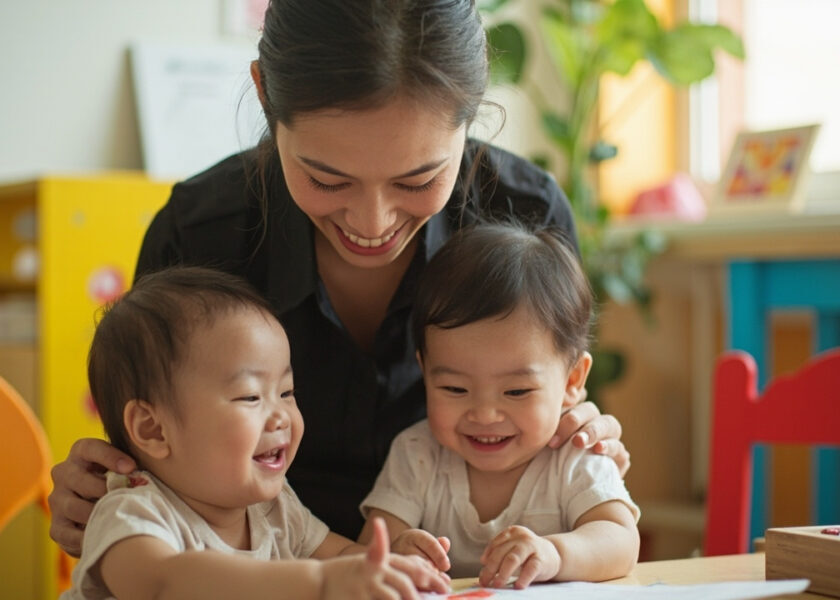
It looks like small ratios that make this kind of attention possible. At EduNanny Singapore, we maintain ratios of up to one caregiver to three infants in our home-based pathway. These are not just numbers on a brochure. They are the condition that makes responsiveness possible.
Quality care also means transparency. Singapore parents are not able to be with their child throughout the day, and that distance can feel like a wound if you do not have trust in its bridge. Where CCTV measures are deployed, they are not there to surveil but to reassure. They are there so that when you receive a message from your caregiver that your child had a beautiful morning at the park, you can feel the truth of it in your chest.
Trust requires evidence, especially when vulnerability is involved. Good care is designed around closing the distance, not widening it.
The Shift That Changes Everything
The shift from search mentality to cultivation mindset is not a one-time decision. It is a daily practice.
It is choosing, each morning, not to scan for evidence that you made a mistake but to invest in the connection that will make the day better for your child and for the caregiver who will be with them.
It is choosing, each evening, not to interrogate your child for signals of distress but to have a genuine conversation with your caregiver about how the day went.
It is choosing to see the relationship as something that grows stronger through attention, through communication, through the messy, imperfect, daily act of showing up for each other.
This shift will change you. It will change you as a parent. Because when you move from anxious evaluation to confident partnership, you begin to notice something.
You begin to notice that you are more attuned to your child. You are more able to read their signals because you are no longer filtering everything through fear. You are more present during the hours you do have together because you are not spending them in guilt or second-guessing. You are more trusting of your own instincts because you have seen that your instincts led you to a good place.
The relationship you build with your caregiver does not just serve your child. It serves your own growth as a parent. It gives you back something you may have lost in the blur of early parenthood: confidence.
Your Caregiver as Your Partner
There is something that often goes unsaid in conversations about childcare quality, and that is the professional knowledge your child’s caregiver carries.
At EduNanny Singapore, we do not see caregivers as interchangeable. We see them as skilled professionals who have chosen a calling, who bring knowledge about child development and infant care that many parents, in the intensity of their own daily experience, do not have the bandwidth to access.
When you build a genuine partnership with your caregiver, you gain a resource. You gain someone who can help you understand your child more fully because they see them in a different context. You gain a trusted informant who notices patterns you might miss.
This is not a service add-on. This is relationship at its most practical.
What If I Make the Wrong Choice?
The anxiety around “wrong” choices often comes from viewing childcare as a product to be vetted rather than a relationship to be built. The truth is, relationships can heal, adapt, and grow. A thoughtful choice made with intention matters more than a perfect choice that does not exist.
How Do I Know If the Caregiver Is Really Responsive?
Look for signs during your interactions: Does this person notice your child? Do they ask questions about your child’s preferences, rhythms, and personality? Do they communicate with you in a way that feels genuine rather than formulaic? The quality of attention you receive as a parent is often a reflection of the attention your child will receive.
What If My Child Resists?
Separation anxiety is a normal developmental phase, not a sign that something is wrong. When children observe that their parents trust their caregivers, when handoffs are warm and consistent, and when the relational environment is secure, children adapt. The resistance often tells us more about parental anxiety than about the quality of care.
What About the Cost?
The financial reality of quality childcare is real and matters. We believe excellent care should not be the privilege of families with unlimited budgets. That is why EduNanny Singapore participates in the ECDA Childminding Pilot, why our fee structures are designed to be accessible, and why Central Development Account funds and Baby Bonus payments can be used toward our services.
Every child deserves to be seen. Every child deserves to be in a relational ecosystem that models trust. And we have worked to make that accessible across Singapore.
Why EduNanny Singapore Was Built This Way
EduNanny by BUTLER was not built to be the most comprehensive childcare search platform or the most elaborate centre. We built it around a different premise.
We set out to understand what Singapore families actually need, what actually makes a difference in a child’s developmental experience, and what actually gives parents their peace of mind back.
What we found, through our ECDA Childminding Pilot and through listening to families across Singapore, is that parents do not need perfection. They need responsiveness. They need to know that when they hand their child to someone, that person will see their child. Not just care for them. Not just keep them safe. But truly see them.
That is why we offer both home-based and community or centre-based pathways—because different families have different needs, different children thrive in different environments, and there is no single right answer for everyone. We maintain small infant ratios because they are the condition that makes responsiveness possible. We have built transparency into the way we work because trust requires evidence.
But what we cannot offer you is the relationship itself. That part is yours to build. And that part is worth more than any perfect checklist could ever be.
Where to Begin
If you are ready to move from search to cultivation, here are some practical starting points:
- Shift your question. Instead of asking “Is this the perfect childcare?”, ask “Do I feel genuinely seen and heard by this caregiver?” The answer will guide you better than any checklist.
- Observe the handoff. When you visit a potential caregiver or centre, notice how the interaction feels. Is it warm? Present? Do you feel like a partner or a customer?
- Ask about ratios. Small ratios are not a luxury—they are the condition that makes responsiveness possible. Ask specifically how many infants each caregiver cares for.
- Invest in communication. Choose arrangements that support daily exchange—quick notes, photos, honest updates. Trust grows when distance shrinks.
- Give it time. The relationship you build with your caregiver will evolve. Resist the urge to evaluate too quickly. Show up, communicate, and trust the process.
You Are Not Searching for Perfect. You Are Building Something Real.
Here is what we want you to carry with you after reading this:
You are not searching for the perfect childcare. You are building the relationship your child will learn from. You are choosing a caregiver who will see them, who will respond to them, who will be part of the village that raises them.
You are choosing to trust your own judgment, to invest in a partnership, to show up each day for the messy, beautiful work of cultivation.
And in doing so, you are not just securing childcare. You are modeling for your child what it looks like to build trust, to communicate with care, to be human in relationship.
That is the work. That is what we are here for. And that is what will make all the difference.
If you are ready to explore what it looks like to move from search to cultivation, we invite you to start a conversation with us. Not about programmes or features—but about your family, your child, and what you are really looking for.
Because every family deserves to find their village. And we would be honoured to be part of yours.
Ready to explore quality childminding in Singapore?
Connect with EduNanny Singapore to learn about our home-based and centre-based pathways, our ECDA Childminding Pilot participation, and how our relational approach to infant care is designed to serve Singapore families.