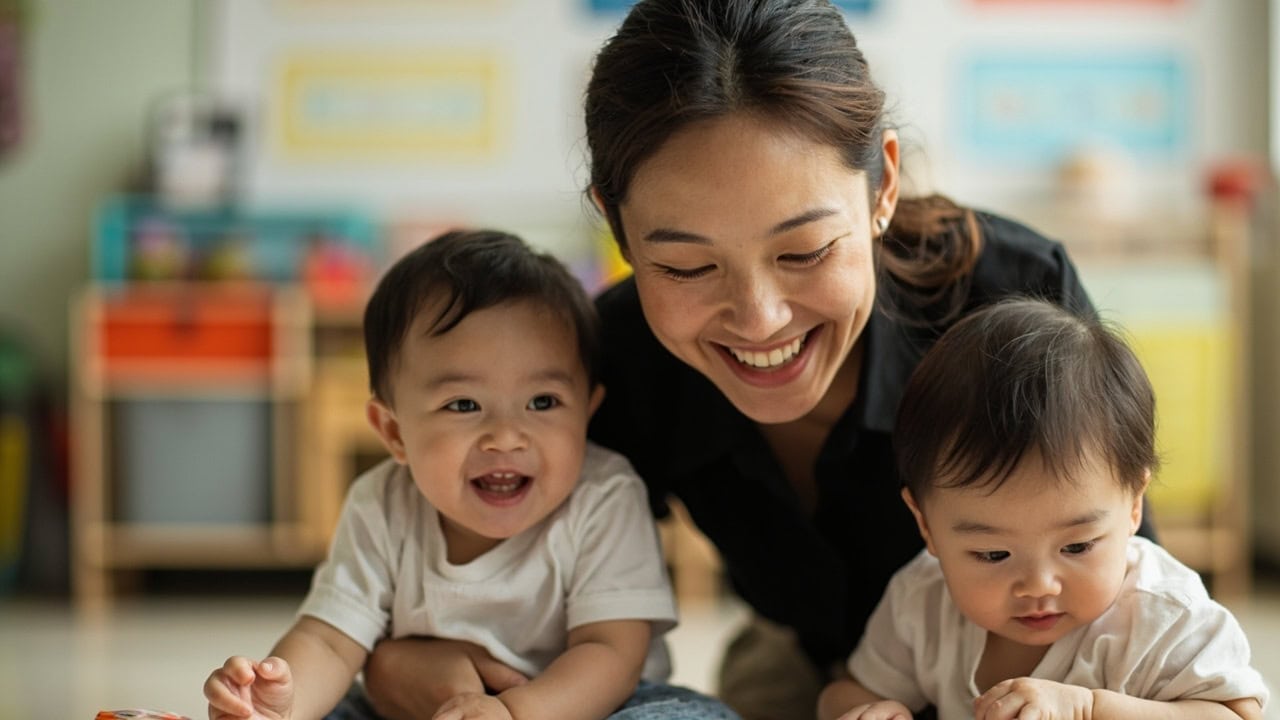
How Thoughtful Childcare Helps Your Children’s Sibling Bond Thrive
When a Second Child Arrives, Everything Reorganizes
There is a moment every parent of multiple children knows, though few speak of it aloud. It arrives not at a crisis point, not during a meltdown or a bedtime battle, but in the quiet interlude of an ordinary afternoon. You are with both children, present in body, and yet your mind is already divided. The older one needs help with her 拼图, the younger is reaching for something on the shelf, and somewhere in the architecture of that simultaneous need, you feel it: the impossible arithmetic of being one person with two small people who deserve all of you at once.
This is not a confession. It is simply the truth of raising siblings in a city where parents carry the weight of two full-time jobs, extended family often far away, and the relentless awareness that the years in which everything matters most are slipping past at a pace no calendar can capture.
When a second child arrives, parents often brace for disruption. They prepare the older child, rearrange the household, stock the cot with fresh sheets. What they may not anticipate is how completely the sibling relationship will reorganize itself around this new reality of divided parental attention.
The older child, who once commanded the full gaze of every adult in the room, now finds herself in a world where a smaller being demands and receives equal measure. The younger child, from the very beginning, learns that the path to connection runs through someone who was here first.
These are not problems to solve. They are dynamics to understand. And understanding begins with an honest look at what siblings actually need—not just from each other, but from the world around them.
What Siblings Actually Need
What siblings need, above almost everything else, is time. Time in each other’s company that is not filtered through the lens of parental management. Time to discover each other without the constant mediation of a tired adult redirecting, intervening, settling disputes. Time to develop the particular language that siblings share—the private jokes, the unspoken cues, the shorthand that comes only from living alongside someone through the full arc of childhood.
Quality childcare can protect and cultivate this time. When children are in an environment designed not just for their individual development but for their relationship with each other, something quietly remarkable begins to happen. The sibling bond, instead of fraying under the pressure of competing needs, begins to strengthen—not because parents are doing anything wrong at home, but because the architecture of their days outside the home has been thoughtfully considered.
The Moments That Reveal Everything
Consider what it means for a four-year-old and a twenty-month-old to spend a full day together in the care of someone who understands that these are not merely two children sharing a space, but two children in an active relationship with each other.
The caregiver notices when the younger one watches the older one with fascination. When the older one softens her voice to match the younger one’s comprehension level. When something passes between them that no adult could manufacture.
These are the moments that rarely survive into the parent report at day’s end, because they are quiet and unspectacular. But they are the foundation stones of a relationship that will shape both of them for decades.
In a setting with ratios designed for attentiveness—small enough to ensure genuine observation—these moments do not slip past unnoticed. There is space to observe, to gently encourage, to create circumstances where the older sibling can become a guide, where the younger one can marvel and imitate, where both can discover the pleasure of being needed by someone their own size.
What Quality Care Offers Parents
There is a question that haunts many parents of multiples, rarely asked aloud because it sounds ungrateful: Are my children actually close, or are they simply obligated to each other by circumstance?
The fear behind this question is real. Siblings raised in the same household sometimes grow into distant adults, connected by obligation rather than affection. Parents worry that the friction they witness—the toys grabbed, the attention competed for, the bedtime battles over shared space—is carving grooves that will become canyons in the future.
What quality childcare offers these parents is evidence. Not the statistics-heavy evidence of research papers, though that exists, but the lived evidence of watching siblings who have spent years in thoughtful shared care move through the world with a visible ease in each other’s company.
- The younger one who runs to the older one for comfort at a birthday party.
- The older one who reads to the younger one without being asked.
- The ease with which they include each other in play, negotiate without screaming, understand each other’s moods before any adult can.
This does not happen automatically. It happens when the environment has been designed to make it possible—when caregivers are quietly active in nurturing the bond, seating siblings near each other where parallel play is beneficial, assigning gentle helper roles that build confidence and connection, and creating space—unscheduled, unstructured time—where siblings can find each other without an agenda.
When you see your children thriving together, the invisible stress of divided attention begins to ease. Not because you are doing less—you are doing the same impossible, beautiful amount—but because you can see that the architecture of your family’s days is working.
Reframing the Guilt That Parents Carry
We should speak plainly about something that parents often feel but hesitate to admit: the guilt of needing childcare for multiple children. There is a particular sting in the thought that your children might, somehow, be better off with more of you and less of a schedule.
This guilt is understandable. It is also, in the context of quality care, frequently misplaced.
The question is not whether your children need you—they do, and nothing can replace the bond between a child and their parent. The question is whether your children also need the kind of experiences that thoughtful childcare provides: exposure to other caring adults, interaction with peers, the structure and stimulation of an environment designed for their development.
The answer, for most families, is yes. And when siblings receive these experiences together, something more emerges: they receive them in each other’s company, in the company of someone who sees them as a unit, a pair, a relationship worth cultivating.
What Quality Care Actually Does
Quality childcare for multiple children does not fragment the family. When it is done well, it strengthens the family.
- It gives parents back the energy that depleted hours drain.
- It gives children experiences they cannot give each other alone.
- It gives the sibling relationship room to grow in directions that proximity alone cannot produce.
What Quality Childminding Actually Looks Like
For childcare to genuinely support sibling bonds, certain elements must be present. These are the markers of care that goes beyond supervision into something more purposeful.
Key Indicators of Quality Sibling Care
| Element | What It Looks Like |
|---|---|
| Small ratios | One caregiver to every three infants maximum in early years—small enough for genuine observation and connection |
| Intentional observation | Caregivers who notice when siblings reach for each other, when older ones guide younger ones, when chemistry reveals itself |
| Protected sibling time | Unscheduled moments where children can find each other without adult direction |
| Relationship-focused philosophy | A program that sees siblings not as two children sharing a room but as a pair whose bond deserves cultivation |
| Transparent communication | Daily updates that include observations about sibling dynamics, not just individual milestones |
The Home-Based Advantage
Home-based childminding offers particular benefits for siblings. The smaller, more personal environment means the living room becomes genuinely shared territory where both children feel at home. The caregiver learns the rhythms of both children together, understanding what each needs from the other as well as from her. Transitions between family time and care time feel more seamless, and younger and older siblings can settle into routines that feel familiar rather than institutional.
The EduNanny Approach: Partnership, Not Transaction
This conviction shaped the EduNanny approach from the beginning. EduNanny was built on a simple but powerful premise: that childcare is not a service transaction but a partnership with families. That every child deserves individual attention, and that every sibling pair deserves to be seen as a relationship, not just two children sharing a room.
Operating Within the ECDA Framework
Our work operates within the ECDA Childminding Pilot, which means we are part of a carefully structured framework designed to make quality childminding accessible to families across Singapore. Whether through home-based pathways, where a caregiver comes to you, or community and centre-based options that bring children together in thoughtfully designed environments, we offer families real choice in how their children’s days are structured.
Ratios, Training, and Transparency
In our infant care settings, we maintain ratios of up to one caregiver for every three infants—small enough to ensure genuine attention, large enough to allow natural social dynamics of sibling and peer interaction to emerge. Our caregivers are trained not only in child development but in the specific art of observing and nurturing sibling bonds. They understand that a sibling pair is a system, and that every intervention in that system ripples outward in ways both small and significant.
We believe in transparency. Where CCTV measures are deployed, families know. Where daily updates are provided, they are provided with intention, not just as a checkbox. Where communication is offered, it is offered as a dialogue, not a broadcast. We understand that trusting someone with your children is not a single decision but an ongoing act, and we earn that trust one day at a time.
Affordability as Foundation
We understand that affordability matters. The ECDA Childminding Pilot structures its fees to be within reach for families who need quality care without the burden of prohibitive costs. The use of CDA and Baby Bonus funds where applicable means that the financial architecture of childcare is navigable, not labyrinthine. We want quality care to be a realistic option for families across Singapore, not a privilege reserved for those with means.
Choosing the Right Childcare for Your Siblings
If you are researching infant care options for siblings in Singapore, here are the questions worth asking—and what to look for when you visit.
Questions to Ask Any Provider
- How do you handle sibling pairs at different developmental stages?
- What is the caregiver-to-child ratio, especially for infants?
- How do caregivers support sibling bonding throughout the day?
- What does a typical day look like for siblings in your care?
- How do you communicate observations about sibling dynamics to parents?
- What training do your caregivers receive in sibling relationship development?
- How do you handle conflicts between siblings?
- What role do siblings play in activities and routines?
What to Look For
When visiting a potential childcare setting, notice whether caregivers seem aware of the siblings as individuals and as a pair. Look for unstructured time where children can find each other naturally. Notice if the environment feels designed for connection, not just supervision. And pay attention to whether you feel heard when you share concerns about your children’s relationship.
You know your children better than anyone. Trust the feeling you get when you walk into a space. If something feels off—if siblings seem disconnected rather than supported, if caregivers seem overwhelmed rather than attentive, if the environment feels generic rather than thoughtful—keep looking. The right fit exists, and it will feel like a partnership rather than a transaction.
To the Parents Carrying This Quietly
There is a moment near the end of each day, at centres and in home-based settings, when the energy shifts. The activities wind down. The children begin to settle into the particular calm that precedes reunion with parents. And sometimes, if you are watching carefully, you will see a small hand reach for another small hand. Not out of need. Not out of fear. Simply out of the habit that has formed, over hundreds of days, of reaching for the person who has been there all along.
We know that Singapore parents carry more than they often say aloud. They carry the weight of expectation, the pressure of achievement, the logistical complexity of modern family life in a city that moves at extraordinary speed. They carry, especially, the quiet fear that they might be failing at something they care about more than anything else in the world.
To those parents: you are not failing. You are navigating a complexity that your own parents never faced, with resources that are still being built. And you are doing it with a care and intention that shows in every question you ask, every transition you agonize over, every evening you spend reading one more article about how to do this better.
The sibling relationship your children share is not a complication to be managed. It is a gift they are giving each other, one that will outlast your own presence in their lives. And when that gift is placed in the right environment—with caregivers who see it, structures that support it, and space that lets it breathe—it grows into something remarkable.
EduNanny exists to give it that environment. Not because we think childcare replaces parents, but because we believe parents deserve partners who share their vision for what their children can become. We believe siblings deserve to be known not just as individuals but as a pair, a duo, a relationship that has its own needs and its own possibilities.
This is the work we have chosen. This is the work we will keep doing, for every family who walks through our doors or invites us into their homes, across Singapore, Monday through Friday, one ordinary day at a time.
Because the sibling bond does not need to be forced or engineered or manufactured. It needs to be witnessed, and protected, and given room to grow.
We witness it. We protect it. We give it room.
And in doing so, we do not take your children from you. We give them back to you—stronger, more connected, more themselves—along with all the ordinary days that made them so.
Ready to explore your options? Learn more about how EduNanny supports sibling pairs across Singapore. Let us show you how sibling care, done thoughtfully, can strengthen not just your children’s bond with each other, but your family’s foundation for the years ahead.
Tags: #SiblingBonding #SingaporeChildcare #InfantCareSG #ChildmindingSingapore #EduNannySG