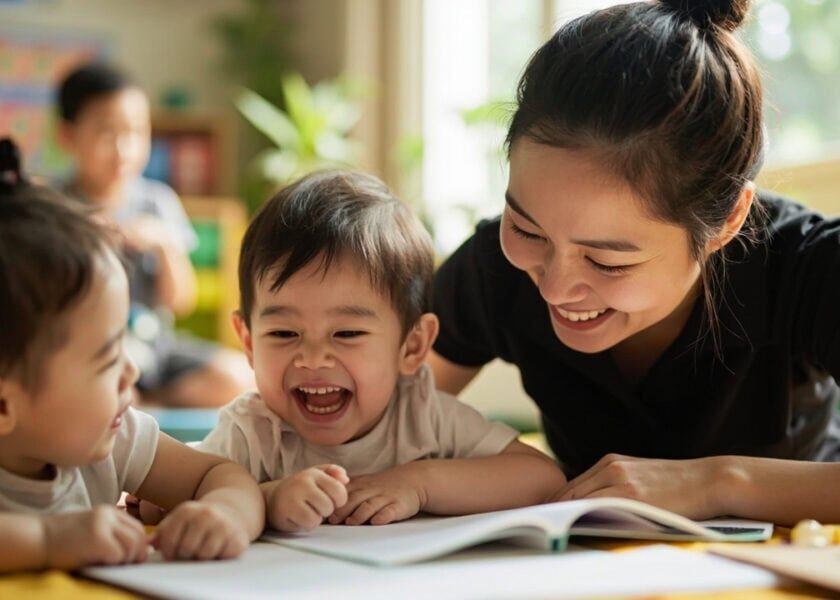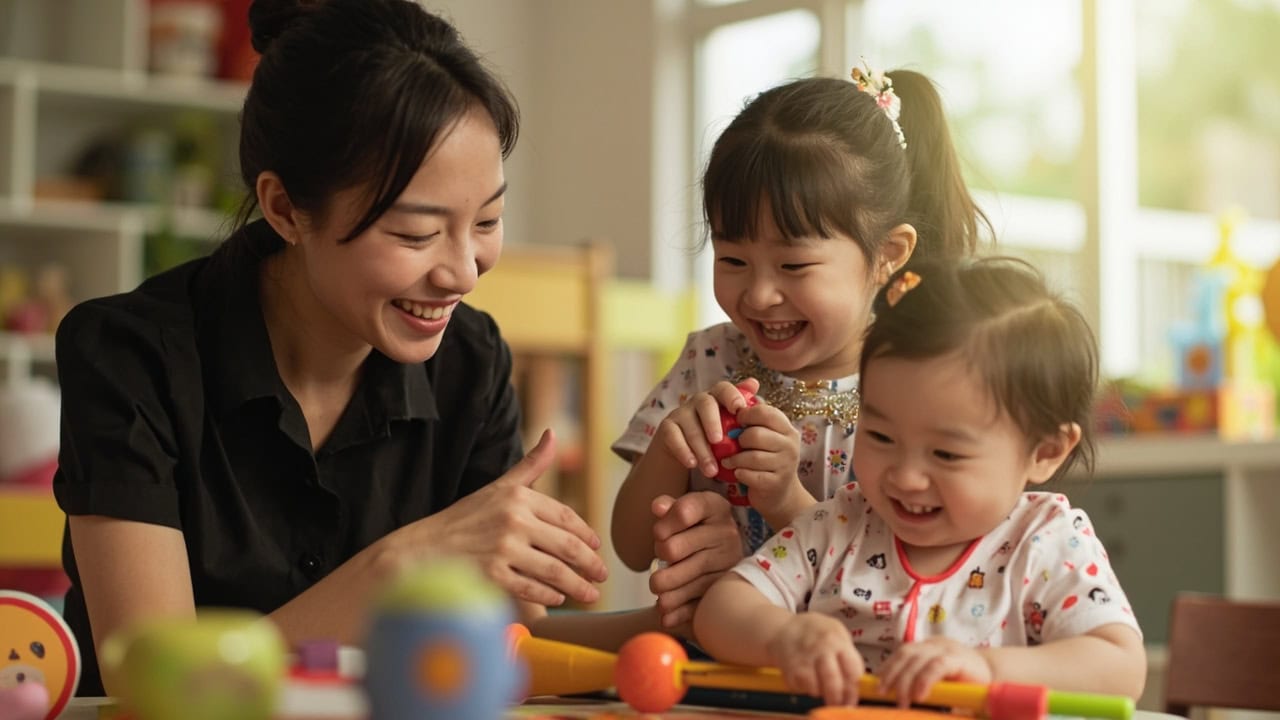
What Sustained Quality Childcare Looks Like Across the Months
Quick Summary: What Sustained Quality Care Actually Looks Like
- Development takes months, not days — Quality care works on a seasonal timeline, not a daily report card.
- Language blooms in sustained environments — Vocabulary and conversational ability deepen through thousands of micro-interactions.
- Social confidence compounds over time — Parallel play gradually becomes collaborative play.
- The middle months are not a plateau — What feels quiet is actually consolidation and integration.
- Curiosity, not performance — The sign of genuine quality is a child who pursues interest for its own sake.
- You develop new eyes for your child — Ongoing caregiver partnership deepens your own understanding.
The Timeline You Did Not Expect
The first thing to understand about child development in a sustained quality environment is that it operates on a different timeline than the one we instinctively expect. As parents, we are primed to look for immediate results. We want evidence that our child learned something today, that they grew, that the investment we are making is yielding returns. This is not impatience—it is simply how we are wired.
But development in quality care does not work like a report card. It works more like the growth of a tree, which is to say it is happening all the time, but you will only see the evidence of it if you are willing to look across seasons rather than days.
Consider what actually changes between month two and month eight of quality care. In the early weeks, your child was learning the basic grammar of their new world: where the bathroom is, who to ask for water, where their cot is, what the routine feels like. These are essential adaptations, and they matter. But they are not development in the fullest sense. They are orientation.
True development—the kind that changes who your child is becoming—begins to emerge once orientation is complete. And this is where something quiet and profound starts to happen.
The Language Bloom: What Six Months Actually Produces
Over the months that follow, you will notice your child’s language transform in ways that feel almost magical until you understand what is actually producing them. This is what we sometimes call the language bloom, and it is one of the clearest signs of sustained quality care at work.
It does not happen because a caregiver sat down and taught your child new words. It happens because your child has spent months in an environment where their attempts at communication are consistently received, mirrored, and expanded.
When a child at eight months points and says “ba” and their caregiver responds with enthusiasm, “Yes, ball! You see the ball!”—something is being built. When a child at eighteen months offers a half-formed observation about the weather and their caregiver responds as though it were the most interesting thing said all morning—something is being formed. These micro-interactions, repeated thousands of times across months, create the architecture of language.
You will notice this bloom most clearly not in the moment but in retrospection. One evening, you will catch yourself having a real conversation with your child—actual back-and-forth, actual listening and responding—and you will realize that this was not possible six months ago. The language bloom is not a performance. Your child is simply living inside a communication-rich environment that has become, over time, the normal way they expect the world to work.
Social Confidence That Compounds
There is another transformation that happens in sustained quality care, and it is the one that often catches parents most off guard: the development of social confidence.
In the earliest weeks and months, children in quality care are often doing what developmental psychologists call parallel play. They are in the same space as other children, but they are not yet truly playing with them. They are alongside, not together. This is entirely normal and developmentally appropriate. Social engagement requires a sense of safety, a sense of self, and a sense of the other as a reliable presence.
What happens in sustained quality care is that these three elements gradually accumulate. Your child begins to trust that the other children will be there tomorrow and the next day. They begin to have preferences, to notice who they enjoy being near, to experience the pleasure of shared attention directed at the same object.
And slowly, almost imperceptibly, parallel play becomes collaborative play.
You will know this is happening not when your child tells you they made a friend—though that moment will come—but in the smaller moments before language is even available to express it. You will see it in the way they move toward other children rather than away from them. In the way they handle the disappointment of a toy being taken, with increasing capacity to recover and redirect. In the way they begin to notice others’ emotions and respond to them with genuine responsiveness, the kind that comes from months inside a community of small people learning to be together.
This is what we mean when we speak of social confidence that compounds. It is built across months, through the accumulated experience of being in a consistent social environment with consistent caregivers who model what it means to be in relationship.
The Middle Months: Why Quiet Is Not the Same as Stalled
There will come a period—often around months four, five, or six—where it may feel like not much is happening. The dramatic growth of the early settling-in period has settled into something quieter. Your child seems comfortable, happy even, but you are not seeing the kinds of changes that were so visible in those first weeks. You may begin to wonder if the quality you were hoping for has plateaued, or worse, that it was never quite there.
This is one of the most important things I can tell you about longitudinal development in quality care: the middle months are not a plateau. They are a consolidation.
When a child is learning to walk, there is a period where they are not yet walking steadily and no longer content to crawl. Parents often experience this as frustration, but what is actually happening is that the child’s body is integrating new capacities.
The same thing happens cognitively, linguistically, and socially in the months after a child has settled into quality care. The early gains are being woven into something more stable. The vocabulary that bloomed is being connected to deeper understanding. The social confidence that emerged is being tested and refined in increasingly complex interactions.
This is why we sometimes say that quality care reveals itself most clearly over twelve months, not twelve days. Anyone can create an impressive first impression. The true measure of quality is what happens in the months when no one is watching with the same intensity, when the novelty has worn off, when the work of genuine development is happening beneath the surface.
When you choose quality care and stay with it—not because you are afraid to change, but because you are genuinely curious about what sustained attention produces—you are giving your child the gift of consolidation. You are allowing the environment to do its deepest work.
Your Partnership With Your Child’s Caregiver
There is something else that happens to you, as a parent, over these months. Something that is rarely discussed but that I consider one of the most valuable outcomes of sustained quality care: you develop new eyes for your child.
In the early days of parenthood, we observe our children with love but often with limited frames of reference. We do not yet know what is typical and what is exceptional. We do not know what to look for, or what the absence of something might mean, or what the presence of something else might indicate. We are loving and devoted, but we are also somewhat blind.
Quality care changes this. Not because it tells you what to see, but because it creates a sustained mirror for your child’s development. When you are in regular, transparent dialogue with caregivers who know your child deeply—who have seen them across months, through moods and changes and growth spurts and difficult days—you begin to receive a more complete picture of who your child is becoming.
And this picture begins to change how you see your child at home. You start to notice things you might have missed. You recognize the signs of a child who is beginning to test their own capabilities, and you understand that this is healthy and necessary. You see the moments when your child is genuinely curious versus when they are performing for attention, and you understand the difference.
In the early weeks, communication with your child’s caregiver tends to focus on logistics: how the day went, whether they ate well, how the nap went. This is necessary and appropriate. But as months pass, the nature of the conversation can shift. It can become less about the day’s events and more about patterns—what you are noticing at home and what they are noticing in your child’s time with them. You begin to have conversations about development, not clinical or diagnostic conversations, but genuine observations shared between two people who care deeply about the same small person.
This is what distinguishes genuine quality care from care that simply performs well. In quality care, the relationship between parent and caregiver is one of genuine collaboration, not a service transaction with reports attached.
Curiosity, Not Performance: The Sign of Genuine Quality
I want to speak about something that may seem tangential but is, I believe, at the very heart of what we are discussing: the difference between a child who is performing well and a child who is genuinely curious.
These two things can look similar from the outside. A child who is performing well may be compliant, may follow instructions well, may produce the outputs that are expected of them. This is not bad. It is just not the same as genuine curiosity.
A genuinely curious child is one who wants to know things for their own sake, not for the sake of approval. They are interested in the world as a world, not as a series of tasks to complete. They ask questions that have no practical purpose. They notice things that no one has pointed out to them. They persist at things that are difficult not because they have been told to persist but because they cannot bear to leave a problem unsolved.
Quality care, over time, tends to produce genuine curiosity rather than mere performance. This is because curiosity requires safety. A child who is anxious about approval, who is constantly monitoring whether they are doing the right thing, who is insecure in their environment, cannot afford to be curious.
Curiosity requires a certain recklessness—a willingness to not know, to try something without knowing whether it will work, to fail and try again. In a quality care environment that has been sustained over months, children develop the emotional security that allows curiosity to flourish. They know they are safe. They know their caregivers are reliable. They know the world they are in is a place where their questions will be taken seriously and their explorations will be supported.
You will know your child has crossed this threshold when you catch them pursuing an interest with no external motivation whatsoever—when they are doing something simply because they want to understand it better, not because anyone told them to. This is one of the clearest signs that the decision you made months ago is still working, is still producing the kind of development you hoped for.
Addressing the Doubt That Lingers
Singapore is not short on childcare options, and the landscape can feel overwhelming. There are many paths available, and each path has its advocates. You may have family members who questioned your choice, or friends who made different decisions and seem equally convinced that theirs was correct. You may have moments of genuine doubt, wondering whether another path might have served your child better.
Here is what I want to say to you about that doubt: it is not evidence of failure. It is evidence of care.
The parent who never questions their choices may simply not be paying close attention. The parent who wonders, who reflects, who asks themselves whether the decisions they made are still serving their child well—this is a parent who is awake to the responsibility of raising a child.
And here is the quieter truth beneath the doubt: if you are still noticing, still curious, still invested in understanding what is happening in your child’s development, then you are already doing what quality care was designed to support. Quality care is not just a service you purchase for your child. It is a partnership you enter into, a relationship that unfolds over time, a shared commitment to understanding who this small person is becoming.
Quality Childminding in Singapore: What It Looks Like in Practice
For families in Singapore, understanding what quality childminding looks like in practice matters. The ECDA Childminding Pilot offers structured pathways that reflect what developmental science tells us about how children actually grow.
Quality in this context is not about impressive facilities or elaborate curricula. It is about conditions that allow development to unfold on its actual timeline:
- Consistency of caregiver — The same familiar face day after day, which allows trust to deepen and development to compound.
- Small group ratios — Enough individual attention that every child is truly seen, not just supervised.
- Communication that deepens over time — Not just daily logs, but ongoing dialogue about patterns and development.
- Home-based or community-based options — Environments that feel safe and predictable for young children.
EduNanny Singapore, operating under the ECDA Childminding Pilot, has structured their approach around these principles. Whether through home-based pathways or community-based settings, the design prioritises sustained relationships and genuine attention—because that is what produces the kind of development we have been discussing.
For families within the pilot, fee structures are designed to be accessible. CDA funds and Baby Bonus can be utilised, making quality care not just a philosophical ideal but a practical possibility for Singapore families across different circumstances.
A Seasonal View: What You Might Notice at Each Stage
Here is a way to think about what you might observe in your child at different stages of quality care:
- Months 1–2: Orientation and adaptation. Your child is learning routines, building basic trust, adjusting to new people and spaces.
- Months 3–4: Early social emergence. Your child begins to notice other children, responds to caregivers with increasing warmth.
- Months 5–7: Consolidation. Language blooms, social confidence emerges, curiosity begins to replace anxiety.
- Months 8–12: Integration. Genuine social engagement develops, language becomes complex and fluid, curiosity becomes sustained and visible, confidence is evident.
Remember: the quiet months are not empty months. They are the months when early gains are being woven into something permanent.
Staying With the Long View
You are watching your child in the evening, after a day of quality care that you may not have thought about much, because it has become routine. And you notice something—a word, a gesture, a moment of connection with another child at the playground, a flash of genuine curiosity in their eyes—and you wonder, quietly, if this is still working.
The fact that you are still noticing is itself the answer.
A child in sustained quality care does not need you to verify every day that the care is working. They need you to be present, to be curious, to be willing to see them clearly as they are becoming. And that is exactly what the parent who asks this question is doing. They are present. They are curious. They are willing to look.
What you are seeing in these months, across these seasons, is not a series of impressive moments to be catalogued and compared. It is the slow, quiet, profound construction of a person. It is language blooming in sustained attention. It is social confidence compounding across thousands of small interactions. It is curiosity replacing anxiety, as safety becomes the foundation from which genuine interest can grow.
The decision was never just about the first week, or the first month, or even the first year. The decision was about committing to a relationship between your child and an environment that could support their development over time. It was about trusting that sustained attention produces different outcomes than short-term care. It was about believing that who your child is becoming matters enough to choose the path that serves that becoming most fully.
You made that decision. And now, months later, you are living inside it.
The child you see before you—this small person who speaks in sentences now, who navigates social worlds with increasing confidence, who looks at the world with something that is beginning to look like genuine wonder—is the child you chose to raise when you chose quality care.
They are doing exactly what sustained quality makes possible. And so, I believe, are you.
Considering Your Next Steps
If you are a parent in Singapore exploring your options and would like to understand how sustained quality care might serve your child’s development over time, EduNanny Singapore welcomes the opportunity to speak with you.
As part of the ECDA Childminding Pilot, EduNanny offers pathways designed around the principles discussed in this article: consistency, small ratios, transparent communication, and the kind of sustained caregiver relationships that allow development to unfold on its actual timeline.
Learn more about EduNanny’s approach and take the first step toward quality care that reveals itself across seasons, not just days.