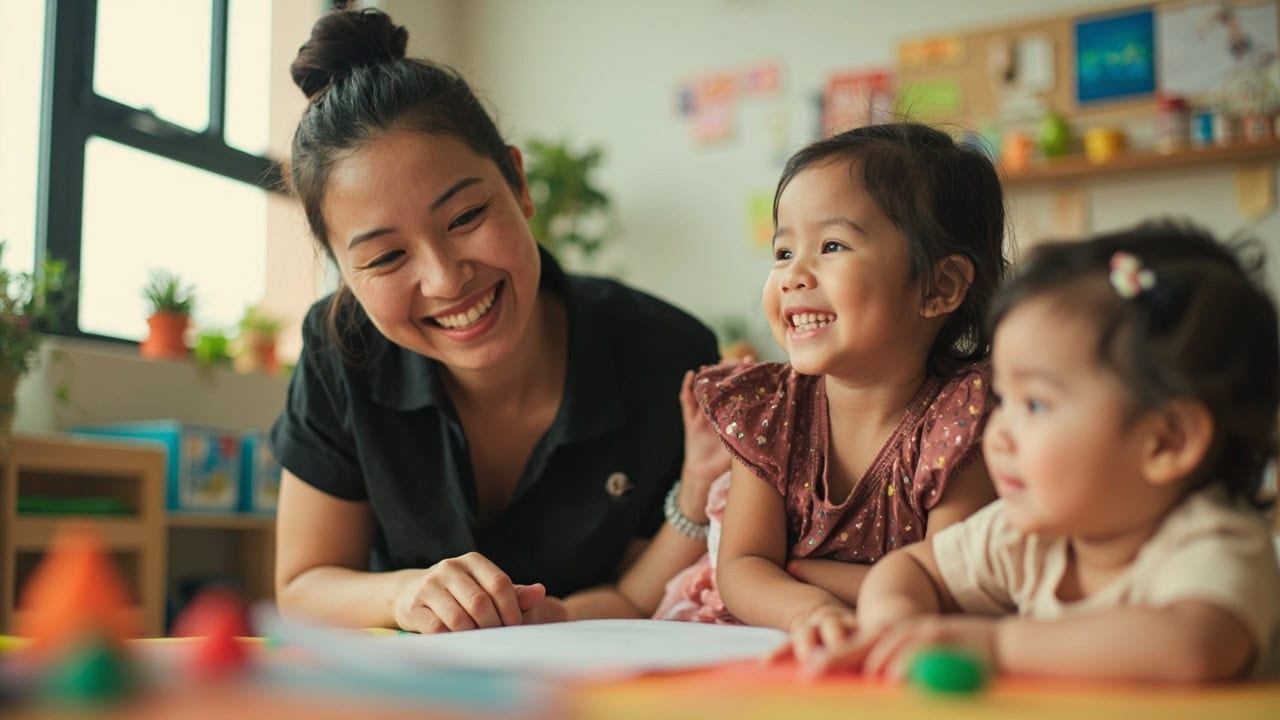
The Invisible Excellence That Transforms Your Child’s Development Every Day
What You Cannot See Matters Most
There is a quiet anxiety that follows every parent who leaves their child in someone else’s care. It does not announce itself. It lives in the half-second pause before you drive away, in the questions you almost ask at pickup, in the way you study your child’s face for clues when you return.
You are not a bad parent for feeling this. You are a thoughtful one. And the discomfort you carry is, at its core, a question you cannot fully answer: What is actually happening in all those hours when I am not there?
Most conversations about childcare begin with the visible—the tour you take, the classrooms you inspect, the ratio of children to caregivers you calculate. These things matter. They are the foundation upon which trust is built, or broken.
But here is what deserves deeper attention: the visible elements of childcare are necessary but insufficient. What shapes your child most profoundly is precisely what you cannot witness.
Quick Summary: What This Means for Singapore Parents
- The best caregiving happens in moments you will never see—the quiet adjustment when your child is tired, the gentle facilitation before a conflict escalates, the observation that catches a developmental leap.
- Visible quality markers matter, but they do not tell the whole story. Curriculum, facility design, and tour impressions are necessary starting points, not complete answers.
- Professional caregiver judgment is the invisible variable that changes everything. Training, reflection, and professional standards are not optional extras—they are the foundations of quality.
- Trust in childcare is justified confidence, earned through professional depth that operates beyond what is easily observed.
- The caregiver who understands what you cannot see is the caregiver your child needs most—and finding one requires looking beyond the checklist.
The Invisible Work That Shapes Your Child
Consider what it means to care for a child in the way a genuinely skilled caregiver cares. Picture it from the inside.
A child arrives in the morning carrying the residue of a difficult night, or the overstimulation of a weekend, or simply the particular temperament of that particular Tuesday. The caregiver does not have a doctor’s note or a parent update to explain this. She reads it in the way the child holds his body, in the half-second hesitation at the door, in the particular pitch of his greeting.
And she adjusts.
She slows the morning’s pace. She offers the quieter activity before the energetic group time. She does not announce this adjustment. She does not report it to you at pickup. She simply responds to what she sees, and the day unfolds differently because of it.
Thousands of these small attunements accumulate into a child who is emotionally regulated, who can name his feelings, who can wait, who can share, who can recover from disappointment. They accumulate into a child who runs to his caregiver in the morning because the relationship has been built on thousands of moments he cannot articulate but feels completely. They accumulate into a child who mentions his day with joy—not because you asked, but because the day genuinely held joy.
Three Moments That Reveal Invisible Work
A three-year-old discovers exclusion. She has just learned that she can say “you can’t play with us” and watch the other child’s face crumple. This is developmentally normal. It is also a moment of enormous consequence.
A skilled caregiver witnesses this not as bad behavior to be punished but as a social learning opportunity to be guided. She does not intervene with lectures or consequences that shame the excluding child. She moves toward the excluded child with quiet presence, modeling for the group what inclusion looks like.
She does not announce what she is doing. She simply creates a small, embodied lesson in kindness, and within minutes the group is expanded again. The learning has happened without trauma and without humiliation. The excluded child has felt seen. The excluding child has not been labeled. The dynamic has shifted.
A toddler in full-body tantrum is overwhelmed by emotions he cannot yet name or regulate. A less skilled caregiver might ignore him, or soothe him with words he cannot yet process, or become frustrated in ways that escalate rather than de-escalate.
A skilled caregiver does something different. She sits nearby—not rescuing, not fixing, just present. She regulates her own voice to a lower, calmer register. She breathes visibly, so the child can see it. She waits.
Slowly, imperceptibly at first, the child’s nervous system begins to match hers. The storm passes. The child is held in the aftermath, briefly, before he pulls away to resume his play.
This moment—the regulation that happens before the child even knows he needed it—this is invisible work of enormous consequence.
Why This Work Is Professional, Not Magical
Here is what deserves emphasis: this invisible work does not happen by accident. It does not happen because some people are naturally warm and others are not.
It happens because of training, reflection, and professional standards that elevate caregiving from a job into a practice.
A caregiver who has been professionally formed has been taught to observe, not just to watch. She notices the difference between a child who is quiet because he is tired and a child who is quiet because he is withdrawing. She has been coached in the art of redirection that preserves dignity—when a toddler’s meltdown threatens to become a public spectacle, she does not shame him, does not negotiate under pressure, does not abandon him to his distress.
She moves with him, speaks quietly, creates a brief pocket of calm, and helps him return to himself.
This is not intuition. This is skill. And skill can be taught, developed, and relied upon.
When you entrust your child to a caregiver who has been formed by rigorous preparation, you are not relying on the kindness of a stranger on a given day. You are relying on a practice that has been refined through intentional development. You are relying on judgment that has been exercised, corrected, and refined across many children and many situations.
The invisible work that shapes your child’s day is, in its best form, not mysterious at all. It is professional. It is reproducible. It is worthy of your trust because it is built on foundations that you may not see, but that make all the difference.
Evaluating Quality: What to Look For in Singapore
For parents in Singapore evaluating infant care or childminding options, understanding what quality looks like requires looking beyond the checklist. Here is a framework grounded in the invisible work we have been describing.
Signs of Quality You Can Look For
- Caregivers who are calibrated to individual children, not just to schedules. You may notice this in how your child is greeted—specifically to him, responsive to his mood that morning.
- Transitions that feel unhurried. When caregivers have time to read a child’s state before moving to the next activity, you will see fewer escalations and more regulated children.
- Communication that reflects observation. Updates that mention not just what happened but what your child seemed to need from that experience.
- A caregiver who speaks about children with nuance. Not “he was good today” but “he seemed to need more processing time after the group activity.”
- Children who are relationally confident. They run toward their caregiver, they are curious about the space, they do not show signs of ambient anxiety.
Questions to Ask
- How does your caregiver team observe and track individual children’s developmental progress?
- What is your approach when a child is having a difficult emotional moment?
- How do you handle social conflicts between children?
- What training do your caregivers receive in child observation and attunement?
- How do you individualize the day for children who may be tired, overstimulated, or going through developmental shifts?
The answers you receive—and the ease with which caregivers answer—will tell you something important about whether professional standards are in place.
How to Evaluate Beyond the Tour
Start with the visible, then go deeper. Ratios, curriculum, facility cleanliness—these are legitimate starting points. Do not abandon them. But use them as filters, not final answers. A centre that looks perfect on a tour may still lack the professional depth that makes caregiving reliable. A smaller arrangement that feels warm on introduction may have the invisible structures that matter most.
If possible, spend time observing—not touring, but observing. Watch how caregivers respond to children who are not directly in front of them. Notice whether there is attunement in the small moments, not just during structured activities. Notice whether children seem regulated and curious, or whether there is ambient tension in the room.
Trust the evidence that accumulates over time. You will not know everything immediately. Look for: Is your child happy to go? Does he mention his day with something other than distress? Does he show signs of emotional regulation, social confidence, and developmental progress? These are the returns on the invisible investment you are making.
EduNanny Singapore: Built Around Invisible Excellence
This understanding—about the primacy of invisible work and the professional standards that make it reliable—is the foundation of how EduNanny Singapore approaches infant care and childminding.
EduNanny operates within the ECDA Childminding Pilot, which means our caregivers are part of a thoughtfully designed ecosystem that values professional standards and thoughtful ratios. In our infant care arrangements, we maintain ratios of up to one to three, which means your infant receives a quality of attention that is simply not possible in larger group settings.
This is not an accident of policy. It is an acknowledgment that the invisible work we have been describing requires space to happen—space for observation, for attunement, for the quiet adjustments that make all the difference.
Options Designed for Real Families
EduNanny offers both home-based and centre-based pathways, because families are different and the right fit matters more than a rigid structure. Our care operates Monday through Friday, in structured blocks that give both parents and caregivers the rhythm they need for consistency and predictability.
We know that Singapore parents carry real concerns about the practicalities of quality care. That is why we have worked to ensure that our fees are structured to be affordable within the pilot framework, and why we have made CDA and Baby Bonus usable for those who qualify—because quality care should not be a privilege accessible only to the wealthy, and because Singapore has designed smart mechanisms to support families in these choices.
What Makes EduNanny Different
The practical features matter—the ECDA pilot, the ratios, the CDA and Baby Bonus eligibility, the CCTV where deployed, the Thomas AI Chatbot that supports parents with scheduling and updates. But these are not why EduNanny is different.
EduNanny is different because we believe that the invisible work is the real work.
We have built our approach around the conviction that the caregiver who understands what you cannot see is the caregiver your child needs most. We train our caregivers not just in safety protocols and developmental milestones—though we train them in these things rigorously. We train them in observation. We train them in attunement. We train them in the thousand small decisions that make up a child’s day.
We hold them to professional standards that go beyond competence and toward mastery. And we support them with the ratios and structures that make excellence possible.
Trust as Justified Confidence
That quiet anxiety that follows every parent who leaves their child in someone else’s care is not your weakness. It is your awareness. It is the recognition that what happens in your child’s earliest years matters enormously, and that you cannot fully verify it in real time.
But awareness, without understanding, leads only to vigilance that never resolves. Understanding, on the other hand, leads somewhere different.
Understanding leads to the recognition that you do not need to witness everything. You need to trust the right things. You need to find caregivers whose professional depth justifies your confidence.
EduNanny is not asking you to trust blindly. We are asking you to trust the way you trust a skilled surgeon—not because you understand every procedure, but because you trust the depth of training and professional commitment that makes the invisible work reliable.
Your child’s caregiver knows things about your child’s development that you will learn from her. She sees him in contexts you cannot see. She observes him among peers, responding to challenges, navigating the social world of early childhood.
She has a perspective on your child that is complementary to yours, not competitive with it. When you find a caregiver whose professional depth earns your trust, you are not losing insight. You are gaining a partner in your child’s development.
The quality you feel in your child’s evening mood, in his eagerness to return, in the way he mentions his day, in the resilience he shows when things go wrong—these are not accidents. They are the visible evidence of invisible excellence. They are the returns on investment in professional care that you cannot witness but can absolutely trust.
Your Next Step
EduNanny Singapore exists to earn that trust, every day, in the moments you will never see. We believe that the best caregiving is exactly what you will never witness—and that the invisible architecture of professional care is what your child needs most.
Not because we can prove it to you in a tour, but because we have built our entire practice around the conviction that this is what matters.
Explore EduNanny Singapore’s infant care and childminding options. Learn about our ECDA Childminding Pilot arrangements, our approach to professional caregiver development, and how we support Singapore families in accessing quality care that operates at the level your child deserves.
Your child is shaped in the moments you cannot see. Let us be worthy of that shaping.
EduNanny Singapore is a developmental infant care and childminding service built on professional standards, thoughtful attunement, and the conviction that the best caregiving happens in the moments you will never see. Learn more about our approach or connect with our team to explore whether EduNanny is the right fit for your family.