Why Singapore Parents Feel Grief Instead of Guilt at Drop-off
The Goodbye Nobody Talks About: Navigating the Grief of Leaving Your Child
There is a moment—maybe you have felt it—when the car door closes and your child is already inside, walking toward a room you have never seen, toward a person you have chosen but do not yet know the way your child will come to know them. You are still in the driveway. Your hand rests on the car door. And something inside your chest feels like it is being pulled apart, quietly, without any sound.
You might call it guilt. Most of us do. We say we feel guilty for going back to work, guilty for needing a break, guilty for wanting the life that reminds us we are whole people.
But that word—guilt—has a sharpness to it. It implies something wrong. It implies you have done something you should not have done.
What you are feeling is not guilt. What you are feeling is grief.
Grief for the mornings you will not see. Grief for the small discoveries that will happen without you—the first time your child stacks a block just so, the afternoon they finally master the shape-sorter, the way they will look at their caregiver and feel the same safe love they feel with you.
Grief is what happens when love meets absence. And love—fierce, unrelenting, impossible love—never goes away. So neither does the grief. Not really. Not until your child is grown and the leaving is different and the room is empty in a whole new way.
The fact that you feel this is not evidence that you are doing something wrong. It is evidence that you are doing something profoundly, terrifyingly right. Because you are capable of the kind of love that aches when it cannot be present.
What Nobody Tells You About That Morning Goodbye
Here is what nobody tells you about that moment—the drive to school or the handover to the caregiver who will hold your child the way you hold your child, with patience and intention and the kind of attention that makes a child feel like the most important person in the world.
Nobody tells you that what you are modeling for your child, in that moment, is courage.
Not the absence of fear. Not the blithe confidence of someone who has never loved enough to be afraid. But the quiet, trembling, extraordinary courage of saying goodbye because you trust someone else to keep your child safe. Because you trust the world to hold what you hold most precious.
Your child is watching. Not just when you leave, but in how you leave. In the way you bend down to say goodbye, voice steady even when your hands are not. In the way you trust the person waiting at the door. In the way you walk back to the car and breathe, and breathe again, and drive away.
Your child is learning, right now, that the world is not only safe but trustworthy. That love does not require constant presence to be constant. That people can be counted on. That the door closes, but it opens again.
This is not a small thing. This is the beginning of everything: security, attachment, the belief held deep in the body that the people who love you will come back, and that there are others who can love you too.
Singapore Parents: Why the Goodbye Feels Heavier
You carry something particular. You carry the weight of a culture that values education, that understands the stakes of the early years, that has poured extraordinary resources into building a childcare ecosystem that can hold your family while you hold your career.
You understand, perhaps more clearly than most, that the first thousand days matter. That infant brains are forming at a speed they will never match again. That the quality of care in these early years echoes forward into a life.
And you feel that. Deeply. That is why the goodbye is so hard. Because you know what is at stake. And that knowledge does not make it easier. It makes it heavier.
But you are not alone in that heaviness. And you do not have to carry it in silence.
What Quality Childminding Actually Looks Like
Before we go further, let us be practical about what good care actually means—not as an abstract ideal, but as something you can recognise and demand.
The Ratio Matters
Small hands, small voices, small everything—everything is urgent and everything is important, and the children who hold them need adults who can hear that. Who can respond. Who can be present in a way that shapes neural pathways and builds the architecture of a human being.
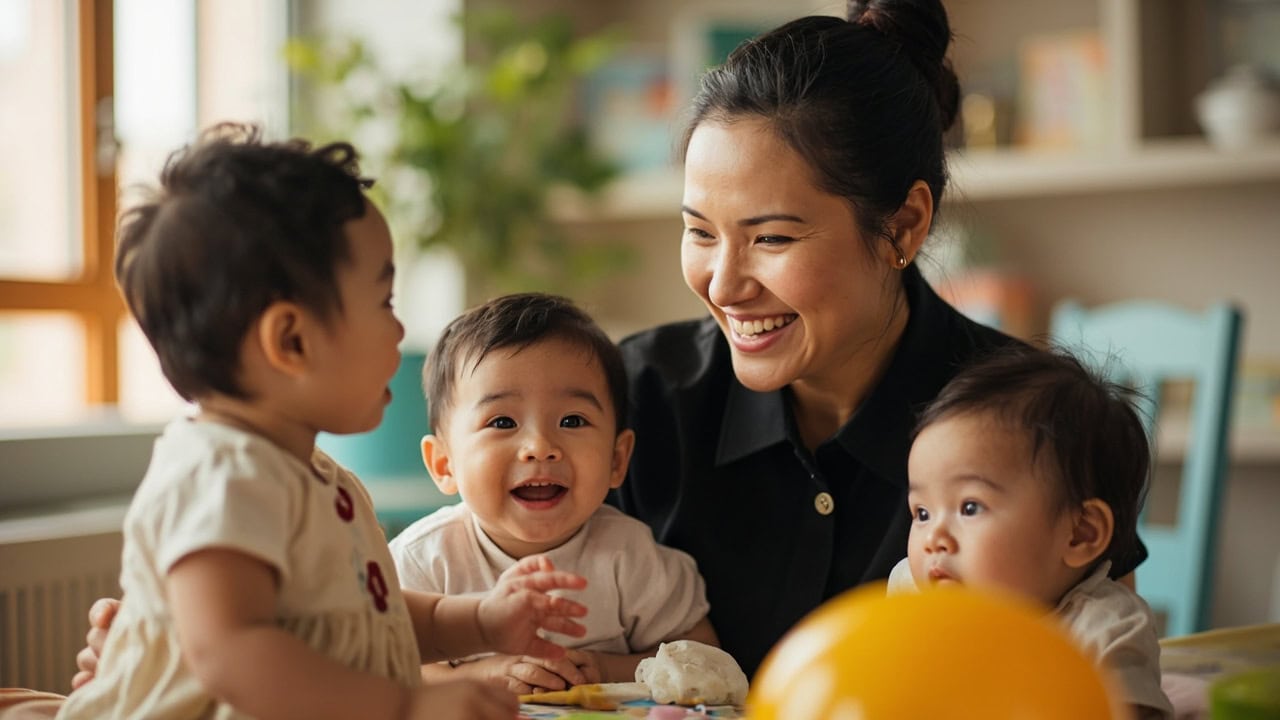
In home-based childminding settings like those supported through Singapore’s Childminding Pilot, ratios are structured to ensure this attention is possible. Up to three infants in the earliest stages means your child’s needs are not lost in a crowd.
Communication and Transparency
Quality care means you know what happened. How your child ate. How they slept. What made them laugh. Daily updates that let you piece together the day you were not there for—not to monitor a caregiver’s performance, but because you want to see your child thriving.
Technology offers a window into the day that is not surveillance but connection. You are not watching to catch someone failing. You are watching because you want to see your child happy, absorbed, safe in someone else’s care.
The Intangible: Tenderness and Intention
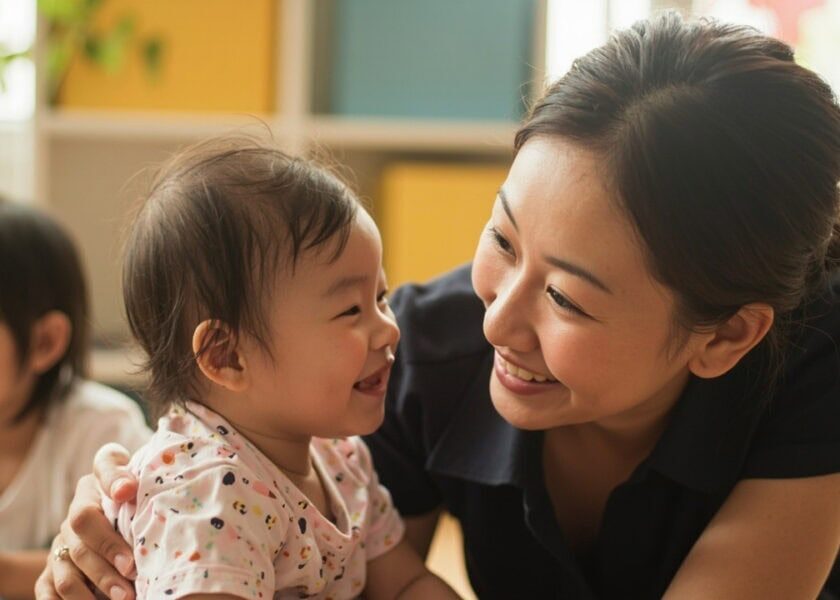
Beyond ratios and communication logs, there is something harder to measure but easy to recognise: the quality of attention. Does the caregiver bend down to your child’s level? Do they respond to coos and cries with patience, not irritation? Does your child seem settled, not just supervised?
You know your child. Trust that knowledge as you observe.
Questions You Are Already Asking
You may have questions. Of course you do. These are not intrusive questions. They are the questions of love. And they deserve real answers.
Who is caring for my child? How do I know?
You should know who is holding your child. You should understand their training, their approach, their values around infant care. At EduNanny, caregivers are trained and vetted as part of a structured ecosystem that prioritises transparency and trust.
What happens when I am not there?
Your child is in a space designed for them—small ratios, attentive care, daily communication so you are never left wondering. The image of your child happy, absorbed, safe in someone else’s care is not a betrayal of your love. It is proof that you chose well. That you trusted wisely.
Is it okay to want my career and my child?
It is okay to want your life alongside your child. It is okay to want the intellectual stimulation, the adult conversation, the sense of purpose that comes from work that matters to you. It is okay to miss your child and be grateful for the people who are caring for them at the same time.
These things do not cancel each other out. They do not make you a lesser parent. They make you a whole person who is raising another whole person.
Choosing with Your Whole Heart, Not Half
Choosing childcare is not a compromise. It is a commitment.
You are reading reviews. You are visiting centres. You are asking other parents—the ones you trust, the ones whose children seem whole and bright and unafraid. You are trying to make the decision with your whole heart, not half.
That is exactly right. That is exactly what your child needs from you: not perfection, not a guarantee that cannot be given, but the evidence of your whole heart in the choosing. The intention behind it. The care.
The children who grow up knowing that their parents are whole people—people with ambitions and friendships and lives that extend beyond the walls of home—they learn something important. They learn that love is not clinging. Love is not need. Love is the thing that can stretch to include other people, other places, other experiences, and still, always, come back home.
When you choose quality care—when you trust someone else with the person you love most—you are teaching your child that the world is full of people who can be trusted. You are teaching them that the first person who showed them this was you.
That is the gift you leave behind. Not just your child in capable hands, but the quiet knowledge that trust can be learned. That courage can be modeled. That love, the real kind, the kind that prepares a child to go out into the world and come back and go out again—it is not the love that holds on too tight.
It is the love that knows when to let go.
What You Can Do Today
- Name the feeling. When you feel that weight in your chest after drop-off, call it what it is: grief. Love’s shadow. Not guilt, not failure. Proof of how much you care.
- Observe, don’t just drop. When visiting childcare options, watch how caregivers interact with the children—not just with your child, but with all children. Notice patience. Notice responsiveness. Notice warmth.
- Ask about communication. How will you know what happened in your child’s day? What kind of updates can you expect? Transparency is not optional—it is a sign of quality.
- Trust your instincts. You know your child. You know what feels right. If something feels off, it probably is. If something feels warm and responsive, that matters too.
- Know your options. CDA funds. Baby Bonus. Monday through Friday care blocks. These are real supports that make quality care more accessible. Ask what applies to your situation.
- Choose with your whole heart. Not because you have to be perfect, but because your child deserves your intention. Your care. Your best decision, made with love.
The Bravest Love There Is
So when you drive away from that drop-off, and the weight is in your chest, and you are wondering if you are doing the right thing—I want you to know that you are.
Not because the fear is unfounded. Not because nothing could ever go wrong. But because you are doing the brave, tender, difficult thing: you are loving your child enough to let them go, a little, for now, in the care of people who will love them well.
And when you choose that care—with its commitment to quality, its alignment with the structures shaping the future of childminding in Singapore, its ratios and its transparency and its respect for the trust you are placing in it—you are not giving up. You are giving your child a village. You are giving yourself permission to be whole. You are teaching your child that the world is full of people who can be trusted.
That is the bravest love there is. And you are living it. Every single morning.
If you are exploring infant care or childminding options in Singapore and want to understand how a trusted, development-focused childminding arrangement might fit into your family’s life, we welcome the conversation. No pressure. No obligation. Just an honest discussion about what your family needs and how thoughtful, quality care might support you.
Learn more about EduNanny’s approach to childminding or connect with our team to begin a conversation.