How Singapore Parents Can Help Their First Child Thrive When a Sibling Enters Childcare
The Sibling Transition: What Singapore Parents Don’t Expect
When your second child enters childcare, you bring something you did not have the first time: experience. You know how to evaluate a caregiver. You know the questions that matter. You have done the observation visits and you understand what quality looks like when you see it. In many ways, you are better prepared than you were with your first child.
And yet, you are also carrying something else this time. You are carrying your first child’s entire relationship with their care environment. Your second child’s entry is not happening in a vacuum. It is happening in the presence of a sibling who has, by now, made that place their own.
This is the variable no one tells you to prepare for.
- It is different, not easier. Adding a second child to an existing childcare arrangement restructures the entire family system, not just the logistics.
- Your first child will respond. Regression, clinginess, or subtle shifts in behaviour are normal communications, not behavioural problems.
- The second child’s experience will be different. This is not inequity—it is mathematics. The question is whether both children receive what they need to thrive.
- Quality care individualises. Each child needs their own relationship with their caregiver, not merely a sibling’s hand-me-down connection.
- You are not failing. The exhaustion, guilt, and anxiety you may feel are legitimate markers of caring deeply about getting this right.
When Your First Child Responds to a New Sibling in Care
Your first child has built a world within their childcare setting. They have friendships, familiar rhythms, a specific rapport with their caregiver. They have, over months or years, developed a sense of security that took time to build and should not be taken for granted.
And now, almost without warning, a new person enters that world. A smaller person. A sibling. The new child becomes the centre of the same attention your first child has been receiving, and your first child watches this happen with the clarity and emotional attunement that young children possess in abundance.
You may notice a change. A regression in toilet training. Increased clinginess at drop-off. A new reluctance to go to school that seemed, just weeks ago, to be their favourite place. Or you may notice something subtler: a quietness, a shadow of uncertainty in their eyes during pickup, a small question they ask about whether the teacher still loves them.
These responses are not behavioural problems. They are communications. Your first child is telling you, in the only language they have, that the family architecture has shifted, and they are figuring out where they stand in the new configuration.
Here is what matters most: the fact that your first child is responding to this transition does not mean your second child should wait longer to enter care. It does not mean the choice is wrong. It means that both children are alive, sensitive, relational beings who are affected by change in their family system, and who deserve support as they move through it together.
The Architecture of Care That Holds Both Children
The word architecture is intentional, and it matters.
When you settled your first child into care, you were building a structure for one. You chose a caregiver or a centre. You established routines. You developed a relationship with that caregiver based on trust and communication. You created something that felt solid, something your child could rely on.
Adding a second child is not simply adding a second person to that structure. It is redesigning the structure itself. The foundation may hold, but the load distribution changes. The rooms multiply. The relationships require individual attention. The logistics, which seemed complicated with one child, become a different kind of complicated with two.
The Reality of Two Children in Care
Let me speak plainly about logistics, because this is where many parents feel the strain most acutely and where the gap between expectation and reality can be most jarring.
With your first child, drop-off was a ritual. You may have walked in together, stayed for a moment, built a small goodbye routine. You may have felt the weight of leaving, and then the weight lifting as your child settled.
With two children in care, you may be coordinating two drop-offs. Different teachers. Different rooms. Different rhythms for rest, for feeding, for play. You may be managing a newborn in a carrier while trying to shepherd your toddler through the gate. You may be racing against a work meeting, or a train schedule, or a bus that runs every twelve minutes and does not wait.
This is exhausting. It is not a failure. It is the reality of modern family life in Singapore, where two working parents is not an exception but a norm, and where the village that once surrounded families has, in many cases, been replaced by a search for quality care that feels both urgent and overwhelming.
Honest Answers to the Equity Question
Every parent who has navigated the sibling transition carries some version of this question: Am I giving my second child the same experience I gave my first? Is it wrong that my second child’s entry into care feels different, more practical, less laden with the discovery and uncertainty that marked my first child’s settling?
These questions deserve honest answers, not reassuring platitudes.
The honest answer is this: your second child will have a different experience. This is not a failure. It is mathematics. Your second child is entering a family that already includes a child, a family that has already navigated the terrain of childcare, a family that has different energy, different bandwidth, and different experience to bring to the process.
The question is not whether the experience is identical. It cannot be. The question is whether both children are receiving what they need to thrive.
- Is your first child being seen and held through a transition that threatens their sense of place?
- Is your second child receiving warm, responsive, quality care that meets them where they are?
- Are the adults in both children’s lives attending to each child as an individual, not merely as a sibling?
What Quality Childminding Looks Like for Siblings
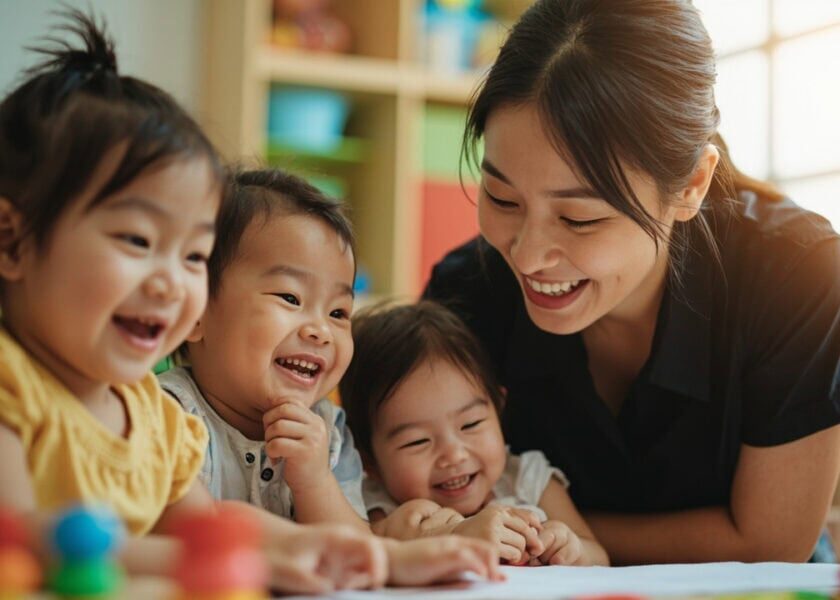
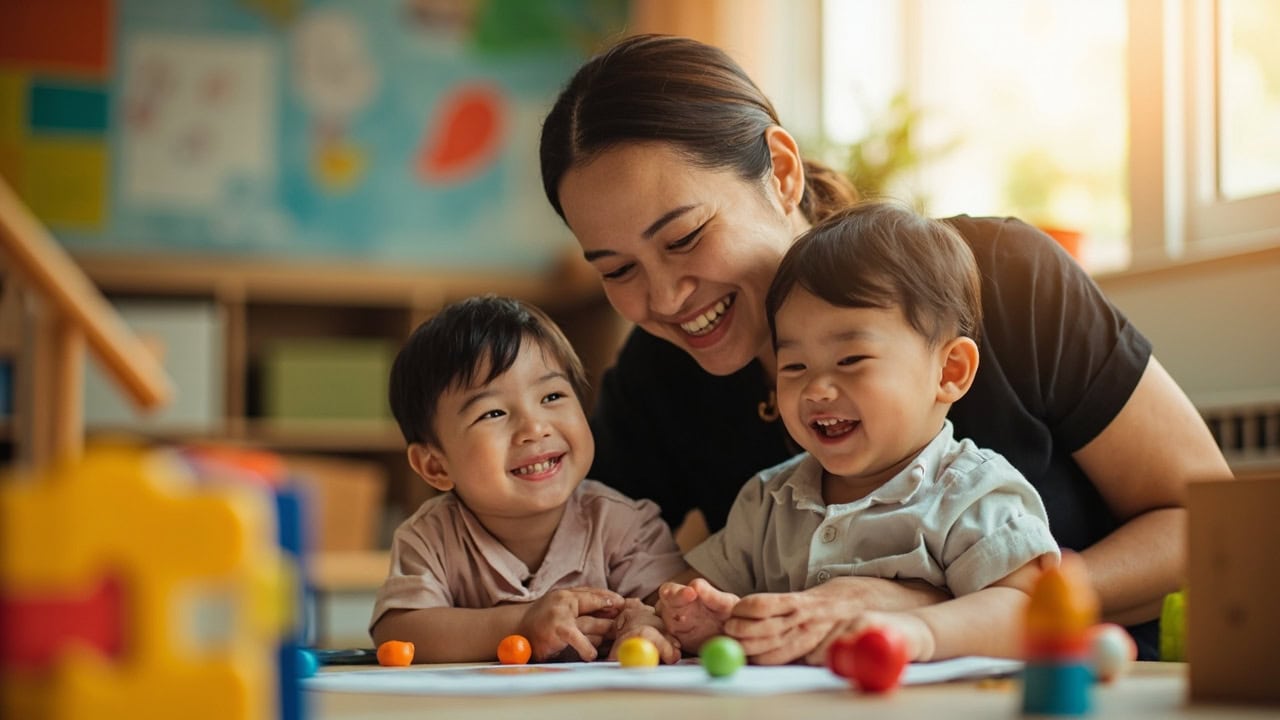
In a high-quality setting, caregivers understand that siblings are not simply two instances of the same relationship. Each child requires their own connection. Your first child’s caregiver must be, in a meaningful sense, your first child’s caregiver. Your second child’s caregiver must be, equally and genuinely, your second child’s caregiver. These are different relationships, built with different children, serving different developmental needs.
When parents receive updates about their children, those updates reflect each child’s day, not a generic account of a group. Parents know what their firstborn ate for lunch and how they played, and they know the same for their second child. Both children are held in the family’s attention. Both children are seen.
What to Look for in a Childcare Arrangement That Serves Siblings
| Quality Indicator | What It Looks Like in Practice |
|---|---|
| Individual attention | Caregiver knows each child’s temperament, preferences, and developmental stage separately |
| Separate relationships | Updates and reports are specific to each child, not generic group accounts |
| Flexible ratios | Small group settings allow genuine one-to-one moments throughout the day |
| Responsive settling | Caregiver adapts approach to each child’s unique adjustment needs |
| Family communication | Transparent updates that honour each child’s individual experience |
The Sibling Bond: A Developmental Gift That Grows in Quality Care
There is a reason that parents who have moved through this period often describe it as one of the richest experiences of their parenting journey. Not because it is easy. It is not. But because something beautiful emerges when siblings grow up together in a setting that supports their individual development and their relationship with each other.
Children who share a quality care environment learn something that children who do not share care cannot easily learn: they learn that the world is large enough for both of them. They learn that love is not divided by addition but multiplied by sharing. They learn that their sibling is not a rival for attention but a companion in experience.
Your first child, who may have shown a moment of regression or anxiety when the second child entered care, begins to see that second child in a new light. They are not just a person who arrived and disrupted the routine. They are a person who is present in the same world, who knows the same songs, who walks the same path to the playground, who shares the same caregiver’s warmth. Over time, this familiarity becomes something precious: a bond that is rooted in shared life, not just shared blood.
And your second child, who entered care knowing that a sibling was already there, learns early what it means to be part of a family in motion. They learn that they belong to something larger than themselves, and that their place in that something is secure.
Practical Guidance for the Sibling Transition
The sibling transition is hard. It is hard in ways that feel almost unfair to name, because by the time you reach it, you have already done the hard work of the first settling. You have already built your confidence. You have already learned to trust. And so when the second transition arrives and brings its own challenges, there can be a particular kind of exhaustion that comes from believing you should be more prepared than you are.
This exhaustion is legitimate. The guilt you may feel about divided attention is legitimate. The anxiety you may feel about whether both children are getting what they need is legitimate. None of these feelings mean that you are doing something wrong. They mean that you are a parent who cares deeply about getting this right.
Here is what you can do:
- Name the transition aloud. Before the second child begins care, talk with your first child about what is coming. Use simple, honest language: “A new person is going to be at your school. They are your sibling, and they are going to love it there too.”
- Expect and normalise your first child’s response. If you see regression or clinginess, respond with steady reassurance, not correction. “I see you are missing me. I always come back. Your teacher loves you, and I love you.”
- Maintain individual rituals. Find one small, consistent moment each day that belongs only to each child—whether it’s a bedtime song, a morning walk, or a particular goodbye phrase. This anchors their sense of individual place in the family.
- Communicate with caregivers about both children. Ask specifically about each child. “How was Mei Ling today? How was Jia Hao?” Both names matter. Both experiences matter.
- Give yourself permission to do this differently. Your second child’s settling will not look like your first’s. That is not a failure. It is evolution. Trust the experience you have built.
- Build your village intentionally. Whether through home-based care, centre-based care, or a combination, choose arrangements that allow your family to function as a whole—not just survive, but genuinely thrive.
Preserving individual connection with each child when time is divided is one of the most common concerns parents raise. The answer is not found in quantity but in quality. Fifteen minutes of genuinely present attention—where your child has your full presence, your eye contact, your responsiveness—builds connection more effectively than an hour of distracted proximity.
How Quality Care Supports the Sibling Transition
The best childcare arrangements are built to hold complexity. They understand that siblings are not simply two instances of the same relationship. Each child requires their own connection, their own attention, their own space to be known and seen.
This is particularly important in the sibling transition, where the first child’s sense of place is already under revision and the second child is establishing their own relationship with care for the first time. A quality arrangement adapts to these dual needs rather than applying a uniform approach to both children.
Home-based care, with its smaller ratios and more personal settings, often offers families the flexibility this transition requires. Small group environments allow caregivers to know each child deeply—not just their routines, but their temperaments, their fears, their joys, the particular quality of their curiosity. When parents receive updates, those updates reflect each child’s day specifically. Both children are held in attention. Both children are seen.
The right care partner understands that they are not just looking after children—they are supporting a family through one of its most significant evolutions. This requires more than good intentions. It requires systems that support transparency, communication, and genuine individualisation. It requires caregivers who are trained not only in developmental pedagogy but in the emotional realities of family life.
The Horizon Ahead
The sibling transition is not the end of your childcare story. It is a chapter. It is a chapter that asks more of you, and that gives more back. It is a chapter that, navigated with care and supported by the right partnership, leaves your family stronger, your children more secure, and your village more complete.
On the other side of that doorway is a family that has learned, together, how to share love and attention without diminishing either. It is a first child who has discovered that a sibling is not a threat but a gift. It is a second child who has entered a world already populated by warmth, and who will grow into that warmth with confidence. It is a caregiver relationship that has deepened because it now serves two children, and has learned to see and hold each one.
It is an expanded village. It is a richer developmental environment. It is the architecture of a family that holds.
If you are standing at the beginning of this chapter, uncertain of what lies ahead, what lies ahead is worth the uncertainty. The challenges are real, but so are the rewards. Your children will not only survive this transition. They will grow through it, and they will carry what they learn into every relationship they build for the rest of their lives.
At EduNanny Singapore, we walk with families through the sibling transition with clarity, intentionality, and the kind of transparency that builds real trust. From the first conversation through the settling process for each child, through the daily rhythms of drop-off and pickup, through the questions and proud moments that accumulate over years—we are here.
We are not a generic childcare service. We are a thinking partner for families who take this work seriously. Learn more about our approach or begin a conversation with us today. Whether you are in Bishan or Bukit Merah, Clementi or Choa Chu Kang, your family deserves care that meets the standard your children require.
One family at a time. One sibling at a time. One child, seen and held and loved, at a time.