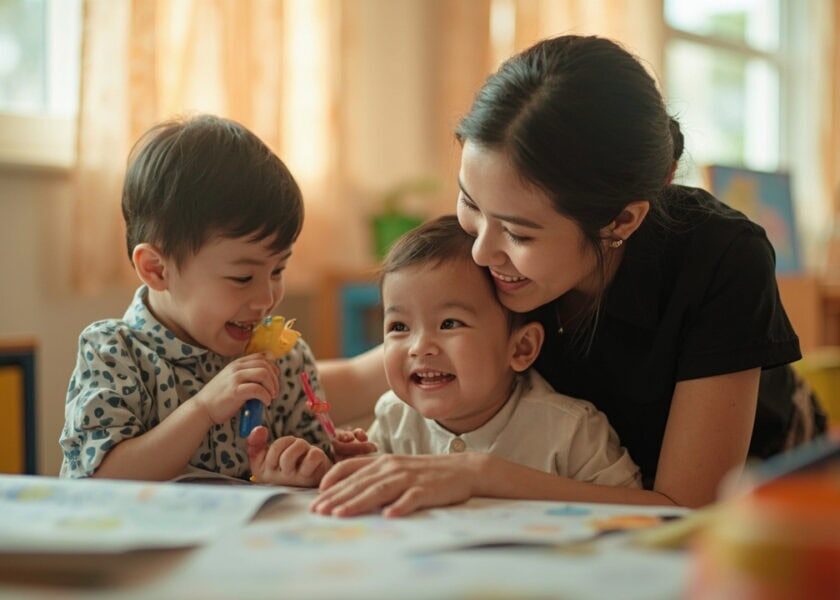
What Your Child Is Quietly Becoming in Quality Care
The Invisible Hours: What Children Are Becoming
Every parent in Singapore has noticed it. The child who returned from a week with grandparents speaking in a new sentence structure. The toddler who came back from a stay with relatives using a word no one in your household says. The infant who, after a few weeks of consistent care, begins to look around the room differently—alert, expectant, scanning faces with a kind of social curiosity that was not there before.
Something happens when children are in environments that are genuinely prepared for them. Something that does not happen at home, or that happens differently at home, because children behave differently when they are with their caregivers. They are learning. They are always learning. But in a quality care setting, with trained attention and structured opportunity, the learning takes on a particular shape. It accumulates. It compounds.
You’ve likely heard of “the thousand days”—the extraordinary window from conception to roughly age three, when neural pathways are forming at a rate that will never be matched again. What is less often discussed is what fills those thousand days when parents are working. What fills them, in the most literal sense, is experience. Sensory experience, social experience, the experience of being responded to and being challenged and being allowed to try again.
Not all experience is equal. The experience of being in a room with a television is not the same as the experience of being in a room with a caregiver who notices when you are about to tip over, who steadies your cup, who speaks to you as though your babbling is the beginning of something important.
The experience of being in a household of adults is not the same as the experience of being in a setting where there are other children, where sharing is not just a rule but a negotiation, where you learn the first grammar of social life by watching how others react to you. Quality care does not just supervise children. It shapes developmental experiences with intention. And that is a fundamentally different thing.
What Quality Childcare Actually Builds
- Social confidence — Learning to belong in a group, negotiate with other children, and feel at ease beyond the family
- Emotional regulation — Building the capacity to wait, tolerate frustration, and recover from setbacks
- Language and communication — Expanding vocabulary and sentence structure through consistent, responsive interaction
- Curiosity and exploration — Developing the confidence to try new things because safety has been established
- Resilience — Learning that falling is survivable and that getting back up leads to continued engagement
These are not outcomes that happen by accident. They are shaped, day by day, by trained caregivers who know what to look for. Understanding what is actually unfolding during the hours apart can transform the way you experience drop-off—from a source of guilt to a quiet recognition that your child is expanding into the world.
What a Trained Caregiver Sees
Consider what unfolds over a single morning in quality childcare, through the eyes of someone trained to observe.
She sees the moment when an infant stops crying within minutes of drop-off, because she has learned that the crying will stop. She reads this not as evidence that the infant does not miss the parent—she knows better than that. She reads it as evidence that the infant has internalized a felt sense of safety, and she holds that knowledge carefully because she understands what it means for the child’s developing sense of security.
She sees the toddler who spends the first twenty minutes of each morning watching the door, not quite engaging, waiting. She does not rush this. She creates conditions where engagement becomes interesting. And she notices the day when the watching stops earlier, when the child walks straight to the block corner, when the waiting is simply no longer necessary. That is not a small thing. That is a social milestone. That is a child who has learned that this place belongs to them too.
She sees the way children learn to wait—not through lectures or discipline, but through the natural rhythm of a day that is structured enough to have patterns and flexible enough to have warmth. She sees children who have never had to wait for anything begin to understand that they can wait and that what they are waiting for will come.
This is the beginning of emotional regulation, the foundation of the capacity to tolerate frustration that will serve them in school, in relationships, in every context where the world does not immediately yield.
She sees the child who was afraid of other children become the child who initiates play. She sees the child who communicated only through pointing begin to use words because words are how people get things done here. She sees the child who fell last week and cried for ten minutes begin to stand up, check for comfort, and go back to running, because this environment teaches, through its consistent response, that falling is survivable and that getting back up is rewarded with continued engagement.
She sees these things. And she holds them, because parents need to know—not as a report card, not as a series of checkboxes, but as a story. The ongoing developmental story of what their child is becoming.
Belonging: Building a Second World
There is a term in child development for what happens when a child begins to move comfortably between two worlds. It is called belonging. Not belonging in the passive sense of being allowed to stay somewhere, but belonging in the active sense of having a stake, a place, a sense of oneself as someone who fits.
When a child learns to belong in a quality care setting, they are not replacing the belonging they feel at home. They are building a second one. They are developing the capacity to be whole in two places—to carry home with them when they go to care, and to carry care with them when they come home. This is not fragmentation. This is expansion.
You will see evidence of this. The child who tells you about her morning with a caregiver’s words—”We made a tower, and it fell down, and then we made it again”—is doing something sophisticated. She is narrating an experience from a perspective outside the home. She is holding two worlds in her mind and bridging them with language. This is cognitive development. This is identity formation. This is what you have made possible by choosing an environment where your child can build this.
The child who greets his caregiver by name with genuine enthusiasm, who runs to the play area without looking back, who is not performing a dutiful transition but genuinely inhabiting a place of his own—this child is showing you what he has learned. He has learned that there are people in this world beyond his family who value him, who respond to him, who are interested in what he does.
This is not a diminishment of family attachment. It is its extension. It is proof that the attachment you have built at home is strong enough to support further growth.
What Quality Care Actually Looks Like
When distinguishing adequate care from quality care, the word that matters most is attention. Not the abstract idea of attention, but the specific, trained, sustained kind. The kind that comes when a caregiver is not juggling five other tasks. The kind that emerges when the ratio of children to caregiver is small enough to allow real noticing.
EduNanny operates under ECDA’s Childminding Pilot, which means they operate within a framework designed specifically to protect the caregiver-to-child ratio. In infant care, this ratio can reach up to one caregiver to three infants. This number exists because researchers and policymakers determined that below this threshold, the quality of observation—the caregiver’s ability to truly see each child—begins to degrade.
| Care Setting | What It Enables |
|---|---|
| Smaller caregiver ratios | Trained observation of each child’s developmental milestones |
| Consistent caregiver relationships | Secure attachment and trust that compounds over time |
| Structured daily rhythm | Predictability that frees cognitive resources for learning |
| Intentional environment design | Play and exploration calibrated to developmental readiness |
What This Looks Like in Practice
- When your child takes a first wobbly step while cruising along a low table, there is someone there to witness it
- When your infant reaches for a toy with a new kind of intention, someone notices the difference between this reach and yesterday’s reach
- When a child’s face flickers with a feeling they cannot yet name, there is a caregiver who names it for them—gently, consistently, in the way that eventually allows the child to name it for themselves
There is something else that quality care provides that is harder to quantify but equally important: it gives children a consistent daily architecture. Rhythm. Pattern. The security of knowing what comes next.
For infants and toddlers, this is not a minor comfort. It is a developmental tool. When a child knows that circle time follows snack, that outdoor time comes after, that pickup is at the end and not a surprise, they are freed from a kind of low-grade anxiety that consumes cognitive resources. They do not have to spend their energy wondering what will happen. They can spend it on the actual work of play, exploration, and learning.
Transparency in childcare is not just about knowing what your child ate for lunch. It is about understanding what your child is learning. It is about receiving, at the end of a day, not a checklist of activities but a narrative of growth—a sense of what your child tried today, what surprised them, what they reached for.
Addressing the Ache: What Parents in Singapore Need to Know
Parents in Singapore often feel guilt about this. They feel that their child’s growing ease in care settings is somehow a reproach to them, a sign that the child does not need them as much. I want to be clear about what the evidence shows: a child who feels secure at home is more capable of forming healthy attachments elsewhere. The second belonging comes from the first. Your child’s confidence in care is built on the foundation of your relationship. It is not in competition with it.
- Your child’s separation anxiety—or absence of it—is not a measure of your bond. Children can be securely attached to parents and still feel comfortable with caregivers. In fact, security in the first relationship is what enables exploration of the second.
- The child who cries at drop-off and the child who walks in without looking back are both developing normally. What matters is not the absence of distress, but how the environment responds to it, and how consistently the child is welcomed back to you at pickup.
- The changes you notice after a day of quality care are real. The new word, the new gesture, the new social confidence—these are not imagination. They are evidence of what happens in the hours apart.
- You are not losing your child to someone else. You are watching your child expand their sense of where they belong in the world, while returning to you as their foundation.
There is also something to be said for what parents receive—and why that matters for your child. A parent who comes home less frantic. A parent who, because they were not with their child every single waking moment, has something left to give when the evening comes. The parent who can be present in the hours of overlap because they were not depleted by the hours of absence.
This is not about productivity. It is about quality of presence. Research consistently shows that children do not need their parents to be present all the time. They need their parents to be present some of the time, and for that presence to be genuine. A parent who is with their child for twelve hours a day but is distracted, exhausted, running on fumes is not giving their child more than a parent who is with their child for four hours a day and is genuinely there—making eye contact, playing with full attention, responding to their child’s lead.
Quality childcare, by taking some of the hours, does not diminish parental presence. When done well, it enhances it. It gives parents back themselves, and what children need more than hours is the aliveness of their parents.
What to Look For When Choosing Infant Care in Singapore
If you are researching childcare options, here are the questions that matter most:
- What is the caregiver-to-child ratio? Smaller ratios mean more individual attention, more observation, more responsiveness. Under ECDA’s Childminding Pilot, ratios are structured to protect this attention.
- Is the caregiver consistent? A rotating cast of caregivers undermines the attachment security that enables growth. Ask about turnover and how assignments are made.
- What does communication look like? You should receive more than a log of meals and naps. Look for narrative—stories of what your child tried, what they reached for, how they engaged.
- Is there a recognizable daily rhythm? Structure is not rigidity. It is the architecture that allows children to stop worrying about what comes next and start engaging with what is happening now.
- How does the environment feel when you visit? You cannot always articulate why a space feels right or wrong for your child. Trust that instinct. Watch how the children move through the room. Watch how caregivers respond to them.
The Morning Handed Back: A Different Ending
Usually, the story of drop-off ends with the parent driving away feeling a mix of relief and guilt. The child is somewhere safe. The parent is going to work. And the day passes in two separate tracks until pickup brings them back together.
But what if the story did not end there? What if, in the moment of that handover, you saw not just a child being left but a child stepping forward? What if the drop-off was not a separation but a signal—a signal that your child is growing into someone who can hold two worlds at once, who can belong in the care of another, who is developing the social and emotional capacity to be whole in places beyond you?
That is what is happening. That is what quality care is making possible. Not supervision. Not a holding pattern until you return. Growth. Real, meaningful, developmental growth that will show up in your child’s language, in their confidence, in the way they navigate other children, in the way they ask questions, in the way they try things that are hard.
EduNanny is part of this story. Not the whole story. Your family is the foundation. What happens at home, in those evening hours, on weekends, in the particular language and culture and values you are passing on—these are the bedrock. But EduNanny is a partner in the expansion. They are building the second world your child needs to belong to, with the same intentionality you bring to building the first. They are noticing the moments that matter. They are narrating the growth that is happening in the hours you cannot see.
When you choose this kind of care, you are not choosing a service. You are choosing a collaborator in your child’s development. You are choosing people who will watch for the moments that matter and tell you about them. You are choosing an environment where your child can build social confidence, emotional regulation, curiosity, language, and the emerging capacity to belong in a group. You are choosing consistency, attention, and the kind of daily rhythm that makes exploration possible.
And you are choosing, whether or not it feels like it in the moment, to trust the process of your child’s growth.
That morning I described at the beginning—the smooth commute, the pale sky, the child being handed over—is not a picture of loss. It is a picture of something beginning. Every time you leave your child in quality care, you are leaving them in an environment that is actively authoring the next chapter of their development. You are trusting that while you are building your life, your career, your family, someone is building alongside you—building the person your child is becoming.
That is not a small thing to trust. It is one of the most significant trusts a modern parent is asked to extend.
EduNanny has earned the right to be that trusted partner. Not because they promise to replace you, but because they understand that they cannot and should not try. What they offer is different. It is complementary. It is the second shore your child is learning to stand on while the first shore—the home, the family, the foundation—remains steady and strong.
Your child is growing. Every day, in ways you can see and ways you cannot, your child is becoming more of who they will be. And in the hours you are not in the room, something remarkable is happening. Something that, when you finally pick them up and they run to you with that new word, that new gesture, that new confidence, you will recognize.
Trust it. Trust the process. Trust what quality care is building alongside you.
And know that the ache you feel at drop-off is not a sign that something is wrong. It is a sign that everything is working.
Ready to learn more about what quality childminding looks like for your family? Connect with EduNanny to arrange a conversation about your child’s development and how their care model supports the milestones that matter most.
#childmindingSingapore #infantcareSG #qualitychildcare #ECDAchildcare #Singaporeparenting #childdevelopmentSG