How Singapore Parents Learn to See Quality in Infant Care
The Moment Every Singapore Parent Knows
There is a moment that most Singapore parents know well.
You have booked the tour, arrived on time, walked through the doors with your notebook and your questions and your carefully prepared list of things to ask. The centre looks bright. The children look content. The caregiver smiles and greets you warmly. You nod. You smile back. You spend twenty minutes — perhaps thirty — walking through the classroom, watching the children, listening to the sounds of the morning.
And then you step outside, back into the Singapore humidity, and you realise you cannot quite name what you just saw.
Was it good? Was it right? Was that warmth you sensed something real, or something performed? You saw children who seemed happy. You saw a space that seemed clean and well-designed. You saw a caregiver who seemed attentive.
But you also know that tours are curated moments. You know that first impressions can be polished. So you leave with a folder full of brochures and a quiet uncertainty that no amount of comparison shopping seems to resolve.
You are not alone in this. You are, in fact, in very good company.
Why Singapore Parents Deserve Better Than a Brochure
Singapore parents are extraordinarily careful people. They read reviews. They ask friends. They join Facebook groups and weigh recommendations with the rigour of a research analyst. They want to choose well — deeply and genuinely.
And yet the tools they are given for that choosing — the tour, the brochure, the checklist of features — are not quite equal to the task. Because quality in infant care is not primarily a feature you can tick. It is a texture. A quality you can feel once you know how to look for it.
The problem is not that parents cannot observe. The problem is that during a tour, they are observing everything at once, without a frame for what matters most. They are watching the whole forest without knowing which trees to pay attention to.
So here is that frame. There are four layers of observable evidence in any childcare setting. Each one is visible during a tour or an early visit. Each one reveals something real and important about what the programme actually values.
When you learn to see them clearly, something shifts. The uncertainty does not disappear entirely — that is the nature of choosing with your heart as well as your head. But it transforms into something more like discernment. And that is a far more comfortable place to stand.
How to See Quality in Infant Care: Four Key Lenses
- Caregiver presence — Watch whether attention feels genuine, unhurried, and attuned to children’s small signals, not just their obvious needs.
- Child signal — Notice whether children move with ease and curiosity, or with hesitation. Freedom looks different from temporary happiness.
- The architecture of the day — Observe transitions and daily rhythm. Well-managed transitions reveal a programme that values children’s emotional experience.
- Environmental responsiveness — Ask whether the space was designed for children to inhabit, or for adults to admire. Evidence of children’s work is a strong positive sign.
These four lenses do not require expert training. They are tools any parent already possesses — once given a frame for what matters most.
The First Lens: Caregiver Presence
The most important layer is also the one most parents focus on without quite knowing how to name it: caregiver presence.
When you watch a caregiver in a room of infants, you are not just watching what she does. You are watching how she is. Consider these questions while you observe:
- Is her attention distributed broadly across the room, or does it seem to narrow and widen like breathing?
- Does she move with a sense of unhurried intentionality, or does she seem to be managing multiple things at once without full presence in any of them?
- When an infant makes a sound — not a cry, just a small vocalisation — does the caregiver notice? Does her face respond even briefly? Does she acknowledge it in some small way?
These are not small things. In the early years of life, infants are building the foundations of their capacity for connection. They are learning — through countless small moments — whether their signals reach another person and whether that person responds with attunement.
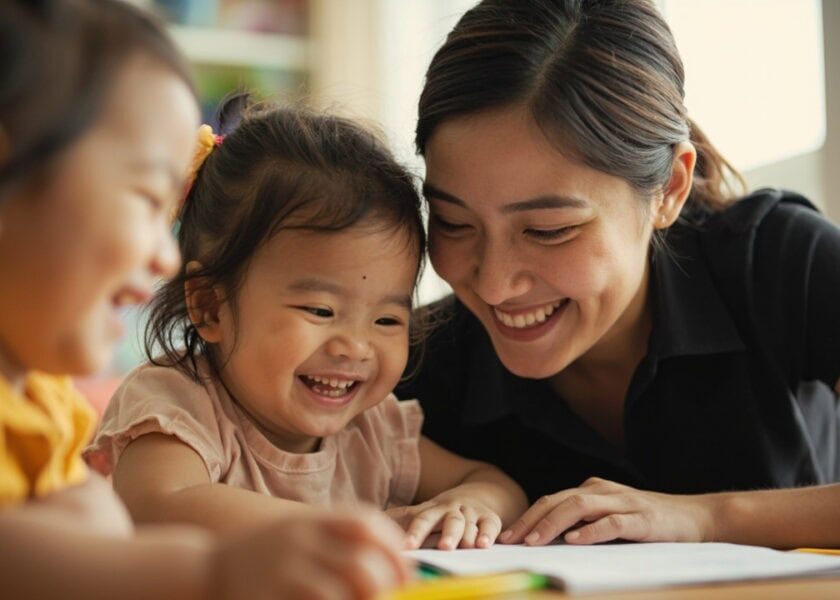
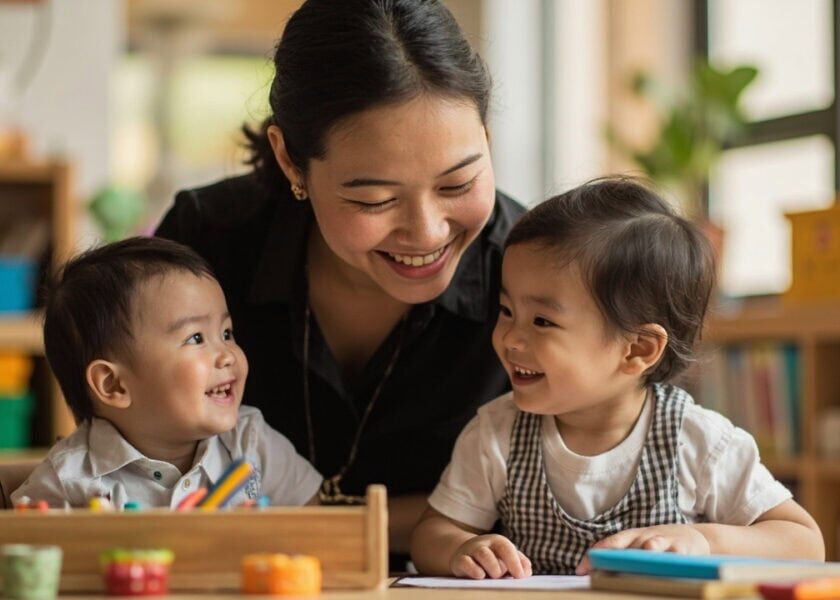
When a caregiver notices a child’s quiet vocalisation, moves toward it, mirrors it back, or simply holds eye contact for a moment — that is not a policy in practice. That is attunement. And attunement, over time, becomes the foundation of trust and security.
What to Watch For During Your Tour
- The moments that are not stage-managed — what happens when two children need something at the same time?
- How the caregiver speaks to a child who is fussing — is her voice calm and warm, or sharp and hurried?
- Whether her face matches her voice — whether the warmth she shows you is the same warmth she shows the children when no visitor is present.
You will not see everything. But you will see enough to know whether her presence feels genuine or performed. And that is not something you can learn from a brochure.
The Second Lens: Child Signal
The second layer is child signal — the visible evidence of how children actually feel in the space.
This is not about whether children are quiet or noisy, active or calm. It is about something subtler. Ask yourself:
- Do children move through the room with a sense of ease?
- When they move toward a caregiver, is it with the naturalness of approaching a familiar person, or with the hesitation of navigating an unfamiliar one?
- Do they explore the environment with curiosity, picking up objects and investigating them? Or do they tend to stay close to edges, watching rather than participating?
These signals tell you something essential: whether the environment feels safe enough for children to be curious. In quality infant care, safety is not just about physical protection — it is about emotional safety. It is the felt sense, developed over time, that the environment is predictable, that caregivers are consistent, and that their needs will be met.
When children have that security, they are curious. They take risks in their play. They experiment. They grow.
When you visit, watch the children — not just whether they are happy, but whether they seem free. The difference is small but significant. A child can be temporarily happy in a visually stimulating environment. But a child who feels free is a child who is learning.
The Third Lens: The Architecture of the Day
The third layer is the one that surprises most parents when they learn to see it: the architecture of the day.
What you are watching for is rhythm. Not a schedule, exactly, but a felt sense of time moving with a kind of natural logic. In quality infant care, the day has breath. There are active periods and quiet periods, social moments and solo moments, times of stimulation and times of rest.
Transitions — from play to mealtime, from indoor to outdoor, from group activity to free exploration — are not rushed or forced. They are managed with care, because transitions are where children experience the most stress. When a transition is handled well, you can see it in the children’s bodies. They are not resisting. They are moving with the flow of the day.
Watch the Transitions During Your Visit
- How do caregivers signal what is coming next — do they prepare children verbally and visually, or is it sudden?
- Do children seem prepared or caught off guard?
- Does the transition from one activity to the next feel calm or chaotic?
If transitions are handled with care, it tells you something important about the programme’s values: that they are not merely interested in efficiency or in keeping children productively occupied, but in protecting children’s emotional experience throughout the day.
The Fourth Lens: The Environment Itself
The fourth layer — the one that many parents overlook because it is easy to mistake for aesthetics alone — is the environment itself.
This is not about whether the space is pretty or modern. It is about whether the space is responsive to the child. Quality infant environments are designed with intention at every level:
- The height of shelves so children can reach what they need
- The texture and variety of materials available for exploration
- The presence of soft spaces and active spaces
- The way natural light enters the room
- The quality of the air and sound levels
These are not decorative choices. They are pedagogical choices. They communicate something about how the programme understands the child’s experience.
Questions to Ask Yourself in Any Space
- Does this feel like a space designed for adults to admire, or a space designed for children to inhabit?
- Are there low shelves with accessible materials?
- Are there quiet corners for children who need to retreat?
- Is there evidence of children’s presence and work — their drawings on the walls, their constructions, their marks? Or does the space feel sterile, as though it has been prepared for a photoshoot rather than for daily life?
These are not superficial observations. They are signals of whether the programme has thought deeply about the child’s experience in that space — whether the design prioritises the child’s agency and development, or the centre’s image.
What These Observations Actually Reveal
You can have a beautiful space without deep values. You can have a cheerful caregiver without genuine attunement. You can have well-behaved children who are not truly free.
But what you cannot have — what is very difficult to sustain — is a programme with genuine values that does not show it in these observable layers. Values that are real tend to express themselves. They show up in the caregiver’s face when she thinks no one is watching. They show up in the way children move through the room. They show up in the texture of the transitions and the thoughtfulness of the environment.
This is why quality childcare benefits from parents who know how to look. Not because parents need to become inspectors. But because when parents observe carefully, they see more clearly — and programmes that are doing genuine work are not afraid of that observation. They are strengthened by it.
How to Use Your Visit: A Practical Framework
Before your visit, decide what you are specifically watching for. Pick no more than two of the four lenses to focus on deeply. Trying to evaluate everything at once leads to overwhelm.
During your visit, slow down. The most important moments are often the quietest ones — not the scheduled activity, but the in-between. What happens when nothing particular is happening? How do children occupy themselves? How does the caregiver fill the space between events?
Ask a question that requires narrative, not a yes or no answer. Instead of “Do you follow a routine?”, ask “Can you walk me through what a typical morning looks like for an infant in your care?” Listen to how the answer is given. Is it detailed and reflective? Does it centre the child’s experience? Or does it feel scripted and generalised?
Trust the feeling in your body as you move through the space. Your nervous system knows something that your analytical mind may not yet have framed. If something feels off, name it. If something feels warm, name that too. You do not need to justify your instincts on a tour — but you do need to let yourself have them.
After your visit, write down what you observed while it is fresh. Not what you were told, but what you saw. Compare visits this way. Patterns will emerge. And the programme that stays with you not just as a checklist item but as a felt sense of rightness — that is the one worth trusting.
Addressing Common Parent Concerns
“I don’t know if I’m being too picky.”
You are not being too picky. You are being a parent. The desire to evaluate carefully is not anxiety — it is the appropriate response to one of the most important decisions you will make in your child’s early years. The question is not whether to evaluate, but whether you have the right framework to evaluate effectively.
“What if the tour looks good but the daily reality is different?”
This is a legitimate concern, and it is why the right programme will offer more than a single tour. Look for ongoing observation opportunities, open communication channels, and regular engagement with parents throughout your child’s time with them.
“How do I know if the caregiver’s warmth is real?”
Watch for the unguarded moments. Watch how she responds when no one is introducing themselves. Watch her face when she thinks she is unobserved. Watch how she handles a child who is fussing, versus how she handles a child who is smiling. Warmth that is genuine tends to be consistent. Warmth that is performed tends to be context-dependent. You will not need long. Your instincts are reliable here.
EduNanny: Built for Discerning Singapore Parents
EduNanny was not built to impress on a tour. It was built to work, day after day, with the children and families who trust us with their most precious responsibilities. And that distinction matters enormously for how we approach the observation process.
We are part of the ECDA Childminding Pilot, which means our model is grounded in evidence and designed to meet real family needs. We offer both home-based and centre-based pathways, because Singapore families are not all the same, and one-size-fits-all solutions rarely serve infants well.
Our infant ratios — up to one caregiver for every three infants — are designed not just to meet regulatory standards but to create the conditions for genuine attunement. In a room of three infants, a caregiver can notice. She can respond. She can be present in the way that matters.
Our care runs Monday through Friday, in structured blocks that give families the consistency they need. And we have designed our fee structures to be accessible within the pilot framework, because quality infant care should not be a luxury available only to those who can afford premium private rates. CDA and Baby Bonus funds can be used, which means the financial architecture of your child’s care is as streamlined as possible.
Beyond these specifics, what matters most is how EduNanny relates to your observation.
We do not just tolerate parent scrutiny. We invite it. We welcome parents into our spaces not as a formality but as partners in their child’s care. Our communication is proactive and transparent — you will not wonder what your child’s day was like. Where deployed, our CCTV measures give you an additional layer of visibility into the daily life of our centres, because we believe that transparency is not a concession to anxious parents but a recognition that parents have a right to know what is happening with their children.
This is not a performance of openness. It is an expression of our actual values — values that believe children thrive when parents and caregivers are in genuine partnership, when communication flows freely, and when the invisible work of infant care is made visible and shared.
Choosing With Your Eyes Open
Let us speak to something that matters more than any feature or policy.
Choosing infant care is one of the most emotionally weighted decisions a parent makes. It is not simply a logistical choice about childcare. It is a statement about who you trust with your child’s wellbeing during the hours when you are not there. It is a statement about what you believe your child deserves. And it is, inevitably, a source of some grief — the grief of sharing something that feels too precious to share.
That grief is legitimate. It deserves to be honoured. And it is exactly why you deserve more than a polished tour and a stack of brochures. You deserve to be seen as the discerning, thoughtful parent that you are. You deserve tools that help you trust your own observations rather than override them. And you deserve a programme that is not afraid of your attention — that welcomes it, that grows stronger under it, and that sees your desire to evaluate carefully not as anxiety to be managed but as the good instincts of a parent who cares deeply.
When you leave a childcare tour feeling uncertain, that uncertainty is not a failure of your judgement. It is the perfectly rational response to an evaluation task that most parents have never been taught how to perform.
The lenses you have read about today — caregiver presence, child signal, the architecture of the day, the responsiveness of the environment — these are not expert tools. They are the tools you already have, now given a frame.
And what we have found, in working with families across Singapore, is that when parents learn to see with these lenses, something beautiful happens. The uncertainty does not vanish, but it transforms. It becomes the uncertainty of a thoughtful person making an important decision — not the uncertainty of someone who does not trust themselves. It becomes discernment.
EduNanny is here for parents who want to choose with their eyes open. Who want to know what they are seeing. Who want a programme that will not just withstand careful observation but will be enriched by it.
Your child is not a checklist. Your observations matter. And you are more capable of knowing quality than you have been led to believe.
The right programme is out there. And when you find it, you will know — not because the brochure told you to feel that way, but because you saw it with your own eyes, understood what you were watching, and trusted what you observed.
That is the parent you already are. And that is the parent we are here to serve.
Ready to see EduNanny for yourself? Book a visit to our centre and observe with your new lenses. We welcome your attention — because we believe you will find something worth trusting.