The Gift of a Second Safe Place in Singapore Childcare
That Quiet Moment at the Door
It does not announce itself. You do not wake up thinking, today I will feel like I am leaving part of myself behind. But then the car pulls up outside the childcare centre, or the caregiver opens the door, and something in your chest tightens. You watch your child’s face for the flicker — the moment they realise you are going.
And in that moment, something in you wonders whether you are doing the right thing. Whether this separation is good for them. Whether, somehow, in your absence, they might feel less loved.
You are not alone in this. It is one of the most quietly devastating tensions any parent in Singapore carries. You planned meticulously. You chose the best school, the nearest clinic, the most nutritious foods. And now you face the reality that someone else — for a few hours each day — will be the one holding your child when they stumble, the one wiping their tears, the one noticing when something is wrong.
What if what your child builds in those hours is not a compromise? What if inside quality care, something genuinely beautiful is happening?
What Children Actually Experience When You Are Not There
There is a body of research — not the headline-generating kind, but the careful, longitudinal kind — that tells us something important about how young children form relationships. A child is not born knowing only their parents. A child is wired to connect. Given consistent, responsive, warm care, a child will form an attachment bond with a caregiver who is not their mother or father. This is not a lesser version of the bond they have with you. It is a different bond, shaped by different circumstances, serving a different but equally vital function in their development.
The psychologist John Bowlby, who spent his life studying how children attach, understood something that we are only now beginning to appreciate fully in how we design childcare. He called it the secure base.
A child who feels emotionally safe with a caregiver can use that safety as a launching point. They look up from their play. They see that the caregiver is there. And because that caregiver is there — consistently, predictably, with warmth — the child feels free to go. Free to climb, to explore, to fall and get back up, to say hello to another child, to try something new.
Emotional security is not a static feeling. It is the quiet engine that drives a child’s curiosity and confidence throughout the day.
The Two Children in the Room
Picture two children in the same room. One is tentative. They stay close to the door. They look around frequently, checking. They are not in distress, but they are not fully present either. A part of their attention is always on vigilance.
The other child is building with blocks, humming to herself, occasionally glancing over at the caregiver with a small, easy smile before turning back to her work. That child is not worried about where the caregiver went. That child knows. Not because the caregiver told her, but because the experience of many days has taught her that the caregiver comes back, that the room is safe, that she is known.
Which child learned that? The second child did not learn it from you. She learned it from the hours she spent inside a relationship with someone who showed up the same way, every day, with patience and attention. That is not supervision. That is attachment happening in real time.
The Third Relationship: Why Secondary Attachment Matters
Here is what is so rarely spoken about, even among parents who have chosen childcare with great care. That second bond — the one your child forms with a consistent, well-trained, emotionally attuned caregiver — does not take anything from your relationship with your child. It adds to it. It complements it. It creates a child who is so fundamentally secure in the experience of being loved and cared for that they can carry that feeling with them into any room, with any person, in any circumstance.
Developmental psychologists call this a secondary attachment figure. Not a replacement. Not a surrogate parent. A genuine, meaningful relationship that stands alongside the one you have with your child, doing its own important work.
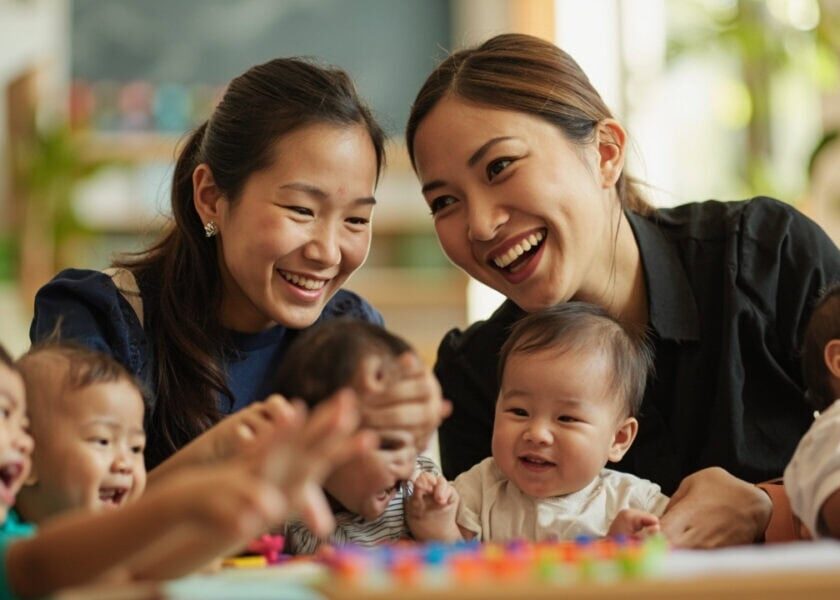
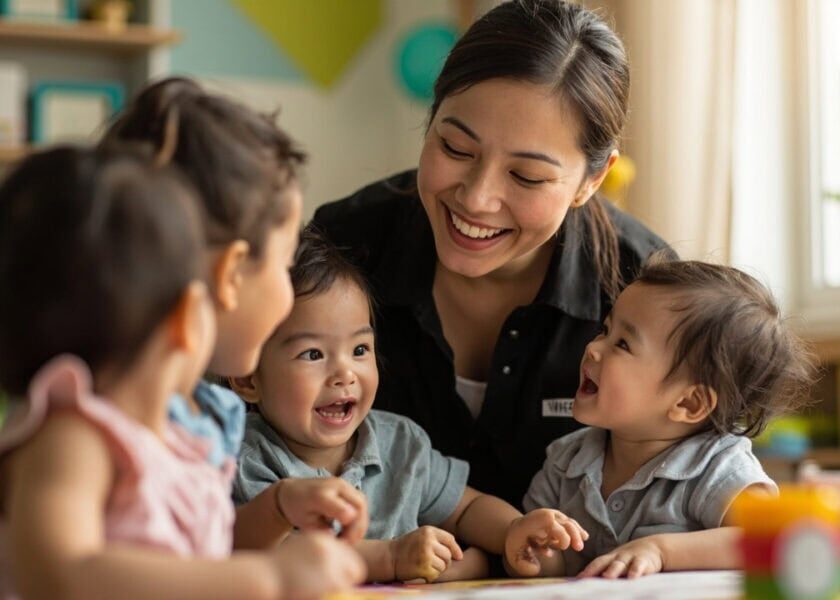
When your child is at home with you in the evening, fully present, able to play freely and connect deeply — part of that ease comes from knowing they have another safe place. When they run to their caregiver in the morning with a kind of animated recognition — not hesitation, not wariness, but genuine gladness — that is your child showing you evidence of a bond you could not build for them.
You built the foundation. Someone else is helping them build the next floor.
Why Consistency Is the Foundation of Attachment
What makes this possible is consistency. A child cannot form a meaningful bond with a rotating cast of caregivers. Attachment is built in the small, accumulated moments of recognition — the caregiver who remembers that your child takes milk at a certain temperature, who knows exactly how to hold them during a thunderstorm, who notices when a child’s usual cheerfulness dims and takes quiet, calibrated action.
These are not generic caregiving skills. These are the signs of a relationship. And a relationship requires sameness. Day after day. Week after week. A predictable human presence that the child can internalise as safe.
What Quality Childminding Actually Looks Like
Parents sometimes ask how they will know if the care is truly good. This is the right question. But it is usually asked with the wrong frame. Parents ask about CCTV and daily updates, about photo logs and incident reports. These things matter — and a thoughtful care provider will offer clear communication. But the deeper answer is simpler and more human than any reporting tool.
You will know because your child will show you.
Not dramatically. Not with grand declarations. With the small, daily evidence that a child carries when they feel emotionally safe:
- They are more confident around other children, because they have learned that adults can be trusted
- They are more willing to try new things, because they have learned that making mistakes does not mean losing love
- They come home and play with a kind of easy contentment that is hard to fake
- At some point — perhaps on a morning when you were dreading the drop-off — they run ahead of you toward the caregiver with a grin on their face
That is not a child who has been pacified. That is a child who has been known.
Being Cared For Versus Being Known
There is a meaningful distinction between these two states. A childcare setting can be clean, well-staffed, and safety-compliant. Your child can be fed, napped, and entertained on schedule. And yet something can still be missing.
Being known looks like this: a caregiver who notices the particular way your child tilts their head when they are thinking hard. Who sees the flash of shyness that melts into curiosity the moment a familiar face appears. Who understands the difference between a tired cry and a frustrated one, and responds to each differently. These are not protocols. These are relationships.
When a child is known, they do not just survive their hours in care. They thrive in them. They build something inside that environment — confidence, curiosity, the quiet assurance that the world is a place where people show up for them — that they carry into every new situation.
EduNanny by BUTLER: Built Around the Relationship
This is why EduNanny by BUTLER structures its care the way it does. The ECDA Childminding Pilot that EduNanny participates in is designed around a clear understanding — that ratios matter, that consistency matters, that trained, attentive caregivers matter.
With small care configurations of up to three infants in certain settings, a caregiver has the genuine capacity to know each child. Not just their routines. Their rhythms, their preferences, their particular ways of expressing joy or discomfort. In a city where childcare centres can be stretched thin, EduNanny has chosen a model that makes real relationship-building possible.
Beyond the care model itself, EduNanny has built this with Singapore’s families in mind:
- Pilot fee structures are designed to be accessible — CDA and Baby Bonus can be used, meaning quality infant care is a genuine option for many families
- Monday to Friday care blocks offer regularity that helps children settle into predictable rhythms — and lets parents plan their lives with confidence
- The care philosophy holds regardless of setting — whether home-based, community, or centre-based, the child comes first and the relationship is the vehicle through which everything else is delivered
- Communication tools like the Thomas AI Chatbot support parents with everyday questions and specific concerns, reflecting a commitment to transparency without replacing the human relationship at the centre of the care
EduNanny’s caregivers are not anonymous staff. They are attachment figures. For the hours they share with your child, they are some of the most important people in your child’s world.
Questions Parents Ask — and What Research Tells Us
“Will my child feel abandoned?”
This is the worry underneath every drop-off. The research is clear: when children experience consistent, warm, responsive care, they do not feel abandoned. They feel held. The key word is consistent. A child who knows their caregiver will be there tomorrow, and the day after, and the day after that, does not experience your leaving as a loss. They experience it as the beginning of a reliable rhythm — one that includes your return.
“What if my child cries every time I leave?”
Transitional distress at drop-off — a brief, situational protest — is normal and does not indicate that your child is unhappy in care overall. Developmental psychologists distinguish between protest (a short-lived reaction to a specific change) and despair (a sustained, withdrawn state that suggests the care environment lacks warmth or consistency). In quality care with a familiar caregiver, even initial crying typically decreases over days and weeks as the child learns to trust the new environment.
“Can one caregiver really know my child as well as I do?”
No — and that is not the goal. The secondary attachment figure does not replace you. They do something different. They give your child a second safe place, which paradoxically makes your primary bond even stronger, because your child is not operating from a place of scarcity. A child who has one secure base is fragile. A child who has two is resilient.
“How do I choose when everything looks similar on paper?”
Ask one question above all others: who will be with my child, and will they be there tomorrow? Look for a setting where caregiver continuity is genuinely prioritised — not just promised in marketing, but built into the structure of how care is delivered. Ask how long caregivers typically stay in their roles. Ask how the centre handles transitions. Ask to observe, not just once, but over a short period of time.
Practical Signs of Quality When You Visit
- Observe the caregiver-child interactions — not the facilities. Watch for warmth, eye contact, and how caregivers respond to distress. Is the response calibrated, patient, and individualised?
- Ask about caregiver continuity — how long has the same caregiver been with the same children? High turnover is a red flag for attachment quality
- Check the ratios — fewer infants per caregiver means more individual attention, which directly supports the relationship-building your child needs
- Use available subsidies — in Singapore, CDA and Baby Bonus funds can significantly reduce the cost of quality infant care. This should not be a barrier to accessing the right care
- Trust the long game — the evidence of quality care is not always visible on day one. Give the relationship time to develop, and watch for the small, daily signs of trust that emerge over weeks
You Are Not Leaving Them. You Are Extending Your Love.
We live in a city that moves very quickly. We are accustomed to optimising — for productivity, for efficiency, for competitive advantage. And in the face of that momentum, choosing childcare can feel like one more item on a list of logistics to manage.
But the thing your child is building in those hours is not logistical. It is the slow, patient construction of emotional architecture. The rooms inside that architecture are shaped by every interaction with every person who has genuinely cared for your child.
And one of those rooms — a room your child will carry into school, into friendships, into future relationships — is being built right now, by a caregiver who has committed to showing up, day after day, with warmth and intention.
If you are a parent in Singapore weighing this decision right now, know this: the love you have for your child does not stop at the door of the childcare centre. It travels with you into every choice you make.
The choice to find care that is relationship-based, consistent, and genuinely attentive is not a choice that signals your absence as a parent. It is a choice that extends your love into the hours you cannot be there. It is a choice to give your child the gift of a second safe place — not instead of you, but alongside you.
EduNanny by BUTLER is that second safe place for families across Singapore. Because every morning, somewhere in this city, a child runs to their caregiver.
And that child is not running away from their parents. That child is running toward a world where they are known, held, and secure.
That is what quality childminding looks like. That is what EduNanny builds. And that is the relationship your child deserves.
Explore infant care options with EduNanny by BUTLER — where every child is known, and every relationship matters.
Learn more about the EduNanny approach or get in touch with our team.