How Singapore Parents Learn to Read Quality in Childcare
The Education of Seeing: A Singapore Parent’s Guide to Reading Quality in Childcare
There is a particular kind of silence that falls over you the moment you step through the entrance of a childcare centre for the first time. Not an uncomfortable silence—something else. A quiet that asks a question you cannot yet articulate.
You are standing in a room full of children and routines and carefully arranged learning corners, and yet you feel, unmistakably, that you are missing something. You reach for the brochure. You glance at the credentials on the wall. You take out your phone to note the ratio of children to caregivers. And still, something feels unresolved.
You are doing everything right. You are being thorough. But beneath all that thoroughness is a quieter, less acknowledged question: What am I actually supposed to be looking at?
That question is more common than the childcare industry would have you believe. In Singapore, where quality childcare is both a genuine need and a genuine investment, parents have become extraordinarily diligent. You research. You compare. You visit. You ask about curriculum frameworks and meal plans and teacher qualifications. You read reviews from other parents, some glowing, some troubling, most somewhere in between. You build mental checklists and weigh costs against features.
And yet, for all that preparation, many parents describe the same hollow feeling afterward: they have gathered information but have not felt clarity. They have visited but have not seen.
This guide will not give you a checklist. It will give you something more useful: a framework for observation—one that helps you read the quality that is already present, already visible, simply waiting to be understood.
You Are Not Failing—You Are Missing a Framework
This is not a failure of intelligence. It is not a lack of care or commitment. It is something more specific, and once named, something more fixable.
What you are experiencing is the absence of a skill—one that nobody has yet taught you, but one that you are entirely capable of learning. The skill is observation. And the moment you understand it as a practice rather than a gift, everything changes.
Observation is not the same as looking. Looking is passive—the undirected sweep of the eye across a room, registering surfaces, taking in what is obvious. Observation is different. Observation is the deliberate, trained engagement of your attention—your curiosity, your empathy, your analytical mind—toward understanding what is really happening in a space.
It is the difference between hearing noise and listening to meaning. And like any capacity worth developing, it becomes sharper with intention and practice.
What Good Care Looks Like: Reading a Childcare Space
1. The Caregivers: Reading Warmth Without Sentimentality
When you walk into a room, resist the urge to immediately catalogue their qualifications. Instead, watch them first. The caregivers are the axis around which every quality childcare arrangement turns.
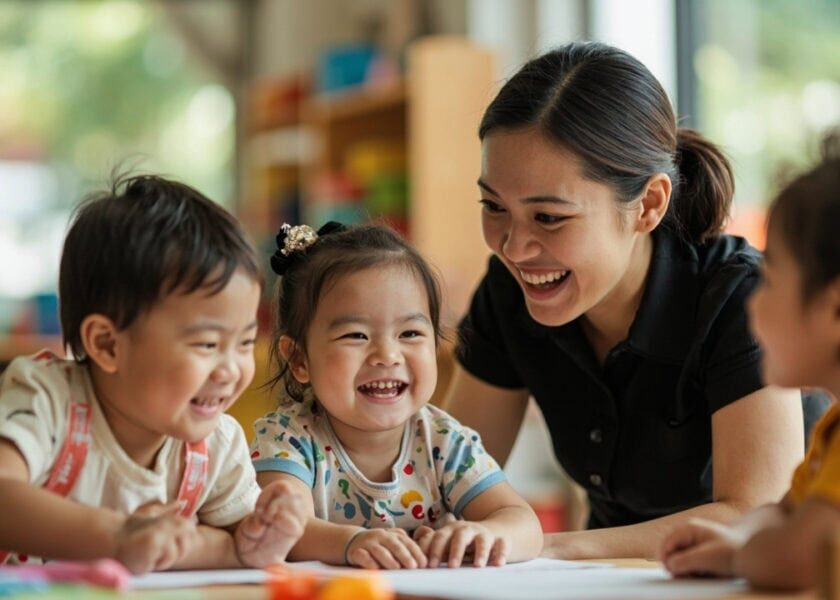
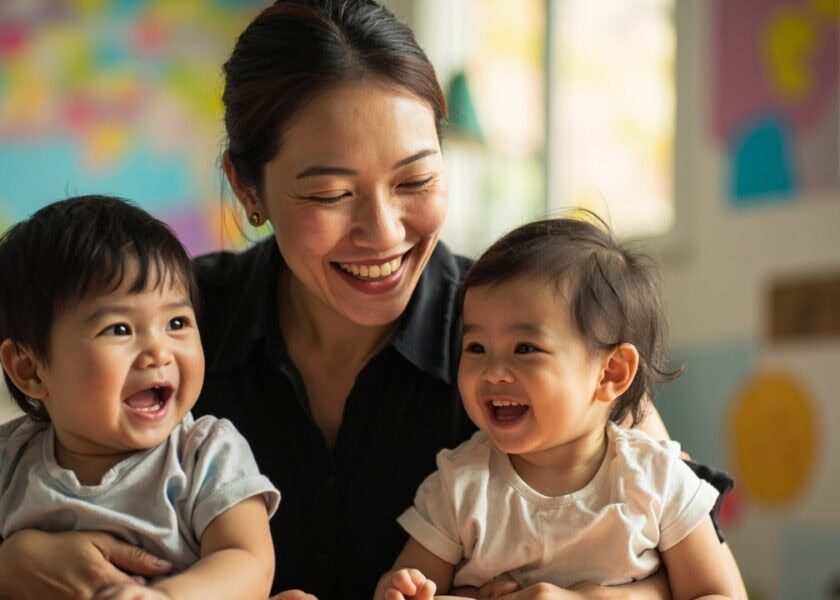
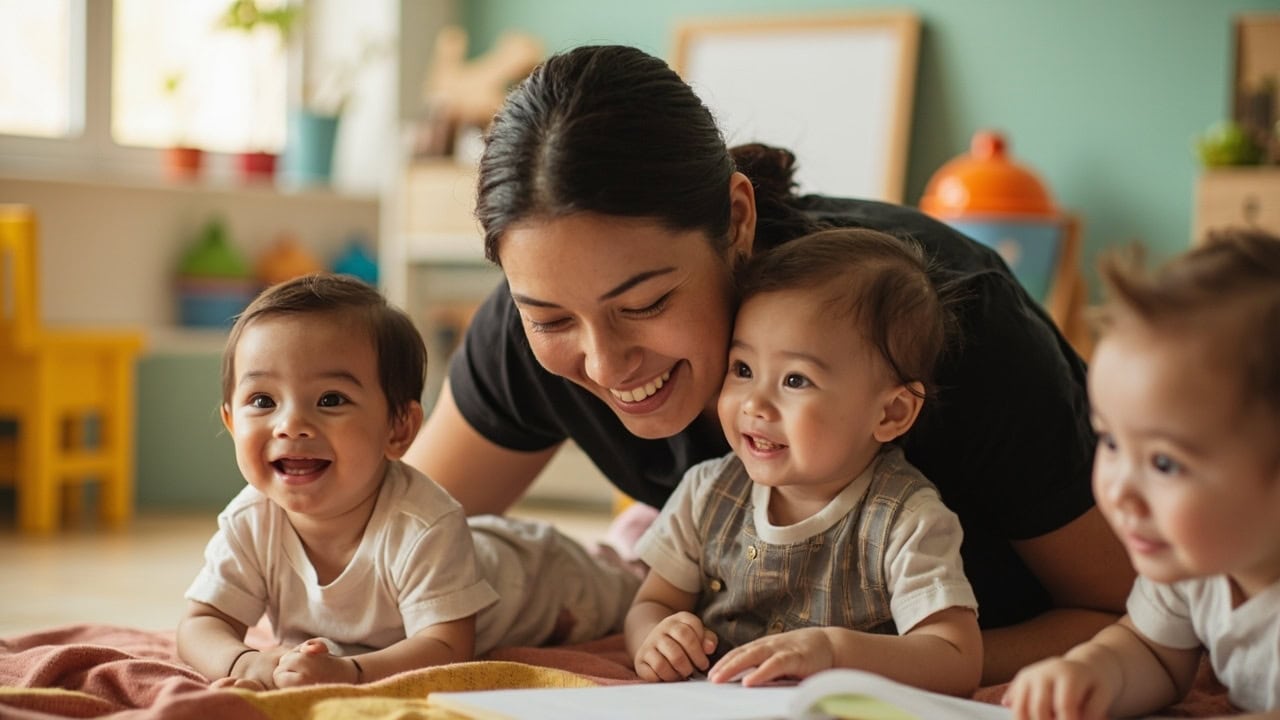
Watch how they kneel. Good caregivers lower themselves to the child’s level—not only during formal interactions, but as a natural posture of respect. They do not hover above children in a supervisory crouch. This is not a minor detail. It is a philosophy made physical.
Notice whether their movements toward a child are purposeful or perfunctory. Purposeful movement carries warmth even when it is efficient. Perfunctory movement is correct but cold. You can feel this distinction immediately, even if you cannot yet articulate it.
Watch how a caregiver responds when a child approaches them unprompted. Is there a shift in attention—a softening, a realignment of focus—or does the caregiver continue what they were doing while acknowledging the child peripherally? These are not subtle, theoretical differences. They are felt, immediately, in the room. A child feels them. So will you, once you learn to look.
2. The Children: Reading Emotional Texture
Consider the children not as a collective, but individually, as you are able. What is the emotional texture of the room?
This is not about whether the children are noisy or quiet, active or calm. It is about something deeper: are they tense or at ease?
Do you see spontaneity—children initiating play, making choices, experimenting with materials—or do you see a kind of ambient compliance, where children move through prescribed activities without visible engagement?
The children in a quality environment will not be perfectly behaved, because perfectly behaved children are often children who have learned not to express themselves freely. What you want to see is a range:
- The comfortable child who is fully absorbed in play
- The frustrated child who is being gently helped to navigate a conflict
- The tired child who is resting rather than being pressured to participate
Children who feel safe do not perform safety. They simply inhabit it.
3. The Physical Space: Reading What the Room Communicates
The physical space itself carries its own language. Walk through a centre and notice how it feels to your body.
Lighting: Is the lighting natural where possible? Harsh artificial light creates a different kind of atmosphere than soft, warm alternatives. Natural light is not a luxury—it is a signal that the space has been considered.
Sound: Is the noise level regulated? Not silent—children need some ambient sound, the hum of activity—but manageable. You should be able to hear individual voices without straining, to have a conversation without shouting.
Materials: Notice what is available to children. Are they varied? Are they accessible—placed at child height, within reach, not locked behind glass doors or stacked on high shelves? A space that expects children to ask for everything is a space that controls rather than invites.
Smell: Notice whether the space smells like anything at all. A childcare environment with young children should smell clean but not chemically, functional but not sterile. Smell is a primitive sense, and it communicates directly to the nervous system. Trust it.
4. Your Child: The Most Honest Signal
And then there is the most important observation of all—the one that most parents instinctively want to follow but are often told not to trust: your child.
Watch how your child responds to being in the space. Not in the way you might watch a child in a playground where they are simply playing, but with the understanding that this is an unfamiliar environment with unfamiliar people, and that some initial hesitation is normal and even healthy.
What you are watching for is the trajectory of that response:
- Does your child begin wary but gradually soften as they observe the room?
- Does a caregiver approach in a way that respects that wariness rather than pushing through it?
- Does your child begin to engage with a material or a toy, or, tentatively, another child?
- Or does your child remain consistently distressed in a way that does not ease?
Your child is giving you data. Real, honest, irreplaceable data. No review, no credential, no marketing material can substitute for your child’s lived response to a space in real time.
Confidence vs. Certainty: What Trained Observation Actually Offers
This is what trained observation offers: not certainty, but confidence. There is a difference.
Certainty is the feeling that you know exactly what will happen, that you have somehow accounted for every variable. No parent has that, and no honest childcare provider would promise it.
Confidence is something else. Confidence is the knowledge that you have looked carefully, that you have read the signals accurately, that you have weighed what you saw against what you value. Confidence is the capacity to make a decision and trust it—not because the decision was risk-free, no meaningful decision is, but because the decision was informed by your own perception, which you have learned to trust.
You may be wondering whether this approach is realistic given the constraints of a typical centre tour. You have limited time. You are visiting during a lunch break or on a Saturday morning. The tour is guided, which means you are being shown, not simply looking.
These are real constraints, and I do not want to suggest that observing quality is effortless. It is not. But here is what changes when you enter with the right orientation:
- You stop being a passive recipient of information and become an active reader of a space.
- You stop relying solely on what you are told and begin to look for what is demonstrated.
- You ask different questions—not because you are suspicious, but because you are curious.
You ask a caregiver, “What does a typical morning look like for a child in their first week?” and you watch how they answer—whether they speak from procedure or from memory, whether their eyes go to you or to the children. You notice whether the centre feels like a place where your questions are welcomed or merely tolerated.
These are not advanced skills. They are the natural consequences of paying attention with intention.
Addressing Common Worries: Questions Singapore Parents Ask
“What if I miss something important?”
This fear is valid, but it is often misdirected. You are not likely to miss quality. You are likely to miss distraction—the brochures, the credentials, the metrics that feel concrete but actually tell you little about daily experience. The best indicators of quality are not hidden. They are simply qualities that require a trained eye to read clearly. That eye, you can develop.
“I don’t have the expertise to judge childcare professionals.”
You do not need to evaluate teaching methods or assess developmental milestones. You need to observe what any attentive person can observe: warmth, responsiveness, the child’s ease, the space’s invitation. The caregiver who kneels is not demonstrating advanced technique. They are demonstrating respect. You can see that.
“What if my child has a bad first impression?”
Some hesitation is normal. What matters is the trajectory—does the child begin to settle? Does the caregiver honour the child’s pace? A good childcare environment does not demand immediate comfort. It creates the conditions for comfort to emerge.
“The tour feels artificial—everything seems staged.”
It may be. But you can still observe what is real even in a prepared space. Watch whether the warmth you see in caregivers feels genuine or performed. Watch whether the children’s engagement feels spontaneous or scripted. Watch whether your own child responds to something in the room—a material, a caregiver’s voice, a quality of light. The space may be staged. The responses cannot be fully controlled.
Your Next Centre Visit: A Practical Observation Guide
When you visit a childcare space in Singapore—whether centre-based or home-based—arrive with these questions as your guide:
- How do the caregivers move through the space? Do they kneel, lower themselves, meet children at eye level?
- How do caregivers respond when a child approaches them unprompted?
- What is the emotional texture of the room—are children at ease, absorbed, spontaneous?
- Are materials accessible to children, or must everything be requested?
- How does the space smell? How does it feel to your own body?
- How does my child respond to the environment over time—not just initially, but across the visit?
- Do my questions feel welcomed or merely tolerated?
Take notes if it helps, but more importantly, take your time. You are not collecting data points. You are learning to read a space the way you might learn to read a person’s character—not all at once, but through accumulated observation of small, meaningful details.
The Best Indicator of Quality Is Not Hidden
Seeing clearly begins not with the brochure, not with the checklist, not with the star rating, but with what is visible when you know how to look.
If you are standing at the beginning of this search, feeling the weight of the decision, uncertain whether you have the expertise to make it well, I want to leave you with this: you are not untrained. You are not insufficiently prepared. You are simply untrained in a specific skill that is entirely learnable.
Observation is not a talent some parents possess and others lack. It is a practice, and like all practices, it improves with attention.
The next time you step into a childcare space, do not silence your uncertainty. Let it orient you. Use it as a prompt to look more carefully.
- Notice the caregiver who kneels.
- Notice the child who plays freely.
- Notice the room that smells clean and feels warm.
- Notice your child’s response—honest and unfiltered.
And then, when you leave, trust what you have seen. Not because it was perfect, because it never is. But because it was real, and you were paying attention.
The best indicator of quality is not hidden. It is waiting to be seen by someone who knows how to look.
Begin Your Search with Clarity
Choosing childcare is one of the most important decisions a family makes. It deserves more than a checklist—it deserves a clear eye, and the confidence to trust what you observe.
If you are looking for childcare that reflects the principles described here—warmth, responsiveness, genuine attention to each child—EduNanny Singapore offers home-based childminding through the ECDA Childminding Pilot, alongside connections to centre-based pathways. For families who value the intimacy of smaller settings, EduNanny’s home-based approach offers ratios of up to one caregiver to three infants—an architecture of attention where observation becomes natural rather than effortful.
Whether you are exploring home-based childminding or seeking quality centre-based options, connect with EduNanny Singapore to learn more about available pathways, fee structures, and how the right care arrangement can support your family’s needs.
#ChildcareSingapore #ObservationSkills #QualityChildcare #EduNanny #SingaporeParents