Beyond ABCs: Why Your Singapore Child’s Social Readiness Matters More Than Academics for Primary 1
The Real School Readiness Gap: What Singapore Primary 1 Actually Needs
It is a Saturday evening. You are scrolling through a parenting forum or a Singapore Facebook group, and you come across a post from another parent asking the question that has become almost ritualistic in its frequency: “Is my child ready for Primary 1?”
Below it, the comments arrive quickly. Some suggest flash cards. Others recommend worksheets. A few mention phonics programs. Someone links to a list of things children should know before P1 enrollment — colors, numbers, letter recognition, proper pencil grip. The post gets hundreds of reactions and dozens of shares, because it resonates so deeply with what parents across Singapore are quietly worrying about.
And yet, something about the conversation feels incomplete. You can sense it in the way parents respond to those lists — not with relief, but with a nagging question underneath: Is this really what my child needs? Or am I preparing them for the wrong thing?
That question — that specific, persistent, quietly exhausting uncertainty — is what this article is about. Not because there is a simpler answer than the forums provide. But because the real answer has been missing from this conversation entirely. And understanding it may be the most important thing you do for your child’s entire educational journey.
What Singapore Parents Need to Know About School Readiness
- Primary 1 teachers consistently report that academic knowledge matters far less than social-emotional capacity
- The skills that make a child genuinely ready for school are built over years, not months
- Quality daily childcare compounds into readiness through consistent, responsive care
- The child who wants to go to school — not just has to go — is the child who has learned they are capable
- Choosing childcare is one of the most significant educational decisions you will make
What Singapore Primary 1 Actually Requires
Let me say something that might sound counterintuitive, given everything you have likely been told: the skills your child needs for Singapore Primary 1 are not primarily academic.
By the time your child sits in that first classroom, the colors and the counting and the letters will come. Children are extraordinarily adaptable. They learn what they need to learn, often faster than we expect.
What Singapore’s primary schools are actually looking for — what they need from your child — is something harder to measure and far more important to develop. They need children who can regulate their emotions when things don’t go as planned. Children who can focus their attention on a teacher for sustained periods. Children who can navigate social dynamics with peers, who can share, take turns, recover from minor conflicts, and re-engage after a difficult moment. Children who feel, at some foundational level, that school is a place they belong.
When parents receive a checklist of academic milestones, they often feel a temporary sense of control. They have something concrete to work toward. They can buy the materials, track the progress, and feel that they are doing their part.
But that sense of control rarely lasts. Because underneath the checklist anxiety, there is a deeper fear — a mother’s intuition, a father’s doubt — that they are preparing their child for the wrong thing.
That intuition is correct. And it is worth listening to.
Singapore’s Ministry of Education and the teachers who welcome your children into Primary 1 have been consistent in their feedback over the years, even if it rarely makes it into the parenting forums. The children who transition most successfully are not the ones who arrive knowing the most. They are the ones who arrive knowing how to learn — how to listen, how to follow multi-step instructions, how to wait, how to manage the disappointment of not being chosen first, how to ask for help, how to sit with discomfort and regulate themselves back to calm.
They are children who have learned, over time, that they are capable. That failure is not final. That adults can be trusted. That other children can be friends.
That is what readiness actually looks like. And that is precisely what most school readiness advice fails to address.
Why the Final Sprint Doesn’t Work
Most parents approach school readiness as a project with a start date. They begin preparing their child a year before enrollment, sometimes six months before. There is nothing wrong with this impulse.
But the science of child development tells us something important: the capacities that make a child ready for school are not built in that final sprint. They are built across years. They compound. They layer. And they are built in the places where your child spends the most time — in the daily rhythms of care, in the quality of attention they receive, in the opportunities they have to play, to struggle, to solve problems, to be part of a group.
This is why the childcare decision you make today — not just for the year before P1, but for the years before that — matters more than almost any other decision you will make in your child’s early education.
These are not skills that appear overnight. They are not skills that a six-month enrichment program can instill. They are capacities that develop through thousands of hours of interaction, observation, gentle challenge, and experience — beginning in the earliest years of life, in the everyday moments of care that might seem ordinary but are anything but.
What Quality Childcare Actually Provides
When I talk about quality childcare, I want to be specific — because this is where the conversation often becomes vague, and you deserve clarity.
What children need, in those formative years, is not a miniature classroom. They do not need worksheets stacked on tables or academic pressure applied before their brains are ready to process it.
What they need is something more subtle and far more valuable:
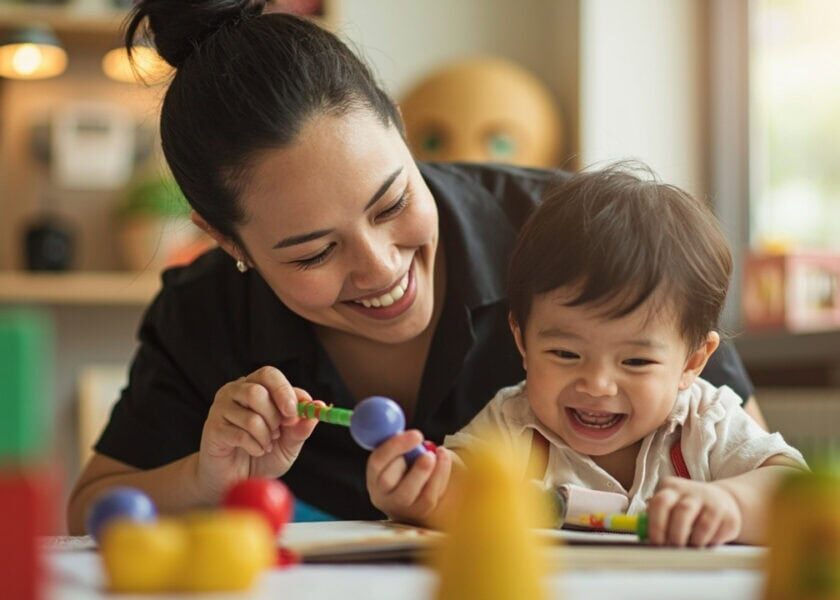
- A caregiver who responds to them consistently, who helps them name and manage their emotions, who creates a safe base from which they can explore
- Opportunities to play alongside other children and learn, through gentle guidance, how to negotiate, cooperate, and resolve conflict
- An environment that challenges them just enough — that introduces novelty, that tolerates messy attempts at learning, that celebrates effort over outcome
- Routines that build predictability and transitions that teach flexibility
- To be genuinely known by the adults who care for them, not just supervised
This is not a luxury. This is the actual curriculum of school readiness. The child who receives this kind of care day after day — in the years before Primary 1 — is the child who walks through those school gates with their head up, ready to learn, ready to belong.
The EduNanny Model: Quality Care Within Reach
EduNanny Singapore was built on a recognition that parents need more than a list of credentials or a tour through a well-designed space. They need a model of care that is grounded in what children actually need, delivered by caregivers who are trained and supported, and structured in a way that is genuinely accessible.
That is why EduNanny is part of the ECDA Childminding Pilot — a framework designed to bring quality home-based and community-based childcare options to families across Singapore. A framework built around something essential: the right ratios.
In EduNanny’s infant care, you will find ratios of up to one to three — meaning your child receives the kind of individual attention and responsive care that larger settings simply cannot provide. This is not a marketing claim. It is a structural commitment to what developmental science tells us works.
And because this model is supported within the pilot framework, it is structured to be accessible. Your Child Development Account can be used. Your Baby Bonus can be applied. Monday through Friday care blocks are designed around the realities of working parents, not around an idealized family situation. For families across Singapore — in HDB estates and private properties alike — this model is within reach.
You deserve transparency in this conversation, not performance. When you visit an EduNanny caregiver or community setting, you should expect to see what is actually happening with your child. Depending on the arrangement, this may include communication tools that keep you connected throughout the day, and in some settings, transparency measures such as CCTV that allow you to check in visually. These are not substitutes for trust — they are supports for it. The right childcare provider welcomes that scrutiny, because they have nothing to hide.
Questions to Ask Any Childcare Provider
When you are evaluating any childcare arrangement — whether it is EduNanny or another provider — look beyond the obvious. Here are the questions that will tell you whether a setting is building school readiness or simply occupying time:
- How does the caregiver handle conflict between children? Listen for whether they mediate with patience, whether they help children name emotions, whether they guide rather than simply intervene.
- How are transitions managed? When the activity changes, when a favorite toy is put away, when a child is frustrated — these are the moments that reveal everything.
- What does a typical day actually look like? Not just the schedule on paper, but what your child will be doing during those hours.
- Do the caregivers get down to the children’s level? Literally and figuratively — do they interact at the child’s height, both physically and emotionally?
- Do the children seem at ease? Are there moments of genuine engagement, or just surveillance?
- How does the caregiver respond to distress? With patience and consistency, or with frustration?
You are not ceding your role as your child’s primary developmental partner when you choose quality childcare. You are entering into a collaboration. The readiness that your child develops in a quality care environment does not replace what you build at home. It amplifies it. When your child comes home from a day of secure, responsive care, they bring that experience with them. They are calmer. They have more capacity for connection with you. They have practiced the skills of regulation, of social engagement, of learning — and now they can extend those skills into the family context.
Walking Through Those School Gates
I have spoken about skills and readiness and development, and I believe in all of that deeply. But I also want to speak to the feeling that I know many of you carry, often silently, in the gap between what you are told to do and what you actually hope for your child.
You want your child to be happy. Not just successful — happy. You want them to walk into Primary 1 not because they have been drilled into compliance, but because they genuinely want to be there. Because school feels like an exciting place to explore. Because they trust that adults there will care about them. Because they have learned, in the years before, that learning is something they can do, and that they are capable of navigating new and uncertain situations.
There is a difference between a child who has to go to school and a child who wants to go to school. That difference is not trivial. It is the difference between endurance and engagement. Between compliance and curiosity. Between doing what is required and actually thriving.
The child who wants to go to school is not necessarily the child who knew the most before they arrived. They are the child who learned, in the earliest years, that they are capable. That adults are reliable. That challenges can be faced. That other people are interesting and worth knowing. That the world is large and sometimes overwhelming, but also deeply rewarding. That they belong.
That is what quality care builds. Not on a checklist. Not in a crash course. Day by day, year by year, in the thousand ordinary moments that make up a childhood.
You are making decisions now that will shape your child’s relationship with learning for the rest of their lives. That is not an exaggeration, and it is not a burden I want to place on you — it is a recognition of the real significance of these years. But it is also a source of profound hope. Because it means that what you do matters. That the care you choose matters. That the partnerships you build with the people who help care for your child matter.
EduNanny Singapore exists to walk alongside you in that work. Not as a service provider you hand your child to and forget about. As a developmental partner who understands what is actually needed and is committed to providing it — consistently, transparently, and with genuine respect for both you and your child.
The first bell will ring. Your child will walk through those school gates. And what they carry with them — not in their backpack, but in their confidence, their curiosity, their resilience — will be the result of all the days that came before.
Those days start now. And they could not be in better hands.
To learn more about EduNanny Singapore’s approach to infant care and childminding — or to explore how our team can support your family — visit our website or connect with us directly.