What Your Singapore Childcare Tour Is Really Telling You
That Moment in the Tour Room: How to Read Quality When You Cannot Yet Name It
There is a moment you already know.
You are standing in a room. It might be a childcare centre, a home-based setting, or someone’s living room that has been transformed into something more. A caregiver is there. Children are there. And you are watching — not with your full attention, because part of you is also managing your phone, answering the tour coordinator’s questions, trying to remember the checklist you prepared.
But there is a part of you that is simply present. Observing. Sensing.
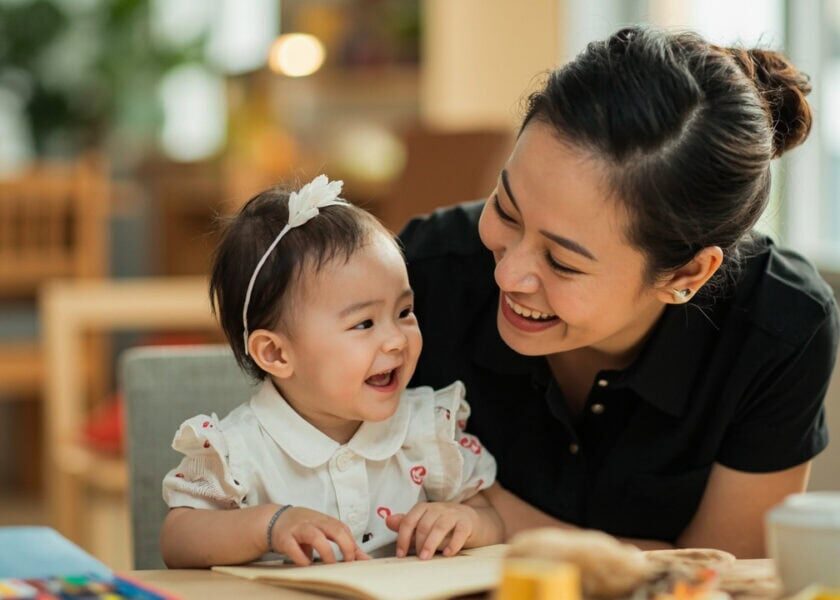
And in that sensing, something is happening. You notice that a child walks over to the caregiver with a toy and says something you cannot hear. The caregiver does not look up immediately. She is helping another child with a shoe. The first child waits — not anxiously, just waiting. And when the caregiver finishes, she turns, and her hands move in a way that makes the child smile before she even says a word. She crouches down. She listens. She responds.
You see this. You feel something shift in your chest. But then the tour coordinator says “and we follow the Montessori approach here” and you nod, because that is a word you recognize, and you move on to the next room. By the time you reach the car park, you are not sure anymore what you just witnessed.
Was that moment important? What should you have looked for? Is this the kind of place you want to leave your child?
This is the moment we want to talk about today.
Not trust. Not guilt. Not the science of attachment or the architecture of a developing brain. Those things matter, and they have been written about extensively. But there is a skill that sits before all of that — a skill most Singapore parents are never explicitly taught. It is this: how to read a childcare environment with clarity. How to observe with intention. How to know what you are looking at before you know what you are choosing.
We call this the observation skill. And it is the most practical tool a parent can carry into a tour, a pickup, a homecoming.
You already have it. You just have not yet learned to trust it.
The Room Tells You Everything
When you walk into a childcare space, your eyes go to the obvious things — the colorful murals, the labeled corners, the child-sized tables and chairs. This is what spaces are designed to show you. But the room is also communicating in quieter ways, and these are the messages that matter most.
Listen First
What is the ambient sound? Not the activity noise — that tells you little. Listen beneath it. When children are genuinely engaged, there is a particular quality to the room. It is not silent, but it is not chaotic either. There is a rhythm.
You can hear the difference between a room where children are being managed and a room where children are at ease. A room where children are at ease has what we might call productive quiet — moments where one child is concentrating, where another is listening, where the energy is purposeful rather than frantic.
Look at the Arrangement, Not the Decoration
Where are the toys? Are they accessible to children, or are they arranged for display? A room that communicates quality will have materials within reach — shelves at child height, baskets that invite exploration, open-ended materials that children can choose rather than containers that control.
This is not about aesthetics. It is about what the room is telling you about who is valued here. Is the space designed for the adults who will photograph it, or for the children who will live in it?
Notice the Movement
Where can children go? In a high-quality environment, children are not arranged in rows facing a single teacher. They are distributed. They can move. They can choose a corner, a mat, a table.
This is not about freedom in the abstract. It is about the room’s implicit message: are children trusted to self-regulate, or are they expected to require constant external control?
Notice What Is Missing
A room that is genuinely attuned to children’s needs will not have every surface covered. There will be calm. There will be uncluttered space. Too much stimulation is not richness — it is overwhelm. A room that understands this will give children room to breathe.
You will not find a sign that says “we prioritize children’s autonomy.” But you will feel it. The question is whether you will know to look for it.
The Caregiver: What She Does Matters More Than What She Says
During a tour, the coordinator will tell you about qualifications, ratios, curriculum. But when you watch a caregiver in motion — when you observe her moving through the room, responding to children, managing the ordinary chaos of a morning — that is where the truth lives.
Watch Her Hands
This sounds simple, but it is one of the most revealing details you can observe. How does she touch the children? Not in greeting — that is performative. Watch when she moves a child, steadies someone, picks up a baby who has stumbled.
Her hands should be calm. They should communicate presence before they communicate instruction. A caregiver who moves with calm hands is a caregiver who has internalized her role as a regulator. She is not managing children. She is co-regulating with them.
Watch What Happens When a Child Is Upset
This is the moment that separates adequate supervision from genuine care. Does the caregiver respond to the distress or to the disruption?
There is a difference. A caregiver who is focused on managing the room will move quickly to stop the crying — with distraction, with commands, with a raised voice. A caregiver who is focused on the child will move toward the distress. She will crouch down. She will be with the child before she tries to fix anything.
This is what responsiveness looks like in real time. It is not about warmth in the abstract. It is about whether this particular child, in this particular moment, has the full attention of the adult who is responsible for him.
Watch the Arrivals
During a tour, you will not always see distress. But you can watch transitions. Arrivals are a window. When a parent drops off a child, how does the caregiver receive them?
Does she look at the parent or the child? Does she engage with the parent’s verbal handover, or does she already have her eyes on the child, waiting to receive what the child brings through the door?
These are small moments. But they are the moments that repeat every single day, and they are the moments your child will live inside.
Pickup: The Data You Already Receive
Many parents feel most uncertain at pickup. You arrive at the end of the day. Your child is in the room. You cannot see inside clearly from the doorway — there are bodies, bags, the organized chaos of departure. You call your child’s name.
What happens next is data. Not metaphor. Not your intuition trying to read tea leaves. Actual, observable information about what your child’s day has been.
The Quality of the Greeting
Does your child run to you, or does she finish something before she comes? This matters.
A child who cannot pause, who has been in a state of high arousal all day, may run to you with an intensity that feels like excitement but is actually dysregulation. A child who is genuinely content may look up, register your arrival, and then come — calmly, because she trusts you are there.
The Handoff
Does the caregiver tell you something? Anything?
A caregiver who is paying attention to your child will have something to say — a small detail, an observation, a note about something that happened. “She ate well today.” “She asked for the blue cup again.” “She had a lovely time building with the blocks.”
This is not bureaucratic reporting. This is the caregiver seeing your child as a person with a history, and sharing that history with you.
The Evening Behavior
We want to be honest about this, because many parents feel guilty when their child behaves differently at home after childcare. They wonder if something is wrong.
But the evening behavior is not a sign of failure. It is a sign that you are paying attention to something real.
What you are seeing is the aftereffect of your child’s day. A day full of stimulation, demands, social navigation, and learning takes energy to process. When children come home and fall apart — clingy, tearful, resistant to bedtime — it is often not a sign that the day was bad. It is a sign that the day was full.
But here is what matters: this behavior should resolve. By the next morning, or over a few days, your child should be settling into the rhythm. The evening distress should ease.
If it does not — if your child is showing persistent distress, withdrawal, or behavioral regression — that is a signal worth taking seriously. Not with panic, but with curiosity. Because it is saying something.
Pay attention to sleep. Pay attention to appetite. Pay attention to the quality of play your child initiates in the evening — is she playing out what happened during the day, processing it, integrating it? These are healthy signs. They tell you that the care environment is not suppressing your child’s inner life but providing material for it.
This is what pickup and homecoming offer you: a weekly report card written in behavior, not grades. Learn to read it.
The Tour Observation Gap
There is a gap we need to name. It is the gap between what parents typically look for during a tour and what actually indicates quality.
What do parents usually look for? Cleanliness. Bright colors. Friendly staff. A curriculum they can name — Montessori, Reggio, thematic. Age-appropriate toys. Safe equipment. Perhaps a TV showing children’s programming, or a sign declaring the centre a “happy learning environment.”
These are not wrong things to notice. But they are surface things. They tell you about presentation, not philosophy. They tell you what the space wants you to see.
What actually indicates quality is harder to see and easier to feel.
- It is in the ratio. One to three for infants — not because the regulation says so, but because infants need continuous attuned attention. When you see three infants to one caregiver, you should see a caregiver who is not overwhelmed, who can respond to each one individually, who is not spending most of her time managing logistics.
- It is in the caregiver’s attention. Is she circulating, or is she stationary? A caregiver who sits in one place, managing children who come to her, is a caregiver who is waiting for children to need her. A caregiver who circulates, who anticipates, who is already moving toward a child before the need becomes a cry — this is a caregiver who is truly present.
- It is in the children’s freedom. Are children allowed to be bored? This sounds counterintuitive, but boredom is where imagination begins. A room that fills every moment with stimulation is a room that does not trust children to create their own engagement. A room with quiet moments — a child sitting with blocks, another watching the light, another engaged in something the adult is not directing — this is a room that understands development.
- It is in the communication. How do you hear about your child’s day? Not just “she ate and slept well” — though that matters too. But do you hear about her relationships? Her moments of frustration and resolution? The game she invented? A caregiver who can tell you these things is a caregiver who is paying attention.
Quality is not hidden. It is simply not loud. It lives in the quiet details, the ordinary moments, the small interactions that no one has taught you to notice.
Quality in the Singapore Context
In Singapore, the reality of family life shapes childcare in ways that require honest acknowledgment. Many households have domestic helpers who are part of children’s daily lives. Many have grandparents who are actively involved. Some arrangements combine all of these.
This is not an obstacle to quality. This is the actual texture of family life.
When quality care is integrated with your family’s structure — when your helper, your parent, your caregiver is supported with training and framework — your child benefits. When the system around your child is coherent, your child feels it. This is not a philosophical point. It is a practical one.
The question is not whether your arrangement fits a particular model. The question is whether the people caring for your child have the support, training, and attention to do it well — and whether the environment around them allows them to be present rather than just presential.
What EduNanny Offers
EduNanny was built on a simple conviction: that Singapore parents deserve to understand what quality looks like, and that understanding should not require a degree in early childhood education.
We are part of the ECDA Childminding Pilot. This situates us in a specific context — a national effort to expand what quality home-based and community-based care can look like in Singapore. We are not improvising. We are working within a framework that values ratios, training, oversight, and the kind of transparency that lets you see what is happening when you are not in the room.
Our home-based care pathway is designed around the reality of Singapore family life. We do not treat helper-supported or grandparent-involved arrangements as obstacles to quality. We treat them as part of the actual picture, and we work with them.
Our ratios reflect what developmental science tells us about what infants need. One to three, or better. This is not a selling point — it is a baseline. What we want to offer beyond the ratio is something harder to quantify: the skill to help you read what is happening inside it.
We have built communication into how we work. Depending on the setting and what is deployed in your particular arrangement, this might include direct conversations, observation notes, or where applicable, technology that supports transparency. Not surveillance — transparency. The difference matters. Surveillance implies suspicion. Transparency implies partnership.
CDA and Baby Bonus can be used. The pilot fee structures are designed to be within reach of families who want quality without premium pricing.
Now You Know What to See
Let us come back to that moment. The moment you already knew.
You are standing in a room. You are watching. And for the first time, you know what you are seeing.
You see the caregiver’s hands — calm, unhurried, present. You see the room — arranged for children, not for cameras. You see the children — moving with purpose, engaged, at ease. You see the transitions — arrivals and departures handled with care, not just logistics. You see the communication — a caregiver who has something to tell you about your child’s day because she was paying attention.
There is a parent who comes to mind. She had toured six centres before she found us. She described her experience as feeling like she was looking at everything and seeing nothing — a blur of rooms and faces and promises. When she came to us, she was tired. She did not trust herself to evaluate what she was seeing.
What we did was simple. We watched with her. We pointed to the details. We explained what we were looking for and why. By the end of the visit, she said something we have never forgotten:
“I feel like someone turned the lights on.”
That is what we want for every parent who walks through our doors. Not to hand you a checklist. Not to give you a scorecard. To help you see.
Because that is really what EduNanny offers — not just care, but education. We want to make you a more competent observer of your own child’s world.
This is a different ambition than most childcare providers articulate. Most will tell you about their curriculum, their staff qualifications, their safety record. These things matter. But they are the answer to a question you may not yet know how to ask.
And the question you are actually asking — in that moment in the tour when you feel something but cannot name it — is simpler and harder: how do I know?
We want to give you that answer. Not just by showing you quality — though we will do that. But by teaching you to see it. By normalizing the skill of observation. By trusting that when you know what to look for, you will know what is right for your child.
This is not about suspicion. It is not about walking into a room and scrutinizing every interaction like an auditor. It is about confidence. The confidence that comes not from hoping a place is good, but from knowing — with your own eyes, your own judgment — that it is.
And when you go home, and your child falls asleep, and you sit in the quiet and think about what you chose — you feel it. Not certainty that everything will always be easy. But the grounded confidence of knowing that you made this decision with your eyes open.
That is the parent we serve. Not the parent who does not care, but the parent who cares deeply and wants to care well. The parent who knows that choosing childcare is one of the most important decisions she will make, and who refuses to make it in the dark.
The room is waiting. The caregiver is there. Your child is watching you watch.
Now you know what to see.
If you would like to learn more about EduNanny’s approach to quality childminding and care, we invite you to schedule a conversation with our team. You can also read more about us and explore our services at your own pace.
We look forward to watching with you.