When Your Child Turns Back: Understanding Emotional Security in Early Childhood
The Moment Your Child Turns Back
There is a moment, somewhere between the car seat and the front door, when your child turns back. Not for a toy left behind. Not because they are tired. They turn back simply to find your face — to confirm that you are still there, still watching, still their person. And then, satisfied by that glance, they turn forward again and walk into the day.
That small, unremarkable gesture is one of the most profound things you will ever witness. It is your child telling you something about trust. About the way they feel when they know you are near.
And it is the same feeling — that same quiet, bone-level sense of safety — that we at EduNanny Singapore believe every child deserves to carry with them, even in the hours when you are not in the room.
The Question You Actually Need Answered
Every parent in Singapore has stood at the threshold of a childcare centre, or welcomed a caregiver into their home, and asked a question they may not have even said aloud.
The question is not whether the food is nutritious or whether the ratios are right or whether the programme is enriching. Those things matter. But the question underneath all of that — the one that lives in your chest and tightens when you are stuck in traffic on the way to pickup — is simpler and more vulnerable than any checklist can answer.
Is my child okay?
Not okay as in safe from harm. Okay as in — do they feel held? Are they at ease? When something startles them, does someone they trust come close? When they are tired and out of sorts, does someone see it before it becomes a full collapse? When they laugh, is there someone there who laughs with them — not performatively, but genuinely, because they know this particular child’s laugh, this particular child?
This is the question that EduNanny Singapore was built to answer. Not just at the level of policy and practice, but at the level of the child’s inner world — the place where security is either built or quietly eroded, where the capacity to explore or the need to cling is determined by something as real and measurable as the quality of the presence around them.
The Weight You Carry — And Why It Matters
We understand the landscape you are navigating. Singapore parents carry something particular — a pressure that is real and often unspoken. The cost of living. The demands of dual-income households. The speed of a city that does not slow down for anyone, and yet here you are, trying to slow down enough to do this one thing right.
You are making decisions about who will hold your child during the years when the brain is building its architecture for everything that comes after — emotional regulation, the ability to trust, the willingness to be curious, the resilience to be disappointed and recover.
These are not abstract developmental ideals. These are the qualities that will determine how your child navigates friendships, handles failure, reaches out for help when they need it, and eventually, as an adult, loves and works and rests.
And they are all built on the same quiet foundation: the felt sense that someone is there, consistently, warmly, and with genuine attention.
What Emotional Security Actually Does
Attachment researchers have understood for decades what you already know in your bones: a child who feels secure does not need to cling. A child who feels secure can afford to wonder. They can move away from the safe base because they trust it will still be there when they return.
This is not sentiment. This is developmental science, and it begins in infancy, in the ordinary, daily accumulation of moments when a caregiver responds — or doesn’t.
Here is what research consistently shows us, and what our own experience at EduNanny has taught us in ways that are deeply practical:
- A child who feels emotionally secure does not merely tolerate their care environment. They thrive in it. They have the internal stability to be curious, to try new things, to engage with other children, to persist at a puzzle that frustrates them, to recover quickly when something goes wrong.
- A child who is anxious, who is always half-watching the door for you, who has not yet settled into trust with their caregiver, spends an enormous amount of their cognitive and emotional energy on vigilance. On managing fear. On wondering if this person will come when they call.
The difference between these two children — and it is a difference that every educator and every experienced caregiver can recognize within the first few weeks — is the difference that the right care relationship makes. It is the difference between a child who is present in the room and a child who is truly inhabiting their life.
Emotional security is not the opposite of challenge — it is the precondition for it.
What Quality Childcare Feels Like
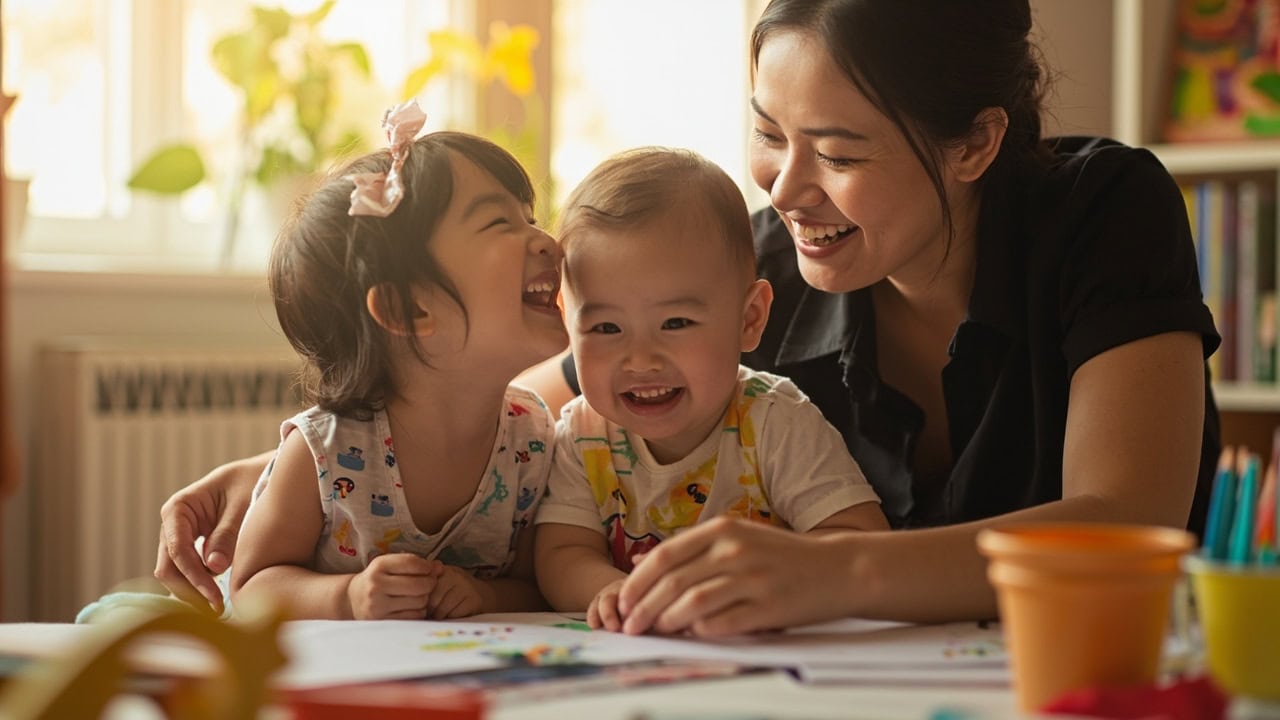
Not what the programme promises, not what the centre brochure describes, but what a two-year-old experiences when they are dropped off at nine in the morning and their caregiver kneels down to their eye level and says, in a voice that is calm and warm and entirely present: I am glad you are here today.
That moment — that single, ordinary moment — is doing something enormous. It is telling the child’s nervous system: you are safe here. This person is reliable. You can let your guard down. The day can begin.
This is what we mean when we talk about attunement. It is not a technique. It is not a training module checkbox. Attunement is the caregiver’s capacity to read the child — not just their behaviour, but their emotional state, their thresholds, their particular ways of expressing discomfort or joy — and to respond in a way that makes the child feel known. Not managed. Known.
Over days, and then weeks, and then months, that consistent, attuned presence becomes something remarkable. It becomes a quiet anchor. The child begins to carry a mental map of safety that includes this caregiver — not as a replacement for you, never that, but as a recognized, trusted figure within their world.
The caregiver-child bond is not a nice extra. It is not a byproduct of good childcare. It is the very mechanism through which all other development becomes possible.
How That Bond Is Built
- Consistency. Not almost-constant, not mostly-regular, but consistent in the way that allows a child to form expectations and rely on them. When the same caregiver is there, morning after morning, the child begins to build an internal model of the world that says: this is reliable. I can count on this. I do not have to be on guard.
- Responsiveness. When a child reaches out, someone reaches back. When a child cries, someone comes — not eventually, not when it is convenient, but with the attunement to recognize what this particular cry means. A child whose signals are met with accurate, warm response learns something profound: my feelings make sense. I am understood. The world responds to me with care.
- Genuine knowledge of the individual child. Your child’s favourite rhyme. The way they like their hands held when they walk. The particular facial expression that means they are about to be overwhelmed and need a quiet moment. These are the details that no curriculum captures but that a truly excellent caregiver holds like a living map of the child in their care.
Addressing the Guilt — And Why You Don’t Need to Carry It
So let us speak honestly about what this means for you as a parent, because the guilt is real and we know it.
There is a particular kind of worry that Singapore parents carry — the worry that in entrusting your child to someone else, even for the finest hours, you are somehow failing them. That your child will feel abandoned, or secondary, or less loved.
The research on this is clear and it is reassuring: children do not suffer from professional care. Children suffer from inconsistent, unresponsive, emotionally flat care.
What your child needs is not your exclusive presence — it is quality presence. And quality presence can come from more than one source.
When you choose a caregiver with care, with discernment, with attention to this very quality of attunement and warmth, you are not outsourcing love. You are extending your secure base. You are saying: here is another person in my child’s world who is safe, who is warm, who will hold them with the same quality of attention I give them myself.
That is not a diminishment of your role as a parent. That is an expansion of your child’s world.
The caregiver who does this well knows that they are not replacing you. They know they are part of a circle — a network of genuine warmth that supports the primary bond between you and your child, not replaces it.
What EduNanny Singapore Stands For
EduNanny Singapore, as part of the BUTLER ecosystem, is built on this understanding. We are part of the ECDA Childminding Pilot, which means our approach is grounded in the recognition that every family’s circumstances are different, and that the quality of the care relationship must be tailored to those circumstances.
Whether care happens in the warmth of your own home or within a community setting, we believe the principles are the same: small ratios that allow for genuine attunement, consistent caregivers who build trust over time, genuine warmth in every interaction, and transparency that lets you see what you cannot directly witness.
Why Ratios Matter
We maintain up to one-to-three infant ratios because we know that a caregiver who is responsible for too many children cannot attune the way we are describing. They cannot respond in time. They cannot hold the emotional map of each child in their mind and respond to each one with full presence. The ratio is not a policy detail. It is the structural condition that makes everything else possible.
Making Quality Care Accessible
Our fee structures within the pilot are designed to make quality care accessible — because emotional security should not be a privilege reserved for families with considerable means. CDA and Baby Bonus can be used, as Singapore families well know, to ease the financial dimension of this decision, because it should not have to feel like a choice between what you can afford and what your child deserves.
Communication You Can Count On
We ensure that you are not left to wonder. Whether through daily updates, or transparent practices, or the practical tools we provide to make the administrative side of childcare as smooth as possible — our commitment is that you never feel out of the loop. You chose thoughtfully. You deserve to know what that choice looks like in practice.
What We Hope for Every Child — And How to Find It
We hope your child feels the door open in the morning and recognizes, before they even see the face, that something about the energy in the room is warm and steady. We hope they learn, over weeks and months, that when they fall, someone will come. When they need a moment of quiet, someone will notice. When they accomplish something small and wonderful — stacking three blocks, or saying a new word, or making eye contact with another child for the first time — someone will celebrate it with them, because their joy is real and it deserves to be witnessed.
We hope they develop what psychologists call internal working models — the deep, largely unconscious mental templates that tell a child how the world works:
- Does the world respond to me with warmth?
- Are people reliable?
- Can I explore and expect to be welcomed back?
- Is it safe to be curious?
These are not philosophical questions for a toddler. They are lived experiences that become the scaffolding for everything that follows — for confidence at school, for the ability to form healthy friendships, for emotional resilience when life becomes difficult, as it inevitably will.
How to Choose When You Are Ready
If you are in the process of researching childcare options, here are the qualities that matter most — not as a checklist to mechanically apply, but as things to feel for and observe:
- How the caregiver responds to your child in the first moments. Do they kneel to eye level? Is their voice warm and unhurried? Do they acknowledge your child as an individual, not just a task?
- Whether the same caregiver will be with your child consistently. Consistency is not a nice-to-have. It is the foundation on which trust is built.
- How the environment feels. Not just whether it is clean and safe, but whether there is a sense of warmth — whether you can imagine your child feeling at ease there.
- The quality of communication you receive. You should not have to guess what your child’s day was like. Regular, genuine updates are a sign that the caregiver sees your child and wants you to see them too.
- Whether the caregiver seems to know your child as an individual. Can they tell you something specific about your child’s temperament, preferences, or patterns? This is the mark of genuine attunement.
We See You
The parent who researched, who visited, who asked the hard questions, who lay awake weighing one option against another not because they had to but because they could not bear to get it wrong.
The parent who feels the weight of the years they will not get back, and who wants those years to have been good — not just safe, but genuinely, quietly good for the small person in their care.
You are not being judged for the choice to seek care outside your own home. You are being recognized for the seriousness with which you are making it.
And when you choose a caregiver — when you walk into a space and feel something you cannot quite name but recognize as right — you are not hoping. You are not guessing. You are reading, with the same deep parental instinct that told you the moment your child turned back to find your face in the car seat, that this is a place where your child will be okay.
Not just managed. Not just occupied. Okay in the fullest, most human sense of the word.
That instinct is sound. And the system we have built at EduNanny Singapore is designed to honour it — to be worthy of it.
When your child turns back at the door of our centre or our caregiver’s home, it is not with anxiety. It is with the kind of quiet, confident glance that says: I know where I am. I know who is here. I am ready for my day, because someone here will be there when I need them.
That is the feeling we want for every child in our care. That is the feeling we work toward every morning. And that is the feeling we hope you carry with you, too — knowing that you chose well, that your child is held, and that the bond between you and the people who care for your child is not a compromise.
It is an act of love.
If you are ready to explore what EduNanny Singapore can offer your family, we invite you to speak with us. Not to be sold to — but to be heard. We understand the weight of this decision, and we are here to answer every question with honesty and care.
Because you deserve to know, and your child deserves to be okay.
Learn more about who we are and the standards behind EduNanny Singapore’s approach to childcare and childminding.