What Your Child’s Day at Care Is Really Like
What You Know (And What You Don’t)
Consider for a moment what most parents actually know about the hours of childcare. They know whether the centre is clean. They know if the ratio of children to caregivers seems reasonable. They know the food looks decent in the daily photo. They know their child usually comes home happy, or sometimes tired, or occasionally cranky.
But knowing that a day was truly good — developmentally good, the kind of good that compounds quietly over months and years into confidence and curiosity and the ability to form secure relationships — is something most parents have been asked to take on faith.
Safety is non-negotiable, and you are right to demand it. Credentials matter, and you are right to check them. But safety and credentials are the floor, not the ceiling. They tell you the minimum. They do not tell you what is happening in the small, continuous, ordinary moments that make up the vast majority of your child’s day.
The Designed Day: What Quality Actually Looks Like
Quality childcare begins before the children arrive. The caregiver has already thought about the day — its rhythm, its transitions, its opportunities for engagement.
Young children are creatures of pattern and anticipation. They do not experience predictability as restriction. They experience it as security. When a child knows, in their body, that after snack time comes circle time and after circle time comes outdoor play, something in their nervous system settles. They are not guessing at the world. They are moving through it with a guide who has made the world legible to them.
The Moment of Observation
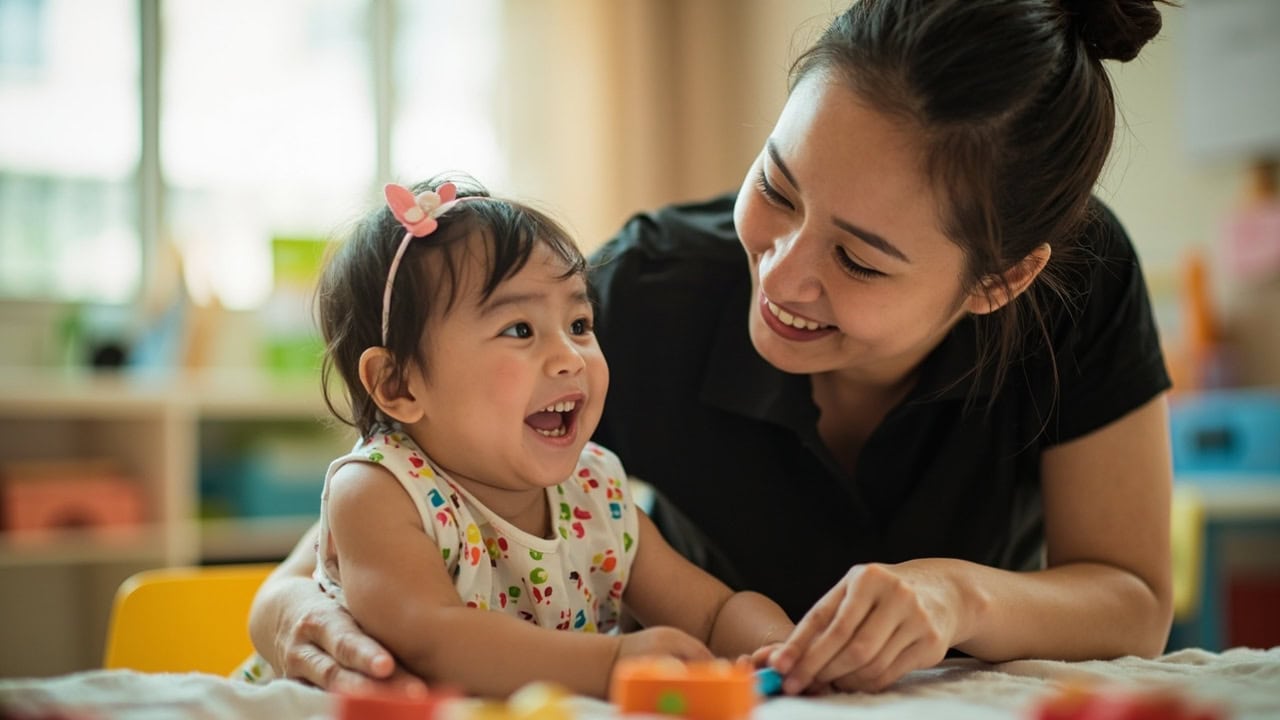
Watch what happens when a caregiver truly observes. There is a moment — it lasts only seconds — when a twelve-month-old reaches for a block, looks at it, looks at the caregiver, and then back at the block.
In a less intentional environment, that look is missed. The child grabs the block, puts it down, moves on. In a responsive, trained environment, the caregiver notices. That look was a question. It was the child asking: is this mine to explore?
And the caregiver, with a quiet nod, a soft sound of encouragement, or simply by kneeling nearby, says yes. In that yes, something important is built. The child is learning that their smallest, earliest communication has an audience. That they matter to someone. That their signals travel and return.
This is what developmental psychologists call contingent responsiveness, and it is one of the most powerful inputs a young brain can receive. It is not a curriculum item. It is not a worksheet. It is a conversation conducted in gaze and gesture and the timing of an adult’s presence — and it happens dozens of times a day in the kind of care that is truly present.
Presence vs. Engagement
There is presence. And then there is engagement.
A caregiver can be in the room, physically present, managing safety, ensuring no child is hurt. That is presence, and it is necessary. But presence alone is passive.
Engagement is the caregiver who notices that a child has been pushing a toy car back and forth for ten minutes and recognises this is not random. This is the child working through a spatial concept — near and far, cause and effect, the relationship between objects.
So the caregiver sits down nearby and offers a second car, gently, without interrupting the child’s concentration, extending the play in a way that deepens the learning without disrupting the process. This is trained observation meeting a child’s natural drive to understand the world.
The Ratio That Makes It Possible
In infant care, where the stakes are highest and the developmental leaps are most rapid, EduNanny maintains ratios of up to one caregiver to three infants.
That is not a bureaucratic specification. That is what makes the kind of observation I have been describing possible. You cannot read and respond to a baby’s signals if your attention is stretched across six or eight children. The ratio is the architecture of responsiveness.
It allows a caregiver to know, by the end of the first week, that this child is soothed by a specific tone of voice, that this one reaches for comfort rather than receives it, that this one is not really upset, just processing a transition. This knowledge is not sentimental. It is practical, and it is developmental.
What Quality Childminding Looks Like: A Practical Comparison
| Passive Supervision | Quality Engagement |
|---|---|
| Caregiver is present in the room | Caregiver is actively observing and responding |
| Children are kept safe and occupied | Children’s cues, interests, and signals are noticed and responded to |
| Activities happen according to schedule | Rhythm is adapted to children’s needs and developmental readiness |
| Incidents are managed as they occur | Potential moments are recognised and extended before they pass |
| Updates report what happened | Updates help parents understand the developmental meaning of what happened |
Making the Invisible Visible
What I have described — the trained caregiver, the responsive environment, the carefully designed day — may sound like something that is happening somewhere behind a closed door, visible only to those inside.
Quality childcare is not simply a service that operates while you are away. It is a service that keeps you inside the experience, not as a watcher — not through surveillance — but as a partner who understands.
When you receive updates about your child’s day, when you hear about the block play and the morning song and the way she reached for her friend at snack time, those are not status updates. They are chapters of a story you are now equipped to read.
When you pick your child up and see something in her face that you recognise — a new ease, a new confidence, a new stubbornness even — you are not guessing. You are reading the evidence of a day well spent.
Why CCTV Is a Window, Not Understanding
Some centres offer CCTV. It can provide a window, and window it remains. It shows you the surface of events.
It does not show you the caregiver who noticed your child’s frustration at not being able to stack the blocks high enough and quietly adjusted the task, just slightly, so the child could experience success without losing the challenge.
CCTV shows you that the caregiver knelt down. It does not show you why, or what the child’s face did in response, or how that small moment connected to the same child’s determination in a completely different context three days later.
Understanding what is happening requires relationship, not just observation. That is why real, thoughtful, ongoing communication between caregiver and parent is not an add-on. It is the connective tissue of quality care.
The ECDA Childminding Pilot: What It Means for You
EduNanny by BUTLER operates within the ECDA Childminding Pilot, and this is not simply a regulatory designation. It is a framework of accountability and quality that shapes everything from caregiver training to the environments in which care takes place.
The Pilot offers both home-based pathways and community or centre-based options, because Singapore families are not a single type. Some parents feel most comfortable with care in a familiar home setting, close to their neighbourhood, with a smaller group of children. Others value the community environment of a centre, with its shared resources and structured programming.
Both are valid. Both can be excellent. What matters is not the setting alone but the intentionality inside it.
And quality that is truly engaged — truly responsive, truly developmental — is available to you. It is structured into a system that is affordable within the Pilot fee structures, that allows for CDA and Baby Bonus usability, that is available across Singapore.
The economics of quality care have been a barrier for too long. The Pilot was designed to remove that barrier without compromising the standard of engagement your child deserves.
Questions to Ask When Choosing Infant Care
If you are researching childcare options in Singapore, here are the questions that go beyond the brochure:
- What is the caregiver-to-infant ratio, and how does it enable individual observation?
- How is the daily rhythm designed, and what is the developmental thinking behind it?
- How do caregivers learn to read and respond to individual children’s signals?
- What does communication with parents look like day-to-day?
- How does the service help parents understand what is happening during the unobserved hours?
- Is the caregiver team stable, or is there high turnover?
- How are transitions handled — arrival, nap time, pickup?
These questions will not be answered the same way by every service. But asking them tells you something important: you are looking for quality, not just safety. And that is exactly the right thing to look for.
Bring Your Curiosity Here
EduNanny Singapore is built on a simple, profound premise. That your child deserves more than safety. That you deserve more than peace of mind.
That the hours of childcare are not hours subtracted from your child’s life but hours added to it — hours filled with engagement, observation, warmth, and the kind of care that sees your child as an individual with a developing mind, not just a small person who needs minding.
And that you, as a parent, deserve not just to trust that this is happening, but to understand it. To be inside it. To carry the knowledge of your child’s day the way you carry the knowledge of her favourite book or her bedtime routine — as something intimate, meaningful, and entirely yours.
Your child is living a rich, textured, developmental experience every single day. That experience deserves to be seen. And so do you — as the parent who loves deeply enough to ask what is really happening, and wise enough to want to understand.
Bring that curiosity to EduNanny. Ask your questions. Read those updates. Talk to the caregivers. Watch what changes in your own understanding, and then watch what changes in your connection with your child — not just at pickup, but in the days and weeks and months that follow, as the quality of what happens in those unobserved hours begins to show up in new ways: in her confidence, her curiosity, her capacity for relationship, her ease in the world.
That is not a promise. That is what the work produces, when the work is done with skill, with intention, and with genuine care.
If you are ready to explore what thoughtful, development-focused childcare looks like in Singapore, we would be glad to hear from you.